
The Late-Night Fridge Romance
To the one who has developed, without ever quite meaning to, a small private arrangement with the pantry after ten,
There is a specific hour of the evening, somewhere between the end of the second episode and the moment one considers bed, when the kitchen begins to make itself known. Not urgently. Not desperately. Only the way a well-mannered suitor might clear his throat from across the room. You were not hungry at dinner. You are not, strictly speaking, hungry now. And yet you have found yourself standing at the open refrigerator with a soft interior lighting a small square of the dark floor, considering something with cheese in it.
This has been happening for months. Possibly for years. And you have, at various points, tried willpower, distraction, and a stern conversation with yourself about what a grown woman ought to be doing at ten in the evening. None of it has particularly worked. Which is why Ms. Whitmore is here, with a small correction to the story you have been telling yourself. This is not a failure of discipline. It is a very old affair, conducted between your hormones and your evening.
The evening body is not, chemically speaking, the same woman as the morning body.
The scandal, once you understand it, is beautifully choreographed. Your body operates on a roughly twenty-four-hour internal clock that governs, among many other things, when you feel hungry and how strongly. Research by Frank Scheer's laboratory at Brigham and Women's Hospital has demonstrated, in controlled studies where meals and activity were held constant, that endogenous hunger driven by the circadian system reliably peaks in the evening, typically around eight o'clock, regardless of what a person has already eaten that day.
In other words, your appetite has its own schedule, and evening is when it likes to write letters. This has almost nothing to do with your character and quite a lot to do with your biology.
The hormone doing most of the writing is called ghrelin. She is produced primarily by the stomach and travels to the brain, where she is unsubtle about her intentions. Ghrelin has a natural rhythm that rises before habitual mealtimes and, in many women, produces a soft second surge in the evening. Her opposite number, leptin, is meant to be the calm voice of satiety. But leptin is exquisitely sensitive to sleep, and sleep, as you may have noticed, has grown less reliable in midlife.
A now-classic study by Spiegel and colleagues, published in the Annals of Internal Medicine in 2004, restricted healthy young men to four hours of sleep for two nights. Ghrelin rose by twenty-eight percent. Leptin fell by eighteen percent. Appetite, especially for calorie-dense foods, climbed accordingly. Later research in women has echoed the same pattern. When the body is under-slept, the hormonal conversation between hunger and fullness tilts, quietly, toward the fridge.
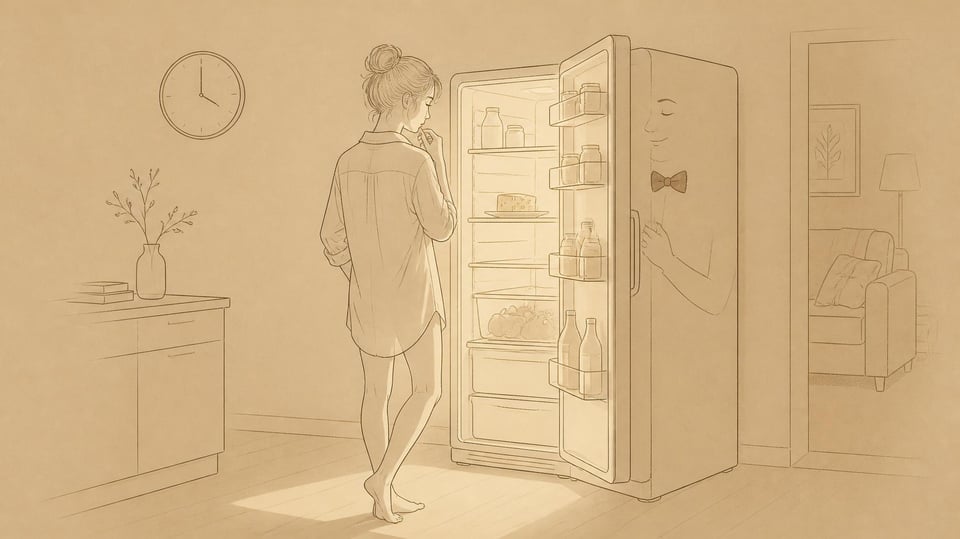
This is not weakness. This is chemistry with an agenda.
Then there is the matter of the evening itself, which for most midlife women is the only stretch of the day when nothing is being asked of them. The children, if there are children, have gone to their own concerns. The work has been closed. The kitchen is quiet. And the brain, having been on service duty for fourteen hours, begins to look for a small, permitted pleasure.
Food, particularly food that is soft, salty, or sweet, is a reliable one. It engages the reward pathways of the brain in ways that are not so different from a small glass of wine or a favorite song.
Researchers who study hedonic eating, meaning eating for pleasure rather than pure hunger, have found that the reward response to food is measurably stronger in the evening than in the morning. Studies in which participants were asked to rate identical foods at different times of day have consistently found greater ratings of appeal and pleasure in the evening hours. Your ten o'clock crackers are, chemically speaking, more delicious than your ten a.m. crackers.
Add to this the perimenopausal fluctuations of estrogen and progesterone, both of which play quiet roles in appetite regulation and mood, and the whole affair begins to make elegant sense. The fridge is not seducing you. Your own chemistry is holding its regular evening salon, and the fridge is merely the nearest guest.
There are, however, quieter ways to attend that salon without letting the fridge run the room.
The first is to eat protein at breakfast. This sounds unrelated, but it is not. Research on appetite regulation has consistently found that a breakfast containing roughly twenty to thirty grams of protein tends to reduce evening cravings, likely through steadier blood sugar and better ghrelin regulation across the day. The evening body, in this respect, is often responding to a morning that was too light.
The second is to make peace with a small evening ritual that is not the fridge, but is also not deprivation. A cup of herbal tea in a beautiful cup. A square of dark chocolate eaten slowly. A small bowl of Greek yogurt with a spoonful of honey. The reward system does not need to be denied. It needs to be acknowledged and, occasionally, redirected.
The third is to protect sleep more carefully than the culture encourages you to. Every additional hour of consistent sleep gently rebalances leptin and ghrelin. This is not a productivity intervention. It is a hunger intervention.
The fourth is to notice, without judgment, whether the ten o'clock visit to the kitchen is really about the food. Sometimes it is. Sometimes it is about the pause, the quiet, the small permission to be off duty. When it is the latter, food is the tool at hand, but not the actual longing.
Ever on the side of evenings that are gently attended by more than one hunger,
Ms. Clara Whitmore