
The Warm Compress Ceremony 🕯️🌿
To the one whose face has forgotten the small ceremony of being warmed,
There was a time, not so long ago, when every household kept a small bowl and a clean cloth for exactly this purpose. When a woman came home from the wind, or from too long a day of reading, or from a cold that had settled behind her cheekbones, her mother or grandmother would pour water from the kettle into the bowl, dip the cloth, wring it out, and press it gently over her closed eyes.
It cost nothing. It required no product, no subscription, no consultation. And it worked, in ways that neither of them could have explained in the language of research.
The ceremony has almost entirely disappeared. In its place, we have humidifying eye drops and steroid nasal sprays and screens that glow into our faces from the moment we wake until the moment we close them at night. And yet the warm compress, Ms. Whitmore is pleased to report, has not become less useful. Only less remembered.
The old remedies were not fashionable. They were often better than the ones that replaced them.
Consider, for a moment, the eyes. Along the edge of each of your eyelids, tucked just behind the lash line, are roughly thirty small glands called the meibomian glands. Their sole responsibility is to secrete a thin film of oil that coats the surface of the tear, keeping it from evaporating too quickly. When these glands function properly, your eyes feel comfortable.
When they clog, which they do with striking frequency in women after forty, the tear film breaks down within seconds, and the eyes begin to feel gritty, dry, and easily fatigued. Ophthalmologists now believe that meibomian gland dysfunction is the single most common cause of the dry-eye complaints they hear all day.
The oil in these glands is a soft wax, and it has a melting point. In healthy glands, the wax liquefies at temperatures the body maintains naturally. In dysfunctional glands, particularly in postmenopausal women, the wax has thickened, its melting point has risen, and it will not flow at ordinary body temperature.
A warm compress applied to closed eyelids, at roughly forty to forty-five degrees centigrade for ten minutes, gently melts the thickened wax and allows the glands to release their oil again. Research published in the journal Cornea and elsewhere has demonstrated measurable improvement in tear film stability with this practice, particularly when performed consistently over several weeks.
The face has more autonomic wiring than nearly any other part of the body.
The benefits do not stop at the eyes. The sinuses, which have been quietly congested for many midlife women through a combination of dryness, allergies, and the low-grade inflammation that arrives with age, respond to warm moist heat with the elegance of an argument finally resolved. The warmth thins the mucus. The blood vessels in the sinus lining dilate. Drainage begins to move again, softly, without the aggressive push of a spray.
But the true secret of the warm compress lies not in the eye or the sinus, but in the nervous system. The face is served by the trigeminal nerve, whose thermoreceptors are among the most densely represented on the body. When those thermoreceptors detect gentle warmth, particularly across the eyelids and cheeks, the signal travels directly to brainstem centers that regulate autonomic tone. Heart rate slows, ever so slightly. Blood pressure eases. The vagus, that long wandering nerve of parasympathetic calm, is quietly given permission to lead.
This is why the warm compress, done well, feels so disproportionately restorative. It is not merely warming the tissue. It is signaling, through a chemistry older than language, that the woman beneath the cloth is safe. That she may put down, for these few minutes, the vigilance she has been carrying since dawn.
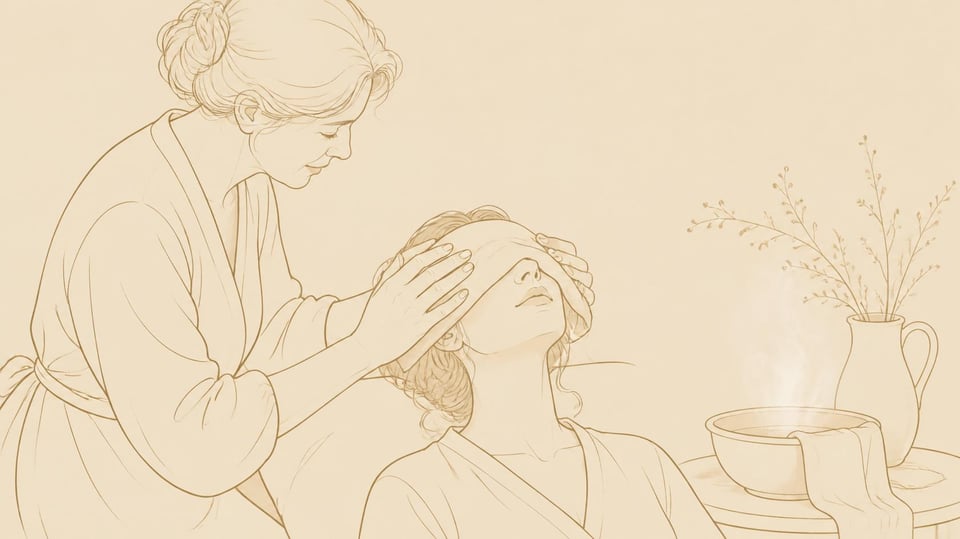
The ceremony, if you would like to observe it, is very simple.
Pour hot but not scalding water into a small clean bowl. The right temperature is warm enough to feel unmistakably warm on the inside of your wrist, but not so hot that you flinch. Fold a soft cotton cloth into a rectangle, dip it, and wring out the excess. Lie down somewhere quiet. Place the cloth across your closed eyes, letting the edges rest gently on the cheekbones and the brow.
Now stay there. Ten minutes, if you can manage. Rewarm the cloth once or twice if it cools too quickly. Breathe through the nose, slowly, so that the exhale is longer than the inhale. This is not a task with a beginning and an end. It is a small withdrawal from the world, done properly.
For sinus complaints, the same cloth may be placed over the cheekbones and the bridge of the nose. For a headache that has settled at the temples, the cloth extended across the forehead and temples eases the small muscles of expression that have been holding on since morning.
The ritual can be enriched, if you wish, with a drop of lavender or chamomile oil on the outside of the cloth, well away from the eye itself. The scent activates olfactory pathways that feed into the same limbic quieting the warmth is already provoking. It is not necessary. But it is lovely.
There is no need, either, to purchase a specialized heating mask, though such things exist and are pleasant enough. A cotton washcloth from your own linen closet, warmed in a bowl of water, is what your grandmother used, and it worked then for the same reasons it will work now.
Ever on the side of small ceremonies that ask nothing and give everything,
Ms. Clara Whitmore