
What the Lymphatic System Does When You Stop Moving 💆
To the one whose rings feel snugger tonight than they did this morning, without any reasonable explanation,
There is a particular kind of tiredness that arrives at the end of a long day spent mostly at a desk. It is not the honest tiredness of physical labor. It is not the pleasant tiredness of a hike or a long conversation. It is a heavier, blurrier tiredness, accompanied by faintly swollen ankles, a dull sense of head fog, and a subtle unwillingness of your face to look quite the way it looked at breakfast. You have been perfectly still all day, and yet you feel, mysteriously, more depleted than if you had walked ten miles.
You have been assuming this is fatigue. It is not, quite. What you are feeling, Ms. Whitmore would like to suggest, is a labor grievance. Filed, politely, by an entire waste-clearance system that has been trying to work for eight hours and has been given almost no opportunity to do so.
There is a whole system in your body that works only when you do.
The lymphatic system has been the quiet junior partner of your circulation for as long as you have been alive, and she almost never receives a mention. Where the blood has a heart to move it and a pulse you can feel at your wrist, the lymphatic system has none of these dramatic instruments.
She produces roughly two to three liters of clear fluid every day, drawn from the spaces between your cells, carrying with her the waste products of ordinary metabolism, small proteins that have leaked out of blood vessels, immune cells on patrol, and the dietary fats absorbed from your small intestine.
That fluid must return, eventually, to your bloodstream. And it must travel, in most cases, uphill. [source]
The lymphatic system has no pump. She works instead through a delicate cooperative arrangement between three quiet forces. The first is the rhythmic contraction of your skeletal muscles, particularly in the calves, which squeeze the small lymphatic vessels running alongside them and press their fluid onward. The second is your breathing, which through the movement of the diaphragm creates alternating pressure changes in the chest that pull lymph up through the thoracic duct and back into circulation.
The third is a set of tiny intrinsic contractions of the lymph vessels themselves, generated by a specialized muscle in the vessel walls, that beat softly at roughly six to ten times per minute and coax the fluid forward.
Two of these forces are yours to provide. And on a day when you have not walked, not breathed deeply, not stood up in three hours, you have provided her with almost none of them. [source]
The lymphatic system has no salary, no pump, and no ambitions of her own.
The consequences of a sedentary day are not merely aesthetic, though they show themselves aesthetically. When lymph flow slows, fluid accumulates in the interstitial spaces of your tissues. Ankles thicken. Fingers swell against their rings. The face, particularly around the eyes, begins to hold what looks like ordinary tiredness but is in fact backed-up drainage.
More seriously, the waste products your metabolism has produced all day are supposed to be carried away in that fluid. When it stalls, inflammatory mediators, cellular debris, and small waste molecules linger in the tissues longer than they should. This is a piece of what likely contributes to the diffuse afternoon heaviness and low-grade brain fog that so many midlife women describe after a full day at a screen. [source]
And there is one more dimension worth mentioning. The lymphatic system is not merely a waste service. She is also the road network your immune system uses. Lymphocytes, the T and B cells responsible for defending you against everything from a passing cold to the small cellular irregularities that arise and are handled quietly throughout life, move through the lymph and gather at the lymph nodes to compare notes. When lymph flow slows, immune surveillance slows in proportion. This is not catastrophic in the short term. But it is not nothing, either, over the accumulation of many long sitting years.
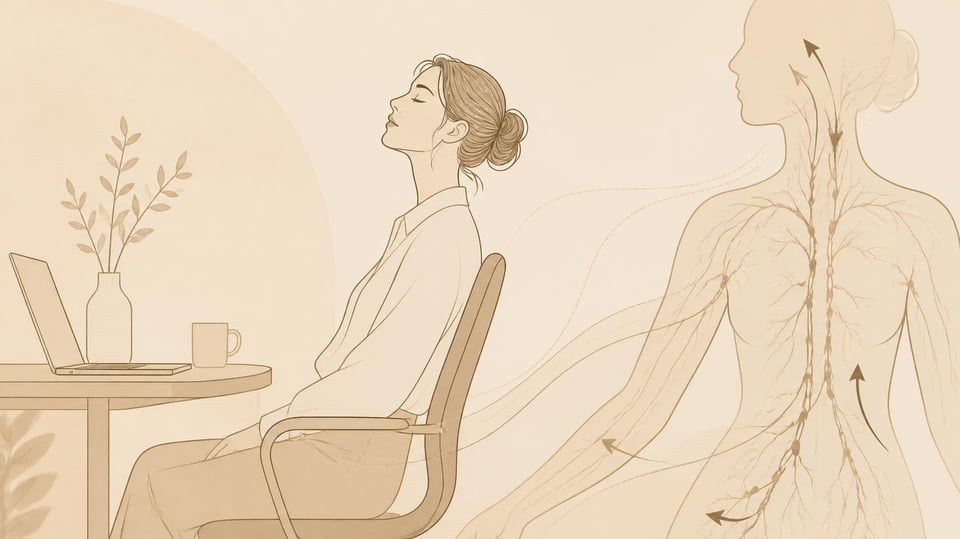
It asks very little, but it does require that you move on its behalf.
The invitations, as always, are quiet ones. The first is to stand up every thirty or forty minutes, even briefly. Not to complete a task. Not to fetch anything. Simply to interrupt the stillness. Even ten steps to the window and back is enough to activate the calf pump, and the calf pump does more for lymphatic return than any other single muscular action in the body. This is why the calves are sometimes called the second heart.
The second is to breathe, occasionally, in a way the desk does not require. Three or four slow, full breaths, drawing the diaphragm down deliberately and letting the exhale be unhurried, is a small gift to the thoracic duct. The lymph moves best when the chest and abdomen participate together in the ordinary rhythm of respiration, and most of us, once we have been sitting for a while, are breathing far more shallowly than we realize.
The third is the ritual of legs up the wall, or legs elevated on a footstool or the arm of the sofa, at the end of the day. Ten or fifteen minutes with the feet above the heart allows gravity, for once, to work in the lymphatic system's favor. Many women find their ankles perceptibly slimmer by morning after this small practice.
The fourth is a walk after a meal, if the day permits it. A meal is when the lymphatic system is most active, absorbing the fats from your intestine, and gentle movement in that window doubles her efficiency. This is not about calories. It is about giving her the transportation she was built to expect.
Ever on the side of the quiet systems that ask only that we participate in our own maintenance,
Ms. Clara Whitmore