A Wildflower With a Surprisingly Serious Record 🌸📋
To the one whose evenings have grown a little louder than they used to be, in the small anxious way that no one recommends a pill for,
There is a particular quality of unease that visits many women in their forties and fifties. It is not a diagnosis. It is not, on most days, incapacitating. It is a low, persistent hum, most audible around dusk and again around three in the morning, that hovers at the edge of the evening and refuses to name what it is worried about.
You have probably wondered, at least once, whether you ought to speak to a physician about it. And you have probably decided, at least once, that whatever they might offer would be more medicine than the situation seems to want.
If that is the small dilemma in which you have been living, Ms. Whitmore would like to introduce a wildflower that has been quietly working in this exact territory for four centuries, with rather better clinical credentials than most people realize.
The plant in question has been keeping surprisingly serious company since the sixteenth century.
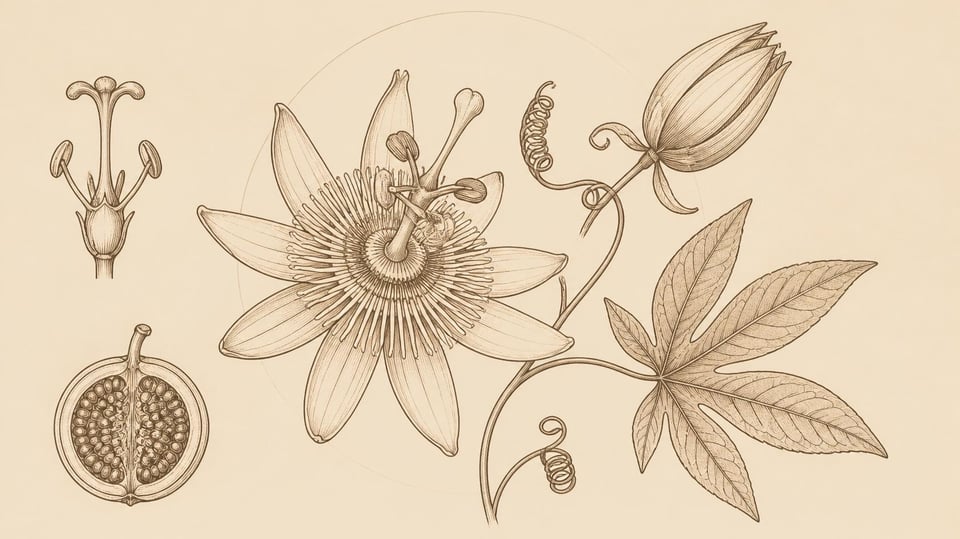
Her name is Passiflora incarnata, though most speakers of English know her simply as passionflower. She is a climbing perennial vine native to the southeastern United States, from Texas up through Virginia, where she was used long before European arrival by the Cherokee and other peoples for restlessness and insomnia. Spanish missionaries encountered her in the sixteenth century and named her after the Passion of Christ, believing the elaborate architecture of her flowers, with their crown of filaments and their five stamens and three styles, corresponded to the crown of thorns, the five wounds, and the three nails.
The flower is remarkably striking. Ms. Whitmore recommends looking her up if you have never seen one. But the more interesting story is what happens inside her leaves and stems, which contain a small cabinet of flavonoids, including vitexin and chrysin, that appear to gently modulate a receptor in your brain called GABA-A.
GABA is the primary inhibitory neurotransmitter of the human nervous system. It is the molecule your brain uses to tell itself to be quieter. Benzodiazepines, such as the ones prescribed for acute anxiety, work by dramatically enhancing GABA's signal at that same receptor. Passionflower's compounds do something similar in principle, though at a much smaller magnitude. The effect is less like a sedative and more like a permission slip for the nervous system to loosen its grip. [source]
The evidence is real, though quietly assembled.
The most-cited human trial appeared in 2001 in the Journal of Clinical Pharmacy and Therapeutics. A team of researchers led by Shahin Akhondzadeh in Tehran conducted a four-week randomized trial in adults diagnosed with generalized anxiety disorder. Half received passionflower tincture at forty-five drops daily. The other half received oxazepam at thirty milligrams daily, a standard low-dose benzodiazepine. Both groups showed significant and comparable reductions in anxiety scores over the four weeks. The passionflower group, notably, reported meaningfully less impairment in job performance, suggesting the calm arrived without the daytime dulling that pharmaceuticals of that class often produce. [source]
A subsequent trial, published in Anesthesia and Analgesia in 2008 by Movafegh and colleagues, tested a single dose of passionflower before elective surgery against placebo. The passionflower group showed significantly lower pre-operative anxiety, without any effect on sedation levels once anesthesia was administered. A smaller Australian study by Ngan and Conduit in 2011, published in Phytotherapy Research, found that adults drinking a cup of passionflower tea nightly for a week reported measurable improvements in subjective sleep quality compared with a placebo tea. [source]
These are not enormous trials. They are not Phase Three pharmaceutical studies. But they are real, well-designed studies, published in peer-reviewed journals, and they point consistently in the same direction. Passionflower, taken at reasonable doses, does something quietly useful for anxious nervous systems, without the addiction potential, the daytime sedation, or the withdrawal difficulties that make women hesitate before accepting a benzodiazepine.
There are, quietly, several honest ways of introducing her into a week.
The first is a cup of tea in the early evening. One heaped teaspoon of dried passionflower steeped in boiling water for ten minutes, taken with or without honey, is the form your great-great-grandmother would recognize. The flavor is grassy and mild, closer to chamomile than to peppermint, and the effect, if you are sensitive to her, will announce itself within twenty or thirty minutes as a soft loosening at the shoulders.
The second is a tincture, which is the form used in most of the clinical trials. A liquid alcohol extract, taken as drops in a small amount of water, delivers a more concentrated dose. Reputable herbal producers sell it in dark glass bottles with droppers. The dose used in the anxiety trials was roughly forty-five drops per day, divided among two or three times, though a smaller amount is often sufficient for milder concerns.
The third is a standardized capsule, which is the most predictable form for those who prefer numerical certainty. Doses in the studies have ranged from three hundred to five hundred milligrams of extract, taken once or twice daily. Any reasonable herbalist or naturopath can help you calibrate.
The fourth, if you take any prescription medication for sleep, anxiety, or seizures, is to speak with your physician before adding her to your routine. Passionflower is generally well tolerated on her own, but her mild GABA-modulating action can compound with pharmaceutical sedatives, and this is worth attending to rather than assuming away.
Ever on the side of quiet plants whose science has been underestimated for far too long,
Ms. Clara Whitmore