
The Neck Stuck Between Phone and Past
To the one who cannot quite remember the last time her neck was at rest,
There is a small evening ritual that most women in midlife have quietly perfected without ever naming it. The tilt of the head to the left, then the right. The pressure of two fingers at the base of the skull. The half-hearted rotation of the shoulders. The audible crackle that follows, which is neither reassuring nor alarming, only familiar. You have been managing this neck for so many years that its unease has become part of the furniture of your life.
You have blamed it on the phone. You have blamed it on the pillow. You have blamed it on the desk chair, the driving, the aging, the weather. And each of these guests has been present at the scene, Ms. Whitmore will grant you. But none of them, alone or together, quite accounts for the fact that the tension arrived long before the phone did, and has never quite left.
The neck, it turns out, has been keeping two very different secrets at once.
The first secret is the one everyone is now willing to discuss. In 2014, a spine surgeon named Kenneth Hansraj published a paper in Surgical Technology International that made a brief tour of the news cycle before being quietly filed away. He calculated that a neutral head, sitting upright over the shoulders, weighs roughly ten to twelve pounds. Tilt that head forward fifteen degrees, and the effective load on the cervical spine climbs to twenty-seven pounds. At sixty degrees, which is roughly the angle you adopt while reading a text message, the load rises to nearly sixty pounds.
This is not a metaphor. It is a matter of leverage. Every degree the head moves forward of its architectural resting place multiplies the strain on the muscles and ligaments that were built to hold it, most notably the upper trapezius and the levator scapulae, which respond to sustained load by shortening, thickening, and eventually complaining.
The second secret is older, quieter, and considerably less discussed. Long before you had a phone to hold, you had a nervous system that learned, somewhere in girlhood or early adulthood, to brace. Perhaps in response to a household that required watchfulness. Perhaps to a workplace that rewarded competence at the price of ease. Perhaps to nothing dramatic at all, but simply to the ordinary female inheritance of being alert, agreeable, and quietly on duty.
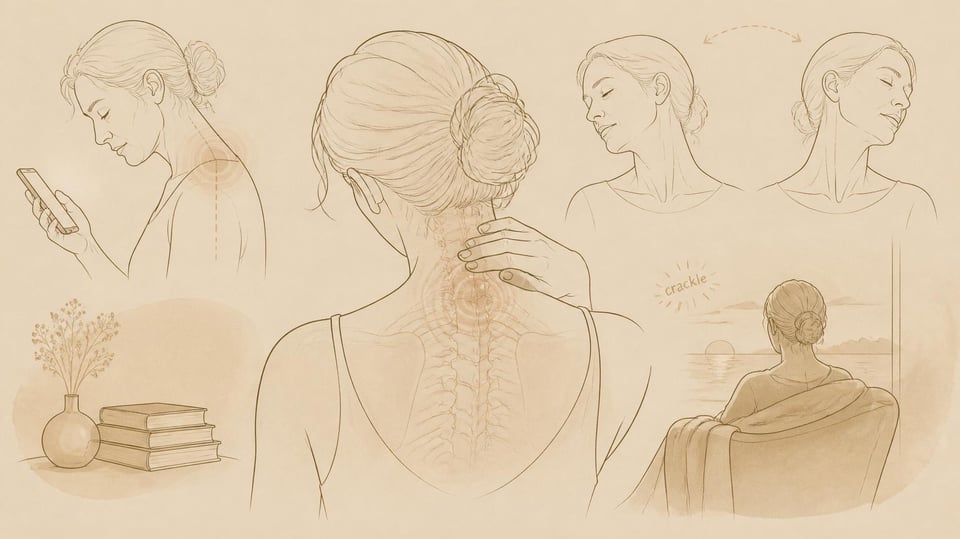
The neck was the first place that agreement was stored.
The muscles that hold the head, particularly the suboccipitals at the base of the skull, contain an unusually high density of proprioceptors, the tiny sensors that report on tension and position. These muscles are among the first to fire when the nervous system perceives a need to remain vigilant. Over decades, this becomes a habit the muscles no longer remember choosing. They contract slightly, all day, without asking permission.
More recent anatomical research has also identified something called the myodural bridge, a small band of connective tissue that links certain suboccipital muscles directly to the dura mater surrounding the brain and spinal cord. The full clinical significance of this bridge is still being studied, but it offers a physiological explanation for why chronic tension in this exact area so often accompanies headaches and a diffuse sense of head fog. The neck has been in continuous conversation with the head all along, in a language most physicians were never taught to read.
So the scandal is this. Your neck holds your phone posture, yes. But it also holds every meeting you sat through without breathing, every conversation you managed rather than had, every decade in which the muscles at the base of your skull were quietly on duty on your behalf.
The remedies, as always, are quiet ones.
The first is not to stretch harder. Stretching an already vigilant muscle often provokes it into deeper contraction. Instead, try lying flat on your back on the floor for five minutes at the end of the day, with a rolled towel just beneath the base of your skull. The floor does something that a chair cannot. It removes gravity from the argument entirely and lets the suboccipitals notice, perhaps for the first time in years, that they are permitted to release.
The second is a small correction to how you hold the phone. Bringing the screen up to eye level, even for a portion of your reading, redistributes those sixty pounds back toward the ten or twelve they were designed to carry. This is not a discipline. It is a courtesy to the ligaments.
The third is an occasional slow, deliberate exhale that is longer than the inhale that preceded it. The vagus nerve, which runs alongside the great vessels of the neck, is directly responsive to this pattern. A longer exhale gives the sympathetic nervous system a soft reason to relax its grip on the muscles it has been quietly holding taut.
The fourth is to consider, without shame, that some of what lives in your neck may not respond to stretching or massage at all, because it is not, strictly speaking, muscular. It is postural memory. A patient somatic therapist, or a physical therapist trained in the nervous system dimensions of chronic tension, can sometimes help the neck learn what it was never given the chance to learn on its own.
What Clara would like you to carry from this letter is the recognition that your neck has not been failing you. It has been carrying you, in the most literal sense, for longer than you realize, and in more ways than one. The tension is not a flaw in the equipment. It is the memory of a woman who has been quietly holding something up her entire life. The invitation is not to fix her, but to let her set it down.
Ever on the side of muscles that are finally permitted to unclench,
Ms. Clara Whitmore