
What Lutein Does Inside the Eye That Sunglasses Cannot 👁️
To the one who has been wearing sunglasses religiously for thirty years and never quite considered what happens to the light that gets through anyway,
There is a small oversight built into the modern conversation about eye protection. Most adults have been told, correctly, that ultraviolet light damages the eye over decades, and most have accordingly acquired the habit of wearing sunglasses whenever the sun is bright. This is entirely reasonable. But it is only half of the story. Because your eye, unlike the eye of any camera or optical instrument, has always had its own internal filter against damaging light, and that filter is made from a dietary compound that most modern diets radically under-provide.
Ms. Whitmore would like to introduce this small carotenoid, because the research on it has become considerably more specific in the last decade, and because the average adult is currently walking around with a macular pigment density that a person of the same age two hundred years ago would have found puzzlingly thin.
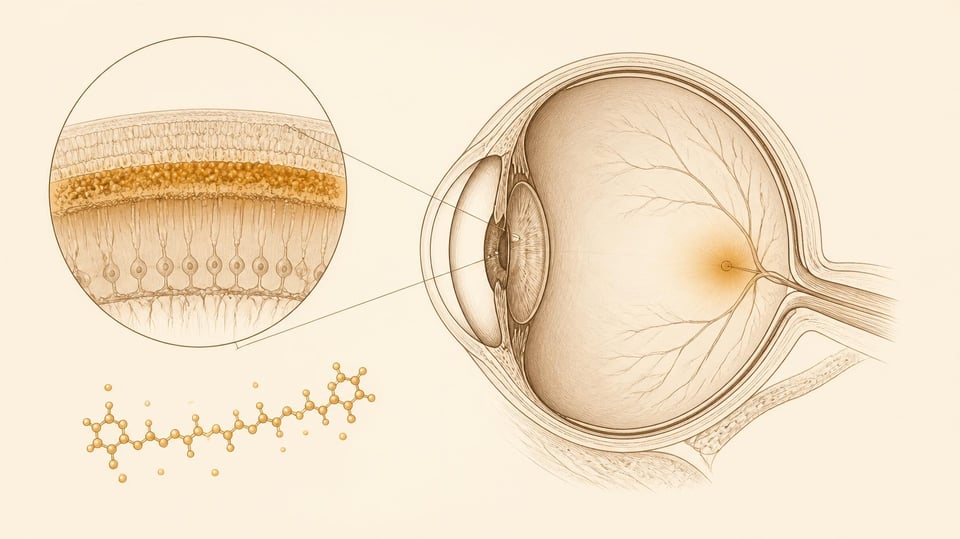
There is a natural filter inside your eye that has been there all along, and that you have to eat to maintain.
The compound is called lutein, and its close relative is called zeaxanthin. They are both xanthophyll carotenoids, meaning they belong to the same broad chemical family as beta-carotene but carry an additional pair of oxygen atoms that make them slightly more soluble in certain tissues. They are the yellow pigments that color marigolds and orange peppers and the yolks of eggs from hens fed on greens.
They are also, among all the dietary carotenoids humans consume, the only two that accumulate in significant quantities in the retina. Once absorbed from the intestine and transported into the bloodstream, they are selectively taken up by the cells of the macula, the small central region of the retina responsible for detailed vision. There they concentrate in a specific layer called the Henle fiber layer, forming what ophthalmologists call the macular pigment. It is what gives the macula its distinctive yellow color when examined through an ophthalmoscope. [source]
The pigment does two useful things. It absorbs blue light in the range of four hundred to five hundred nanometers, which is the portion of the visible spectrum most damaging to retinal cells over time. And it acts as an antioxidant within the retinal tissue itself, quenching the free radicals produced by the extraordinary metabolic activity of processing light. It is, in the most literal sense, a sunscreen built into the interior of the eye. [source]
Which means that sunglasses, however dark and however well-fitted, are protecting only part of the picture. They filter the light that reaches the eye. The macular pigment filters the light that has already entered.
91% of people with failing vision eat THIS every morning… [ad]
The evidence is now quite specific about how much matters.
For decades, the connection between diet and eye health was suggestive but not particularly quantitative. This changed in 2013, when the results of the Age-Related Eye Disease Study 2, known as AREDS2, were published in the Journal of the American Medical Association. The trial involved over four thousand participants with intermediate age-related macular degeneration and tested, among other things, whether adding ten milligrams of lutein and two milligrams of zeaxanthin daily to a standard eye-vitamin formula would slow progression to advanced disease.
It did. Not dramatically, but reliably. And when the analysis was restricted to participants whose baseline dietary intake of lutein and zeaxanthin was in the lowest quintile, the effect was considerably more pronounced. In other words, the people who benefited most were those who had the least of these carotenoids to begin with. This is a category that includes a large fraction of adults on modern American diets. [source]
The typical American consumes only one to two milligrams of lutein and zeaxanthin per day combined. The AREDS2 study used ten and two respectively, for a total of twelve. Other observational studies have consistently found that intakes above six milligrams daily are associated with meaningfully reduced risk of macular degeneration compared with intakes below two. Which is to say that most of us are eating a fraction of what the evidence associates with substantial macular protection.
There is also emerging research on lutein and cognition. These same carotenoids appear to accumulate in the brain, particularly in the frontal cortex and hippocampus, and higher intake correlates in observational studies with better cognitive performance in older adults. The mechanism is likely similar to what happens in the retina, meaning antioxidant protection of tissues that undergo considerable oxidative stress in the course of their ordinary work. The research is younger and less settled than the eye literature, but it is not incidental. [source]
The corrections, if you decide to adopt them, are more about your grocery list than your medicine cabinet.
The first is to eat leafy greens with more consistency than you probably do. A single cup of cooked kale contains roughly twenty-six milligrams of lutein and zeaxanthin. A cup of cooked spinach contains around twelve. Collard greens, Swiss chard, and turnip greens are in the same territory. Any of these, several times a week, easily supplies the amounts the research associates with benefit. Cooking increases bioavailability, and adding a small amount of fat, such as olive oil or a bit of cheese, further improves absorption because these are fat-soluble compounds. [source]
The second is to include egg yolks unless you have been specifically advised against them. Egg yolks contain modest amounts of lutein by mass, but the lutein in them is extraordinarily bioavailable, because it comes pre-packaged in a lipid matrix that the body absorbs efficiently. Two eggs a few mornings a week meaningfully raises measurable macular pigment density in most studies where this has been tested. [source]
The third is to consider orange and yellow foods for their zeaxanthin content specifically. Zeaxanthin is somewhat harder to find than lutein and is concentrated in orange peppers, yellow corn, and saffron. A weekly appearance of these on the plate matters more than most people realize.
The fourth, if your diet is unlikely to provide these amounts reliably, is to consider a modest daily supplement of lutein and zeaxanthin in the doses used in AREDS2. This is one of the better-supported nutritional supplements for anyone over fifty, particularly those with a family history of macular degeneration. As always, this is a conversation to have with an ophthalmologist rather than a decision to make alone.
Ever on the side of the small pigments that have been quietly filtering light on your behalf for decades,
Ms. Clara Whitmore