
What Actually Happens Inside an Artery Before It Closes 🩸
To the one who has been told, at some point, that the cholesterol number is a little high but nothing to worry about, and who has been quietly worrying anyway,
There is a piece of cardiovascular medicine that has been undergoing a quiet revolution for the last twenty years, and yet the version of the story most patients still receive at their annual physical is the one from 1985. Cholesterol number, arterial narrowing, eventual heart attack. Take a statin, or do not. Eat less butter, or do not. This linear narrative, though not entirely wrong, has been eclipsed by a considerably more elegant and considerably more accurate understanding of what actually happens inside an artery over the decades that precede a cardiovascular event.
Ms. Whitmore would like to walk you through the true sequence, because once you see it, the whole architecture of prevention begins to make a different kind of sense.
The story you have been told about cholesterol is not, quite, the whole story.
The lining of every artery in your body is a single layer of cells, one cell thick, called the endothelium. These cells face the flowing blood and are the interface between your circulation and the rest of the vessel wall. In a healthy artery, the endothelium is a remarkable diplomat. It secretes nitric oxide, which keeps the vessel dilated and pliant. It prevents platelets from sticking. It resists inflammation. It selectively controls what molecules pass from the blood into the wall behind it.
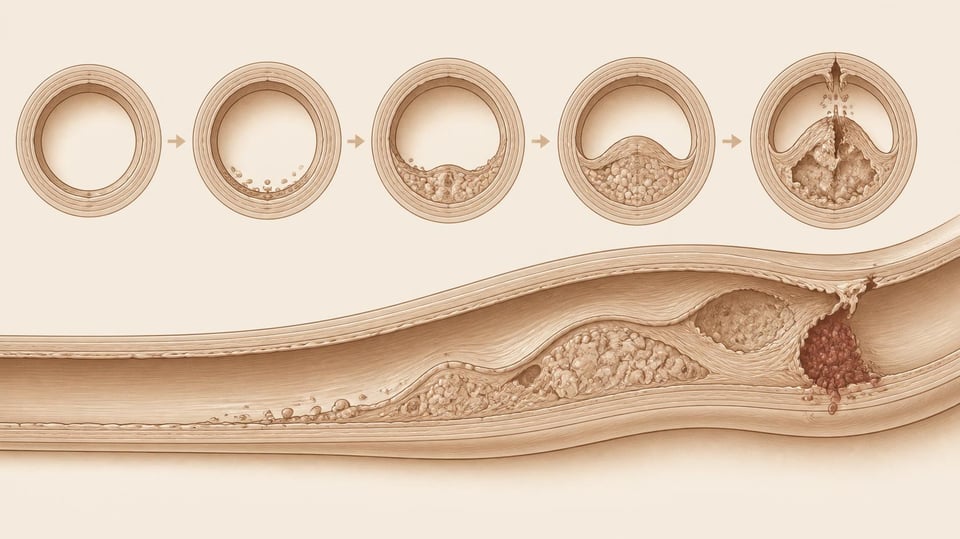
Atherosclerosis does not begin with cholesterol depositing on the inside of an artery like scale on a pipe. It begins with damage to this endothelial layer. The damage is caused by the ordinary insults of modern life. Elevated blood pressure. Elevated blood sugar. Cigarette smoke. Chronic inflammation. High levels of circulating LDL particles, which physically stress the endothelium as they pass. The endothelium, injured, loses its protective functions and becomes selectively permeable. [source]
Once this happens, LDL particles slip from the blood into the intima, which is the layer of the vessel wall just behind the endothelium. Inside the intima, the LDL undergoes chemical modification. It becomes oxidized. Oxidized LDL is not merely inert cargo. It is highly inflammatory, and its presence summons immune cells from the bloodstream to the site.
Monocytes arrive. They migrate through the injured endothelium and take up residence in the intima, where they mature into cells called macrophages. The macrophages, following their usual protocol for engulfing foreign material, begin to swallow the oxidized LDL. They swallow so much of it that they become bloated with lipid, at which point they are known as foam cells. Accumulated foam cells form what pathologists call a fatty streak, and fatty streaks have been observed in the aortas of children as young as ten. [source]
The plaque is not the event. The rupture is.
Over years and decades, the fatty streak develops into a more complex structure. Smooth muscle cells migrate from the deeper layers of the vessel and lay down collagen and other proteins, forming a fibrous cap over the accumulated lipid core. This is the mature atherosclerotic plaque. It can remain in place for twenty, thirty, or forty years without producing any symptom whatsoever. The artery may narrow slightly. Blood flow may be modestly reduced. And nothing, in most cases, happens.
The scandal, and the piece that changes prevention entirely, is this. Most heart attacks and most strokes are not caused by plaques that gradually narrowed an artery until it closed. They are caused by plaques that abruptly ruptured, exposing their inflammatory contents to the flowing blood, and triggering the rapid formation of a clot that occluded the vessel in minutes.
Studies of coronary angiograms and pathology series have consistently shown that most acute events occur at plaques that were only thirty to fifty percent stenotic, meaning they had narrowed the artery only modestly and would not have been considered dangerous by conventional measures.
Which means that the goal of prevention is not simply to slow the growth of plaques, though that matters. The goal is to keep the plaques you already have from becoming the vulnerable, thin-capped, inflammation-loaded structures that rupture. And this is a considerably more complex undertaking than lowering a single number. [source]
The corrections, if you decide to attempt them, are more comprehensive than a statin alone.
The first is to understand your actual cardiovascular risk with better tools than the standard cholesterol panel. Ask your physician about ApoB, which measures the number of atherogenic particles in your blood rather than the total cholesterol they carry, and about lipoprotein(a), a genetically determined variant that most people have never had measured and that quietly elevates risk in a significant minority. A high-sensitivity C-reactive protein test provides a marker of systemic inflammation, which the 2017 CANTOS trial in the New England Journal of Medicine confirmed was independently predictive of cardiovascular events. [source]
The second is to consider a coronary artery calcium score if you are between forty and seventy and have any risk factors at all. This is a quick, low-radiation CT scan that quantifies the calcified plaque in your coronary arteries. A score of zero is powerfully reassuring. A score elevated for your age is powerfully clarifying. It is one of the most useful cardiovascular tests in existence and remains underused, in part because primary care physicians are not routinely trained to order it. [source]
The third is to attend to the drivers of endothelial dysfunction, because these are the true origin of the entire cascade. Blood pressure control, blood sugar control, cessation of smoking, and consistent aerobic movement all preserve the endothelium in ways that any medication can only partially mimic.
The PREDIMED trial, published in 2013, found that a Mediterranean pattern of eating reduced major cardiovascular events by roughly thirty percent through mechanisms extending well beyond simple lipid lowering.
The fourth is to have a serious conversation about statins if your risk warrants it. Statins lower LDL, yes, but their more interesting effect is what cardiologists call pleiotropic. They stabilize existing plaques, reduce inflammation within the vessel wall, and appear to convert vulnerable plaques into more stable ones. This is why they reduce cardiovascular events even in some patients whose cholesterol was not particularly elevated.
Ever on the side of the delicate linings whose quiet work has been keeping the whole system open for decades,
Ms. Clara Whitmore