
High Blood Pressure Does Not Knock Before It Enters 🩺🚪
To the one who has felt perfectly fine for years and has therefore assumed the numbers must also be fine,
There is a particular sleight of hand the body performs in midlife, and it involves a piece of physiology so quiet that most women never learn to listen for it. Your blood pressure has, quite possibly, been drifting upward for a decade. You would not feel it. You would not notice it. It has not caused a headache, a dizzy spell, a moment of shortness of breath.
And yet, if the drift continues, or if it has already crossed the small numerical thresholds that mark the beginning of hypertension, the cost will be paid, one day, in a currency the body cannot easily replace.
This is precisely what makes the condition so easy to ignore. Ms. Whitmore would like to explain why the silence itself is the scandal, and why nearly half of American adults are currently living with a condition that reveals itself only after it has already done a great deal of quiet work. [source]
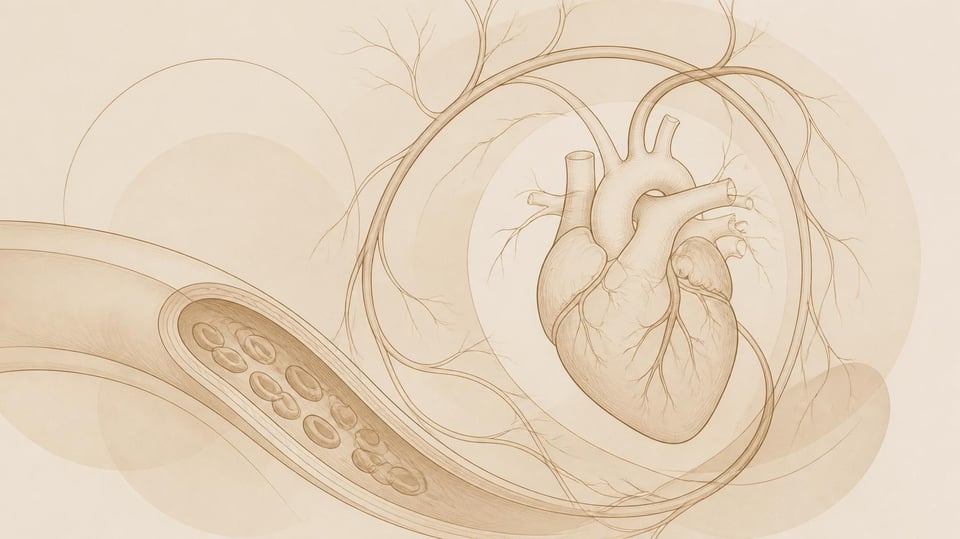
The absence of symptoms is not the same as the absence of damage.
Blood pressure is, at its simplest, the force that your circulating blood exerts against the walls of your arteries. Systolic pressure, the higher number, is measured at the peak of each heartbeat. Diastolic pressure, the lower number, is measured in the pause between beats. In a body operating well, these numbers sit somewhere around one hundred and twenty over eighty, and the arteries, which are meant to be soft and elastic, expand and recoil with each beat like a well-made accordion. [source]
When the numbers climb, the arteries are the first to be reshaped. They begin to accommodate the increased pressure by thickening and stiffening. The elastin fibers that gave them their pliancy are gradually replaced by collagen. The inner lining of the vessel, called the endothelium, sustains small daily damage that inflames and scars over time. Cholesterol, which passes through a healthy endothelium without incident, finds these damaged patches considerably more attractive, and begins to deposit there. This is how atherosclerosis actually begins, not as a moral failure of diet but as a mechanical consequence of pressure. [source]
Meanwhile, the heart itself is doing extra work with every beat. Muscle that is required to pump against elevated resistance responds the way any muscle does. It thickens. This is called left ventricular hypertrophy, and it is one of the earliest and most reliably measurable structural consequences of untreated hypertension. A thicker heart muscle sounds, on first hearing, like an improvement. It is not. The thickened wall is stiffer, less efficient, and considerably more prone to the arrhythmias and heart failure that appear decades later. [source]
There is a slow correspondence between your heart and your arteries that has been going on for years.
And none of this, at any point, produces a symptom you can feel. Arteries have no pain receptors in their walls. The heart, working harder in the way that a muscle at the gym works harder, does not complain. The kidneys, whose delicate filtering units are being subtly injured by the elevated pressure passing through them, send no signal. The tiny vessels of the brain, being remodeled and thickened in a manner that quietly raises the long-term risk of stroke and cognitive decline, register nothing conscious. [source]
This is the exact reason regular measurement matters, and why the physical exam that a woman attends only when something is wrong has been an inadequate strategy for cardiovascular health.
There is a piece of this story that particularly concerns women, and it has to do with estrogen. For most of a woman's premenopausal life, estrogen exerts a mild vasodilating and endothelium-protective effect. Blood pressure tends to sit lower in women than in men through the reproductive years. This protection wanes considerably at menopause, and the trajectory of a woman's blood pressure often steepens sharply in the years immediately surrounding it. [source]
By the time she is sixty-five, her risk of hypertension has often surpassed that of men her age. The Multi-Ethnic Study of Atherosclerosis and other large cohorts have documented this pattern with considerable precision.
The number that qualifies as hypertension has also changed. The American College of Cardiology and the American Heart Association revised their guidelines in 2017, lowering the threshold from one hundred and forty over ninety to one hundred and thirty over eighty. Which means many women who were told, five or ten years ago, that their pressure was borderline, are now, by current standards, hypertensive.
This is not a matter of goalpost-moving. It reflects a growing body of evidence, including the SPRINT trial published in 2015 in the New England Journal of Medicine, showing that more assertive blood pressure control substantially reduces cardiovascular events and mortality, even in older adults.
The corrections, if you decide to attempt them, are largely known.
The first is to measure, at home, on your own schedule, using a properly calibrated cuff. Office blood pressure readings are notoriously affected by the small anxieties of the medical visit, a phenomenon called white-coat hypertension, and are less accurate than a series of quiet home readings taken in the morning and evening over a week. A good arm cuff costs less than a decent handbag and produces information no annual physical can match. [source]
The second is to attend to sleep, and specifically to consider whether sleep apnea might be part of your story. Untreated sleep apnea is one of the most common and most reversible contributors to hypertension in midlife women, and its symptoms are often mistaken for ordinary midlife tiredness. A home sleep test is now widely available and worth the small inconvenience.
The third is to make the small dietary adjustments that the research has confirmed most reliably. The DASH pattern of eating, which emphasizes vegetables, fruits, whole grains, lean proteins, and low-fat dairy while reducing sodium, has been shown in multiple trials to lower blood pressure comparably to a modest dose of medication. Reducing alcohol to no more than one drink daily has similar magnitude of effect for many women.
The fourth, and one of the most consistently underused, is regular aerobic movement of any kind. Thirty minutes of brisk walking, most days of the week, is one of the most reliable natural antihypertensives available, and it costs nothing but the time. Resistance training, added twice a week, further improves the elasticity of the vascular system.
Ever on the side of the quiet measurements that keep the loud ones from arriving,
Ms. Clara Whitmore