
What D-Mannose Is and Why the Bladder Finds It Persuasive 🫐
To the one who has had the same difficult conversation with her doctor about the same recurring infection for the last several years,
There is a particular pattern that visits many women after forty and intensifies after menopause. The small burning sensation on Tuesday evening. The trip to the doctor on Wednesday morning. The prescription for antibiotics filled by Wednesday afternoon. The gratitude for their relief by Friday. And, three months later, the whole cycle beginning again, with the accompanying quiet worry that this cannot continue indefinitely, and no one has offered a very good alternative.
You have possibly heard of a supplement called D-mannose, mentioned by a friend, a naturopath, or one of the more thoughtful corners of the internet. You have possibly wondered whether it is a wellness trend, or a real option, or something in between. Ms. Whitmore would like to explain the chemistry, the evidence, and the reasons a great many women in midlife have found the molecule worth understanding, whether or not they ultimately choose to use it.
The mechanism is small, specific, and rather clever.
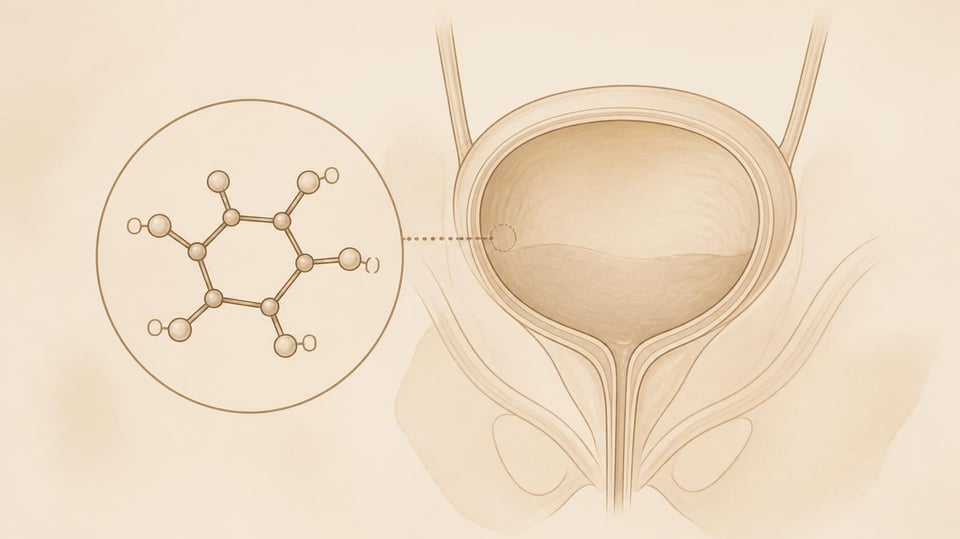
D-mannose is a simple sugar. She is chemically related to glucose, sharing the same molecular formula but arranged in a slightly different three-dimensional shape, and she occurs naturally in modest amounts in cranberries, blueberries, apples, oranges, and peaches. Unlike glucose, however, she is not readily metabolized for energy. When taken by mouth, she is absorbed into the bloodstream and then largely excreted unchanged in the urine, which means she arrives in the bladder in essentially the same form in which she left the glass. [source]
This is where the elegance begins. The bacteria responsible for roughly eighty percent of urinary tract infections are strains of Escherichia coli. In order to cause an infection, these bacteria must first anchor themselves to the wall of the bladder. They do this using small hair-like projections called fimbriae, whose tips carry a protein known as FimH. FimH is highly specific in its taste. It binds to mannose residues, small sugar molecules that happen to decorate the surface of the cells lining the bladder wall.
Which means that E. coli, in the ordinary course of an infection, grabs onto mannose that is already attached to your bladder. When free-floating D-mannose is present in the urine, however, the bacteria find themselves offered a considerably more accessible target. They bind to the free mannose instead of the mannose on the bladder wall. And the next time you empty your bladder, the bacteria are flushed away with the urine, having failed to establish the grip they required to cause trouble.
This is not folk medicine. It is a specific molecular sleight of hand, and it was worked out in some detail in the microbiology literature decades before anyone thought to sell it as a supplement.
The evidence, in fact, has grown more complicated than the enthusiasts suggest.
The earlier clinical trials were encouraging. A well-designed study by Kranjčec and colleagues, published in 2014 in the World Journal of Urology, followed three hundred and eight women with a history of recurrent urinary tract infections over six months. Some received two grams of D-mannose daily, some received a low-dose antibiotic called nitrofurantoin, and some received nothing at all. Both D-mannose and the antibiotic significantly reduced the rate of new infections compared with no treatment, and the D-mannose group reported considerably fewer side effects. [source]
Several smaller studies since have reported similar findings, and the mechanism, as described above, has continued to hold up under laboratory investigation.
The situation grew more nuanced with the publication of the MERIT trial in 2024, a larger placebo-controlled study led by Gail Hayward and colleagues at Oxford, appearing in JAMA Internal Medicine. This trial, which followed nearly six hundred women with recurrent urinary tract infections over six months, found that daily D-mannose was not significantly more effective than placebo in preventing new infections. This is a serious result. It does not mean D-mannose is useless. It means the picture is mixed, and the earlier optimism now sits alongside a large trial that did not confirm it.
Where does this leave a thinking woman? Somewhere honest. D-mannose has a plausible, well-characterized mechanism. She is exceptionally safe, with a long human safety record and negligible side effects at reasonable doses. She is not an antibiotic, which means she does not contribute to antibiotic resistance. And she may or may not, in your particular case, reduce your recurrences. This is not a satisfying answer. It is, however, the accurate one.
The practical steps, if you decide to try her, are few.
The first is to speak with your physician about the pattern of your infections, because recurrent urinary tract infections in midlife women often have contributing causes that D-mannose alone cannot address. Vaginal estrogen, in particular, has strong evidence for reducing recurrences in postmenopausal women, by restoring the urethral tissues and the local microbiome that estrogen used to maintain. This is a conversation worth having before or alongside any supplement decision. [source]
The second, if you and your physician decide to try D-mannose, is to take her at a reasonable dose. Most studies have used two grams daily, sometimes split into morning and evening portions. Powder, dissolved in a glass of water, is the form used in most trials, though capsules are also available. She has a very mildly sweet taste and mixes without incident.
The third is to consider her more aggressively at the first hint of a beginning infection, before it becomes established. Some clinicians recommend one gram every two or three hours during the first day of symptoms, though this is not a substitute for antibiotic care if the infection progresses. If burning worsens, if fever appears, or if you feel systemically unwell, an actual antibiotic and a physician are what the situation requires. [source]
The fourth is to remember that hydration remains one of the simplest preventives. Frequent urination physically flushes bacteria before they can establish. The old-fashioned recommendation to drink water and empty the bladder soon after intercourse is, in the sober light of research, still among the best-supported preventives available.
Ever on the side of small molecules whose only ambition is to be more attractive to the bacteria than you are,
Ms. Clara Whitmore