The Herb Your Great-Grandmother Kept Near the Kettle 🫖
To the one whose heart has grown a little more easily startled than it used to be, and who is not sure why,
There is a particular category of nervous unease that arrives, unpredictably, in the second half of life. It shows up as a small quickening of the pulse before a difficult phone call. As a subtle fluttering at the base of the throat during an ordinary conversation. As the feeling, at nine in the evening, that the whole day has caught up with the heart at once and does not know how to unload itself.
You are not, medically speaking, in any peril. But you are also not, quite, at ease, and there does not seem to be a very good name for the small territory in between.
Ms. Whitmore would like to introduce a plant that has been quietly attending to exactly this territory since the twelfth century, when Hildegard of Bingen first wrote about it. Its flowers have been drunk in teacups by grandmothers across France, Germany, Spain, and much of Latin America for so long that most French children can identify it by scent before they can read.
There is an herb the French have been drinking after supper for four hundred years.
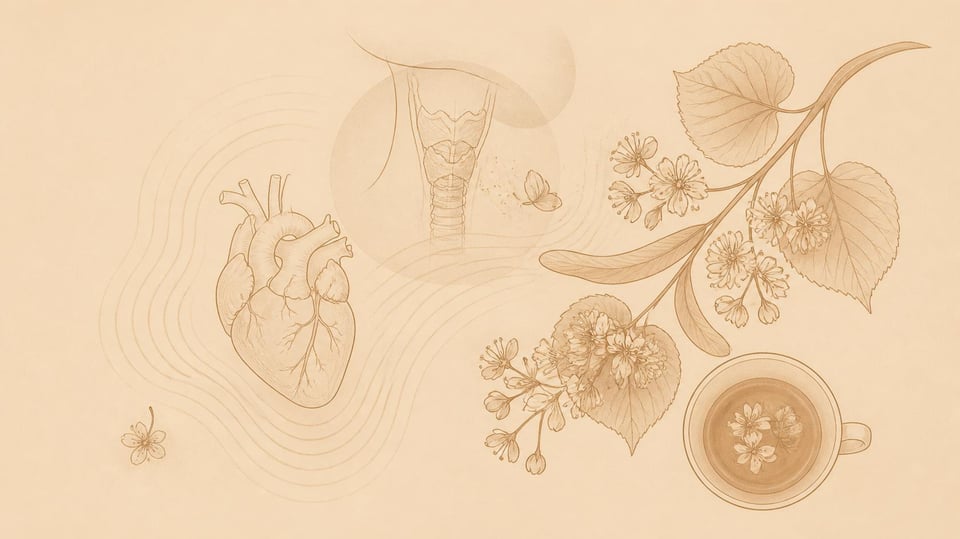
Its name is Tilia, and English speakers call it linden or, in the British tradition, lime blossom, though it has nothing to do with the citrus fruit. It is a stately deciduous tree, sometimes reaching a hundred feet, whose small yellow-green flowers appear in early summer and release a honeyed fragrance so pronounced that European towns with linden avenues are sometimes recognizable by smell alone. It is these flowers, dried, that are steeped into the pale golden tea that a great many European households still keep in a tin near the kettle.
The tea is soft and honeyed and slightly viscous, owing to the mucilage the flowers release into hot water. It is the taste, and the sensation, of being reassured by something older than the room you are sitting in.
Marcel Proust, famously, dipped his madeleine into a cup of linden and unlocked an entire novel of memory. He was not being fanciful. The scent of linden has been so consistently associated with domestic calm across generations of European life that it functions, for many people, as a Pavlovian summons to the parasympathetic nervous system before a single molecule has crossed the intestinal wall.
The evidence, though modest, aligns with what generations have already known.
The compounds inside the flowers are worth naming. Linden is rich in flavonoids, particularly quercetin, kaempferol, and a lesser-known molecule called tiliroside. It also contains a variety of volatile oils and a considerable quantity of mucilage. Animal studies conducted over the past two decades, including work by Aguirre-Hernández and colleagues at the National Autonomous University of Mexico, have shown that extracts of Tilia americana produce measurable anxiolytic effects in standard behavioral models, likely through mild modulation of the GABA-A receptor, the same broad system that benzodiazepines act upon at much greater magnitude. [source]
Human clinical trials on linden are less abundant than the animal literature and less extensive than those for passionflower or lavender. But the European Medicines Agency has issued a traditional-use monograph for Tilia flos, recognizing it for the symptomatic treatment of mild stress and as an aid to sleep. This is not a pharmaceutical endorsement. It is an official acknowledgment that centuries of consistent household use, taken together, constitute a form of evidence, and that linden's safety and gentle utility have earned it a place on the small shelf of botanicals a regulator will publicly recognize. [source]
There is also its older use as a companion to a fluttering heart. Traditional herbal medicine, particularly in the German and French traditions, prescribed linden for palpitations of nervous origin, meaning those small skipped beats and quickenings of pulse that are not cardiac in cause but respond to a softening of the nervous system. Any intervention that gently shifts the balance toward the parasympathetic will, in turn, quiet the pulse. [source]
It asks to be met with a cup, and very little else.
The first is a cup of tea in the evening, roughly an hour before bed. One heaped teaspoon of dried linden flowers, steeped in freshly boiled water for eight to ten minutes under a saucer or lid, produces a pale golden infusion with a distinctive honey-like flavor. It needs no sweetener, though a small spoon of honey suits it well. The saucer matters, because the volatile oils escape rapidly in steam, and covering the cup during the steep preserves the more delicate aromatic compounds.
The second is to combine it, if you like, with chamomile or lemon balm for a somewhat deeper evening effect. Linden alone is gentle. Blended with one of its cousins, it becomes a soft floor beneath the day. The traditional French bedtime tea called tilleul is often prepared exactly this way, with a few flowers of chamomile added for depth.
The third is to consider it in the small nervous moments of the day, not only the evening. A cup in the mid-afternoon, at the hour when the day has grown loud and the shoulders have crept toward the ears, can restore a certain quiet to the next several hours. This is not a stimulant replacement. It is a companion to whatever else you are doing.
The fourth, as always, is to speak with your physician if you take heart medications or prescriptions that act on the central nervous system. Linden is remarkably safe on its own, and the traditional cautions about excessive long-term use have never been well substantiated in modern research. But its mild effects can compound with sedatives, and this is worth mentioning rather than assuming away. [source]
Ever on the side of soft-voiced plants who have been quietly translating between the heart and the day,
Ms. Clara Whitmore