
What the Jaw Clenches When the Mind Cannot 🤫
To the one who caught herself, at the end of a long meeting, unclenching a jaw she had not known was clenched,
There is a small moment, familiar to a great many women, when the day has finally released its grip and the mouth quietly opens for the first time in hours. Something audible releases. Perhaps a small pop. Perhaps a soft ache that had gone unnoticed. Perhaps only the sensation of a muscle that has been on duty for so long it has forgotten it is supposed to rest.
You have almost certainly been clenching more than you realize. Your dentist may have mentioned it. Your temples may have hinted at it, in the form of headaches you attributed to caffeine or dehydration. Your partner may have remarked, at some point over the years, that you make a small grinding sound in your sleep. And Ms. Whitmore would like to open the scandal proper, because the jaw has been trying to tell you something rather specific, and no one has quite thought to translate.
The jaw has been keeping records that no one has ever offered to read.
The muscle doing most of the work is called the masseter. She is a short, thick, rectangular slab that runs from the cheekbone down to the angle of the lower jaw, and she is, pound for pound, one of the strongest muscles in the entire body. She can generate more than two hundred pounds of force between the molars, which is why nut shells and stubborn caramels and stray bits of ice yield to her without incident. [source]
She was designed for eating. She is used for a great deal more. Studies of adult populations suggest that between eight and thirteen percent of adults grind their teeth measurably during sleep, and that the number of adults who clench during waking hours, particularly during focused work or difficult conversations, is considerably higher. Women are diagnosed with disorders of the jaw and its joint at roughly twice the rate of men, and the disparity widens after forty. [source]
There is a reason for this that most dentists do not raise. The masseter is anatomically married to the trigeminal nerve, the largest cranial nerve, which relays sensory information from the entire face to the brainstem and receives instructions in return. When the nervous system is in a state of low-grade vigilance, and it is at any given moment for most modern women, the trigeminal circuit remains subtly active. The jaw contracts, softly, without permission, and continues contracting all day.
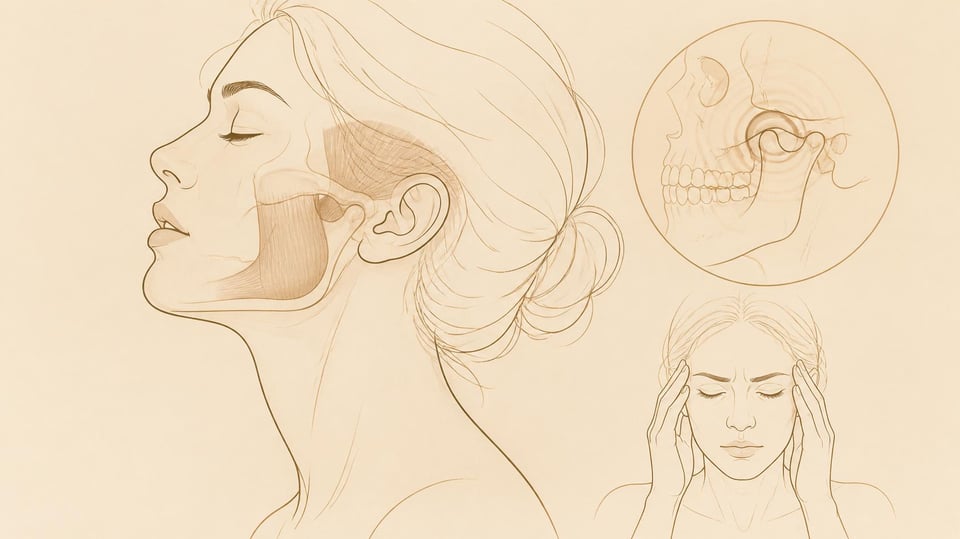
This is not merely a muscle. It is a repository.
Here is the piece that few clinicians name out loud. Research on emotional regulation, particularly the work of James Gross at Stanford and colleagues, has demonstrated that suppression, meaning the effortful concealment of what one is actually feeling, comes at a measurable physiological cost. Heart rate elevates. Skin conductance climbs. The body registers the suppression as a form of work, even when the face registers nothing. [source]
The mouth is the site of speech, and the muscles that surround it are among the most reliable places for suppressed speech to accumulate. Every conversation you managed rather than had, every remark you swallowed at the meeting, every response you drafted and then decided against, every observation about a family member that has waited three decades to be spoken, has left a small trace in the masseter and its associated muscles.
This is not mysticism. It is applied neurophysiology. The tongue moves, the jaw braces, the throat tightens, and then the words do not come out. The preparation, however, has already occurred, and the small muscular effort of stopping the words is itself stored, over days and years, as chronic tone.
You may have noticed this yourself in a specific way. Many women report that their jaw releases most audibly at the end of a phone call with a difficult relative. Or after leaving a workplace where they have been on their best behavior for eight hours. Or, most tellingly, on the days when they have finally said something they had been holding back for months. The release is not imaginary. It is the masseter, at long last, going off shift.
The small mercies she asks for are, as always, quiet.
The first is simply to notice her. Several times a day, at moments when nothing is required of you, check where your teeth are. In a resting jaw, the upper and lower teeth do not actually touch. The tongue rests lightly against the palate, and there is a soft gap of a millimeter or two between the molars. If you are like most midlife women, you will discover that your teeth are in contact considerably more often than they were designed to be. The awareness itself is half of the correction.
The second is to give the masseter a small amount of daily attention. Two or three minutes of gentle circular massage along the cheek, with clean fingertips or the flat of the thumb pressed against the muscle, does more for her than any pharmaceutical. Warm hands help. Warm oil, applied at the end of the day, helps more. The masseter, once she trusts that someone is finally listening to her, releases with surprising cooperation.
The third is to consider a night guard if you grind, and to raise it with your dentist without embarrassment. Untreated sleep bruxism wears the molars measurably over the years, and a well-fitted guard is one of the more sensible small purchases a midlife woman can make.
The fourth, and the most delicate, is to ask yourself what has been going unsaid. Not to demand that everything be spoken, and not to burden the people around you with unedited candor. But to notice, gently, whether there is a particular sentence that has been circulating in the masseter for a long time, and whether it might have a better home than the muscle it currently occupies. Journaling, therapy, a walk with a trusted friend, or an unsent letter written and then thrown away are all reasonable places for a long-stored sentence to go.
Ever on the side of the muscles that have been storing what could not, at the time, be spoken,
Ms. Clara Whitmore