The Lung Herb Ancient Greece Already Knew 🌿
To the one whose winter cough has, once again, refused to leave in the timely manner it once did,
There is a familiar arc that visits most people at some point after fifty. What used to be a two-week cough now lingers for a month. What used to be a mild bronchial tightness in cold weather now takes on a persistence that outlasts any obvious infection. The lungs, which had been quietly reliable through decades of ordinary use, have begun to require slightly more of your attention than they once did. And the standard offerings from the pharmacy, the syrups, the suppressants, the mentholated rubs, provide only partial and often disappointing relief.
Ms. Whitmore would like to introduce a plant that has been growing quietly at the edge of every field, roadside, and neglected lot in America for the last three hundred years, and that a great many older cultures have consistently prescribed for exactly this territory. It is one of those small botanicals whose story is worth telling in some detail, because the evidence, while different in kind from what a pharmaceutical trial provides, is unusual in its consistency.
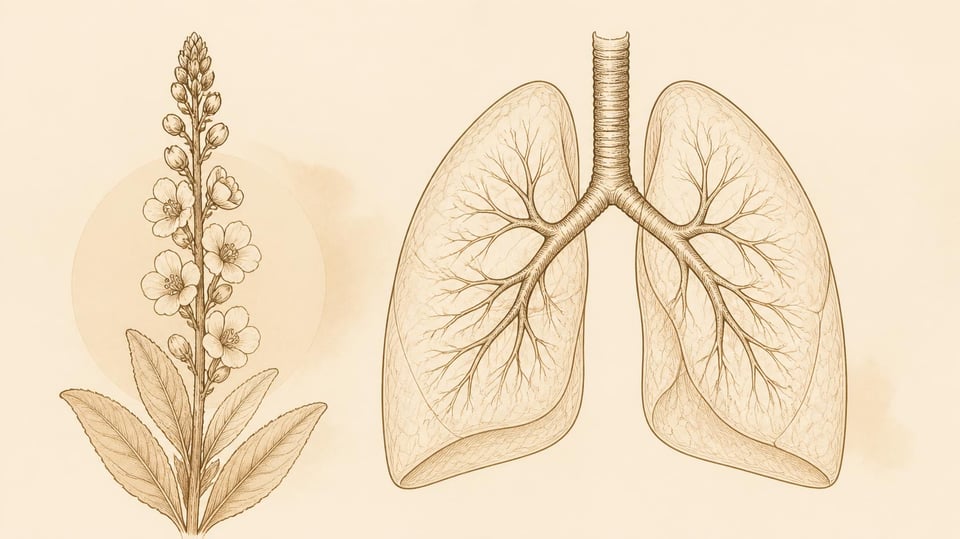
There is a tall, fuzzy plant growing at the edge of every American road that has been prescribed for the lungs for two thousand years.
Its name is mullein, or Verbascum thapsus, and if you have ever noticed the tall, single-stalked plant with soft grey-green leaves and a candle-like spike of yellow flowers rising along a country roadside in July, you have already met it. It is a biennial. In its first year it produces only a rosette of thick, felt-textured leaves. In its second year it sends up a stalk that can reach seven feet, blooms modestly, sets seed, and dies. It is not a rare or precious plant. It grows opportunistically in disturbed soil across most of the temperate world. [source]
It has also been prescribed for the airways by an unusually varied set of medical traditions. Dioscorides described its use in the first century of the common era. Pliny the Elder mentioned it. Traditional European folk medicine used it for coughs and bronchial complaints. Native American peoples, including the Cherokee, the Navajo, and the Iroquois, all used mullein independently, some for tea, some for smoking, some as poultices. Appalachian mountain medicine adopted it, or rediscovered it, and passed the knowledge down through generations of grandmothers who had never read Dioscorides.
Here is the piece that deserves consideration. When medical traditions that had no contact with one another arrive at the same botanical for the same purpose, that convergence is itself a form of evidence. Not a randomized trial, but not nothing. Something in the plant was doing something recognizable enough that observant healers on three continents, across two millennia, kept reaching for it. [source]
The compounds inside it explain much of what the ancient practitioners noticed.
Modern phytochemistry has identified several classes of active molecules in mullein leaves and flowers. The first is mucilage, a viscous polysaccharide that coats and soothes irritated mucous membranes. When you sip a cup of mullein tea, the mucilage physically softens the surface of the throat and upper airway, reducing the mechanical irritation that provokes coughing.
The second is a group of compounds called saponins. Saponins are natural surfactants, meaning they lower the surface tension of liquids they contact. In the airways, this action helps thin the mucus and makes it easier to expectorate. This is precisely what the old herbalists described when they called mullein an expectorant, without knowing the biochemistry that made it so.
The third is a family of flavonoids, including verbascoside and luteolin, which have measurable anti-inflammatory effects in laboratory studies. Chronic low-grade inflammation of the airways is a common feature of aging lungs, particularly in people who smoked earlier in life, spent years in polluted environments, or have any degree of allergic sensitivity. The flavonoids in mullein appear to modulate this inflammation in ways that align with the traditional claim of soothing the bronchial passages. [source]
Modern clinical trials on mullein specifically are limited, and it has not been the subject of the same rigorous study that better-funded botanicals have received. But the mechanistic evidence is well established, the traditional use is exceptionally consistent, and the safety profile is essentially unblemished. It is, in short, one of the more reasonable botanicals a person might consider for lingering coughs, bronchial dryness, and the small respiratory discomforts of colder months. [source]
The ways of preparing it are simple, provided the tea is strained with care.
The first is the standard tea. One heaping teaspoon of dried mullein leaves and flowers, steeped in freshly boiled water for ten to fifteen minutes, produces a mild, faintly sweet infusion the color of pale straw. The critical step is straining. Mullein leaves are covered in tiny hairs that can, if not filtered, irritate the very throat you are trying to soothe. A fine mesh strainer lined with cheesecloth, or a coffee filter, is the traditional solution. Once strained, the tea is gentle and pleasant, and honey pairs well with it. [source]
The second is a tincture, which is a more concentrated form and useful for those who prefer not to fuss with straining. Reputable herbal producers sell mullein tincture in dark glass bottles. Typical doses are twenty to thirty drops in a small amount of water, taken up to three times daily during a period of acute respiratory complaint. [source]
The third, and perhaps the most storied, is mullein flower oil for ear discomfort. A small clinical literature exists on herbal ear drops containing mullein, sometimes combined with garlic, calendula, and St. John's wort, for children with ear infections. Trials have found them comparable to conventional ear drops in acute otitis media, and the practice has some evidence base for adults with mild ear discomfort as well. This is a topical use, entirely different from oral consumption. [source]
The fourth, as always, is to speak with your physician if a cough persists beyond three weeks, if you have any diagnosed respiratory condition, or if you are taking prescription medications for the lungs. Mullein is remarkably safe on its own, and no significant drug interactions have been well documented, but a persistent cough occasionally signals something worth investigating properly.
Ever on the side of the roadside plants whose value has been quietly obvious to everyone except the people driving past,
Ms. Clara Whitmore