
What the Stomach Lining Decides Before Anything Gets Through 💌
To the one whose stomach has begun to protest small offenses it used to accept without comment,
There is a piece of digestive anatomy most adults treat as passively as they treat their kitchen sink. A container. A holding tank. A place food arrives before proceeding to the next stage. This mental model has been consistent enough, and useful enough, that it is rarely questioned. It also happens to be considerably inaccurate.
The stomach is not a container. It is a chemical laboratory of remarkable specificity, running continuous adjustments to acidity, mucus production, enzyme activity, and blood flow, on a scale most people would find quite surprising. And when it stops working well, which it does for a significant fraction of adults in midlife, the reasons are usually located in the working of the laboratory itself, not in the food it was asked to process.
Ms. Whitmore would like to explain what actually happens inside it, because the anatomy is elegant, the mechanisms are specific, and the corrections are considerably more accessible than the average pharmacy would suggest.
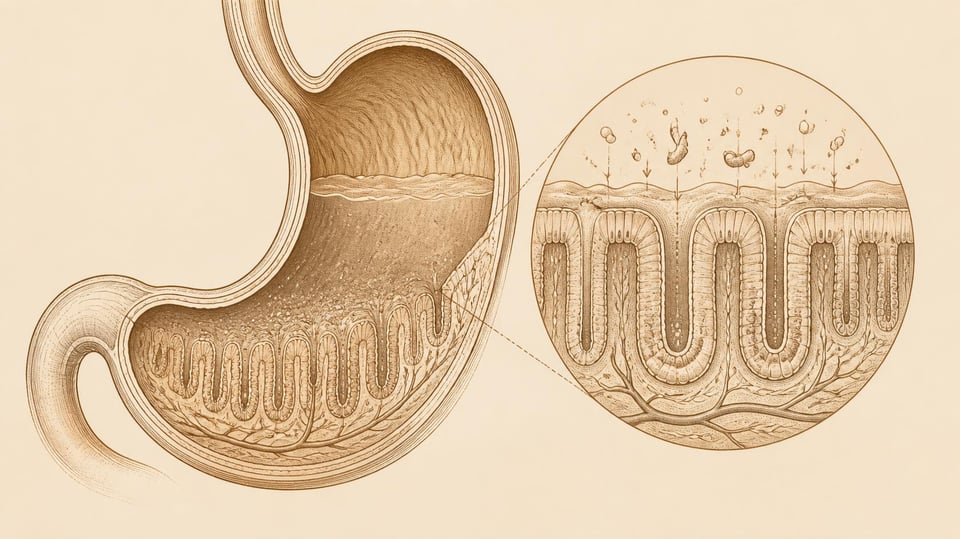
There is more happening between the first bite and the moment nutrients reach the bloodstream than most people realize.
The interior surface of your stomach is lined by a single layer of specialized cells called the gastric epithelium. This layer, though only one cell thick in many places, is composed of at least five distinct cell types, each responsible for a different piece of the chemistry that makes digestion possible.
Mucous cells produce a viscous protective gel. Parietal cells produce hydrochloric acid at roughly a million times the concentration of your blood. Chief cells produce pepsinogen, an inactive precursor that becomes the enzyme pepsin once it encounters the acid. G cells produce a hormone called gastrin that regulates the entire operation. And a variety of other cells manage the feedback loops that keep it all in balance. [source]
The most remarkable feature of this cellular society is the mucus barrier itself. The lining produces a viscous gel roughly two to three hundred micrometers thick that coats the entire interior surface of the stomach. This gel is impregnated with bicarbonate, which locally neutralizes acid at the surface of the cells even while the lumen just above it maintains a pH of nearly two, comparable to that of battery acid. Without this barrier, the stomach would rapidly digest itself.
The epithelium beneath the mucus regenerates faster than any other tissue in the human body. Individual cells are replaced every three to five days, allowing the lining to heal from ordinary insults. This turnover depends on adequate blood flow, hormones, nutrients, and calm operating conditions. When any of these fails, the lining begins to thin, and the acid begins to reach places it was not meant to reach. [source]
Over 84% of kitchens contain this toxic additive. Check your foods. [ad]
The lining is not merely a container. It is an actively managed chemical barrier.
The most common way this barrier is damaged is not exotic. It is the routine use of NSAIDs, the class of medications that includes ibuprofen, aspirin, and naproxen. These drugs work by blocking an enzyme called cyclooxygenase, which produces the prostaglandins involved in pain and inflammation. This is precisely what makes them useful for headaches and joint pain. It is also precisely what makes them damaging to the stomach, because the stomach depends on prostaglandins for both its protective mucus and its blood supply.
A person who takes an occasional NSAID for a headache is unlikely to notice this effect. A person who takes NSAIDs regularly for arthritis, chronic back pain, or any habitual ache is quietly reducing the protective capacity of the very tissue that stands between them and their own gastric acid. This is why NSAID use is one of the leading causes of gastric ulcers in the developed world, and why anyone taking them regularly ought to have a conversation with a physician about protective strategies.
The second common source of damage is alcohol. Ethanol directly disrupts the mucus layer and the tight junctions between epithelial cells, particularly at higher concentrations. Occasional moderate drinking generally allows the lining to recover between exposures. Heavy or frequent drinking does not, and the resulting chronic gastritis is one of the most common findings on the endoscopy of adults who have not otherwise sought medical attention. [source]
The third is chronic stress. Acute stress activates the sympathetic nervous system, which reduces blood flow to the digestive tract as a matter of ancient physiological priority. Blood was needed for the muscles that were expected to run from a predator. When this state becomes chronic, the reduced blood flow to the gastric lining impairs the cell turnover the tissue depends on, and the mucus production becomes less reliable. [source]
The fourth is a diet weighted heavily toward ultra-processed foods. These foods often contain emulsifiers, artificial sweeteners, and preservatives that have been shown in laboratory studies to alter the gastric microbiome and, in some cases, to compromise mucus integrity. The evidence here is less established than for NSAIDs and alcohol, but it is growing. [source]
The corrections, if you decide to attempt them, are matters of restoring the lining's ordinary conditions.
The first is to review your NSAID use squarely. If you are taking ibuprofen or aspirin more than a few times a month, this is a conversation to have with your physician. Many people who assume they need chronic NSAIDs would do considerably better with topical formulations, alternative medications, or physical therapy for the underlying complaint. Others require them, in which case a protective medication such as a proton pump inhibitor or misoprostol is worth discussing.
The second is to give the stomach a reasonable break from alcohol. Two or three alcohol-free days per week is one of the simpler interventions available, and its effect on the gastric lining is measurable within a matter of weeks. This is not a moral prescription. It is a courtesy to a tissue that has been quietly repairing itself between offenses.
The third is to attend to the sympathetic tone under which you have been eating. Meals consumed in a rush, at a desk, while managing email, are meals the stomach processes with less blood flow and less mucus than it would deploy for the same meal eaten slowly. Even five minutes of unhurried breathing before the first bite shifts the digestive nervous system into the parasympathetic mode it was designed to operate in.
The fourth is to eat foods that support rather than tax the lining. Vegetables, particularly members of the cabbage family, contain compounds that appear to support mucin production. Fermented foods support the broader microbiome that touches gastric health. Ginger and turmeric have small but consistent evidence for their gentle protective effects. And ultra-processed foods are considerably less kind to the lining than whole foods eaten in ordinary combinations.
Ever on the side of the linings that have been quietly protecting you from the very acids you produce,
Ms. Clara Whitmore