I recently returned from a two-week summer program for doctoral students and postdocs, Fluid Dynamics of Sustainability and the Environment, at École Polytechnique in the suburbs of Paris. Its dates overlapped neatly with the most recent European heat wave and it was sweltering: it hit 42°C, about 107 Fahrenheit, and pretty humid. It was both a difficult reminder of how hard it is to focus as a sweaty mess and a pointed example of a weather pattern in Europe that will only become more common due to accelerating climate change.
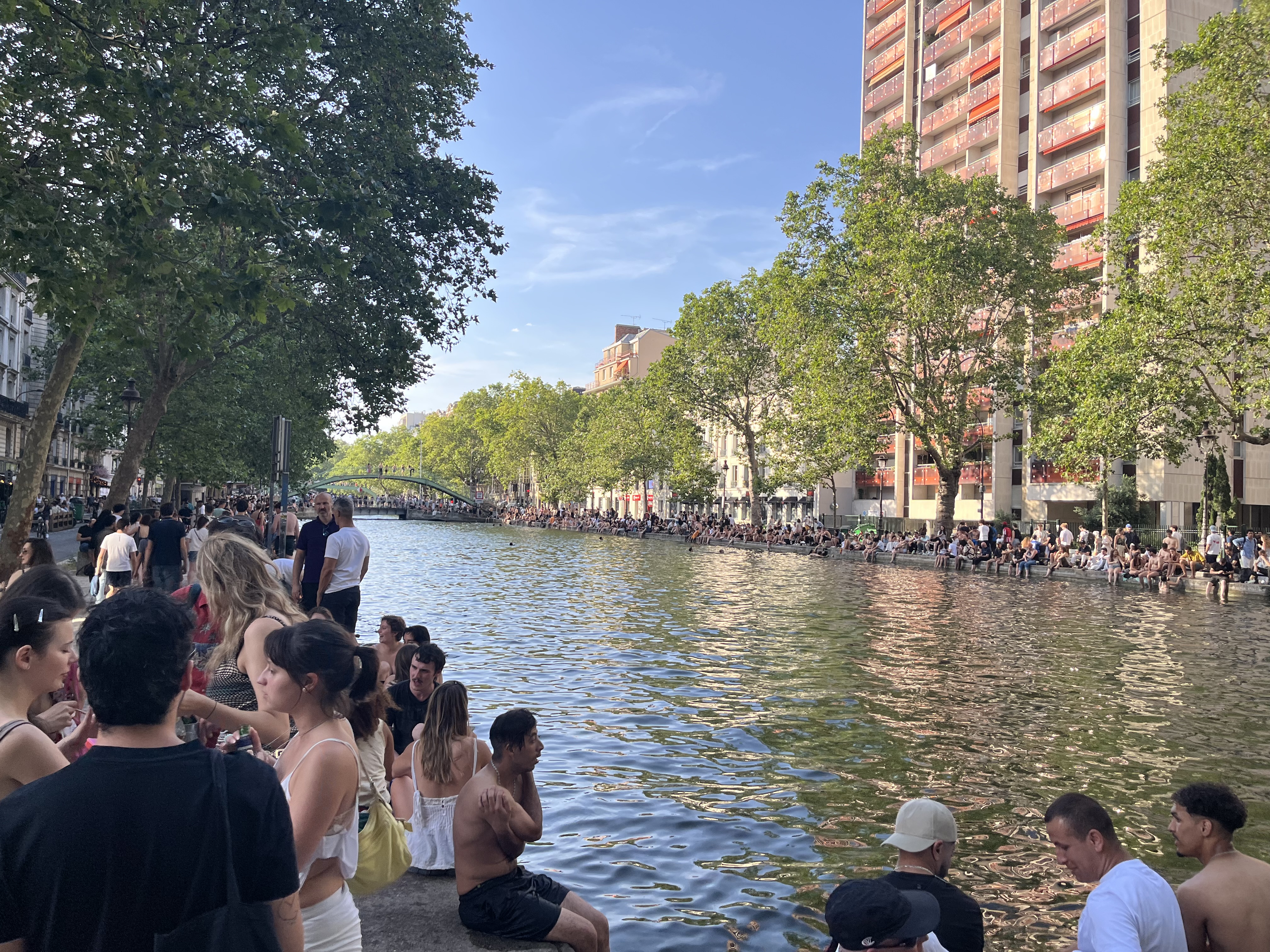
I thought about swimming in the Seine, the main river that bisects Paris, to cool off. Or maybe the Canal Saint-Martin. For simplicity and health I ultimately just swam in the turbid little pond on the university campus. Despite a lot of media attention around a swimmable Seine from the 2024 summer Olympics, swimming in the river now is only allowed in July and August in a few select, supervised locations. Although there is a lot to be done to make this feel like some kind of liberation via city swimming, it's still a huge advance in the swimmability of the urban metropolis. CNN has a decent history of Seine swimming here, which was fun to learn about and inserts Paris into a groundswell of organizing and infrastructure transformation in this contemporary moment towards healthy and swimmable waters in our global urban centers: see Swimmable Cities.org! A swimmable waterway is also likely to host healthier ecosystems and require less expensive treatment of water for downstream use.
Access to rivers for water and easy transportation is a driving force in urban development, and it has been for millennia. I also think recent years have seen celebrations of swimming (particularly "wild swimming," see examples one, two, three). But many rivers in densely developed places have been under a burden of pollution, sometimes for reasons as simple as the rivers being the end points of sewers or gutters: the rivers collect human waste and city grime and industrial pollutants. This is certainly the story of Paris, where wastewater treatment was partial or scarce until after environmental movements got started in the 1970s and 80s. It's a similar story in many other cities, where legacies of pollution and poor water infrastructure inhibit both recreation and aquatic life, including New York and Chicago.
Even if sewage isn't directly thrown into our rivers, many older cities like Paris and NYC have what environmental engineers call "combined sewers." This means that sewage is combined with stormwater (the water that flows into street drains during rain) and the whole mixture is sent to wastewater treatment plants. This makes infrastructure simple, as there is only one inflow of wastewater to treat. But combined systems also can get complicated: it gets extraordinarily expensive to treat all of the water that comes during peak storm events. A city like Philadelphia simply suffers under strain as the volume of household sewage has increased over the decades... and then when a storm with a lot of quick rain arrives, the system gets overloaded. Then, the combined sewage and stormwater ends up back in the open-air river, untreated. It's the trade-off for not spending money on a wastewater treatment plant big enough to treat these peak flow rates. An enormous wastewater treatment plant would sit unused 99% of the time.
 Handy graphic from the US EPA, via Wikimedia. "POTW" would be a water treatment facility.
This problem is heightened further in places with super variable rain regimes, like Los Angeles. To build a treatment plant capable of handling the rare, flashy, but high-volume rains in LA is just financially infeasible. On the west coast of the USA, the only two cities with combined sewage systems are San Francisco and Seattle (Portland a little bit); LA actually basically doesn't treat any stormwater, but stormwater and wastewater are separated, so no sewage is discharged. Still, street pollution is such that after it rains in Los Angeles, it's advised not to go swimming for 72 hours. And that's for the ocean, where nasty stuff can dilute rapidly!
(Environmental Engineering 101: "The solution to pollution is dilution.")
Urban rivers are small relative to the ocean, so the pollutants are more concentrated and the health risks are greater. And combined sewage outfalls are problems that span coast to river. One of the solutions for Paris (as well as San Francisco!) is to build large, underground holding tanks that can fill with combined sewage water during high flows, and then treat the water in a longer period after the rainfall slows. Berlin does this as well, and it helps keep the nearby lakes healthy for swimming.
 Image of Paris' Austerlitz Basin for holding stormwater, via C&E News.
These big infrastructural investments (underground tanks) help a lot, but stormwater is probably best managed in a more distributed way, instead of in these concentrated hotspots like rivers. How can we prevent so much water from reaching the (combined) sewers or our waterways at all? It requires having green space and healthy soils that can "capture" stormwater and slow it down, in its journey from raindrop to ocean. Thus, demands for healthy waterways and effective water management contribute to "depaving" efforts. These seek to remove the concrete seal that separates falling rain from layers of soil on earth, rendering our cities more porous (see Depave.org). More water soaking into the earth is good for water quality as well as infrastructure maintenance and groundwater recharge (in places where that is relevant).
There are many success stories of urban river and bay swimming, some as cherished old traditions and some due to recent efforts in industrial clean-up, infrastructural improvements, and PR campaigns to fight associations between urban waterways and health risks. I'm not sure I would advise swimming in the LA River quite yet, though people seem to increasingly enjoy it for kayaking. There remain many serious challenges especially where diffuse pollutant loads are high from urbanization or agriculture and dependence on the waters is high, like in the Ganges. Fixes take a lot of money, a lot of buy-in, and a lot of coordination. Here in Stockholm, the lake and Baltic sea waters are clean enough for regular swims and dips, though the bottom sediments are considered somewhat polluted. This is similar to conditions back in San Francisco Bay, where I hope to swim again before too long and where the rapid tides flush the waters out pretty well.
Out for an urban dip,
Lukas
You just read issue #108 of Gnamma. You can also browse the full archives of this newsletter.