This edition of Gnamma is something I pitched to Nordic Surfer's Mag after my trip to Scotland in February. TBD if it gets published, so I want to share it here as well. Thanks to those who helped me afford my conference trip: I spent my credit card points on a 2-day surf trip at the end to the northeastern tip of Great Britain when the conference wrapped up! Hope you enjoy.
There’s a concept in anthropology called the “encounter,” typically used to describe interactions between people from different cultures, or “everyday engagements across difference”. The term originated in descriptions of colonial-era collisions between the colonizers and the colonized, including moments like Europe’s early glimpses of surfing via Captain James Cook’s visits to Hawaii. Now, the encounter's ethnographic value has grown into works on decolonization, beyond east-west/north-south dualities, and even expanded into nonhuman relations. Although the exotifying and academic weight behind the term evokes something more akin to Madagascar than anglophone world banality, I found myself, a white American, thinking about the word as the BBC chattered away in a baby-blue Fiat 500 careening through the wetlands of northern Scotland—my lanky ass and a rented midlength wedged inside.
My Scottish rendezvous represented the earliest ascent of spring, the end of February, during a couple of almost disconcertingly sunny days. I had just weathered my first Swedish winter, and I had not surfed in many months since my last trip back to California. In the sequence of grief, my relationship with surfing was moving from "depression" towards "acceptance" with the new routine. I aspirationally squeezed out my entire stock of credit card points to get a rental car and budget hotel, adding a few days at the end of an easy-going week in Glasgow for a work conference to pursue the surf.
But I had also not driven a car a similar number of months, nor a manual in a year or two, and absolutely never had I ever driven a stickshift with my left hand. In some ways my encounter with Scotland actually began the Saturday after the conference as I haltingly pulled into Edinburgh traffic in the Fiat, promptly got honked at for disobeying some traffic rule I did not quite understand, and, with the two-plus hours it had taken to track down this mockingly lighthearted blue Fiat 500 (after my Alamo reservation evaporated in some scam website slight-of-hand), I realized I absolutely could not arrive in Thurso with time to surf this Saturday's sunset. I also forgot my favorite pants back in Glasgow. And my phone charger.
I pulled over to the side of the road and shed a few tears, the emotional equivalent of pouring one out for the plans gone awry. My phone was at 10% and so were my spirits. I considered bailing, ditching the car and staying in Edinburgh to surf the wave pool somewhere near the city. But I was closer to true ocean swell than I had been in a while, and I already had a damn non-refundable hotel reservation anyway. I took a deep breath. I checked the surf forecast: tomorrow would be good as well. Maybe even Monday. I exhaled and fixed my mind: I would beam it to Glasgow, retrieve my forgotten items, and enjoy a more leisurely drive up into the Highlands. One more day without surfing was no excuse to ditch the plan. I leveled myself and pulled back into traffic. The car responded more confidently to my shifting, the radio blasted a cheeky BBC piece theorizing why or why not the name “Shane” is sexy. And so my trip truly began as I charted my miniscule plan in a miniscule car, weaving through Scotland’s tallest peaks.
A crucial aspect of the "encounter"—as well as any true adventure—is it being open-ended, affording a ragged edge of genuine experience. There might be a plan, but what exactly ensues depends on the dynamics of whatever actually shows up. Surf travel has a spectrum of rawness: if you want a guarantee of comfort and waves, you can pay out the nose for a chummy Australian to charter a boat and private chef in the Mentawais. If you want to reach Rasvotich's "papaya consciousness," you've got to embrace unemployment and machete your own way around some remote corners of a Pacific coral atoll. If you want to romanticize cold and stoic beauty, a beach up in Norway will have you. All of these balance some amount of planning with some amount of release, the same balance that surfers navigate daily between expectations (and forecasts) and reality. Regardless of how manicured an adventure we want, we at least aim for glory. When I think of surf glory, "negotiating a rental car contract in the basement of a vape shop" is not really what comes to mind but sometimes that is what surf travel demands of us, and we need to be open to it all. The contact must also go both ways: we can be touched by the world, and we equally get to influence it. For me this meant trading my tired nerves with delight on the hotel concierge’s face when I finally showed up at 10:30pm and asked for some soup. She asked what brought me to Thurso and the warmth on her face made it clear that surfing remained a novelty. The soup was an amazing dose of hospitality, and she was charmed to meet a surfer after hearing “so much about waves here [in Thurso]”.
The week preceding my trip, I had been in touch with a surf school up yonder moor to secure a board rental. They had been friendly, informative, and accommodating, and I knew my board was waiting for me outside the surf shop whenever I could arrive. I woke up embarrassingly late for a day with "dawn patrol" written all over it, and prayed to Saint Andrew that the board would fit in the bloody Fiat—a car much smaller than I anticipated. Incredibly, it did, with maybe one inch to spare. This is to say, the board-car encounter went smoothly. I drove to a nearby beachbreak: beautiful scenery but messy. I drove to the well-known reef: clean breaking and with a couple other heads in the water. Finally, a few things had gone right. My excitement glowed through the Scottish drizzle: I would finally get to surf.
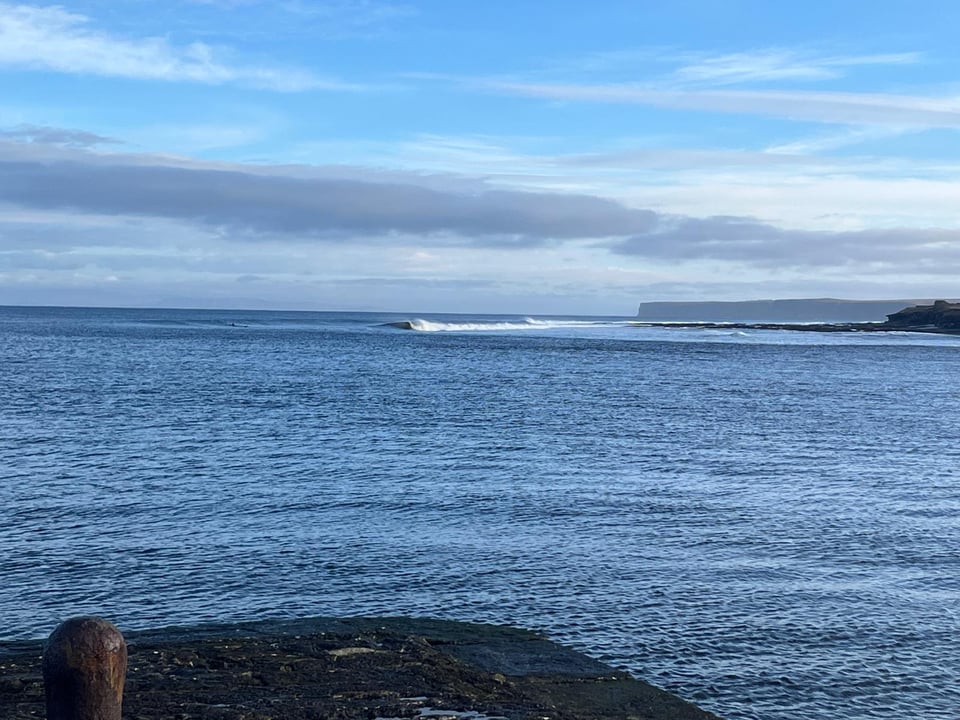
My approach to suiting up in a new location, particularly alone, leans careful yet relaxed. Or so I try to perform. I don't want to be too friendly and betray my naivety, or my tourist status—so is my ego. But also I don't want to be too detached and convey that I'm not paying attention to what's around me. A lack of awareness is one of the principal sins of surfing; surfers respect a kind of carefully trained eye in the water, and so I assume terrestrially as well. Are we trying to play it too safe, or too cool—avoiding the messiness of a true encounter? Or are we just trying to be respectful of a new place? I figured that every encounter is actually a performance, and that it didn’t really matter. I was here, literally diving into it all. The two guys playing Drum 'n Bass music while watching the surf out of the back of a beat-up van next to me, occasionally mumbling a comment on the wave or the rider, were too much for me to stay silent.
"I love the Drum 'n Bass" I said.
Too restrained? Too friendly? This was it, my first encounter with a Scottish surfer. The closest guy grinned at me from behind reflective gas-station sunglasses. "Heck yea it's good right!" he said with a shaka. Whew, phenomenal anthropological success. Here, at the northeastern tip of Scotland, in the rain, the vibes were still good.
I continued to yank on my wetsuit. A dismal cold settled into my fingers that never quite went away for the rest of the day. But, to my delight, I then learned that the van on the other side of my childishly blue Fiat belonged to the woman (let's call her O.) from whom I had rented the surfboard. She was about to suit up herself, so we exchanged typical pre-surf banter before she encouraged me to waddle down the reef and get into the water. I no longer felt alone. I was both with people and immersed in the world around me.
My plunge into the Pentland Firth was bracing but the friendliness in the air kept me warm. One of the guys in the lineup gave me an acknowledging nod. O. joined the flotsam, asked about my nighttime drive, and gave me positioning advice. I got a couple waves, testing the performance of the rental board's rail to go as fast as it could go over the shallow slab. Another chatty fellow (D.) asked where I was from, and recounted the story of a surf trip to California from years prior. The tide dropped lower and the slab got easier and easier to see through the tannin-colored water. I got choosier with the waves, and managed a few more, some half-decent but never quite in the barrel. I was mostly happy to avoid an encounter between my skull and the rock. The head-nod guy (M.) and I stayed in until the others left. By the end of the session, I'd learned that M. was about to become a father, much earlier in life than he had ever planned; Z.'s favorite thing to do was tuck into the barrel lying on his back coffin-style; and D. had opened a surf shop in town to support the local surf scene on his own dime. I left the water frigid but touched by the chance to meet these people in my rushed, solo surf trip. We each had our zig-zagging lives but overlapped for one brief session—some kind of collective encounter between each other and the water, the waves, the rock, the seaweed. An ecology of surfers moving through the world, sharing advice and sharing jokes and sharing space and time, a connection just for the sake of it. And the surfing encounter of course does not end at the shore: as I twisted my way out of my wetsuit up on the bluff, I met O.'s mom and a guy who had just attended the same conference I came from, who was about to paddle out.
The universe of surfers in northern Scotland felt regional in a way that defied the cross-continental cultural differences behind the word "encounter." Everyone seemed to know each other already. And with such conviviality, suddenly, I knew them a little bit too. I realized that in surf travel, the waves are actually the common ground between us: surfing is the bridge to reach across our small differences towards something shared. Despite the cultural homogenization latent in global travel, social media, and third-wave coffee, we surfers still often travel to encounter something "other"—to be challenged by something outside of our own worlds and norms. I think we’d be good to acknowledge that we equally need to share a piece of where we are coming from when we travel, and make sure we do not neglect the political and economic dimensions that can make a place feel different, remote, cheap, or underdeveloped (see this). The ego needs to genuinely encounter reality. The session at a new reefbreak is not really the goal; it's having genuine conversations with someone along the way.
When I woke up the next day, my hotel had the stale, briny, and rubbery air of wet wetsuit, which honestly suited the mood just right. I drove west and appreciated the hills, bogs, and seaside cliffs, saturated under deceivingly bright sunshine: air temperature and water temperature were both 45F (about 7C). On the drive I was shocked to see large-scale, but now mostly decommissioned, nuclear power plant infrastructure: an imposing mess of barbed-wire fences and blocky buildings in an otherwise gently rolling landscape. This unanticipated sight illuminated the lived realities of this place for me. The nuclear plant, its benefits and risks, have been tucked away into a rarely-seen corner of Scotland right here in surf's playground; it employed a lot of the people making the whole region hum beyond fishing and tourism—including paying D.'s salary to support his little surf shop. For me, the nuclear plant felt incongruous; for those living here, it's just part of life. Either way, the plant and the landscape and lives lived around it are interwoven, and in that moment I felt I was encountering both the place’s vast strangeness and its unremarkability. The "other" to us travelers is the everyday for those where we visit.
I looked at a few beaches receiving a bit of new swell but couldn't really choose where to put in. By the roadside at one, I saw peelers breaking in the distance but had a hard time judging size and quality. A man walking his dog recommended I park next to him and said surfers "park here all the time." I took it as a sign that I could trust the universe. A thousand tiny pieces align, from the swell patterns to the winds to these comments from strangers, to make every session happen: this alignment is part of the nature of the nonhuman encounter in surfing. I paddled out and had the bay completely to myself for a couple hours until the dropping tide turned the waves into walls. The water was clear and crisp, the sun bright, and my board had enough float to get into even the small ones. Between sets, I swung my arms wide to bring warm blood to my hands and tried to see fish swimming beneath me. I got to know a few landmarks up on the cliff on one side of the bay to help stay in position and gauge changes as the tide went out. (Thank you, rusty gate.) My mind was empty, and I was the happiest I'd been in months. Afterwards, I changed back into my dry clothes slowly, enjoying the view of the spot, even though the wind had long turned the waves into chop. It felt like a pre-lingual exchange between my body and the beachy bay. I doubt the ocean has much to say about our interaction, but I will always remember it.
Surf travel looks like many things. Strike missions with a perfect forecast. Visiting a friend at their home break. Trips to foreign places for food as much as waves. Even a drive from your house to the parking lot. And then there's whatever I was doing, with a few dangling days at the end of a work trip in a soggy but beautiful corner of the earth. Surfers find ways to make it work, making a connections happen wherever possible in the dance between ourselves, our bodies, the boards, the waves, the sandbars, the other people in the water (or on land), the animals out there, maybe the plants, and maybe even a glistening bright blue Fiat 500. The glory is in genuinely releasing yourself to the experience—the encounter—so that you can enjoy the moment in whatever way the universe folds together all of surfing’s constituent parts. I got my credit card points, eventually a rental car, the board fit in the Fiat, the community was inviting, and the swell and tide lined up well enough. I got to share stories with the others in the water, leave my footprints in the sand, and tuck my ego into the ditch by the nuclear power plant. All of it is this mess of experiences and dynamics we call the encounter of surf travel.
Thanks to edits by E and N for improvements. Thanks to my mom and Adam for talking on the phone for big chunks of the 5-hour drives through Scotland. And thank you for reading!
Encountering,
Lukas
You just read issue #107 of Gnamma. You can also browse the full archives of this newsletter.