
The Late Night Pour | Two Libyas

|
Four Fingers News
The News, Neat.
|
| SUNDAY, NOVEMBER 22, 2026 · DAY 268 |
| The Late Night Pour |
Two Libyas
Two Libyas, read aloud · 7 minutes.
Before dawn on Sunday a Russian warship blew up at its pier in Benghazi, a port city in Libya, on the north coast of Africa, and by afternoon it was lying on its side with only the bow out of the water. The day before, a Russian cargo ship caught fire off the coast of Finland, up at the top of Europe, and drifted into Finnish waters with its crew in the lifeboats. The two ships were nearly two thousand miles apart. Neither was anywhere near Ukraine, where the war is. Nobody has officially said who did it, but every account points the same way: Ukrainian sea drones. The map below shows where all of this happened.
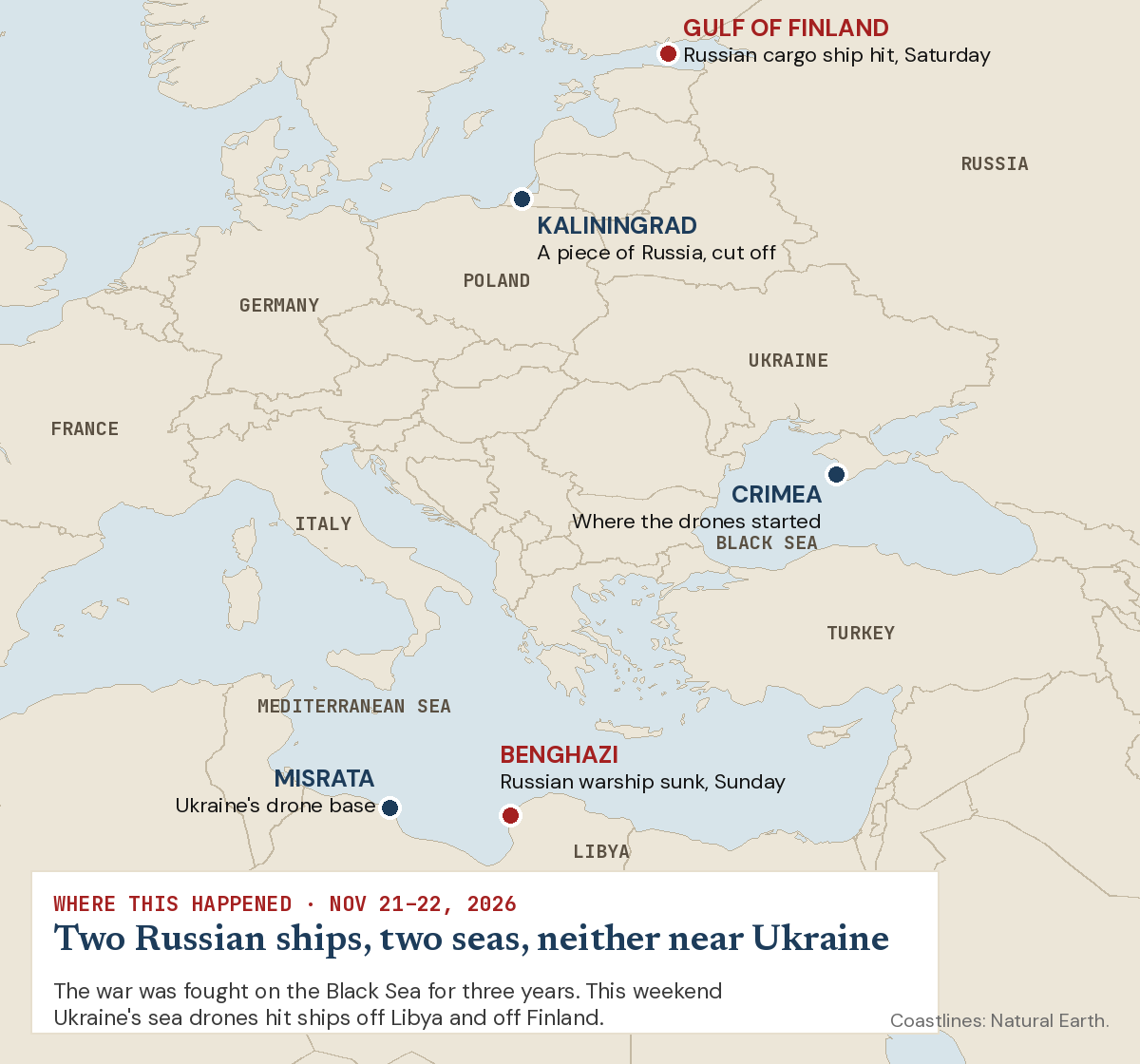
Here’s what a sea drone is, because the whole weekend turns on it. It’s a boat with nobody aboard: a hull about the size of a bass boat, a motor, a camera, a satellite link, and a few hundred pounds of explosives in the nose. Someone steers it from a screen, sometimes from hundreds of miles away, and runs it into the side of a ship. It costs a few hundred thousand dollars. The warship it sank on Sunday was three years old and worth a couple of hundred million. Ukraine built these boats because it has almost no navy and Russia has a big one. For three years it used them on one body of water, the Black Sea, the sea on Ukraine’s own south coast, and it used them well enough to drive Russia’s fleet out of its home port there. Until this weekend that was the story: a weapon for one sea. What changed is where they turned up.
Start with Libya, because the answer is there. Libya is the big country on the Mediterranean coast of Africa, directly south of Italy. It’s had two governments since 2014, and they don’t speak to each other. One sits in Tripoli, on the west side of the country, and it’s the one the United Nations recognizes. The other sits in Benghazi, on the east side, under a general named Khalifa Haftar, who spent twenty years living in Virginia before he went home to fight. Russia backs the general. Russia used to keep its Mediterranean ships at a base in Syria, but Syria’s government fell and the ships had to leave. So Russia moved its business to the general’s side of Libya. Russian freighters now unload weapons at the eastern port of Tobruk, with warships standing by, and the cargo goes by truck across the Sahara to Russia’s mercenary army in Africa. That’s what the warship, the Merkury, was doing in Benghazi: it had escorted cargo ships down from Russia and was tied up at the pier.
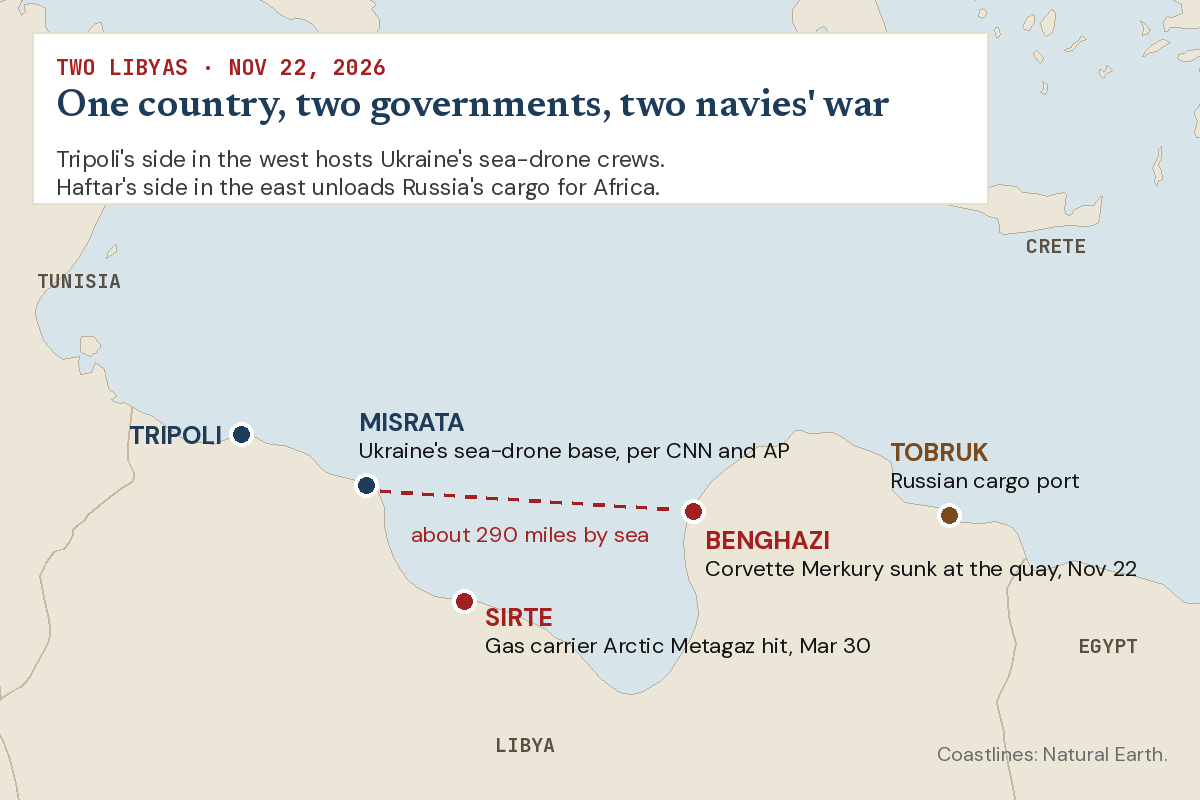
Now the other half of the country. In September a Ukrainian drone operator told CNN that his unit had been working since late 2025 out of a base at Misrata, a city on the western coast, on the Tripoli government’s side. His unit launches drones at Russian ships, and in return it trains the local forces. The Associated Press has described a quiet deal between Ukraine and the western government, with Western backing that included the United States. The western government says there’s “no agreement, arrangement or coordination” allowing any base to be used for attacks on anyone. But Russian ships have been getting hit off Libya since last December, and on Sunday officials on the general’s side told the AP that the drones “were launched at the ship from a base run by Ukrainian forces in western Libya.” Look at the map: Misrata to Benghazi is about 290 miles by sea. At least four drones were shot down before two got through. The warship had a crew of about 90. Nobody has said how many died. As of tonight neither Moscow nor Kyiv has said a word.
The ship off Finland needs one more piece of geography, and it’s the strangest piece on the map. Kaliningrad is a chunk of Russia that isn’t attached to Russia. It sits on the Baltic Sea between Poland and Lithuania, two countries that are in NATO, and about a million Russians live there. There’s no road from Russia to Kaliningrad that doesn’t cross a NATO country, so Russia supplies it by ship: out of St. Petersburg, west along the Gulf of Finland, which is the narrow arm of the Baltic between Finland and Russia, then south down the open sea. The Sparta II was on that run on Saturday morning, a freighter owned by a shipping company the Russian Defense Ministry set up for itself, when two drones hit it in the gulf. It lost its steering, drifted into Finnish waters, and burned into Sunday while a Russian rescue ship and Finnish boats fought the fire together. Finland’s military said Ukraine was the likely attacker.
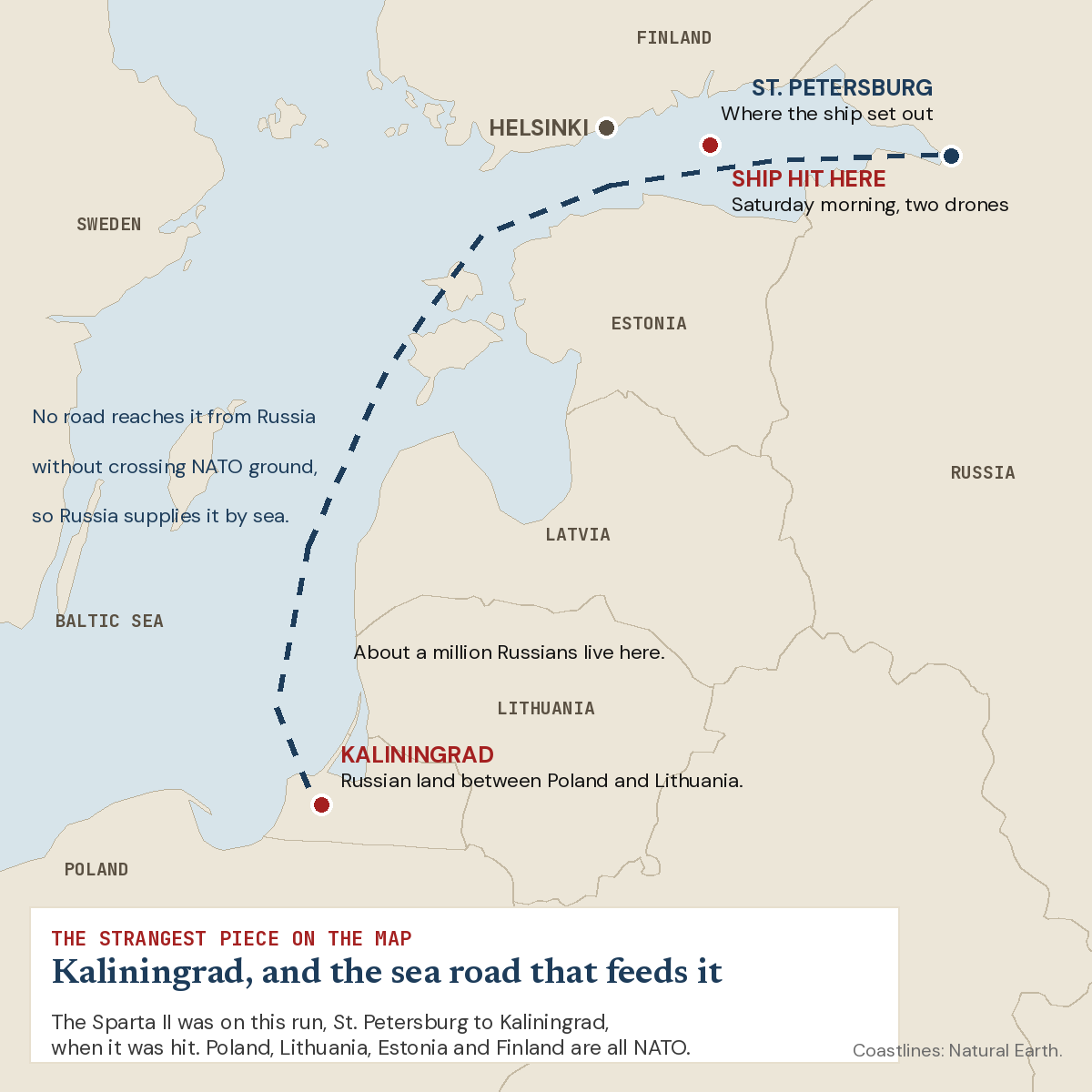
Finland matters here because it joined NATO in 2023, and NATO is the alliance of the United States and 31 other countries in which an attack on one is supposed to be treated as an attack on all. Finland shares an 800-mile border with Russia. Its prime minister, Petteri Orpo, said: “War is spilling over into our immediate vicinity. Ukraine has the right to fight back against the aggressor.” That’s a NATO head of government saying both things at once: this is close to us, and we aren’t going to stop it.
Here’s why it matters more than one sunk ship. For three years the fighting at sea happened in one place, the Black Sea, right next to Ukraine, and Russia could treat every other sea as its own. Ukraine couldn’t reach the ships that carry Russian weapons to Africa, or the ones that keep Kaliningrad fed and armed, or the tankers that sell the oil that pays for the war. Now it can, from a friend’s harbor, with a weapon that costs a tiny fraction of what it sinks. Russia will answer somewhere, and the places it has to choose from are a Libyan port, a Finnish gulf and the sea lanes off a NATO coast. None of them is Ukraine. That’s the part Finland heard.
This is how wars grow. Not with a declaration, but with one side finding a harbor to launch from and the other side’s ships being wherever they are. Libya has had two governments for twelve years, and most of the world stopped paying attention. This weekend each of them had a foreign navy’s war in its harbor, and the water between them is the newest front in a war that began a thousand miles away.
Sources (19), on the site.
The Army Tells Netanyahu an Iran Strike Won’t Stay a Five-Day War
Channel 12 reported Sunday that IDF Military Intelligence has warned Benjamin Netanyahu that an Israeli strike on Iran without the United States could set off fighting on several fronts at once, Lebanon, Syria and Gaza among them, against the view attributed to him and Mossad chief Roman Gofman that an operation could be held to three to five days. The army said it doesn’t comment on closed-door meetings. The Jerusalem Post, confirming a Washington Post report, says Netanyahu sought to have Gofman run an Iran operation with chief of staff Eyal Zamir left out of the loop, and that Zamir wasn’t invited when Netanyahu briefed Pete Hegseth at Uvda air base in October. Avigdor Liberman warned publicly against any strike without American involvement. Trump said Thursday that new strikes on Iran were “quite unlikely” before the new year.
| The plan: Three to five days, by the reports; nobody has said it on the record |
| The warning: Military Intelligence says Lebanon, Syria and Gaza come in with it |
| The rift: Gofman for a joint US–Israel strike before the window closes, Zamir against one in an election season, per the Post |
| Washington: Trump, Thursday: strikes “quite unlikely” before Jan 1 |
| The record: Netanyahu and Gofman planned an operation before the election that Zamir and Trump blocked, Channel 12 said Nov 6 |
| War: Day 268 |
Iran’s Navy Says Two More Tankers Hit Mines; CENTCOM Says the Lanes Are Clear
Iran’s navy said two more tankers struck mines east of the strait on Sunday, a day after UKMTO logged two tankers hit by projectiles near Khasab with no one hurt. On Sunday afternoon UKMTO recorded a “military encounter” involving a tanker in the Gulf of Oman and gave no details. CENTCOM has called the mine claims “FALSE” and says the main transit routes are cleared; its count since July is 147 ships turned back and five disabled. Al Jazeera’s tally: at least 25 tankers hit in and around the strait in seven days.
Bahrain Counts Two Hurt from Saturday’s Attack; the IRGC Claims Two Patriot Radars
Bahrain’s interior ministry now says Saturday’s strike on an industrial site at Sitra hurt two people, a Bahraini in stable condition and a Pakistani resident in critical condition. The IRGC says the same operation destroyed US Patriot radars at the Riffa and Awali bases, in answer to a US strike on its radar on Hengam Island. Nothing confirms the radars, and CENTCOM denied a similar claim on Nov 13. Saudi Arabia, Kuwait, Qatar and the Arab League condemned the attack.
Poland Takes Friday’s Missiles to NATO’s Council on Monday, Without Article 4
Deputy Defense Minister Paweł Zalewski will lay out the military details of Friday’s incursion, two Kh-101 cruise missiles and a jet drone down inside Poland during the mass strike on Ukraine, to the North Atlantic Council in Brussels on Monday. “There is no need to invoke this fourth article,” he said. What Warsaw wants is air defense on the eastern flank, F-35s and AWACS planes among the asks. Mark Rutte said in Warsaw that NATO will defend “every inch” of Polish territory.
Trump Posts ‘My Friend’ over a Putin Handshake and Puts Shenzhen Beside Yalta
Trump published a photograph of himself whispering to a smiling Putin on Truth Social, captioned “My Friend,” beside a split-screen titled “The Great Powers 1945, 2026” that sets Stalin, Roosevelt and Churchill at Yalta against Putin, Xi and Trump in Shenzhen. Zelensky said calling Putin a friend reduces the pressure on the Kremlin; Chuck Schumer said Trump counts Putin a friend despite his abuses. The caption repeats what Trump said at Thursday’s summit when he pointed at Putin: “He’s my friend!”
COP31 Ends with No Deal, the First Since Copenhagen
The climate summit in Antalya closed Sunday, a day past its deadline, with no final agreement after the European Union and others rejected the Turkish presidency’s text; it’s the first COP to end without a deal since Copenhagen in 2009. Delegates argued to the end over fossil-fuel language and money for poorer countries, and the host leaves with no outcome to its name.
Verstappen Wins on the Strip; Huskies Beat the Champions in Overtime; Kraken Host Anaheim Monday
Max Verstappen won the Las Vegas Grand Prix on Saturday night by 0.639 seconds from Lando Norris, with Oscar Piastri third, in a race with 35 lead changes in which Ferrari’s Lewis Hamilton and Charles Leclerc collided again; it’s his third Vegas win in four years. The Huskies beat No. 8 Indiana 27–24 in overtime on Saturday. The Seahawks spent the weekend on the bye, and the Kraken host Anaheim at Climate Pledge on Monday night.
| Read the full dispatch |
You’re receiving The Late Night Pour, an edition of Four Fingers News.
History you haven’t heard yet, poured nightly. Pass the bottle.
Forward this to the most curious person you know.