
The Late Night Pour | Routes and Resources

|
Four Fingers News
The News, Neat.
|
| MONDAY, NOVEMBER 23, 2026 · DAY 269 |
| The Late Night Pour |
Routes and Resources
Routes and Resources, read aloud · 9 minutes.
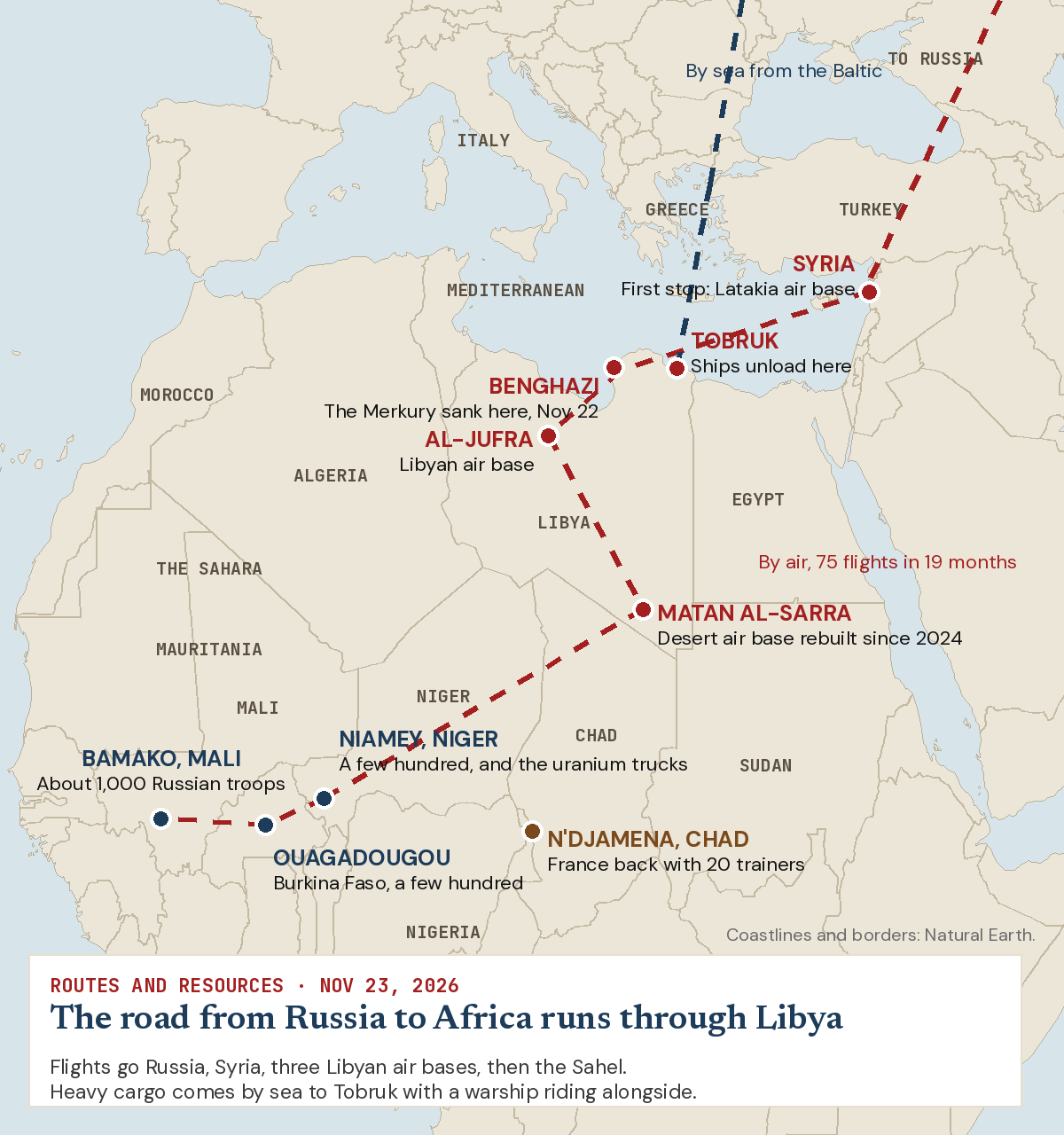
A Russian warship, the Merkury, blew up at its pier in Benghazi, Libya, on Sunday. What was it doing there? Guarding cargo ships, and the cargo was weapons for Russia’s other war, the one it’s fighting in the middle of Africa. That war isn’t a sideshow to the war in Ukraine, and the war in Ukraine isn’t really Ukraine’s alone. The countries that care about what happens in that harbor are the ones paying for Ukraine’s side: the United States, Britain, France, Germany, the rest of NATO. Ukraine can’t run a drone base on the far side of the Mediterranean by itself. Somebody lets it. The map below shows the road the weapons take. This note is about what’s at the other end of it, and why Russia cares.
Start with why. The first reason is money that sanctions can’t reach. Russia is cut off from Western banks, and gold doesn’t need one. In Mali, Sudan and the Central African Republic, Russian mercenaries guard the gold mines, take a cut, and fly the gold out to the Emirates, where it turns into money Moscow can spend on anything. One investigation put it at about two and a half billion dollars in the first two years of the Ukraine war. That’s the first thing Russia wants from Africa. The second is uranium: Niger has a thousand tons of it sitting on trucks at an air base, seized from the French company that mined it for fifty years, and Russia has been trying to buy it. The third is votes: fifty-four African countries sit at the United Nations, and a third of them abstained when the world voted to condemn the invasion. A few thousand mercenaries protecting a general is a cheap way to keep those votes. And the fourth is Libya itself: whoever holds its coast holds the migrant route to Italy, which Russia can open or close, and a foothold on the Mediterranean to replace the one it lost when Syria fell. Gold, uranium, votes and a coast. That’s why.
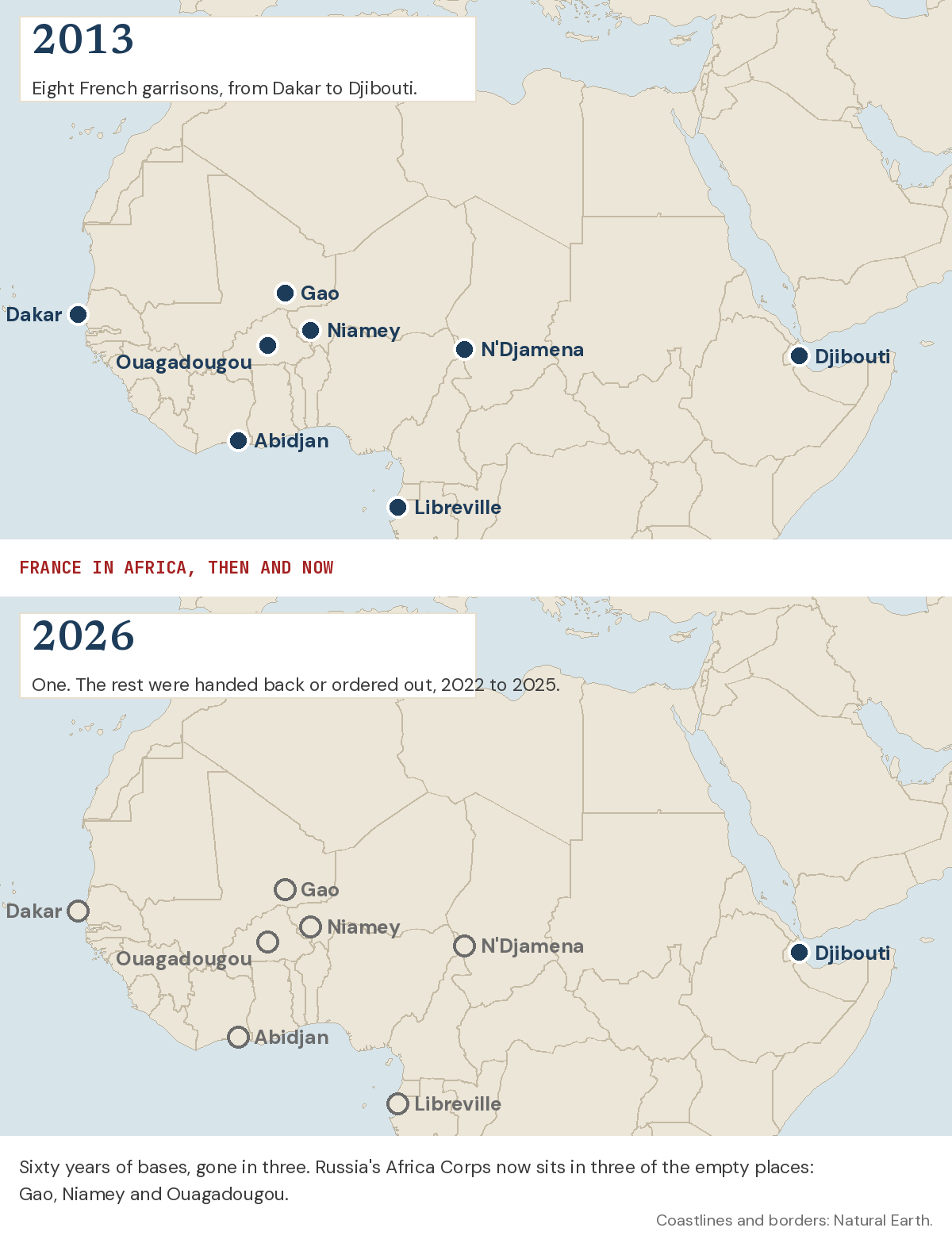
Now how Russia got in, because it didn’t walk into an empty room. The strip of dry country south of the Sahara is called the Sahel, and the countries there, Mali, Niger, Burkina Faso and Chad, were French colonies until 1960. Their governments, their courts and their schools run in French, because France built all three, and sixty years after independence France never really left. It kept soldiers and air bases there, ran their money through a currency printed in Paris, and sent in troops whenever a friendly government was in trouble. The French call that arrangement Françafrique, and in France the word is an accusation, not a boast. In 2013 France sent its army into Mali to drive out the jihadists who had taken the north, and it did. But it made a choice Malians never forgave: it let the Tuareg rebels who had marched in alongside the jihadists keep the northern town of Kidal, and kept Mali’s own army out. From then on, to a lot of people there, France looked less like a protector than like a foreign power deciding who won.
Then, between 2020 and 2023, soldiers took over the governments one after another, and every one of them told the French to leave, saying out loud that France had been in league with the jihadists all along. France denies it and nothing has ever proved it. But it’s what people there believe, and the crowds that cheered the coups waved Russian flags. Within three years France was out of all of them. For the first time since 1960 it has no base of its own anywhere in West or Central Africa.
Russia took the job, and it took it for the gold. The outfit it sent is worth a minute, because it’s the strangest army in this story. Wagner began as a private company, a mercenary army owned by a man named Yevgeny Prigozhin, who’d made his fortune cooking for the Kremlin. For years Russia could send Wagner anywhere and say it hadn’t sent anyone. Wagner guarded presidents, fought rebels, took its pay in gold and mining rights, and did things an army with a flag can’t: in 2022 the UN found that Mali’s soldiers and “foreign military personnel,” meaning Wagner, killed about five hundred people in one village in five days. Then in 2023 Prigozhin marched his men on Moscow, called it off, and died two months later when his plane fell out of the sky. The Defense Ministry kept the business. The same men work the same countries under a new name, the Africa Corps, and now they answer to the Russian state directly. About a thousand of them are in Mali, a few hundred each in Burkina Faso and Niger, and about a thousand in Libya. Getting men and weapons to the middle of Africa is the hard part, and that’s where Libya comes in. The flights run from Russia to Syria, then to Libyan air bases, including one deep in the desert that Russia has been rebuilding, then on to the Sahel. The heavy cargo comes by sea to the eastern Libyan port of Tobruk, with a warship riding alongside. That was the Merkury’s job, until Sunday.
And here’s the bridge back to the war you know. In the summer of 2024, Tuareg rebels ambushed a Russian column in the far north of Mali and killed dozens of Wagner men, the worst loss the mercenaries have ever taken in Africa, and Ukraine’s military intelligence said afterward that it had given the rebels what they needed. Mali broke off relations with Kyiv. Since last year Ukraine has had sea-drone crews in western Libya, hitting the Russian ships that feed the other side of the country. Be clear about what that means. A country fighting for its life at home doesn’t send drone crews to Africa on its own account. It gets there because the people paying for its war want Russia’s gold line cut too. The Associated Press has described the Libya arrangement as one with Western backing, the United States included, and the satellites, the intelligence and the money behind those boats are NATO’s. So Sunday wasn’t the war wandering into a strange new place. It was NATO’s side cutting the line that pays for Russia’s shells, with Ukrainian hands, at the one spot where the line touches the sea.
It isn’t going well for the Russians either. The jihadists they were hired to beat have taken a major northern town this year, killed Mali’s defense minister, and kept the capital under a fuel blockade on and off for more than a year, burning the tanker trucks that try to get through. The security the generals bought isn’t working.
Which is where France comes back in, quietly. I write a lot about the CIA. France has one too. It’s called the DGSE, and inside it sits a unit called the Service Action, the part that doesn’t collect information but does things: sabotage, rescues, snatches, the training of friendly armies and the quiet removal of unfriendly people. It’s the unit that sank the Greenpeace ship Rainbow Warrior in a New Zealand harbor in 1985. French-speaking Africa is where it’s always done most of its work, and the three juntas know it, which is why every Frenchman they catch is a spy. This year Mali convicted a Frenchman from the embassy as a spy, sentenced him to twenty years, and then pardoned him and put him on a plane after the king of Morocco intervened. Burkina Faso did the same with four French “computer technicians” a year earlier. And Chad, which threw France out two years ago, has let about twenty French soldiers back in to train its army and signed a new defense agreement in Paris last month. No bases. A foot in the door.
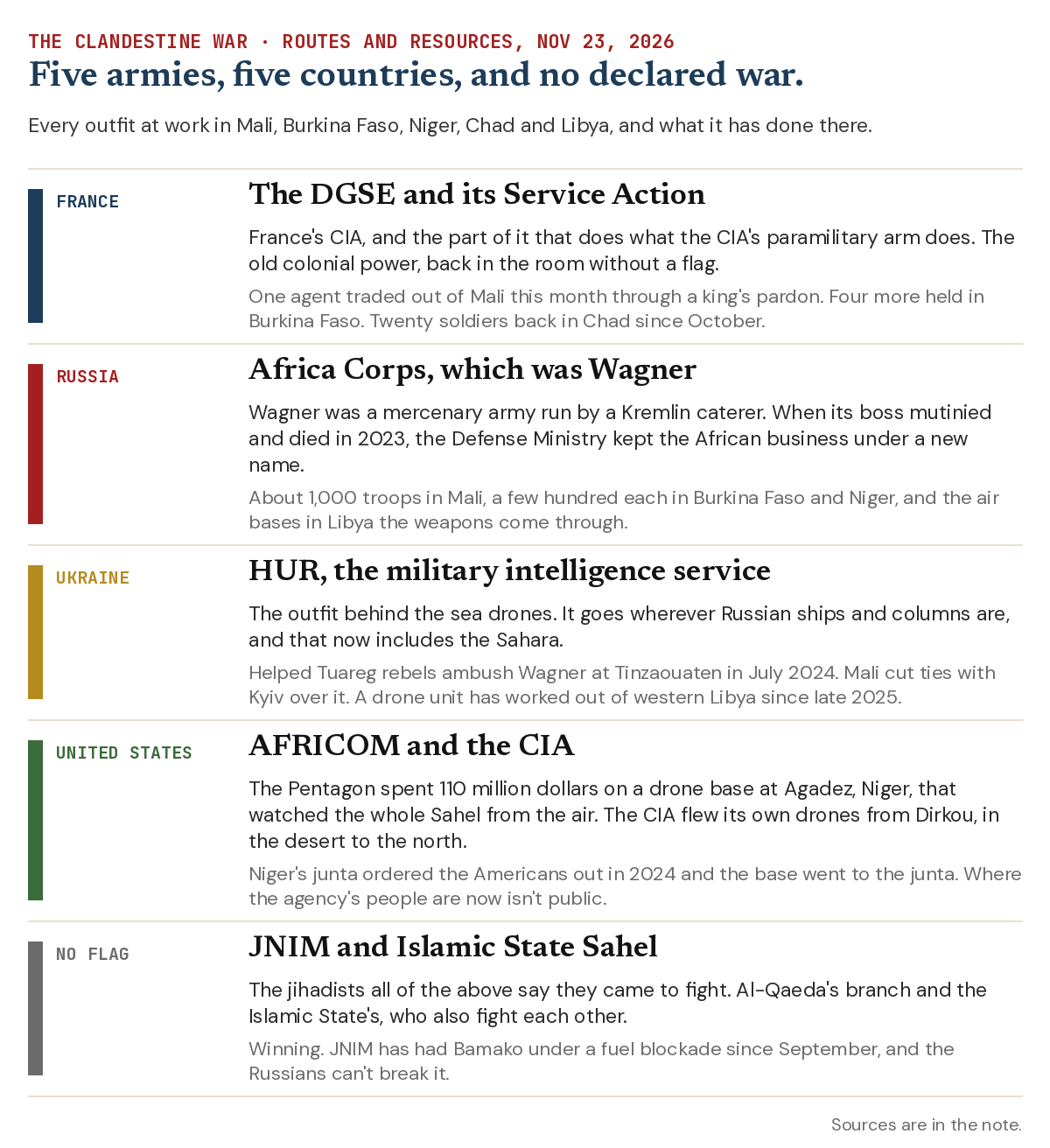
So here’s the shape of it. A region France ran for sixty years and lost in three. Generals who threw France out and hired Russia. Russia, there for gold, uranium, votes and a coast, supplying its men through Libya. Jihadists beating the Russians the way they beat the French. Ukraine reaching in to cut the supply line because the gold pays for the shells falling on Kyiv, and NATO behind Ukraine, because the line is Russia’s. And France, the whole time, working its way back in through the side door. We hear “Russia in Africa” the way we heard “Russia attacks a democracy” about Ukraine, as if the story started the day the Russians arrived. It didn’t. There was already a war in that room. Russia joined it, and NATO followed, with Ukraine out front.
That’s the route, and those are the resources. And that’s why a warship in a Libyan harbor is part of the war between Russia and NATO. Ukraine is where that war is fought. Africa is one of the places it’s paid for.
Sources (28), on the site.
Trump Puts Jensen Huang Back at Nvidia, and Wall Street Has Its Best Day Since April 2025
Eleven days after he resigned over reports of affairs, one with a woman the New York Times says has ties to Chinese intelligence, Jensen Huang is CEO and president of Nvidia again. The board announced it Monday morning, about an hour after Trump told a PBS reporter by phone that Huang “did absolutely nothing wrong” and had “certainly learned a lesson.” Trump said he had called the board “several times directly and indirectly,” and the board said it had input from senior levels of the government and saw no national security risk. Nvidia rose 31 percent, its biggest day since the dot-com era, and took the whole market with it: the S&P 500 gained 4.7 percent, the Nasdaq 6.5, and the VIX fell by a quarter. Hakeem Jeffries called the reinstatement “indefensible, irresponsible, and incomprehensible.” Huang has agreed to a public Senate Banking hearing next week.
| Nvidia: +31 percent, close to a trillion dollars of value back in a day |
| S&P 500: 7,237, +4.7 percent; Nasdaq 24,089, +6.5; Dow 49,598, +3.0 |
| VIX: 26.6, from 35.9 |
| Oil: WTI $80.17, lowest close since Aug 26, on Libya’s Sharara pipeline restarting and Gulf flows rising |
| The Fed: futures price a quarter-point hike on Dec 9 at about 96 percent |
| War: Day 269 |
NATO Sends an AWACS to Poland and Says Russia ‘Bears Full Responsibility’
After Monday’s extraordinary session of the North Atlantic Council, NATO said its supreme commander had authorized the forward deployment of an AWACS early-warning plane and was “examining the deployment of additional assets.” The ambassadors said Russia bears full responsibility for Friday’s missiles. Poland didn’t invoke Article 4; Deputy Defense Minister Paweł Zalewski said there was no need. Lublin prosecutors say the object found near Nowy Lipowiec is a Russian-made Kh-101 cruise missile built in the last quarter of this year, and that a Swedish Gripen pilot had clearance to shoot it down but couldn’t see it through the weather.
Iran Says Three More Tankers Hit Mines Under US Escort; Treasury Goes After the Exchange Houses
The IRGC said Monday that three tankers caught fire after striking mines, one near the southern coast and two in the eastern strait, and that “extensive U.S. military air cover and escort” had failed to prevent it. CENTCOM hasn’t responded, and nothing independent confirms it. The same day the Treasury sanctioned more than two dozen Iranian exchange houses, front companies and people it says run the regime’s shadow banking; Scott Bessent called it “the last financial lifeline of a bankrupt regime.” The Wall Street Journal reports Washington is investigating Iran as the prime suspect in cyberattacks on as many as 50 tankers.
Trump Uses the Justice Department to Go After Newsom; the Second Circuit Opens a Door on the Hush-Money Case
At the Justice Department on Monday Trump called Gavin Newsom’s commutation of California’s 548 death sentences “one of the most shocking acts of injustice our country has ever seen” and said the department was working to get it “overturned in some form,” without saying how; victims’ relatives spoke from the same lectern. Newsom answered that every one of them “will die in prison.” Hours earlier a Second Circuit panel revived Trump’s bid to move his 34-count New York conviction into federal court, where he can argue immunity, and told the district judge to rule promptly.
Dymer’s Toll Is 11 with 11 Still Unreachable; Zelensky Asks Why the Patriots Are Late
Rescuers in Dymer, 45 kilometers north of Kyiv, were still searching Monday for 11 people, two of them children, who were “not responding or cannot be reached” under the five-story building a drone brought down overnight; the regional toll was at least 15. In Kryvyi Rih the governor put the weekend’s dead at 11. Zelensky wrote that it’s “particularly difficult to understand the delays” from the United States on anti-ballistic interceptors.
Kakko Wins It with 2:25 Left; Kraken 3, Ducks 2
A scoreless game through two became a third-period trade: Ben Meyers and Vince Dunn each put Seattle ahead, Cutter Gauthier and Sam Colangelo each tied it, and Kaapo Kakko scored at 17:35 for the winner at Climate Pledge on Monday night. The Kraken are 11–9–1.
| Read the full dispatch |
You’re receiving The Late Night Pour, an edition of Four Fingers News.
History you haven’t heard yet, poured nightly. Pass the bottle.
Forward this to the most curious person you know.