The Late Night Pour | The Island
|
Four Fingers News
The News, Neat.
|
| SATURDAY, NOVEMBER 21, 2026 · DAY 267 |
| The Late Night Pour |
The Island
The Island, read aloud · 11 minutes.
There’s an island in the Persian Gulf, 124 miles from Iran, whose people have been asked only once, in the spring of 1970, what country they wanted to belong to. Everything that happened to it this week comes back to that.
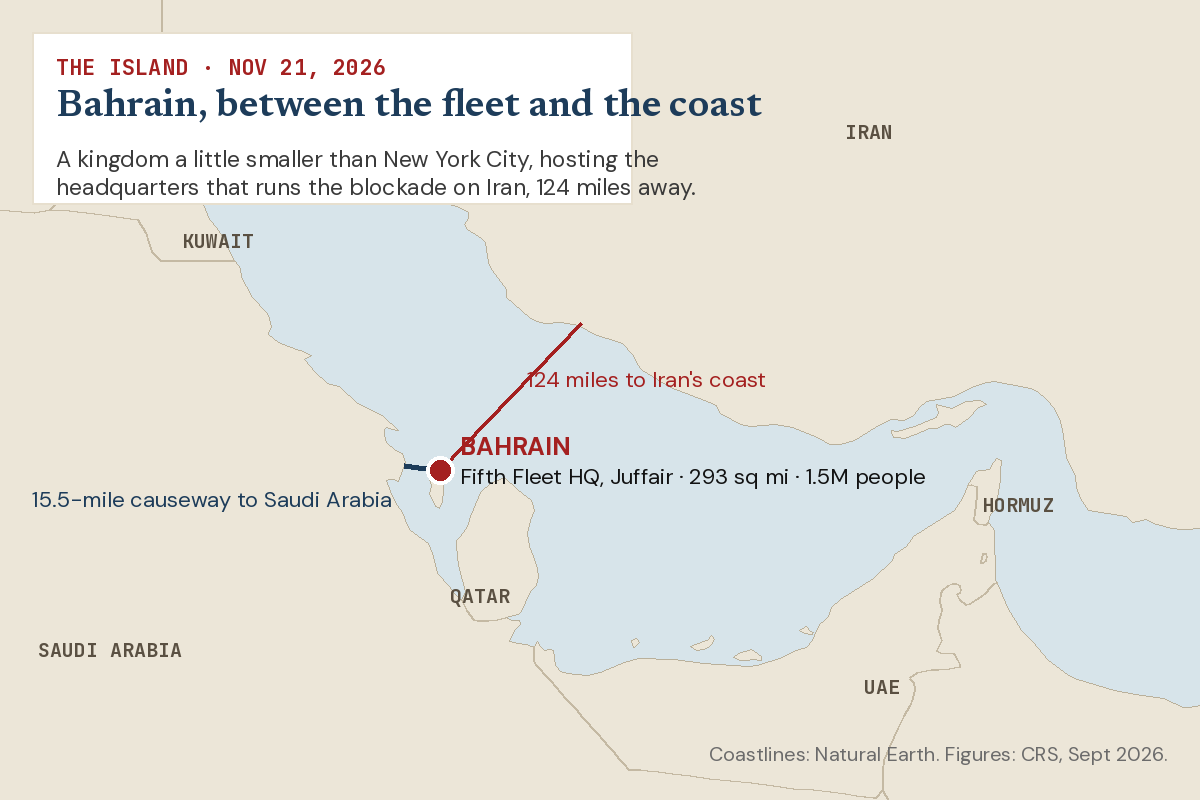
The island is Bahrain. It’s small, a little smaller than New York City, with 1.5 million people, about half of them citizens. Most of those citizens are Shia Muslims. That matters because Shia and Sunni are the two main branches of Islam, Iran is run by Shia clerics, and the family that rules Bahrain, the Al Khalifa, is Sunni. The king is Hamad bin Isa Al Khalifa, 76, who has ruled since 1999. His son Salman, the crown prince, runs the government day to day as prime minister. A Sunni family has ruled a Shia island since 1783, when it took the place from Persia, which is what Iran was called then. A family that rules over a majority of a different faith needs a protector. For a century that was Britain. When Britain ran out of money and empire and announced in 1968 that it was leaving the Gulf, the family needed a new one. The Americans were already there. The US Navy had kept a small command on the British base at Juffair, on the capital’s waterfront, since 1949. In 1971 the new country leased them part of it. The base is small, about 268 acres. What the Navy wanted was the spot, a deep harbor in the middle of the Gulf, next door to Saudi Arabia’s oil fields, in a country whose rulers would always say yes. What the rulers wanted was a guarantee. After the 1991 Gulf War the two signed a defense pact, and in 1995 the Navy named its command there the Fifth Fleet. That’s the bargain the island has lived under for 77 years: the family gets protection, the Americans get the harbor, and the people who live there weren’t asked. It only works with a ruler who needs the protection more than he needs his own people’s consent. A government that answered to the island’s majority might have said no to the harbor in 1971, or to the blockade this year. The Navy has never had to find out.
Iran never fully accepted that the island was gone. In 1957 the Shah, Iran’s king, declared Bahrain Iran’s fourteenth province and kept seats for it in his parliament. But by 1970 Britain was leaving the Gulf, and the Shah wanted two things more than Bahrain. He wanted to be the strongest power in the Gulf after the British left, without a quarrel with every Arab state over an island he didn’t hold. And he wanted three small islands at the mouth of the Gulf, Abu Musa and the two Tunbs, which his troops took in November 1971 as the British left. Many in the region believe the two were a trade; no document says so. So he agreed to let the United Nations ask Bahrainis what they wanted. The UN’s envoy spent three weeks on the island asking. The answer was that they wanted their own country. On May 11, 1970, the UN Security Council approved it with no vote against, Iran’s parliament accepted it, and on Aug 15, 1971, Bahrain became a country. It’s the only time in the island’s history that anyone asked its people a question and then did what they said.
The claim came back with the revolution. In 1979 the clerics took power in Iran. One of them said the Shah had no right to give Bahrain away, and the idea has stayed alive in Iran ever since. This year it came back in print. Kayhan is a hardline newspaper in Tehran. Its editor, Hossein Shariatmadari, is chosen by the office of Iran’s supreme leader, the cleric who has the final say in Iran, so what he writes is a fair guide to what the hardliners near the top are thinking. In April he wrote that Bahrain belongs to Iran and that its people want to join. In June he wrote that “our Bahraini compatriots” shouldn’t be kept waiting. On Oct 24 he wrote: “When the time comes, we will take it back.”
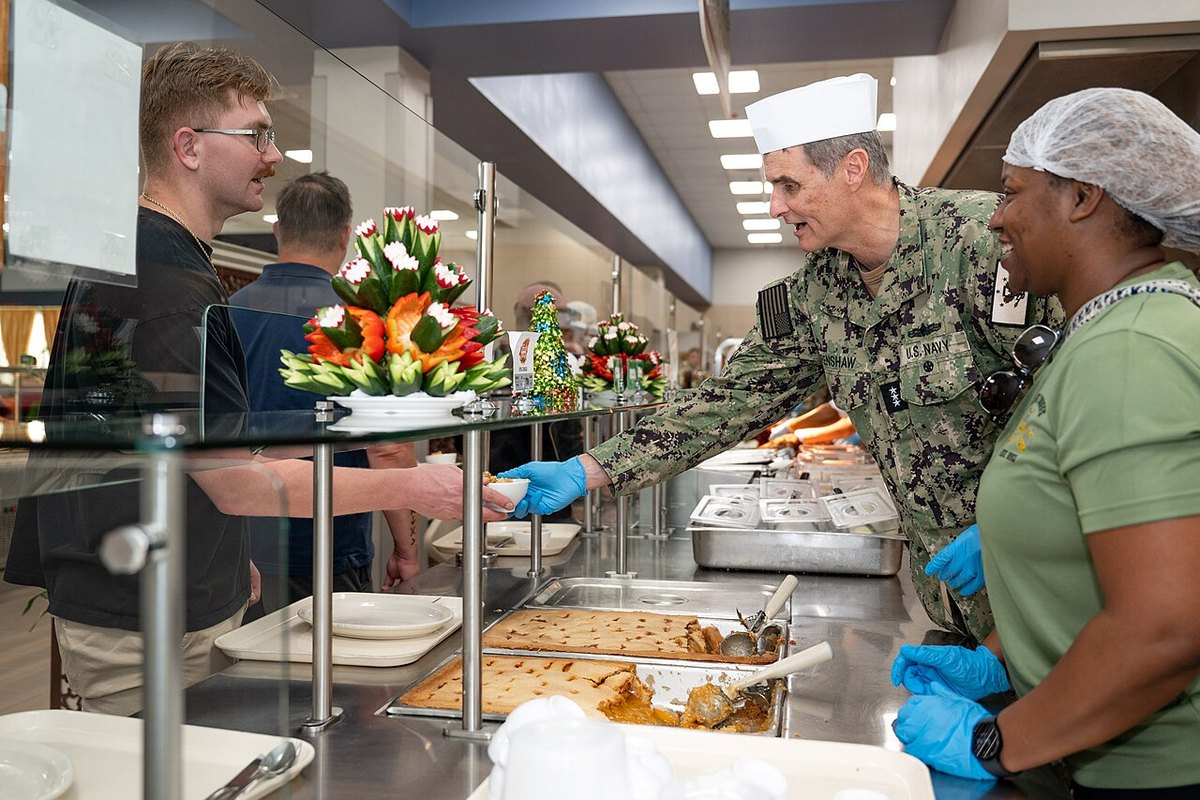
Then the war came to the island, because the island is where the fleet lives. On Feb 28, the first day, Iranian missiles and drones got through to Juffair and hit the fleet’s command building, two satellite dishes, the warehouses and a dozen other buildings. An official told Congress’s own researchers the base “was nearly destroyed.” The Navy’s acting secretary, Hung Cao, said in September that Iran “blew the hell out of Bahrain.” The Navy’s top admiral, Daryl Caudle, told sailors on Aug 31: “We’re not getting back in there anytime soon.” Repairs will cost at least $400 million. Here’s what that means. The base was the fleet’s home port and its warehouse, the place ships came to refuel, rearm and fix what broke. Now carriers and supply ships can’t use it, and the Navy runs its supplies through Diego Garcia, an island 2,200 miles away in the Indian Ocean. The sailors who ran the headquarters were flown out to Florida. Before the war about 8,300 American sailors, civilians and their families lived on the island. On Mar 2 the State Department ordered the families out, and about 1,300 wives, husbands and children left for hotels and short-term rentals in Europe and then America, where most of them still are, without their furniture. By law an order like that can last only 180 days, so it ran out on Aug 25 with the war still on and the base still broken, and nobody could tell the families what came next. Vice Adm. Curt Renshaw, who commands the Fifth Fleet, told them the Navy was “making it up as we go because nothing is conceived to go on this length of time.” The Pentagon has given them until Nov 30, nine days from tonight, to pick a new home base or take an allowance for living apart. So what America has on the island right now is a wrecked base, a flag, and a blockade run from ships at sea. The blockade is the one job the fleet still does from Bahrain: since April it has stopped Iran’s oil from leaving by sea. The protector can’t protect its own headquarters, and it’s still using the island to cut off the neighbor’s oil. Iran’s answer has been to make the island pay: the oil refinery hit, the aluminum smelter hit, a water plant hit, Amazon’s data center hit, a tanker in dry dock hit and a worker on it killed, and its Formula 1 race, the same series that raced on the Las Vegas Strip tonight, taken away. Bahrain has hosted a Grand Prix every year since 2004; this year it ran in Malaysia, under Bahrain’s name, because nobody would race on an island under fire. Iran’s foreign ministry says Bahrain bears “direct and clear responsibility” for American attacks launched from its soil. Bahrain’s government says it “rejects the use of its territory to settle accounts,” and it went to the UN Security Council and won a resolution condemning the strikes. Both are describing the same fact. The island lends its harbor to a war on its neighbor, and its neighbor has told it what that costs.
Here’s where the royal family’s oldest fear comes in. When a Shia power is bombing the island, a Sunni king worries that his Shia majority might side with it. He has reason to remember 2011. That spring, crowds, most of them Shia, camped for a month at the Pearl Roundabout, a traffic circle in the capital with a monument in the middle, and asked for a say in how they were governed. On Mar 14, 2011, about 1,000 Saudi soldiers drove across the 15-mile bridge from Saudi Arabia, whose own oil province next door has a large Shia population, and whose rulers didn’t want a Shia uprising to succeed 15 miles from it. Four days later the government bulldozed the monument. The king then appointed a panel of international judges to look into what his forces had done, and in November 2011 it reported that they had used torture, systematically, and that people had died in custody. He accepted the report, and the crackdown went on. Washington’s answer was to keep the fleet where it was, and in 2017 to drop the human rights conditions on selling him 19 F-16 fighter jets. That’s the kind of ruler the bargain needs, and both sides know it. In 2016 a court shut down the main Shia opposition party. And on Monday of this week, with the island under fire, a Bahraini court sentenced 64 people, most of them Shia clerics, to life in prison, and five more to 15 years, for plotting with Iran’s Revolutionary Guards, the most powerful part of Iran’s military, to overthrow the government. Prosecutors said the men had used the mosques to spread Iran’s idea that clerics should run the state. One of the 64 is Sheikh Isa Qassim, the most senior Shia cleric on the island, who was stripped of his citizenship in 2016, has lived in Qom, a holy city in Iran, since 2018, and was tried without being there. Human rights groups say some of the confessions were forced by torture. That’s the royal family’s answer to the general: the clerics he says it’s pushing around are in prison.
Two days later Iran answered. On Wednesday, Nov 18, 2026, a Revolutionary Guards general, Hossein Mohebbi, said that the survival of Bahrain’s royal family “under the new regional security order will be in doubt” if it kept on as it has. He named three things: helping the attacks on Iran, living inside America’s protection, and pushing around its own Shia clergy. Three days after that, on Saturday night, the Guards hit the island for the fourth time in nine days. He wasn’t talking about a radar. He was talking about whether Bahrain keeps existing as a country.
So the question is the one from 1970, back again. Is this island a country or a province of Iran? That year the people who live there gave the answer, and Iran accepted it. This year Iran’s newspaper says the island will be taken back when the time comes, Iran’s general says the royal family may not survive, the royal family has put its own clergy in prison, and the American fleet that’s supposed to protect the island has been bombed off its own base and runs the war from the sea. Nobody has asked the people of Bahrain, and nobody will, because the whole arrangement depends on not asking. The one time anybody did, they said they wanted a country, and they got one.
Sources (31), on the site.
Three Tankers Hit in a Day as Qatar Carries Messages and Trump Asks for ‘Permanent’
UKMTO logged two tankers struck by projectiles while leaving the Gulf early Saturday, one in the stern about 13 miles north of Khasab and one in the engine room 20 miles east of the port, with no one hurt, and Iran’s navy said a third, sailing dark through a restricted zone east of the strait, hit a mine before noon and burned. State media called the night’s operations the most “intense and varied” of the war. On the other track, Deputy Foreign Minister Kazem Gharibabadi said a Qatari delegation spent two hours in Tehran on Friday evening, and Foreign Minister Abbas Araghchi said the talks “must be given a chance” while calling any discussion of reopening Hormuz “pointless” until Iran’s conditions are met. Trump, by phone to Fox News, said he wants a deal that holds even if “an incompetent president” follows him in four, 15 or 20 years, and that he’s “taken out two regimes already.” CENTCOM said Iran “did not attack a US F-16 fighter aircraft yesterday—at all.”
| The count: Iran’s armed forces claim about 25 incidents in the strait since last Saturday, roughly three a day |
| Kharg: More than 14 loaded tankers wait at the terminal for a convoy run at the blockade; one cargo has already moved ship to ship with transponders off |
| The rule: CENTCOM says vessels that bypass the blockade can be stopped, boarded or seized, ship-to-ship transfers included |
| Trump’s terms: “We make a deal and then they break the deal the next day”; on Thursday he called new strikes “quite unlikely” before the new year |
| Senate: The House-passed war powers resolution failed 48–51 on Thursday; the funding bill is due Dec 11 |
| War: Day 267 |
Drones Set a Russian Freighter Burning in the Gulf of Finland
Two drones hit the Sparta II, a 121-meter Russian cargo ship bound from St. Petersburg to Kaliningrad, west of Gogland island on Saturday; the 16 crew took to lifeboats and were picked up by another Russian ship, and the burning hull drifted into Finnish waters. Finland said Ukraine most likely did it and closed the eastern gulf to civilian flights and small craft for now. Prime Minister Petteri Orpo said Ukraine has the right to fight the aggressor; Estonia’s prime minister said the war’s consequences have reached the Baltic. Kaliningrad’s governor said supplies to the exclave aren’t threatened.
Trump Calls the Missiles in Poland ‘a Mistake’; Tusk Says No, and Asks for F-35s
Two Kh-101 cruise missiles and a jet-powered drone came down in southeastern Poland during Friday’s barrage on Ukraine, nobody hurt, and Trump told Fox News Putin had sent “a couple of little missiles, by mistake.” Tusk, who called it “an intentional provocation,” answered that Putin “is not and never will be our friend,” and Warsaw asked NATO for more F-35s and AWACS radar planes under Eastern Sentry without invoking Article 4. American officials have access to the wreckage. Moscow hasn’t commented.
COP31 Overruns Its Deadline on a Text That Never Says ‘Oil’
The climate summit in Türkiye blew through Friday’s deadline and reconvenes Sunday morning to adopt a 10-page draft that, by AP’s count, uses none of the words “fossil,” “oil,” “coal” or “phase out,” three years after Dubai first wrote “fossil fuels” into a UN climate deal. President Murat Kurum says the language keeps faith with Dubai and that the text covers adaptation money, electrification, methane and a billion-ton carbon-capture goal. With delegates leaving, the two-thirds quorum is the open question.
Masked ICE Agents Pull Two Passengers Off a Jet Bridge; Ferguson Says ‘Out of Control’
Video from Saturday morning shows a woman and a man seated on the jet bridge of an Alaska Airlines flight to Los Angeles at the feet of two masked agents, the woman saying “We have a work permit.” The Port of Seattle said the operation happened “without the Port’s participation or knowledge” and is asking DHS whether its protocols were breached; Alaska said it hadn’t known. Governor Ferguson called ICE “completely and totally out of control,” Attorney General Nick Brown spoke of agents “vanishing people out of thin air,” and Patty Murray said she’s demanding answers from DHS. ICE hasn’t said who the two are.
The Penny Is Law-Dead; Cash Rounds to the Nickel, Cards Don’t
Lost under Friday’s Nvidia news: Trump signed the Common Cents Act, ending the coin after 233 years. Each penny cost 3.69 cents to make, the Mint stopped striking them last year, and the roughly 114 billion in circulation stay legal tender. Cash totals now round to the nearest five cents while card payments stay to the cent, so the same coffee has two prices. The law also lets Treasury make a cheaper nickel.
Huskies Stun No. 8 Indiana in Overtime; Verstappen Wins on the Strip; Kraken Fall in San Jose
Tyler Robles’ 46-yard field goal in overtime beat the Hoosiers 27–24 on Senior Day at Husky Stadium; Washington (7–4) closes at Oregon on Nov 28. In San Jose the Kraken fell 4–3 to the Sharks; Seattle is 10–9–1. In Las Vegas, Max Verstappen won Saturday night’s Grand Prix on the Strip by six tenths over Lando Norris, with Oscar Piastri third; Kimi Antonelli, fourth, still leads the championship by 98 points. Bahrain’s own Grand Prix, run since 2004, went to Malaysia this year.
| Read the full dispatch |
You’re receiving The Late Night Pour, an edition of Four Fingers News.
History you haven’t heard yet, poured nightly. Pass the bottle.
Forward this to the most curious person you know.