Helium 10 vs Sellics: Which Tool Actually Pays for Itself?
If you searched "helium 10 vs sellics," you're trying to pick the tool that will run your Amazon business, and you'd rather not spend a month finding out you picked wrong. So here is the short version first, then the long one.
Sellics, as most sellers remember it, is gone. The company was folded into Perpetua in 2022, sellics.com now redirects to perpetua.io, and Perpetua is built around advertising. Helium 10 is still the all-in-one suite: product research, keyword research, listing tools, ads, profit tracking, inventory, refunds and training under one login. If you wanted what Sellics used to be, Helium 10 is where that job gets done today, and the Diamond plan is the version with nothing held back.
I'm an affiliate for Helium 10, and I'll say so plainly. I'm also a user. The product research helps a lot, the information is up to date, customer care has been good, and for me the benefit outweighs the price. Whether that holds for you is the real question, so I'll go through the numbers further down.
One thing first, because it changes what you pay. The link in this article gives you 30% off the Diamond plan. If you'd rather use a code, FLEXOBA20 gives 20% off for 6 months and FLEXOBA10 gives 10% off for life. Black Friday is a few weeks away, and there's a full section on why this is the right moment to start.
Helium 10 discount, quick reference
- Affiliate link: 30% off the Diamond plan, applied when you click through
- Code FLEXOBA20: 20% off for 6 months
- Code FLEXOBA10: 10% off for life
- Plan this article recommends: Diamond
- How to stop: don't renew
What happened to Sellics
Sellics started in Berlin in 2014 as an Amazon seller platform. It covered PPC automation, keyword rank tracking, review monitoring, inventory and a profit dashboard, and for a few years it was one of the names sellers used when they said "all-in-one."
In April 2022, Perpetua announced that Sellics was joining it following Ascential's acquisition. The Sellics brand was retired. A check of sellics.com in September 2026 by the analytics firm Novadata returned a permanent redirect to perpetua.io.
Perpetua is a real company with a real product, but its product is advertising automation and retail media. Jarvio, a company that publishes a Sellics alternatives page, says the profit dashboard, SEO tools, review monitoring and competitor tracking from Sellics didn't carry over into Perpetua. Revenue Geeks, which reviews seller software, gives the buying advice I'd give: choose Perpetua for dedicated ad automation, choose Helium 10 if you wanted the old Sellics all-in-one suite.
That's the first thing most "Helium 10 vs Sellics" articles miss. They line up feature lists from years ago as if both tools were still on the shelf. Only one of them is, at least in the form people remember.
What Sellics did well
It deserves a fair hearing, because the people still searching for it had reasons.
Its Cockpit dashboard put sales, account health and key numbers on one screen. The review manager was well regarded. Inventory connected straight to Seller Central. The PPC automation was the strongest part of the product, and that part survives today as Perpetua. Reviews from its active years also called it a little pricey and noted that data could take a while to load.
So if your only problem is a large ad budget that needs automation, Perpetua is worth a look. But most sellers don't have only that problem. They have a product to find, keywords to choose, a listing to write, ads to run, margins to watch and a team to train. That's a suite problem, and it's the one Helium 10 was built around.
Helium 10 vs Sellics, job by job
Since Sellics is now Perpetua, the honest comparison is Helium 10 against what Sellics became, with a nod to what it used to offer.
- Product research: Perpetua doesn't offer it, according to Jarvio. Helium 10 has Black Box, Xray, the Chrome extension and Product Launchpad.
- Keyword research: Not part of Perpetua. Helium 10 has Cerebro, Magnet and Keyword Tracker.
- Listing tools: Not offered by Perpetua. Helium 10 has Listing Analyzer and, on Diamond, the AI Listing Builder.
- Advertising: This is Perpetua's core product. Helium 10 answers with Helium 10 Ads on the Diamond plan.
- Profit tracking: Dropped from the old Sellics set. Helium 10 has Profits and the Insights Dashboard.
- Competitor tracking: Also dropped. Helium 10 has Market Tracker.
- Reviews and follow-up: Dropped. Helium 10 has Seller Assistant and Follow-Up.
- Refund recovery: Not offered by Perpetua. Helium 10 has the Managed Refund Service.
- Training: Nothing bundled with Perpetua. Helium 10 has Freedom Ticket, the Academy and, on Diamond, the Amazon PPC Academy.
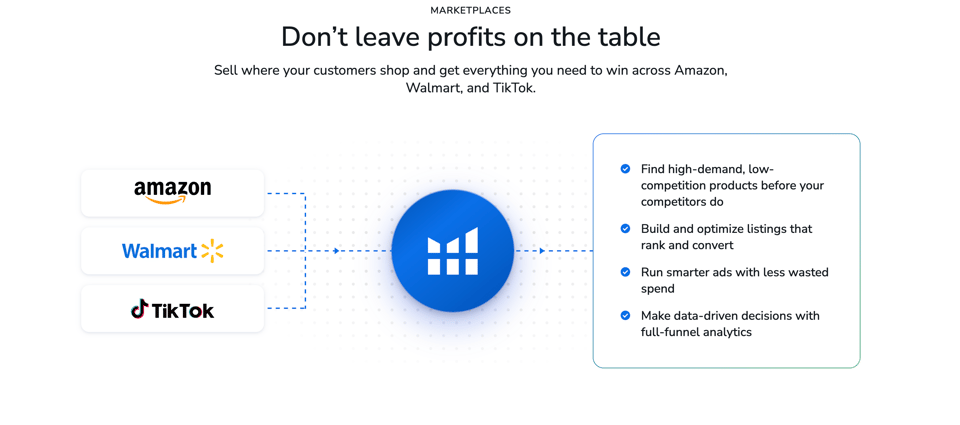
- Marketplaces: Perpetua is focused on retail media. Helium 10 supports Amazon, Walmart and TikTok Shop.
Read down the Helium 10 side and you can see why people call it a suite. Read down the other and you see a specialist. A specialist is fine when you've already solved everything around it. Most sellers haven't.
Product research: where Helium 10 earns its place
Every Amazon business starts with the same decision, which product to sell, and it's the decision that's hardest to undo. Once you've placed an inventory order, a bad choice is paid for in cash.
Helium 10 handles this with three tools that work together. Black Box lets you search the Amazon catalog by filters like price range, estimated revenue, review count and competition, so you can look for gaps instead of guessing. Xray works on the Amazon results page itself through the Chrome extension, and shows sales estimates, revenue, pricing and review numbers for every listing without leaving the page. Product Launchpad then holds the ideas you shortlist so your research doesn't scatter across spreadsheets.
This is the part of Helium 10 that I lean on most, and it's where accuracy matters. Helium 10 describes its own tracking and estimates as among the most accurate available, and in my experience the data is current enough to base a decision on. That matters more than it sounds. A research tool that lags the market by a few weeks can show you a niche that was open and is now crowded.
Sellics never had a product research engine at this level, and Perpetua doesn't try to. If product selection is where your risk sits, and for most new sellers it is, this one section is reason enough to pick Helium 10.
Keyword research and listings
Finding a product is half of it. Amazon is a search engine, and a good product with a badly indexed listing sits where no one finds it.
Cerebro is the tool most people name when they talk about Helium 10 keywords. You enter a competitor's ASIN and it shows the terms that listing ranks for, with search volume and how strong the competition is. On the Diamond plan, Cerebro also gives you historical keyword data, which lets you line up ranking changes against sales trends. That's the difference between knowing a keyword is popular and knowing whether it moved a competitor's sales.
Keyword Tracker follows your rankings over time. Diamond tracks up to 2,500 keywords, compared with 500 on Platinum, which matters once you have several products and several markets to watch.
For the listing itself there's Listing Analyzer, which scores what you've written, and Listing Builder, the AI-assisted tool that Helium 10 lists as Diamond only. You feed it your keywords and product details and it drafts an Amazon-native listing you can edit. Drafting titles, bullets and descriptions by hand for each product is slow work, and anyone with more than two or three products feels that quickly.
Add the Search Query Analyzer, which monitors the search terms customers use to reach your brand, and you've covered research, ranking and copy in one place. Sellics had a keyword tool in its day. It never had this chain connected from the first idea to the live listing.
Advertising
Ads are where many sellers lose money quietly. A campaign runs, spend climbs, and nobody can tell which keywords are earning it.
Helium 10 Ads is the PPC tool inside the platform, and it's on the Diamond plan. Helium 10 describes it as using AI-driven insights alongside rules-based advertising to optimize campaigns. In plain terms, you set goals and rules, and the system adjusts bids and targeting instead of you doing it by hand every morning. Helium 10's own customer story about the brand Hemlock Park claims the company saves more than 15 hours a week with the Ads automation. That's a vendor's case study, so treat the number as a claim, but the direction is believable: manual PPC is a time sink.
Diamond also includes the Amazon PPC Academy, which teaches the strategy behind the tool. That pairing is rare. A tool that automates ads without teaching you what it's doing leaves you dependent. Here you learn the reasoning while the software does the repetitive work.
Perpetua is a serious ads product and I won't pretend otherwise. If you spend heavily and want only ads, it's a fair choice. But you'd still need separate tools for research, keywords, listings and profit, which means separate subscriptions, separate logins and data that doesn't talk to each other. In Helium 10 the ad data sits next to everything else you track.
One honest cost note: Revenue Geeks flags a management fee on Helium 10 Ads, and one pricing breakdown puts it at 2% of managed ad spend on Diamond. Check the current terms at checkout. At typical budgets it's small next to the hours it saves, but you should know it exists before you start.
Profit, inventory, refunds and alerts
The less glamorous tools are the ones that protect margin.
Profits shows revenue, fees and costs so you can see what you actually keep per product. Many sellers find out too late that a bestseller barely breaks even. Inventory Management forecasts stock so you don't run out during a good week, and stockouts do real damage because ranking drops when you vanish from the shelf. Alerts tell you when a listing changes, a competitor moves price, or something breaks.
Then there's the Managed Refund Service. Amazon owes sellers money for lost or damaged inventory more often than people realize, and claims are tedious to file. Helium 10 files them for you and bills a share of what it recovers. Platinum pays 15%. Revenue Geeks reports that Diamond pays 10%, which is a better rate for the plan that's likelier to be moving more stock. Ask yourself how many units a year you'd write off without checking. Even a modest recovery covers part of your subscription.
Market Tracker and the Insights Dashboard sit on top of all this. You follow competitors and markets and see your own sales in one view. This is the ground Sellics was good at in its Cockpit days, and Helium 10 covers it while adding the research tools Sellics didn't have.
Data freshness, support and learning
Two things decide whether a tool is worth keeping beyond the first month: whether the numbers can be trusted, and whether someone helps when something breaks.
On the numbers, I've found the Helium 10 data up to date, which is what I care about when a purchase order depends on it. On support, I've had good customer care. That's my experience, and I'll be straight that other users have reported different ones, which I cover below.
The learning side is where Helium 10 is hard to match. Freedom Ticket is its training course for new sellers. The Academy teaches the software. The Serious Sellers Podcast, hosted by Helium 10's VP of Education and Strategy Bradley Sutton, covers tactics. Diamond adds Exit Ticket, the Amazon PPC Academy and weekly office hours with a customer support manager, where you can bring questions about Amazon and Helium 10. A seller who has someone to ask moves faster than one reading forum threads at midnight.
Helium 10 also reports more than 2,000,000 sellers on the platform. That's its own figure, so weigh it accordingly, but a tool with that user base has a lot of people finding and reporting its problems, which tends to get them fixed.
And the product keeps moving. Helium 10 now has Helium, an AI agent inside the platform that it says diagnoses problems, surfaces opportunities and recommends your next move. It supports Walmart and TikTok Shop alongside Amazon. Sellics stopped in 2022. A tool that's still being built tends to beat one that's been folded away.
Where people criticize Helium 10, and what has changed
You should hear the complaints before you buy, and you should hear them from me, not find them later.
The learning curve
It's real. Helium 10's own comparison page admits the platform takes time to master and isn't always intuitive on day one. It has a lot of tools, and the first week can feel crowded. What has improved is the amount of help built around that. There's the Academy, the AI Hub for sellers, the Helium agent, the course library and, on Diamond, the weekly office hours. The tool is still big, but you're no longer left alone with it.
The price
Helium 10 raised prices in April 2026, according to several pricing guides. Revenue Geeks notes the increases came alongside new AI ad tools and TikTok Shop support. You can disagree about whether that's a fair trade. My view is that the right test is whether the plan earns more than it costs, which I walk through below, and that a discount on the plan changes the answer a lot.
Billing
On Capterra, one reviewer in January 2026 gave Helium 10 a low rating, saying support acknowledged an overcharge but didn't credit it. I can't verify that case, and it's one voice. But it's a reason to take two habits seriously: check your billing page after you sign up, and set a reminder before each renewal date. If Helium 10 isn't earning its place for you, don't renew. That's the simplest exit, and it needs nothing from anyone.
None of these changes my view of the product. They change how I'd buy it: knowing what's expected of me, with the billing dates on my calendar.
Why Diamond is the plan to start with
Here's the argument I most want you to hear. Most new sellers go for the cheaper plan first, planning to upgrade later. I'd skip that step, and here's why.
Higher limits from day one
Platinum gives you 250 uses each of Cerebro and Magnet. Diamond gives you 500. Platinum tracks 500 keywords. Diamond tracks 2,500. In your first month you'll burn through uses faster than you expect, because research is where you go wide. Nothing is more frustrating than hitting a cap the week you're closest to a decision.
Ads built in
Helium 10 lists Helium 10 Ads under Diamond. If you plan to run Amazon PPC at all, and almost every seller does, you want it from the start, not bolted on after your launch has already burned money.
The AI Listing Builder
The AI-assisted Listing Builder is a Diamond feature. Writing a listing from scratch is one of the most tedious parts of launching, and doing it with data from your keyword research is how you start with a listing that's built to rank.
Historical keyword data
Cerebro's historical data on Diamond tells you how keyword performance has moved over time and how it lined up with sales. That's context you can't get by looking at a keyword's current number.
People and learning
Diamond includes 5 multi-user logins, so a partner, a VA or a team member can work in the same account. It includes Exit Ticket, the Amazon PPC Academy and the office hours. A new seller gets help with the thing they know least.
Better refund terms
The recovery fee reportedly drops from 15% to 10%. If you're moving stock, that's money back.
Platinum versus Diamond at a glance
- Cerebro and Magnet uses: 250 each on Platinum, 500 each on Diamond
- Keywords tracked: 500 on Platinum, 2,500 on Diamond
- Helium 10 Ads: listed under Diamond
- AI Listing Builder: Diamond only
- Historical Cerebro data: Diamond
- Multi-user logins: 5 on Diamond
- Courses: Freedom Ticket on Platinum, with Exit Ticket and Amazon PPC Academy added on Diamond
- Support office hours: weekly on Diamond
- Managed Refund Service fee: 15% on Platinum, 10% on Diamond according to Revenue Geeks
Why not upgrade later
There's a practical reason too. Switching plans in the middle of a launch is a bad time to be setting things up. If you start on Diamond, you build your keyword tracking, your ad rules and your listings once, on the plan that will carry them. You're not rebuilding at the moment you most need to be selling.
It also settles a question that quietly costs sellers money, the "am I allowed to do this on my plan" question. On Diamond you stop checking whether a feature is included and spend the time on the business instead.
Does Diamond pay for itself? The math
Helium 10's official pricing page lists Diamond at $359 a month, or $279 a month billed annually. Platinum is $129 monthly or $99 billed annually.
Thirty percent off $279 comes to about $195 a month. Twenty percent off is about $223. Ten percent off is about $251. These figures assume the discount applies to the $279 rate, and the checkout page shows the exact number you'll pay.
About $195 a month is roughly $6.50 a day. Put that next to what the same tool is protecting. Say you place a first order of 500 units at $6 each. That's $3,000 before shipping and fees. A product research mistake on that order costs more than a year of Diamond at the discounted rate. A listing that doesn't rank, or an ad campaign that burns through $40 a day without a single sale, does damage that adds up quickly.
I'll put it the way I think about it. If you're serious about selling on Amazon, a monthly cost like this is small next to what it protects, and it shouldn't be the thing that stops you earning. If the number is the only obstacle, the discount on this page removes a good part of it. If you try it for a few weeks and it isn't earning its place, don't renew and you're out of it.
Which discount to pick
Now the code comparison, because it's simple arithmetic. FLEXOBA20 gives 20% for 6 months, which is the equivalent of 120% of one month's price saved. FLEXOBA10 gives 10% for life, and over 12 months that's also 120% of a month saved. They break even at 12 months.
- Staying under a year: FLEXOBA20 saves more.
- Staying longer than a year: FLEXOBA10 wins every month after the first 12.
- Want the biggest percentage: the 30% Diamond link is higher than either code, so start there and use a code only if you'd rather have one of those terms.
Black Friday: the best time to start, and why on Diamond
Black Friday falls on November 27 this year, with Cyber Monday on November 30. For software, this is the time of year when discounts are strongest, and Helium 10 has a history of running its best offers of the year in this window. Revenue Geeks reports that the 2025 sale was 40% off Platinum for 12 months, and earlier years had offers in the 25% to 30% range.
I can't tell you what Helium 10 will announce this year. As of today, October 27, several affiliate sites say the official 2026 deal isn't live yet. What I can tell you is what's on the table right now: 30% off Diamond through the link in this article, 20% off for 6 months with FLEXOBA20, or 10% off for life with FLEXOBA10. Waiting means you gain a possible deal and lose weeks of work.
Here's why starting now, on Diamond, is the better move for a first-time user.
Set up before the rush
The fourth quarter is when Amazon traffic peaks and when ad costs typically climb. A seller who has research done, keywords tracked and listings built before the rush is in a very different position from one who is still learning the software in the middle of it. Starting on Diamond means your ads, your keyword tracking and your listing work are set up before the busiest weeks, not during them.
Use the season to learn
It also means you spend the holiday period learning. With the courses and weekly office hours included, you can use November to get comfortable with the tools and be ready to launch or scale in the new year. Sellers who wait for January to begin their research are three months behind the ones who started in October.
Put the discount where it counts
A discount on the plan with the most in it is worth more than a discount on a plan you plan to leave. If you'd have upgraded to Diamond anyway, take the discount on Diamond.
Whatever Helium 10 announces later, the offers above are real today, they work all year, and you decide in your own account whether to continue.
How to claim your discount
- Click the link in this article: get 30% off Diamond.
- Create your Helium 10 account and choose the Diamond plan.
- Check that the discount shows at checkout. If you'd rather use a code, enter FLEXOBA20 for 20% off for 6 months or FLEXOBA10 for 10% off for life.
- Spend your first two weeks on product research, keyword tracking and the courses. Set up Helium 10 Ads once you have a listing to advertise.
- Put your renewal date in your calendar. If it hasn't earned its place by then, don't renew.
Frequently asked questions
Is Sellics still available?
Not in the form most sellers knew. Sellics was merged into Perpetua after Ascential's 2022 acquisition, and sellics.com redirects to perpetua.io. Perpetua focuses on advertising.
Is Helium 10 better than Sellics?
For an all-in-one seller suite, yes, because Sellics no longer exists as one. Helium 10 covers product research, keywords, listings, ads, profit, inventory, refunds and training. Perpetua, the successor, covers ads.
Which Helium 10 plan should I choose?
I recommend Diamond. It has the higher usage limits, Helium 10 Ads, the AI Listing Builder, historical keyword data, multi-user logins, extra courses and office hours. Starting there means you don't have to rebuild your setup later.
Is there a Helium 10 discount code?
Yes. Through the link in this article you get 30% off the Diamond plan. FLEXOBA20 gives 20% off for 6 months, and FLEXOBA10 gives 10% off for life.
How much does Helium 10 Diamond cost?
Helium 10 lists Diamond at $359 a month, or $279 a month billed annually. With 30% off, $279 comes to about $195, and the checkout shows your exact price.
Can I stop if I don't like it?
Yes. Don't renew. Put your renewal date in your calendar and decide before it arrives.
Do I need Diamond if I'm just starting?
If you're only testing an idea, Helium 10 has a free plan with limited tools. If you intend to research, launch and advertise, Diamond is the plan built for that.
Will Helium 10 have a Black Friday deal in 2026?
It usually does, and in 2025 it ran 40% off Platinum for 12 months according to Revenue Geeks. The 2026 offer hasn't been confirmed. The 30% Diamond link and the two codes in this article are available now.
Start with Diamond
Here's where this lands. Sellics is no longer something you can buy as it was. Perpetua, its successor, does one job. Helium 10 does the whole run, from picking the product to tracking what you keep, and Diamond is the plan where nothing is rationed.
I've used it. The product research helps a lot, the information stays current, support has been good to me, and the benefit outweighs the price. Today the price is lower than it normally is, and the cost of starting is small next to what a bad product decision runs.
Try it. Click here for 30% off the Diamond plan, or use FLEXOBA20 for 20% off for 6 months or FLEXOBA10 for 10% off for life. If it doesn't earn its place, don't renew. If it does, you'll be glad you began before Black Friday, not after.
Disclosure: I'm a Helium 10 affiliate and earn a commission if you buy through my link, at no extra cost to you.
