Helium 10 vs Jungle Scout: Who Really Wins?
Disclosure: I am an official Helium 10 affiliate. If you sign up through my link, I earn a commission at no extra cost to you. I only recommend tools I have used, and I have used this one.
If you are searching "Helium 10 vs Jungle Scout", you are probably one bad product decision away from either a great year or an expensive lesson. That is the real stake here. Amazon will happily take your money for inventory that does not sell, and no tool on earth can fix a weak product after the container lands. What a good tool can do is stop you from ordering it in the first place.
So let me save you the scrolling. After using Helium 10 myself, my honest answer is that Helium 10 wins for most sellers who are serious about growing, and the Diamond plan is where it wins hardest. The product research is deep, the data feels current, the support team actually answers, and the value outweighs the monthly price. Jungle Scout is a decent tool, and I will tell you where it is the better pick. But if the goal is to scale, I would not choose it over Helium 10.
Here is what you get from reading this page to the end:
- A straight comparison of both tools on research, keywords, advertising, AI, support and price, with the places each one wins.
- A working way to start Helium 10 with a real discount: 30% off through my link, or code FLEXOBA20 for 20% off for 6 months.
- A clear reason why I think new sellers should look at Diamond first instead of defaulting to the cheaper plan.
- A Black Friday section, so you know exactly how to time this.
And one promise: if you try it and it is not for you, do not renew. Cancel before your next billing date and walk away. You lose nothing by testing it properly, and you may lose a lot by guessing.
Helium 10 Discount Code: How to Get 30% Off Before You Compare
Most people read the comparison first and look for a discount at checkout. Do it the other way around, because the offer is the reason to start today.
What is the best Helium 10 discount right now?
- Helium 10 coupon code: FLEXOBA20. Gives 20% off your first 6 months.
- Helium 10 discount link: Click here to start Helium 10 with 30% off. The 30% is applied automatically when you sign up through this link.
- Backup code: FLEXOBA10. Gives 10% off every month, for as long as you stay subscribed.
- Do the offers stack? No. Pick one. Open the link, choose your plan, and compare the final price at checkout before you pay.
- Which plan do these apply to? The Helium 10 paid plans, including Diamond. Check the checkout screen to confirm your exact savings.
How to claim it in under two minutes:
- Open my Helium 10 link.
- Create your account.
- Choose your plan. I suggest looking at Diamond first, and the reasons are further down.
- If you prefer the code, type FLEXOBA20 in the promo box.
- Check the discounted price, then complete checkout.
Why does this matter in a Helium 10 vs Jungle Scout article? Because price is the one place Jungle Scout looks better on paper. A lower sticker price and a 30% discount on the stronger tool change that comparison quickly. Hold that thought while we go through the rest.
Helium 10 vs Jungle Scout: The Quick Verdict
If you only have thirty seconds, here is where I land.
- Product research: Helium 10 for depth and for how much you can filter before you spend anything on stock.
- Keyword research: Helium 10, mainly because Cerebro and Magnet sit next to listing and ad tools in one account.
- Advertising: Helium 10. Its own comparison page counts 8+ automated PPC rules against none in Jungle Scout's brand plan, which is Helium 10's own claim as of June 2026.
- AI and automation: Helium 10, and it is not close right now.
- Starting price: Jungle Scout is cheaper at the bottom. Helium 10 is stronger the higher you go.
- Best plan to scale on: Helium 10 Diamond.
I will back up each of those lines below, including the ones where I have to give Jungle Scout credit.
What Are Helium 10 and Jungle Scout?
 Both tools are built for the same job: helping Amazon sellers decide what to sell, how to rank it and how to keep it profitable. Both have been around for roughly a decade, which is long enough that neither is a gamble.
Helium 10 is an all-in-one seller platform. It covers product research, keyword research, listing optimization, advertising, inventory and profit analytics, and it reaches beyond Amazon into Walmart. Helium 10 describes itself as trusted by more than 4.5 million brands, and that is the company's own figure, so treat it as marketing. It does match what I saw: this is the tool most sellers and course creators seem to mention first.
Jungle Scout started around the same time and built its name on product research and a clean, easy interface. The company says more than a million sellers use it. It sells in tiers, with the cheaper plans leaning on research and the top tiers adding more data and more seats.
The difference in shape matters. Jungle Scout began as a research tool and grew outward. Helium 10 grew into a full operating system for a seller. If your plan is to find one product and move on, that difference is small. If your plan is to build a business with several products, it is the whole story.
Product Research: Where Helium 10 Pulls Ahead
This is the part of the Helium 10 vs Jungle Scout debate that decides most purchases, so I will be specific.
I used Helium 10 to search for products, and the first thing I noticed was how easy the site was to move around in. The second was how complete the data felt. I was not hunting through screens to find the number I needed. Search volume, estimated sales, pricing and competition were right there, and the information was up to date, which is the thing that matters most when you are about to put real money into stock.
The core research tools are Black Box, Xray and Trendster, plus a profitability calculator for checking margins before you commit.
- Black Box is a filter-first search. You set your own rules, such as price range, monthly sales, review count and competition level, and it shows products that fit. You are hunting with criteria instead of scrolling and hoping.
- Xray works on the Amazon page itself through the browser extension. Search a keyword and it lays out the estimated revenue and sales of every listing on the page.
- Trendster helps you see whether a product is rising, flat or fading, which protects you from buying into a fad that is already ending.
- The profitability calculator takes a product idea and turns it into a margin estimate, so a promising product with thin profit gets caught early.
Jungle Scout has a solid answer. Its Product Database, browser extension, supplier database and AccuSales estimates are good, and its interface is friendly. I am not going to pretend otherwise. For someone who wants a simple research workflow, it works.
Where Helium 10 pulls ahead is what happens after you find the product. In Helium 10, the product you found flows straight into keyword research, listing creation, ad management and profit tracking, without switching accounts or exporting spreadsheets. Research does not end the job. It starts it, and Helium 10 is built around that idea.
If you want to test this yourself, start Helium 10 with 30% off here and run Black Box on a niche you are already curious about. Twenty minutes in, you will know whether it fits how you think.
Keyword Research and Listing Optimization
A good product with a weak listing is a quiet failure. Nobody finds it, so nobody buys it, and you assume the product was the problem. Keywords are how you avoid that.
Helium 10 attacks this from several directions:
- Cerebro is reverse ASIN lookup. Enter a competitor's product and see the keywords it ranks for, so you can learn from the winner in your niche.
- Magnet is keyword discovery from a seed term. Start with one phrase and get a long list with search volume attached.
- Scribbles keeps your target keywords beside you while you write the listing, so you do not forget one halfway through.
- Listing Builder and the AI listing tools help draft titles, bullets and descriptions, with the aim of reading well for people and for Amazon's search and Rufus shopping assistant.
- Index Checker and Listing Analyzer tell you whether your keywords are being indexed and how your listing scores. On Diamond these come with larger monthly allowances than on the lower tier, so check the plan page for the current numbers.
Jungle Scout has Keyword Scout, rank tracking and its own Listing Builder. They work. One independent review I read was not kind to Jungle Scout's listing writing, describing the output as stiff and stuffed with keywords. That is one reviewer's opinion, so test it yourself, but it fits a pattern I have seen in tools that try to automate copy.
The bigger point is workflow. In Helium 10, the keyword you find in Cerebro goes into your listing in Scribbles, gets checked in Index Checker, and becomes an ad target in the advertising tools. That is one chain in one account. When tools sit that close together, you stop losing hours to copying, pasting and second-guessing, and those hours add up over a year.
If you are launching your first product, this chain alone is worth the subscription. If you already have products, it is the difference between a listing that ranks and one that does not.
Data You Can Trust: Accuracy and Freshness
Every Helium 10 vs Jungle Scout article eventually argues about accuracy, so let me be careful instead of loud.
Amazon does not publish exact sales numbers for other sellers' products. Every tool on the market, Helium 10 and Jungle Scout included, estimates them. Independent reviewers such as EcomCrew have run side-by-side tests of keyword volume and sales estimates, and the honest summary is that results vary by category and by product. Anyone who tells you one tool is perfectly right and the other is perfectly wrong is selling something.
What I can tell you is what I saw. The data in Helium 10 felt up to date and complete. When I looked at products, the numbers were there, they were current, and they were consistent enough to make decisions from. That matters more than a marketing claim about accuracy, because stale data is what actually hurts a new seller.
Here is the habit I would recommend with any tool, including this one:
- Treat every estimate as a range, not a promise.
- Check a product's trend, not only today's number.
- Confirm that a keyword is relevant by looking at the page that ranks for it.
- Never order inventory based on a single data point.
Helium 10 makes that habit easier because Xray, Cerebro and trend tools live together, so you can cross-check inside one account. Use the data as a guide, apply your own judgment, and you will be ahead of most sellers who never look past the headline number.
Advertising and PPC: The Gap Most Sellers Underestimate
Here is something that rarely gets said in a Helium 10 vs Jungle Scout comparison: finding a product is only half the work. Ads are how most new listings get their first sales, and badly run ads are how most new sellers lose money.
Helium 10 treats advertising as part of the platform. Its own comparison page, which dates its claims to June 2026, says Helium 10 offers 8+ automated PPC rules while Jungle Scout's brand plan offers none. That is Helium 10 describing itself, so check Jungle Scout's current plan page before you decide. Even so, it matches the direction of the two companies. One built ad management in. The other focused on research and market data.
On the Diamond side, the ad tool is Adtomic, Helium 10's AI-driven advertising system. One third-party pricing guide I checked says it is bundled into Diamond, while lower plans pay extra for it, and that Diamond carries a 2% fee on the ad spend it manages. Confirm the current terms on the plan page, but the idea is simple: the tool watches your campaigns and adjusts bids and targets so you are not doing it by hand at midnight.
Why this matters for a new seller:
- A new listing has no reviews and no ranking, so ads do the early lifting.
- Manual bid management is tedious, and tedious jobs get skipped.
- Automation catches wasted spend on keywords that never convert.
- Your keyword research from Cerebro and Magnet feeds directly into your targeting.
If you plan to run ads at all, and you should, a platform that manages them for you is not a luxury. It is protection for your budget, and it is one of the strongest reasons Helium 10 beats a research-only tool.
What Most Comparisons Miss: Running the Business, Not Just Researching It
Most articles on this topic stop at product research and keywords. That is like comparing two cars by looking only at the paint. Here is what I think they skip.
Operations. Helium 10 includes inventory management, profit analytics and alerts, so you can see what you are really earning after fees and what you are about to run out of. A stockout on a ranking product is expensive, because rank you lose is slow to win back.
Refund recovery. Helium 10 offers a managed refund service that chases money Amazon owes sellers for lost or damaged inventory. One pricing guide I read says Helium 10 keeps 15% of recovered funds on Platinum and 10% on Diamond. Even with that fee, recovered money you did not know you were owed is a good deal.
Team access. Diamond supports multiple users, so a VA, a partner or a freelancer can work inside your account without sharing your login. The moment you hire help, this stops being a nice extra.
Training. Freedom Ticket, Helium 10's Amazon selling course, is sold on its own for $997, according to one guide. It comes included with both Platinum and Diamond. For a beginner, that course is the difference between owning tools and knowing how to use them.
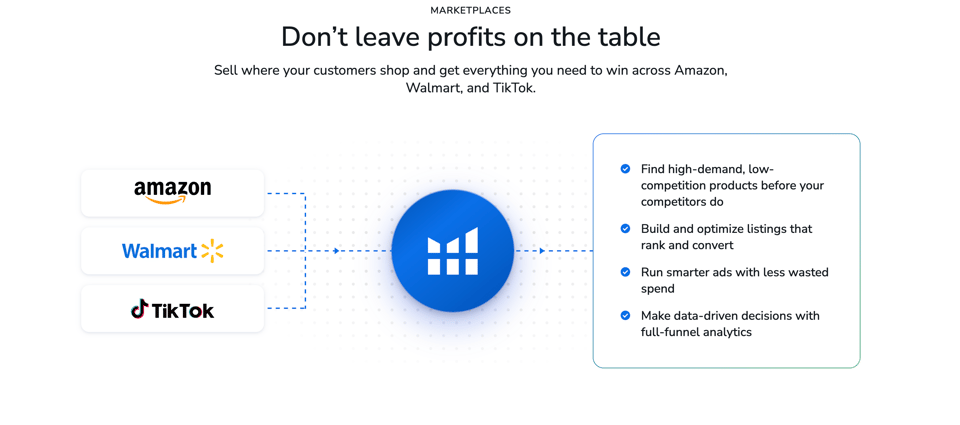
Marketplace reach. Helium 10's comparison page says it supports 24+ marketplaces against 17 for Jungle Scout, and covers Amazon, Walmart and TikTok. Treat those as Helium 10's own figures, but the Walmart support is real and useful if you ever want a second channel.
Support. This one is personal. In my experience Helium 10's customer care is good. When you are spending money on stock and something in the tool confuses you, a responsive team is not a small thing.
One more note, for fairness. Helium 10's page says Jungle Scout emailed some Catalyst Brand Owner customers in May 2026 about being automatically moved to an enterprise plan. I have not seen that email, so if you are a Jungle Scout customer, confirm your plan directly with them. It is a good reminder to read plan terms before you commit to any tool.
AI and MCP: Where Helium 10 Is Moving Fastest
A lot of the tools in this space have bolted on a chatbot and called it AI. Helium 10 has gone further, and this is where Diamond starts to feel like a different product.
- The Helium AI agent lets you ask questions in plain language about your products, keywords and performance, instead of clicking through five screens to find an answer.
- The AI Listing Builder helps you draft listings that fit how shoppers now search, including Amazon's Rufus assistant.
- The MCP connector lets you link your Helium 10 data to an AI assistant you already use, so you can ask it to analyze a niche, compare competitors or review a listing using live Helium 10 data. As far as I know, MCP is a Diamond feature, with a monthly allowance of calls included and extra calls available for heavy users. Check the plan page for the current numbers.
Why does this matter in a Helium 10 vs Jungle Scout decision? Because research is turning into conversation. The seller who can ask a question and get an answer built on live marketplace data in thirty seconds will outwork the seller who spends an afternoon in spreadsheets. That gap grows every month.
Jungle Scout is adding AI features too, and I am not claiming it has none. My point is narrower. If you are choosing a platform you plan to use for years, you want the one that is investing hardest in the direction the market is going, and right now that is Helium 10.
Helium 10 vs Jungle Scout Pricing: What You Actually Pay
Price is where Jungle Scout makes its best argument, so let me lay it out plainly. Both companies have changed their plans over the years, so confirm the numbers on each pricing page before you buy.
Helium 10 right now:
- Free plan: a limited free version, useful for getting a feel for the interface.
- Platinum: $129 a month, or $99 a month billed annually.
- Diamond: $359 a month, or $279 a month billed annually ($3,348 a year).
- Starter: retired for new users in 2026, so the cheapest paid plan is now Platinum.
Jungle Scout right now:
- Plans run from roughly $49 to $129 a month on monthly billing, with annual billing bringing the lower tiers down to about $29 to $49 a month.
- The top plan includes more seats and more product tracking, and there is a 7-day money-back guarantee.
If the comparison stopped there, Jungle Scout would look like the budget winner at the bottom of the range, and I will say so without arguing. Helium 10 did raise its prices in 2026 and removed the cheapest paid plan. That stings, and I will come back to it in the weaknesses section.
But sticker price is only the starting point. Here is what the discounts do to Diamond on monthly billing:
- Full price: $359 a month.
- With the 30% link offer: about $251.30 a month. Over 6 months that is roughly $1,507.80 instead of $2,154, a saving of about $646.
- With code FLEXOBA20 (20% off for 6 months): about $287.20 a month, or roughly $1,723.20 over 6 months, a saving of about $431.
- With code FLEXOBA10 (10% off every month): about $323.10 a month for as long as you stay.
These are my calculations from the published monthly price, so confirm the final number at checkout, because discounts and terms can change.
So the real question is not which tool has the lower price. It is which tool earns back more than it costs. A seller who avoids one bad inventory order, or runs ads that waste less, has already paid for months of the subscription. That is why I judge price against what you get, and not against the cheapest option on the page.
See your discounted Diamond price here
Why Helium 10 Diamond Is the Plan to Start With
This is the part I care about most, because this is where the decision is really made.
Most new sellers do the same thing. They look at the cheaper plan, tell themselves they will upgrade later, and then spend months working around limits they could have avoided. I think that is backwards. Here is why I would start on Diamond.
1. You are buying the whole system on day one. Diamond is the plan where research, keywords, listings, advertising, AI and operations all sit together. You are not learning a half-version of the tool and relearning it later.
2. Advertising is included in the picture. Adtomic, Helium 10's AI advertising tool, is bundled with Diamond according to the pricing guides I checked, while lower plans pay extra. Ads are where new listings get traction, and automation protects your budget while you learn.
3. AI and MCP are on this plan. The Helium AI agent, the AI Listing Builder and the MCP connector are what turn data into answers quickly. As far as I know, MCP access sits at the Diamond level, so Platinum users do not get it.
4. Your team can come in. The day you hire a VA or bring in a partner, multi-user access matters. On Diamond it is already there.
5. Higher limits mean fewer walls. Diamond comes with larger monthly allowances on tools like Index Checker and Listing Analyzer. If you are testing several products, you will not stop halfway because you hit a cap.
6. Lower fees where fees exist. The managed refund fee is reported as 10% on Diamond against 15% on Platinum, which matters once you are recovering money at scale.
7. The course is included. Freedom Ticket comes with Platinum and Diamond, so you are not paying extra to learn how to use what you bought.
8. The discount makes it reasonable. With 30% off through my link, Diamond works out to about $8.40 a day on monthly billing. For a business that can sell physical products across a marketplace this size, that is a small operating cost, not a luxury.
I have compared Helium 10 against Jungle Scout and against what other sellers say about the wider market, and I have not found another subscription that puts these pieces in one account for this price. I cannot test every tool in existence, so take that as my honest finding and not a law of nature. But it is why I keep recommending Diamond first.
One honest caveat. If you have not decided whether to sell on Amazon at all, or you truly cannot cover tools and your first order, do not stretch. Start with the free plan, learn the interface, and come back when you are ready. But if you are serious, and the thing standing between you and a profitable product is a monthly cost you can carry, that is a strange thing to be stopped by. You are spending thousands on stock. The tool that helps you choose that stock should not be the place you cut corners.
Start Helium 10 Diamond with 30% off or use code FLEXOBA20 at checkout. Try it properly. If it does not earn its place, do not renew.
Where Helium 10 Is Weaker, and What Has Improved
I promised honesty, and an article that only praises a tool is not worth trusting. Here are the real weak spots, and what I think has changed for the better.
The price went up. In 2026 Helium 10 raised its plan prices and retired the cheap Starter plan, so the lowest paid entry is now Platinum. That is a fair complaint. What has improved is what the money buys. Both paid plans now include the Freedom Ticket course, Diamond has the AI agent, MCP access and the ad tools in its picture, and the discount through my link brings Diamond back into a range that makes sense. The price rose, and the product grew with it.
There is a lot to learn. Helium 10 has many tools, and a beginner can feel lost on the first day. I did not find it hard to move around, and the site felt easy to use, but I will not pretend a dozen tools learn themselves. The improvements here are real: the Helium AI agent lets you ask questions in plain language, and the included course gives you a path to follow. Pick one workflow, product research first, and add the rest as you go.
Some features carry extra fees. Reported fees include 2% of managed ad spend on Diamond and a percentage on refunds recovered. None of it is hidden once you look, but read the plan page so you are not surprised. Because Diamond bundles the ad tool that other plans charge extra for, the full cost often comes out reasonable.
Estimates are still estimates. Like every tool in this space, Helium 10 gives you modeled numbers for sales and volume. Use them as a range, as I described earlier, and you will avoid most mistakes.
It will not pick the product for you. No tool will. Helium 10 gives you the evidence, and you still have to make the call, source well and run the business. Anyone promising otherwise is not being straight with you.
None of those points is a reason to avoid Helium 10. They are reasons to start it with open eyes, a clear first task and a discount that lowers the risk.
Where Jungle Scout Is the Better Pick
A fair Helium 10 vs Jungle Scout comparison has to give Jungle Scout its due, so here is where I would point someone its way.
- You only want research. If your plan is to find a product, validate it and move on, Jungle Scout's research tools are strong and its interface is friendly.
- You want the cheapest way in. Its entry plans cost less per month than Helium 10's cheapest paid plan, and there is a 7-day money-back guarantee.
- You like a simple layout. Many sellers prefer Jungle Scout's cleaner, narrower feel to Helium 10's wider toolbox.
- You need a supplier database. Jungle Scout includes one, which helps if sourcing is your first hurdle.
If that is you, Jungle Scout is a reasonable choice and I would not talk you out of it.
But notice what those reasons have in common. They are all about starting small. The moment your goal becomes a business with ads, listings, several products and maybe a team, the argument moves to Helium 10, and it moves further the higher you go in the plans.
Helium 10 Black Friday: Why Diamond Is the Smart Place to Start
Everyone wants to know whether they should wait for Black Friday. Here is the straight answer, using what I could verify.
What we know. As of late October 2026, the sites I checked say Helium 10's official Black Friday deal has not been announced. Last year's offer was 40% off for 12 months on the Platinum plan, for new customers, and it ran through the second half of November into early December. Nobody outside Helium 10 can promise what this year looks like, and I will not pretend otherwise.
What that means for you.
- Past Black Friday offers have centered on Platinum. If that pattern repeats, waiting could mean saving on the smaller plan, not on Diamond.
- The 30% offer through my link and code FLEXOBA20 are available now, and they apply to Diamond.
- Helium 10 sets the terms of any holiday sale. If a better offer appears, check what it covers before you assume it beats what you can claim today.
Why I would start on Diamond at this time of year:
- Q4 is when sellers find out what works. Holiday demand shows you which products move and which keywords convert. You want your research tools running during that window, not waiting beside it.
- Early research pays later. The products you choose now are the ones you can launch while competitors are still deciding.
- First-timers lose most by waiting. Every week without data is a week of guessing. A sale that saves a few dollars a month cannot make up for a wrong first product.
- You avoid the upgrade scramble. If you start on Platinum to save money and hit its limits during your first ad campaign, you will upgrade at a bad moment. Starting on Diamond means the ads, AI and team access are already in place.
- You are not locked in. On monthly billing you can cancel before renewal. If a bigger deal lands later, you can reassess with real experience behind you.
So my advice is simple. Start on Diamond now, with the discount that exists today, run your first research properly, and treat any Black Friday deal as a bonus, not a reason to stand still.
Claim the Diamond offer before the holiday rush
Helium 10 or Jungle Scout: Which Should You Pick?
- You are serious about building an Amazon business: Helium 10 Diamond.
- You want to run ads, hire help or sell on more than one marketplace: Helium 10 Diamond.
- You want to use AI to speed up research and listings: Helium 10 Diamond.
- You are testing the water and want to spend nothing yet: Helium 10's free plan.
- You need only simple product research on a tight budget: Jungle Scout's entry plan is a fair option.
- You are unsure whether to sell at all: use the free plan and the course material first, then decide.
Most people reading a Helium 10 vs Jungle Scout article already know which group they are in. If you are in the first three, the decision is easy.
Helium 10 vs Jungle Scout FAQs
Is Helium 10 better than Jungle Scout? For sellers who want research, keywords, ads, AI and operations in one place, yes, in my experience. Jungle Scout is a good research tool and can be cheaper at the entry level, but Helium 10 goes further.
Is Helium 10 worth the money? I think so. The research helps a lot, the data feels current, the support is good, and the value outweighs the price, especially with a discount. It is worth it if you act on what it shows you.
What is the Helium 10 coupon code? FLEXOBA20 gives 20% off for 6 months. The link at the top of this page gives 30% off automatically. They do not stack, so choose the better one at checkout.
Which Helium 10 plan is best for a beginner? If you are serious and can afford it, Diamond, because the ad tools, AI, team access and higher limits are already in place. If your budget is tight or you are still deciding, start with the free plan.
How much is Helium 10 Diamond? $359 a month, or $279 a month billed annually. With 30% off on monthly billing it comes to about $251.30 a month. Confirm the final price at checkout.
Can I cancel if I do not like it? Yes. Monthly plans can be cancelled before renewal. Check the refund terms shown at checkout, because they can change.
Does Helium 10 work with Walmart? Yes. Helium 10 supports Walmart as well as Amazon.
Is Jungle Scout cheaper than Helium 10? At the entry level, yes. At the level where you get ads, AI and team tools, compare what each plan actually includes, not just the monthly number.
Does Jungle Scout have a free trial? It advertises a 7-day money-back guarantee instead of a free plan. Helium 10 has a free plan you can use to explore.
Final Verdict: Helium 10 Wins, and Diamond Is the Way In
So, Helium 10 vs Jungle Scout: who really wins?
For the seller who wants to grow, Helium 10 does. Its product research is deep, its data feels current, its support team is there when you need them, and it connects research to keywords, listings, ads and operations in one account. On Diamond, you add AI, advertising tools, team access and higher limits, and you stop working around the edges of your plan.
Jungle Scout deserves respect. It is a good tool, it can be cheaper to start with, and it suits someone who only needs simple research. But a tool should be judged by what it helps you build, not only by what it costs this month.
You also have very little to lose by trying. Use the link, get 30% off, or enter code FLEXOBA20. Run your first real product search. Test the keyword tools, look at the ad features, and see whether it earns its place. If it does not, cancel before your next billing date and do not subscribe again.
Most sellers do not fail because the tool was too expensive. They fail because they guessed. Do not guess.
Start Helium 10 Diamond with 30% off, or use code FLEXOBA20 at checkout.
