2026 Nᵒ22 - A packed toolbox is a heavy one
How many forms are too many in Playback Theatre?

London, 2nd of June 2026
👋 Greetings, dear readers.
And suddenly, we are in June. Happy Pride Month, everyone! 🏳️🌈🏳️⚧️ Although it’s something that should be (and is) celebrated all year round, let’s put the bigots to shame.
After two weeks in a row of speaking about improv, I wanted to draw the attention back to Playback Theatre, inspired by last month’s gathering. One of the cool things about gatherings is sharing the different ways companies play stories back to the teller and the audience.
There are so many creative forms out there that can be useful, and it's wonderful to see how different people bring their own flavour to the practice, from forms that include live painting to others that tackle the story using psychodrama techniques. It’s been more than fifty years since Playback Theatre started, initially using just the original three forms: fluids, pairs, and the story/free form. But everything evolves.
Whenever you are in an international setting with other playbackers, the debate about how many forms we should keep always sparks. I remember, during my leadership training in the United States, Jonathan Fox told us how awkward it was to have people come up to him gloating about the huge number of forms their company used, expecting validation or praise from one of the creators of Playback Theatre. But the thing is, the co-creator himself is fond of simplicity. And I kind of agree.
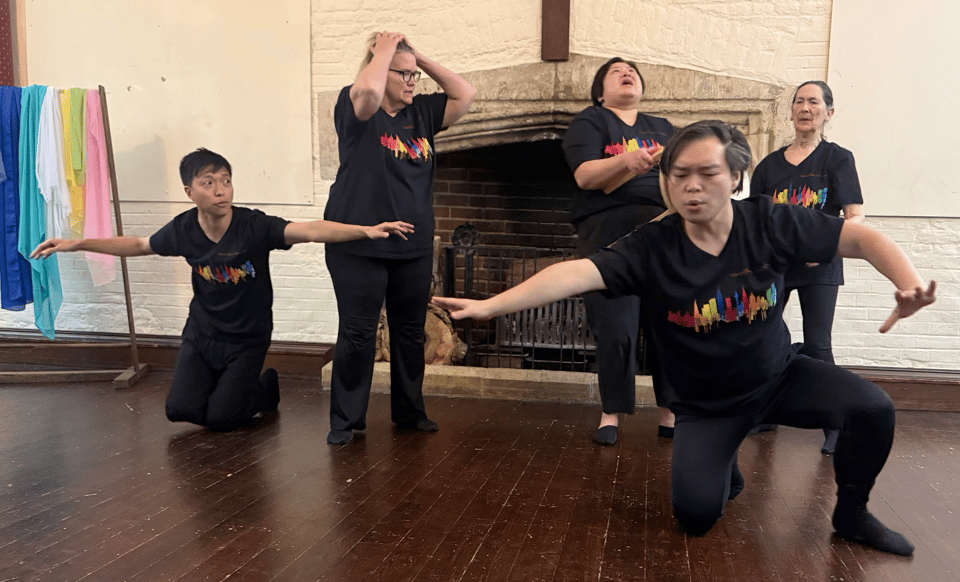
So, how many forms is the right amount for a Playback Theatre company to use? Let’s start by saying that, when I’m involved in core training, five should be enough.
Fluids, transitional fluids, pairs, corridors, and the story/free form make up a solid toolbox that can successfully fulfill a Playback Theatre performance. To the original triad, I add a DLC an expansion to the fluid form, and "corridors," which is my favourite form to isolate and showcase the different tools we can use during an enactment.
Why do we keep adding forms then? One reason is tied to the needs of the group and, specifically, its target audience or theme. For example, if we are working with a vulnerable community, a form designed specifically to hold potentially traumatic stories might be a better fit.
The other reason is simple: artistry. This is especially true when we are doing an open performance. There’s something satisfying about coming up with a form that is visually striking, does justice to a specific story, and elevates our excitement about performing.
These could be musical forms (tee-hee), choreographed forms, or forms heavier on discourse and metaphors… there are certainly no limits to how we can do justice to a story in Playback Theatre. However, with a wider number of choices comes a more difficult decision.
My advice would be this: whenever your group is preparing for a performance, pack your toolbox with a maximum of eight forms. The five core forms I mentioned, one form to tackle deep and/or traumatic stories, and a couple of forms that enhance the artistic value of Playback Theatre. That should be more than enough.
But, by all means, you do you. This is just my advice. There’s no right or wrong as long as you succeed in honouring people’s stories.
Stay hydrated. Love to you all. 🫶
🎭 The Theatre bit
Last week, I read Els miratges de Tatooine (Tatooine’s Mirages), a play by the Catalan playwright Carles Batlle. The title might be deceiving, it is not a play about Star Wars, but it is inspired by one of the franchise's most iconic filming locations: the planet Tatooine, specifically the Skywalker farm, where we first meet Luke in 1977’s Star Wars: A New Hope.
Any fan of the galactic franchise knows that the Tatooine scenes were filmed in Tunisia, but they don’t know that those familiar scenes were shot not too far from Meheri-Zebbeus, a concentration camp run by Vichy French forces, a racist and anti-Jewish faction, and where many Spanish Republicans ended up at the end of the Spanish Civil War. And that is what this play is about.
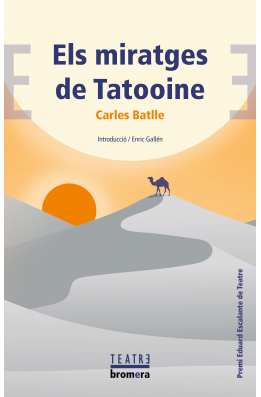
A man digs into the past to uncover his grandfather's history, with only a picture and a map as clues. From this premise, this highly educational play takes us back and forth in time through compelling, poetic scenes, monologues and dialogues. So poetic that the situations presented feel more like suggestions than hard facts, leaving room for the spectator's own interpretation.
I have to give kudos to Batlle for writing with the reader in mind, making this much more than just a script. Instead of offering basic stage directions, he provides meticulous descriptions of the settings, even including images of the cued projections.
📆 What is coming up
🇬🇧 5th to 7th of June - “Is the Personal Story Political?” (London, UK). At True Heart Theatre, we are hosting a Level 2 training led by Michele Chung, focusing on the political dimension of long-form stories in Playback Theatre. Info and registration here.
🇬🇧 12th of June - Acaprov at Shoreditch Balls (London, UK). Join us once again for a brand-new improvised musical. What kind of inspiration will we find with summer within reach? Tickets here.
🇧🇬 20th-21st of June - Level 2 Playback Theatre Training (Varna, Bulgaria). Excited for going to Bulgaria for the first time to deliver my “Honouring Stories with your Voice” intensive. Looking forward to meeting the Playback Theatre community in Varna. Info here.
🇬🇧 10th of July - Acaprov at Shoreditch Balls (London, UK). Stranded in the city with no holidays? So are we! Come and have musical fun with us. Get your tickets.
🇲🇹 18th of September - Intro to Playback Theatre (Valletta, Malta). I´m honoured to be part of the facilitator roster attending the Improvizza! festival in Malta. I´m excited to introduce Playback Theatre to improvisers there. Tickets here.
📚 🎮 🎥 📺 The geeky dessert
I’m thirty years late to the party, but I did finally played through the story of a mainline Pokémon game. When I talked about Pokopia, I mentioned it was that game that really made me feel invested in the universe of these cute creatures.
Of course, I did ask the internet about advice and I did start from the beginning or, as the fans say, the first generation of Pokémon. The friendliest way to do it was getting hands on the 2018 remake, for Nintendo Switch, of the original game.

While many hardcore fans complained about the simplicity of this remake, people with a big backlog, like me, can feel encouraged to keep touring through the story set in the game’s Kanto region. The game deals with two types of encounters: either facing turn based battles or catching a wild Pokémon by throwing a Poké Ball, literally, since the Nintendo Joy-Con translates the movement of our arm to the ball’s trajectory.
You can beat the story relatively quickly, but if you want to grind for all the Pokémon and battles after the credits roll, it can keep you busy for dozens of hours. I’m not going to do that, though. Overall, Pokémon: Let’s Go, Pikachu! is a gentle RPG and a simple, very accessible gateway to the franchise.
📨 That’s all for now
Thanks for reading Playing Back an Improvised Life, a newsletter by Ferran Luengo.
If you like it, spread the voice and share with someone who you think might enjoy it.
If you want to keep in touch, feel free to follow me on instagram (@luenkun).
Want to work with me or start a conversation? email me 😀
Want to support me? You can do it through my Ko-fi page

Ferran Luengo AI Disclaimer: Since English is not my first language, I may have used AI tools to proofread the text, limiting their use to grammar only. Everything in this newsletter has been written by me
Add a comment: