2026 Nᵒ05 - Playing with Strangers? Yes, but...
Reflecting on the universal sameness of improv, exploring my unique approach as an improv artist with autism, and enjoying theatre and geeky movies.

Greetings, dear readers. And just like that, the first month of the year is gone, catching me in a reflective mood, right in the middle of an existential crisis when it comes to improv. It’s as if seeking inspiration within the art form feels like running on a Moebius strip. I feel that all the improv I watch lately looks the same, regardless of how it’s advertised.
Riding this low, I visited Oxford last week for the Oxford Improv Festival. Visiting this charming town for the first time, and hanging out with my friend Neil Curran, provided a couple of reasons to do so.
Neil was there to perform and to teach his remarkable workshop about improvising with strangers, which I effusively recommend. There was something about the fact of improvising with people that you’ve never improvised with before that made me think about myself as an improviser.
For example, let’s take the case of improv jams. I tend to like improv jams and I put my name in every hat, however I rarely find myself enjoying the outcome and leaving the stage thinking that I sucked, despite my masking. Yet I keep gambling at every opportunity.
Some might point at me and say, “You don’t enjoy it because you are a bad improviser.'“ I’d say it’s because I’m a different improviser, and I’ve come to realise that I don’t think the same way a neurotypical does.
Since I got my autism diagnosis last year and dramatically increased my research on the topic, I’m beginning to understand myself and my feelings better in certain situations. Despite being an improviser, randomness can be a highly anxious situation for me. Playing with neurotypicals who don’t know how I process things might be hard. It is now that I understand why I’m always leaning towards slow burn, relationship driven, long form improv. I could do that with a stranger, if we are alike.
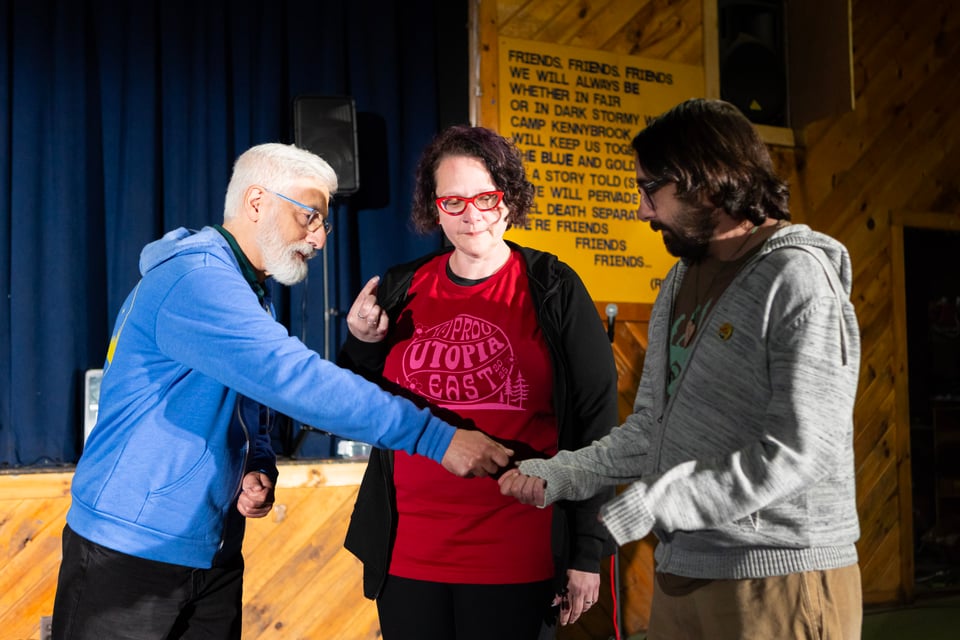
Not every jam is managed with diversity in mind. I really enjoy Improv Utopia diversity jams because they are accommodating. Diverse people needs a space to play with people alike. And, again, that is hard to find sometimes.
But let’s go back to Neil’s work with strangers. He works with people who are strangers to the art form, normally audience members who have never seen improv, let alone practiced it. In that context, I don’t think I would feel anxious because, in a way, I’d be facilitating the experience. I’d be in control… without being in control. Does that make sense?
As a facilitator and storyteller, I play with strangers very frequently because I put myself in a position of knowing what to expect and how to manage the situation, even with kids which is like forging oneself in Hell. I hope I have the opportunity one day to experience playing with a completely inexperienced stranger in a performance setting. Watching Neil play with random people is always inspiring.
I don’t want to close this topic without pointing out that in Playback Theatre, the situation is quite different. I have mentioned many times before that playbackers default to a certain degree of sensitivity, so playing with someone for the first time tends to work well generally.
🎭 The Theatre bit
I went back to Valencian theatre last week, and my stash is running low after reading Dinamarca (Denmark). The play was written by the Valencian playwrights and brothers Josep Lluis and Rodolf Sirera, both of whom are considered relevant figures not only in contemporary Valencian (and Catalan-speaking) theatre, but also in the rest of Spain.

The play was finished by Rodolf after the passing of his brother, Josep Lluis, and it’s the conclusion of a trilogy focused on European conflicts between the First and the Second World Wars.
Nazi-occupied Denmark is the setting of this play. Spanning three years (1942–1945), the scenes are presented anachronistically, focusing on the relationships created between six characters, most of whom are tied both to faith and theatre.
The play relies heavily on peer-to-peer conflicts between the characters, presented in a compelling way. It also tackles sociopolitical dimensions, such as the forbidden love between two women and the duty of the arts to present themselves as subversive while facing a fascist occupation. Does it ring any bell?
As expected from the authors, a brilliant play.
📆 What is coming up
🇬🇧 5th of February - Acaprov at the Hoopla! Mixer (London, UK). Join Acaprov at the upcoming Hoopla! Mixer where we’ll be part of a fun night completed by Do the Right Scene and Rumourville. Get your tickets.
🇬🇧 13th of February - Acaprov (London, UK). Right at the door of Valentine’s Day 💞 we’ll offer a new a cappella musical at Shoreditch Balls. Get your tickets.
🇬🇧 15th of February - Lunar Year Playback Theatre Performance (London, UK). I’ll be coaching next True Heart Theatre’s performance to welcome the new Chinese lunar year. More information and tickets here.
🇩🇪 14th-15th of March - Playback Theatre Level 2 Intensive (Berlin, Germany). I’m going the capital of Germany to offering a two days intensive. Looking forward to it. If you are around check it out.
🇩🇪 21th-22nd of March - Playback Theatre Level 2 Intensive (Hamburg, Germany). And also, I’ll wave the Winter goodbye while offering the same intensive in Hamburg.
📚 🎮 🎥 📺 The geeky dessert
You cannot get geekier as Dungeons & Dragons, so my geeky recommendation today is the Dungeons & Dragons: Honor Among Thieves movie. I recently gave it a rewatch and I liked even more than the first time I watched it.

The world wasn’t ready for the nerds, and the film was considered a box office bomb. But, let me tell you, this is the perfect adventure movie, having the capacity to keep you engaged constantly thanks to its brilliant pace and humour. It definitely has potential to being looked at as a cult classic when we reach the equator of the century.
📨 That’s all for now
Thanks for reading Playing Back an Improvised Life, a newsletter by Ferran Luengo.
If you like it, spread the voice and share with someone who you think might enjoy it.
If you want to keep in touch, feel free to follow me on instagram (@luenkun).
Want to work with me or start a conversation? email me 😀
Want to support me? You can do it through my Ko-fi page

Ferran Luengo AI Disclaimer: Since English is not my first language, I may have used AI tools to proofread the text, limiting their use to grammar only. Everything in this newsletter has been written by me
Add a comment: