|
Fair Value
Weekly · Sunday, November 15, 2026
|
| |
| ▸ | Nvidia's governance crisis shattered the AI trade's center of gravity. The board ousted Jensen Huang on November 11 after an investigation into two extramarital affairs, one with a woman U.S. intelligence suspects is a Chinese spy who allegedly facilitated restricted chip shipments to China. The stock fell 4.3% that day and has shed roughly a third of its value since its October peak, wiping $600 billion in market cap and exposing the sector's single-point-of-failure risk. AMD surged 5.9% and Broadcom jumped 5.5% the same session as capital rotated toward perceived alternatives, but the PHLX Semiconductor index remains down 31.6% from its June peak. | | ▸ | The hyperscaler capex supercycle is eating its own seed corn. Microsoft, Google, Amazon, Meta, and Oracle deployed $691 billion on capital projects over the trailing twelve months, 95.5% of their operating cash flow, collapsing aggregate free cash flow to $33 billion from $201 billion a year ago. Amazon's long-term debt doubled to $129 billion in six months to fund a $220 billion annual capex pace. | | ▸ | Crypto entered extreme fear without a catalyst. Bitcoin ground down 11% over seven sessions to $65,500 without a single day exceeding a 4% move. The Fear & Greed index hit 10, its lowest since the 2022 bear market. U.S. spot ETFs shed $1.065 billion in five days while stablecoin supply contracted 5.3% in 30 days to $287 billion, the sharpest drawdown since June 2022, a slow bleed that looks like institutional de-risking, not panic selling. |
|
| | | The week that was The semiconductor rout accelerated into a structural reset, and the flashpoint was Nvidia. The board ousted Jensen Huang on November 11 after an investigation into two extramarital affairs, one with a woman U.S. intelligence suspects is a Chinese spy who allegedly facilitated restricted chip shipments to China. The stock fell 4.3% that day and has shed roughly a third of its value since its October peak. AMD surged 5.9% and Broadcom jumped 5.5% the same session, suggesting investors are rotating toward perceived alternatives rather than fleeing the AI theme entirely. But the broader PHLX Semiconductor index (SOXX) is down 31.6% from its 52-week high, and monthly declines across the complex are historic, Marvell -36%, Intel -39%, Nvidia -26%, ARM -20%. This is no longer a correction; it is a repricing of the AI infrastructure build-out's durability. That repricing is grounded in cash-flow math. The five largest U.S. hyperscalers deployed $691 billion in trailing-twelve-month capital expenditure, up 94% year-over-year, consuming 95.5% of their operating cash flow. Aggregate free cash flow collapsed to $33 billion from $201 billion a year earlier, an 84% drop. Amazon's FY2025 10-K shows operating cash flow of $139.5 billion against $128.3 billion in capex, leaving just $7.7 billion in free cash flow; in the first half of FY2026, capex reached $98.4 billion and long-term debt doubled to $128.9 billion. Microsoft guided FY2027 capex near $170 billion while reporting Q1 free cash flow down 27% year-over-year. Nvidia's own supply commitments hit $279 billion (96% due by FY2029), heavily weighted to memory with take-or-pay terms. The market is asking: at what point does the capex curve bend, and who absorbs the slack if it doesn't? Crypto provided the week's clearest sentiment signal. Bitcoin fell 11% over seven sessions without a single day exceeding a 4% move, a slow bleed that typically reflects institutional de-risking rather than retail panic. The Fear & Greed index dropped to 10 ("Extreme Fear"), its lowest since the 2022 bear market. U.S. spot Bitcoin ETFs recorded net outflows of $1.065 billion over the last five trading days, bringing the 14-day total to $2.66 billion. Stablecoin supply contracted 5.3% in 30 days to $287 billion, the sharpest drawdown since June 2022. Binance perpetual funding rates are near zero (BTC +0.0008% per 8 hours, ETH +0.0001%), and open interest has fallen 19-32% in dollar terms since mid-October while rising slightly in coin terms, leveraged longs are exiting, not being liquidated en masse. The market is quietly reducing exposure. Oil prices decoupled from geopolitics in a way that should make energy traders uncomfortable. Brent crude fell to $95.84, down 18% from its late-October peak above $117, even as Iran mined tankers in the Strait of Hormuz (at least ten ships hit in the first ten days of November), Houthis struck Saudi pipelines and claimed drone attacks on Riyadh's airport, and the EU prepared its 22nd Russia sanctions package. The collapse reflects two fundamentals: OPEC+ production surged 2.04 million barrels per day in October to 41.23 million bpd, essentially back to pre-war levels, and President Trump declared the U.S. no longer needs an Iran deal, removing a key risk premium. Saudi Arabia's East-West pipeline (Petroline), restarted October 1, now moves roughly 4 million bpd to Red Sea ports, bypassing Hormuz entirely. The physical market is better supplied than the headlines suggest. The dollar and bonds told a different story. The 10-year Treasury yield climbed to 5.10% on Friday, the 2-year to 4.86%, and the ICE Dollar Index (DXY) cleared its one-year high at 103.4. The Chicago Fed's National Financial Conditions Index has now risen for seven consecutive weeks to -0.462, its tightest level since early 2023, even as the VIX fell 28% on the week to 19.3. That divergence (tightening financial conditions alongside falling equity volatility) historically precedes credit stress. 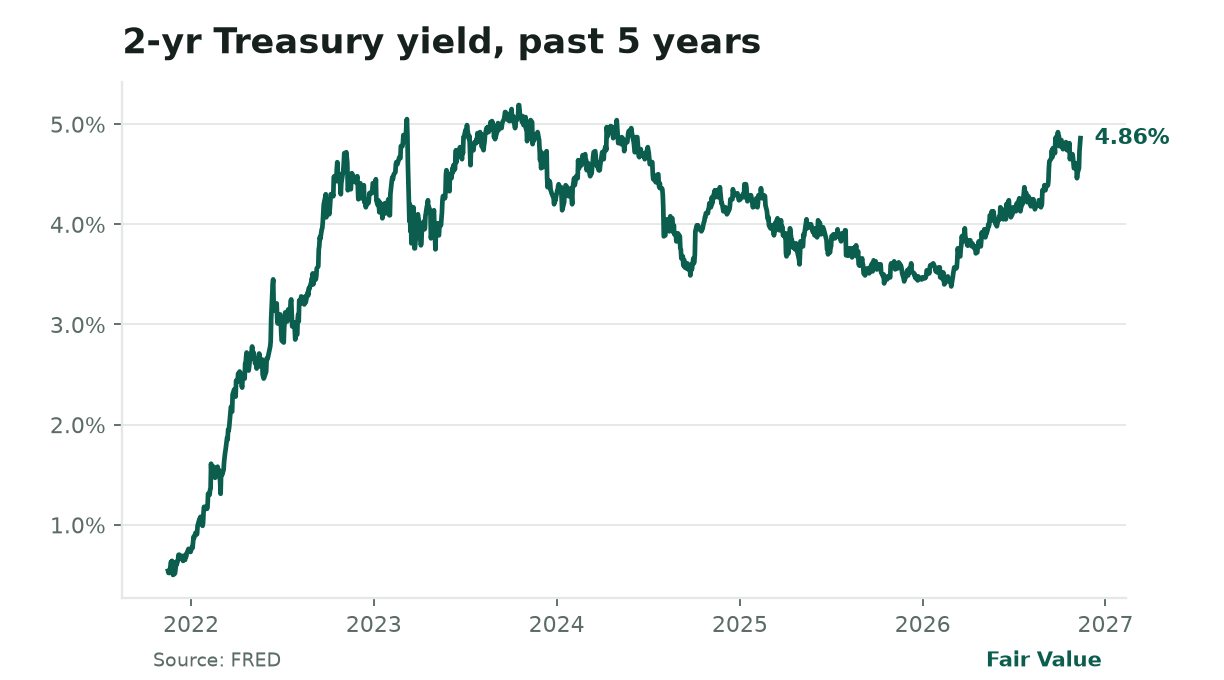 Yield near 5‑year high. The 2‑year Treasury yield sits at 4.86%, its highest since early 2022; the last time it topped 4.8% in March 2022, the economy entered a recession later that year. |
The Fed held rates at 3.75-4.00% with effective fed funds at 3.88%, but CME FedWatch shows a 100% probability of a December hike after October CPI surprised at 0.4% month-over-month headline and 0.3% core. The Bank of England delivered a 25-basis-point hike to 4% on Thursday, its first increase in over three years, explicitly citing Middle East conflict-driven inflation. Global equities offered a counterpoint. The German DAX passed its prior one-year high with a one-year return of +11%, while Japan's Nikkei posted a rare one-month move and a one-year return of +19%. The DAX nears its five-year high; the Nikkei remains 16% below its own. For these moves to continue, economic growth and corporate earnings would need to stay strong, while a reversal could come from a global downturn or a shift in monetary policy from the Fed or ECB. | | | The big question this week Can the hyperscaler AI capex supercycle sustain itself without breaking the balance sheets that fund it? The five largest U.S. cloud platforms, Microsoft, Google, Amazon, Meta, and Oracle, spent $691 billion on capital projects in the trailing twelve months through September, up 94% year-over-year. That figure equals 95.5% of their combined operating cash flow, leaving aggregate free cash flow of just $33 billion versus $201 billion a year earlier. The gap is being filled with debt: Amazon raised $48.1 billion in Q3 alone and doubled its long-term debt to $129 billion in six months; Microsoft priced a $25 billion bond in late October (coupons 4.85-6.35%); Meta issued $30 billion last year; Alphabet raised $84.75 billion in equity in June. Incremental debt financing has risen from 9% of capex in FY2024 to roughly 32% on a trailing basis. The supplier side tells the same story. Nvidia's purchase commitments hit $279 billion as of July 26, 96% due by FY2029, heavily weighted to memory with take-or-pay terms. TSMC guided 2027 capex of $76-90 billion (Goldman $78B, BofA $80-90B, Morgan Stanley $83B) with 2nm capacity doubling and 4x tape-outs versus N3 at a similar stage. HBM (high-bandwidth memory) 2027 blended ASP is projected up 50-121% over 2026 levels. Goldman Sachs estimates hyperscalers need $308 billion per year in AI revenue to break even on 2026-27 capex (depreciation plus opex) and $417-526 billion for a 10-20% return; Microsoft's $37 billion run-rate and roughly $70 billion aggregate "above-trend" AI cloud revenue remain far short. Valuation multiples assume capex peaks soon and free cash flow inflects positive. Amazon's $220 billion FY2026 plan, Microsoft's ~$170 billion FY2027 guide, Nvidia's $279 billion take-or-pay commitments, and TSMC's 2027 capex target crack that narrative. The SOXX is 31.6% below its 52-week high, Nvidia down 26% in a month, the VIX at 19.3, and the 10-year yield at 5.1%, all signaling rising equity risk premium. If capex stays at a ~$170 billion quarterly run-rate or accelerates per Amazon/TSMC/Nvidia guides, free-cash-flow yield compresses further and duration risk rises. $820 billion in off-balance-sheet lease commitments (per prior filings) masks additional capex intensity. For a normal person's money: the AI build-out pulls forward years of semiconductor, memory, and power-equipment earnings (benefiting Nvidia, Micron, Broadcom, TSMC, ASML, Vertiv, GE Vernova) but the largest S&P 500 components are self-funding less and issuing more debt, increasing systemic leverage. The 30-year mortgage at 7.11% and the 10-year at 5.1% are the transmission channel, higher long rates discount those distant AI cash flows more aggressively. What would change the view: Nvidia Q3 revenue below $105.8 billion or gross margin below 71% (reports November 17); 10-year yield sustaining above 5.5%; HBM4 contract pricing for 2027 coming in below ~$825/stack; TSMC guiding 2027 capex below $70 billion or flagging 2nm yield issues below 60%; Amazon showing AWS growth deceleration below 30% year-over-year or cutting its capex guide; Microsoft FY2027 capex significantly exceeding $170 billion or free cash flow turning negative. | | | The week ahead Monday, November 16, Canadian CPI (forecast 0.3% m/m, prior 0.1%) sets up the Bank of Canada's December decision; Fed Governor Warsh speaks (12:00 ET); RBA Governor Bullock speaks (17:50 ET); New Zealand inflation expectations (21:00 ET). Baidu reports pre-market (EPS est. $0.85). Tuesday, November 17, U.S. retail sales (forecast 0.2% m/m, prior 0.8%) and core retail sales (forecast 0.4%, prior 0.9%), the clearest real-time read on the consumer since the October CPI surprise. Nvidia reports after the close (EPS est. $2.47, revenue est. $108.8B); Disney reports pre-market (EPS est. $1.68). This is the week's hinge: Nvidia's guidance will either validate or fracture the AI capex narrative; retail sales will confirm whether the consumer is cracking under 7% mortgage rates. Wednesday, November 18, UK CPI (forecast 3.6% y/y, prior 3.5%) and BOE Governor Bailey speaks twice (02:30 ET, 10:00 ET), markets price ~60% odds of a December BOE hike. FOMC Minutes from the October 27-28 meeting (14:00 ET) will reveal how divided the committee was on holding rates at 3.75-4.00% with core CPI at 0.3%. Australian employment change (forecast +25.2K, prior -39.3K) and unemployment (forecast 4.7%, prior 4.7%). Target reports pre-market (EPS est. $2.07). Thursday, November 19, Walmart reports pre-market (EPS est. $0.637, revenue est. $187.3B), watch for full-year guidance raise to justify a stretched valuation; Alibaba reports (EPS est. $1.65), Chinese consumer and cloud growth are the tells. Friday, November 20, No red-folder data. Earnings wind down. | | | Worth knowing: Gold, the anti-asset (revisited) You've seen gold at $3,886, down 4.6% this week and 27% from its January peak. The textbook says gold is an inflation hedge, but the last two years broke that rule. CPI ran at 3.7% year-over-year in September, core PCE at 3.1%, and gold fell. The mechanism that actually drives gold is real yields: the 10-year TIPS breakeven sits at 2.24%, meaning the inflation-adjusted 10-year yield is roughly 2.86% (5.10% nominal minus 2.24% breakeven). When real yields rise, gold, which pays no coupon, no dividend, no earnings, becomes expensive to hold. The opportunity cost is the risk-free return you could earn in T-bills. Quick check: why would a hot CPI print push mortgage rates up? Because the Fed hikes the short rate to fight inflation, which lifts the entire yield curve, including the 10-year Treasury that anchors 30-year mortgages. The same chain pushes real yields up, which pushes gold down, even while inflation is high. That's what happened this week: 10-year yield to 5.10%, gold to $3,886. Central banks are the other buyer. The People's Bank of China, the Reserve Bank of India, and the National Bank of Poland have been net purchasers for quarters, diversifying away from dollar reserves. That's a structural bid, not a cyclical one. But it's price-insensitive, they buy regardless of level, so it sets a floor, not a ceiling. The sharper edge: gold is a call option on monetary disorder. It pays off when the financial plumbing breaks, 2008, 2020, 2022. Right now the plumbing is tight (NFCI at -0.462, seven straight weeks of tightening) but not broken. The VIX at 19.3 says equity investors aren't pricing disorder. If the 10-year sustains above 5.5% or the NFCI crosses zero, the option gains value. Until then, gold is a drag on a portfolio that needs yield. Tomorrow's prediction prompt: Canadian CPI m/m is forecast at 0.3% (prior 0.1%). If the print comes in above forecast, which way does the 2-year Canadian yield move, and why? We'll walk through the answer tomorrow. |
|
| |
Not financial advice. This brief is for informational and educational purposes only and does not constitute investment advice or a recommendation to buy or sell any security. Data: macro indicators per FRED® (Federal Reserve Bank of St. Louis); not endorsed or certified by the Federal Reserve Bank of St. Louis. Energy data per the U.S. Energy Information Administration (EIA). Auction data per U.S. Treasury Fiscal Data. Filings per SEC EDGAR. Market prices per Yahoo Finance. Earnings calendar per Financial Modeling Prep. Crypto data per Binance and CoinGecko. WSJ headlines per Dow Jones. |
|
