|
Fair Value
Monday, November 16, 2026
|
| |
| ▸ | Nvidia enters earnings week without a CEO, under federal probe, and about to be named a "national champion", the AI trade's center of gravity reports Tuesday after hours with options pricing an 8.5% swing, while Treasury Secretary Bessent demands an outsider CEO and answers on China chip compliance within 10 days. | | ▸ | The bond market is tightening financial conditions without the Fed, the 10-year Treasury yield has climbed 12 basis points in six sessions to 5.10%, the 30-year mortgage hit 7.11% (highest since 2001), and the dollar index broke a one-year high at 103.5, all while the policy rate sits unchanged at 3.75-4.00%. | | ▸ | Two Middle East chokepoints are now actively disrupted simultaneously, Houthi forces seized control of the Bab el-Mandeb Strait as anti-Houthi forces withdrew, while Iran struck Bahrain with drones and claimed tanker attacks in the Strait of Hormuz, creating compound shipping risk that Brent at $93 is largely ignoring. |
|
| | | The big story Nvidia reports fiscal third-quarter earnings Tuesday after the close, and the numbers are only half the story. The company that became the $3.2 trillion gatekeeper of the AI era has spent the last five days in chaos: CEO Jensen Huang resigned November 12 after a board investigation into personal conduct and allegations of a relationship with a woman suspected of Chinese intelligence ties; CFO Colette Kress is interim CEO with no succession plan in place; the Trump administration plans to designate Nvidia an AI "national champion" this week, expediting export licenses and unlocking federal financing, even as Treasury Secretary Scott Bessent publicly demands the board hire an outsider and produce compliance records on China chip sales within 10 days; and Congressional Democrats have opened a probe into whether the administration approved H200 chip sales to China in exchange for political favors. The convergence is unprecedented. A "national champion" designation normally signals government protection; here it arrives alongside a criminal Justice Department investigation into whether restricted chips reached China via Singapore, a Treasury Secretary questioning the company's compliance, and a board that ousted its founder. Options imply an 8.5% post-earnings move, but the real variable isn't revenue (guided at $108 billion ±2%) or gross margin (guided at 74% ±50 basis points). It's whether hyperscalers keep writing checks at a $691 billion annual capex pace when their sole supplier is in leadership freefall and under federal scrutiny. Microsoft, Google, Amazon, Meta, and Oracle deployed that $691 billion over the trailing twelve months, 95.5% of their operating cash flow, and their aggregate free cash flow collapsed to $33 billion from $201 billion a year ago. They are capacity-constrained through 2026, per Microsoft. If Nvidia's roadmap wobbles, the entire AI build-out wobbles. Tuesday's call isn't about one quarter; it's about whether the coordination layer holding the capex supercycle together holds. |
| | | What's going on today Equities are rotating violently beneath a calm surface. The S&P 500 sits 3.3% from its all-time high, but the Nasdaq-100 has fallen 10.5% from its peak, semiconductors 31.6%, and Nvidia alone has shed 26% this month. Meanwhile healthcare, staples, and utilities hit new 52-week highs. The VIX rose 4% to 20.07. Crypto plumbing confirms the liquidity drain: spot Bitcoin ETFs saw five consecutive days of outflows totaling $1.065 billion, Binance BTC open interest fell 20.6% since mid-October, funding rates are near zero, and the Fear & Greed index sits at 10, extreme fear. | | | The big picture The yield curve is bear-flattening, short-term yields rising faster than long-term, with the 2-year at 4.86%, the 10-year at 5.10%, and the 2s10s spread compressed to 24 basis points. That shape says the bond market expects the Fed to hold rates higher for longer, then cut aggressively when growth breaks. The 10-year minus 3-month spread widened to 83 basis points, a classic recession signal that has preceded every downturn since 1980, though with variable lags. High-yield spreads remain tight at 3.20 percentage points, signaling credit markets aren't pricing distress, yet. The dollar's grind higher is the underappreciated transmission channel. At 103.5 on the ICE index and 121.9 on the broad trade-weighted measure, the dollar is squeezing multinational earnings (roughly 40% of S&P 500 revenue is foreign), stressing emerging-market dollar debt, and suppressing commodity prices priced in dollars. The Fed-BOJ rate differential remains 375 basis points (Fed 3.75-4.00%, BOJ ~0.25%), sustaining the yen carry trade at 159.6 USD/JPY, but BOJ board member Takata today called for "nimble" rate hikes and Governor Ueda described wage growth as "quite strong," keeping a December hike live. 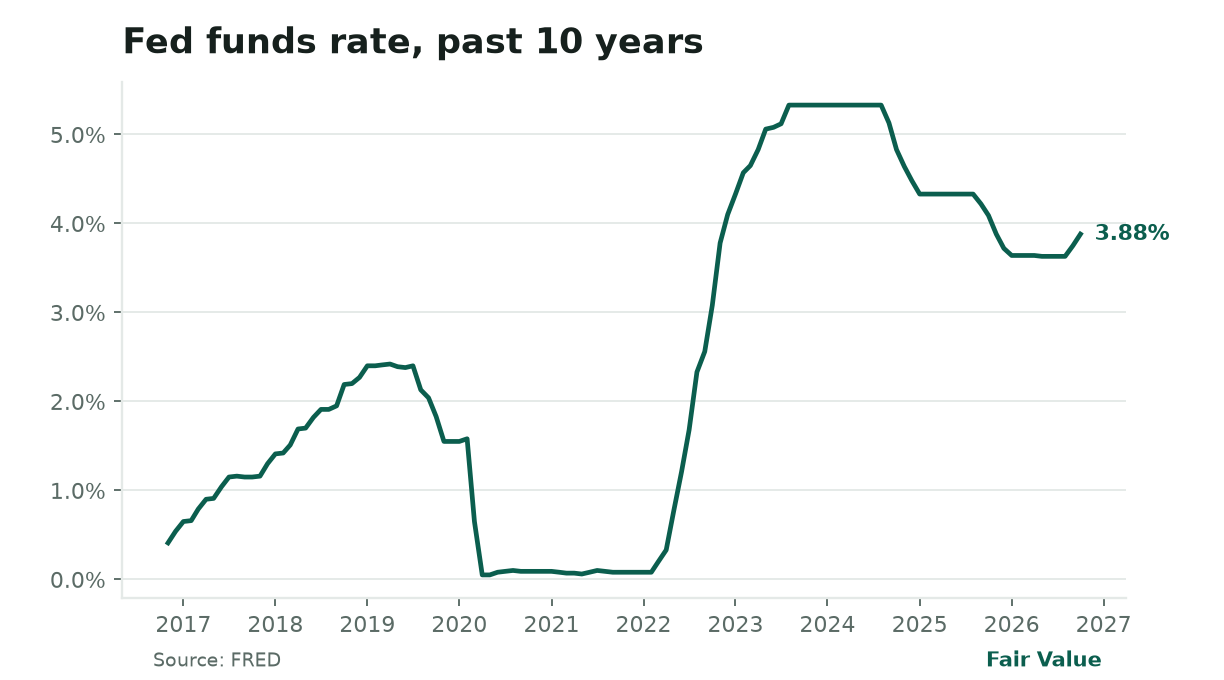 Fed funds steady at 3.75‑4.00%. The policy rate sits at the upper edge of the 2006‑2007 range, the last time it hovered here before the 2008 recession, and it has remained flat since the pandemic‑era lows of near‑zero. |
Housing is already contracting under 7.11% mortgages: starts at 1.22 million, permits at 1.40 million, new-home sales at 676,000, all 15-20% below five-year averages. The Chicago Fed's National Financial Conditions Index has risen for seven straight weeks to -0.462, its tightest since early 2023, even as the VIX fell 28% last week. Financial conditions are tightening through channels the Fed doesn't control: term premium, dollar, mortgage rates, not the policy rate. European and Japanese equities diverge on rate and currency cycles. The DAX hit a five-year high of 26,740 on November 16, clearing its prior one-year peak of 26,570 from November 11 for a 12% annual gain, as the ECB's deposit rate at 2.5% (November 13) and main refinancing rate at 2.65% sit well below the Fed's 3.75-4% range, keeping the euro at 1.102 versus the dollar and supporting earnings for export-heavy German firms. Meanwhile, the Nikkei fell 13.8% over three months to 59,662 (z-score -2.2 rarity), retreating 18% from its June five-year peak despite an 18% yearly rise, as the yen's slide to 159.6 per dollar (November 16) initially boosted exporters but recent strength risks reversing that tailwind. Brent at $93 and WTI at $88.67 (November 16) lift energy costs for both regions. For the DAX to extend, ECB easing must continue without reigniting inflation above the 2.57% core CPI (September); for the Nikkei to recover, the BOJ must tolerate yen weakness while global demand holds above the 4.1% U.S. unemployment (October) threshold. | | | Around the world The Middle East has entered a new phase of dual-chokepoint pressure. Houthi forces now control the Bab el-Mandeb Strait after Yemeni government forces withdrew to defend Aden, putting 10-12% of global shipping under the guns of an Iran-aligned militia that has already fired missiles at Saudi cities and energy sites. Simultaneously, Iran's Revolutionary Guard struck Bahrain twice in three days, targeting U.S. radar installations, and claimed sea-mine attacks on tankers in the Strait of Hormuz. The U.S. intercepted the Bahrain drones; Saudi Arabia intercepted Houthi missiles over Riyadh and the Eastern Province. This isn't two separate conflicts, it's a coordinated pressure campaign across both Gulf chokepoints. OPEC+ signaled steady November output over the weekend, maintaining the surplus regime that added 2 million barrels per day in October to bring production back to pre-war levels. U.S. crude inventories sit at 414 million barrels, 2-3% above the five-year average, with refineries running at 95% utilization. The market has the physical oil; the risk premium has collapsed from $117 Brent in late October to $93 today despite ongoing attacks. The Saudi East-West Pipeline (Petroline) is operational and moving up to 5 million barrels per day around Hormuz, but it hasn't fully capped the risk premium, Brent still carries a geopolitical bid that could reassert if either chokepoint sees a major closure. In Japan, the BOJ's leading hawk Takata urged "nimble" hikes and Governor Ueda told a government panel wage growth is "quite strong", independent corroboration that the conditions for a December move are firming. The 10-year JGB yield sits at 3.05%, German Bunds at 3.47%, U.K. Gilts at 5.24%, all well below U.S. equivalents, reinforcing the dollar's yield advantage. The eurozone's fragmentation dynamic persists: Bund yields stable while French spreads widen on fiscal concerns, and the ECB holds at 2.5% deposit / 2.65% refinancing with Eurozone headline inflation at 3.72% year-over-year in September. China's trade surplus exceeded $1 trillion for the second consecutive year, driven by AI-related exports, but property sector distress deepens, Evergrande liquidators recovered only 1% of claims after 30 months. The U.S.-China trade truce holds until January 10, 2027, though Treasury Secretary Bessent publicly criticized the Commerce Department on November 14 for failing to restrict Nvidia chip exports to China-linked firms, revealing intra-government enforcement fragmentation. China warned against new U.S. export controls on chips amid the Nvidia scandal. | | | Companies making news Anthropic's $1.4 trillion IPO prices this week. The AI startup behind Claude aims to raise $61-64 billion at $70-78 per share, valuing the company at up to $1.4 trillion, down from a $2 trillion target in September. Morningstar Nordics estimates fair value at $92/share ($1.7 trillion), implying 24% upside to the midpoint. The offering tests whether public markets will fund model developers at hyperscaler-like multiples while enterprise AI ROI remains shallow (only 28% of Global 2000 report measurable EBIT impact). Baidu misses earnings as advertising collapses, AI cloud surges. Q3 adjusted EPS ¥6.78 vs. ¥7.67 estimate; revenue ¥30.8 billion (-1% YoY). Core online advertising fell 22% to ¥11.9 billion, but AI cloud revenue nearly doubled to ¥8.2 billion (+94% YoY) and GPU cloud revenue surged 191% YoY. The pivot from advertising to AI infrastructure is real but not yet large enough to offset the legacy decline. AMD, Broadcom, Marvell, Arm sell off in sympathy. AMD fell 8.8% Friday, Marvell dropped 7.3% intraday, Broadcom slipped 4.8% pre-market, Arm declined 4.7%, the entire merchant semiconductor complex is repricing as Nvidia's governance crisis threatens the coordination layer for $691 billion in hyperscaler capex. The PHLX Semiconductor index (SOXX) is down 31.6% from its June peak. L3Harris grounds U.S. air travel. The defense contractor's upgrade work on the FAA's telecommunications system triggered a nationwide ground stop Friday, canceling thousands of flights through Sunday. Transportation Secretary Duffy is pressing Congress for billions in modernization funding. L3Harris was Washington's go-to fixer for troubled projects, until its own work became the crisis. Legal & General misses pension buyout targets. The U.K. insurer reported third-quarter pension buyout volumes below consensus for the third straight quarter, sending shares lower. The miss highlights how higher gilt yields (10-year at 5.24%) are making bulk annuity pricing harder for insurers even as they boost investment income. | | | From Washington The Fed's hawkish chorus grew louder last week. Governor Waller explicitly endorsed a December hike, leaning 25 basis points but flagging a 50-basis-point "big step" if core CPI stayed at or above 0.3% month-over-month, it came in at 0.3%. Vice Chair Jefferson called inflation "the most important signal" and said further policy adjustments may be needed. Governor Bowman warned of a "large correction" in equity valuations if $800 billion in AI capex fails to yield returns, citing "circular financing" among hyperscalers. Today, Governor Barr warned that AI agents could accelerate bank runs from days to minutes, with 87% of financial-stability contacts citing AI as a salient risk. The December 8-9 FOMC meeting includes the Summary of Economic Projections and dot plot; Polymarket prices an 88.5% chance of a 25bp hike and 9.7% chance of 50bp+. Treasury Secretary Bessent moved to a military base after Iran-linked threats, per the WSJ, underscoring the personal risk to officials running the economic pressure campaign. The U.S.-Canada 50% tariff dispute remains active, lawsuits challenging the tariffs proceed in federal court, and small-business impact reporting confirms real effects on products from hockey sticks to wine to cement. Democrats are pushing legislation to require congressional approval for new tariffs, a bipartisan effort that could curb executive trade powers. | | | Under the hood Professionals debate whether the term-premium rise reflects fiscal-supply fears (QT + deficit), a convexity hedge unwind from MBS markets as mortgages extend, or a global dollar shortage signaling emerging-market stress. The second-order risk: if 10-year yields breach 5.25% and 30-year mortgages exceed 7.5%, the housing credit impulse turns negative enough to spill into agency MBS and regional banks, a transmission the Fed's dot plot does not anticipate. Watch: 10-year yield above 5.25% / 30-year mortgage above 7.5% confirms acceleration; DXY above 105 signals global dollar funding stress. A close below 5.00% on the 10-year with DXY under 102 would refute the shadow-tightening thesis. | | | The long view: Why are US mega-cap tech and AI stocks valued as highly as they are when the AI build-out is not yet showing up as profit? Prisoner's dilemma / option value: No hyperscaler can afford to not build; Microsoft says demand exceeds supply through 2026. Enterprise adoption broad but shallow: 78% of Global 2000 have ≥1 AI workload in production, but only 37% report measurable EBIT impact; 22% scaled across multiple business units, 28% meet ROI, 20% fail outright. Rate sensitivity: 10-year at 5.10%; forwards imply ~5.4% March 2027, ~5.7% June 2027. A sustain above 5.5% crushes present value of 2030s AI cash flows. Revenue requirement: Gartner sees $2.7 trillion AI spending in 2026; economists estimate ~$3.55 trillion mature annual revenue needed to support AI data-center buildouts. What it means for markets: Rally remains narrow, capex-dependent. Top 8 S&P names ≈$24.4 trillion (~39% of index). Breadth poor (Russell 2000 -9.1% from 52-week high). Sector rotation: financials (Visa, Mastercard), staples (Walmart, Coca-Cola, P&G), healthcare (Lilly, Thermo Fisher) at 52-week highs; semis (SOXX) -31.6% from 52-week high. Key near-term catalysts: Nvidia Tuesday (options imply ±8.5% move), hyperscaler capex trajectory, 10-year yield path, China export-control finalization post-November 15, Texas legislative session January 2027 (Governor-elect Hinojosa pledges immediate moratorium on new data centers; Texas holds 27% of planned U.S. data-center gigawatts). What would break the valuation: (1) Nvidia Tuesday, revenue below ~$105.8 billion or gross margin compression below 70%. (2) 10-year yield sustain >5.5%. (3) Enterprise AI ROI fails, if 20% failure / 52% partial success persist through mid-2027. (4) TSMC outlook revision, walk-back of 2027 capex (<$75 billion), wafer price hikes, or AI demand outlook through 2029-2030. (5) Chinese competition materializes, credible low-cost AI chip alternatives erode Nvidia/TSMC pricing power. (6) Geopolitical shock, Taiwan Strait tension disrupting TSMC supply; China export controls fragment supply chains. (7) Off-balance-sheet stress, ~$820 billion-$3 trillion commitments force earlier cash outlays or covenant breaches. (8) Capex > operating cash flow, already at 95.5%, projected to surpass in 2026. (9) EU antitrust remedies disrupting CUDA ecosystem or GPU allocation. (10) Alphabet/Amazon FCF stays negative, forcing continued dilution/debt issuance. (11) Open-source commoditization erodes pricing power. (12) Texas data-center moratorium slows build-out and raises cost of capital. (13) Revenue gap, if $3.55 trillion mature revenue target proves unattainable by 2029-2030. | | | Worth learning today: Compounding, money's snowball Yesterday's prediction: You were asked about today's Canadian CPI (forecast 0.3% m/m, prior 0.1%). The report releases at 8:30 AM ET, after this brief publishes. We'll have the actual number and the market's reaction in tomorrow's edition. The mechanism to watch: if core measures (median/trimmed CPI, forecasts 2.0%/1.9% y/y) come in hot, the Bank of Canada's December 10 rate decision leans hawkish, pushing the 2-year Canadian yield up and the loonie stronger, because higher policy rates attract short-term capital. Compounding is growth on growth. If you earn 7% on $10,000, you gain $700 in year one. In year two, you earn 7% on $10,700, $749. The extra $49 is interest on last year's interest. Over 30 years at 7%, that $10,000 becomes $76,123, only $21,000 of which is your principal. The other $55,123 is compounding. The rule of 72: divide 72 by your annual return to estimate doubling time. At 7%, money doubles every ~10.3 years. At 10%, every 7.2 years. At 3% (a high-yield savings account today), every 24 years. This is why starting early beats starting big: $5,000 invested at 25 growing at 7% becomes $74,872 at 65. The same $5,000 invested at 35 becomes $37,949, half the result for a 10-year delay. Fees are negative compounding. A 1% annual fee on a 7% gross return cuts your net to 6%. Over 30 years, that 1% fee consumes 28% of your total gains. On a $100,000 portfolio, that's ~$60,000 lost to the fee drag alone. Sharper edge: Compounding works in reverse on debt. Credit-card debt at 28% doubles every 2.6 years (72/28). Carrying $5,000 at 28% for five years without paying principal costs $7,000 in interest, more than the original balance. The highest guaranteed return most people can earn is paying off high-interest debt. Tomorrow's setup: Canadian Median CPI y/y (forecast 2.0%, prior 1.9%) releases at 8:30 AM ET alongside the headline. If median CPI prints above 2.0%, which way does the 2-year Canadian yield move, and why? We'll walk through the answer tomorrow. |
| | | What to watch this week | ▸ | Today 8:30 AM ET — , Canada CPI m/m (forecast 0.3%, prior 0.1%), Median CPI y/y (2.0% vs 1.9%), Trimmed CPI y/y (1.9% vs 1.8%). Hot prints push BoC toward December hike, lift CAD. | | ▸ | Today 12:00 PM ET — , Fed Governor Warsh speaks. Watch for color on December hike odds and AI financial-stability framework. | | ▸ | Today 5:50 PM ET — , RBA Governor Bullock speaks. Australian employment Wednesday (forecast +25.2K vs -39.3K) is the key input for February rate path. | | ▸ | Tuesday 8:30 AM ET — , U.S. Retail Sales m/m (forecast 0.2%, prior 0.8%) and Core Retail Sales (0.4% vs 0.9%). Softness fuels "Fed pivot" hopes; strength reinforces higher-for-longer. | | ▸ | Tuesday after hours — , Nvidia earnings (EPS est $2.49, rev est $108.9B). Options imply ±8.5% move. The AI trade's coordination layer reports. | | ▸ | Wednesday 2:00 AM ET — , UK CPI y/y (forecast 3.6%, prior 3.5%). BoE Governor Bailey speaks 10:00 AM ET. Sticky UK inflation complicates Fed/ECB divergence. | | ▸ | Wednesday 2:00 PM ET — , FOMC Meeting Minutes (Nov 6-7 meeting). Look for debate on December hike size and AI capex financial-stability risks. | | ▸ | Wednesday — , Anthropic IPO expected to price (range $70-78, targeting up to $1.4T valuation). First pure-play model-developer public offering. | | ▸ | Thursday — , Thanksgiving (U.S. markets closed). Thin liquidity Friday; crypto/FX trade through. |
|
| |
Not financial advice. This brief is for informational and educational purposes only and does not constitute investment advice or a recommendation to buy or sell any security. Data: macro indicators per FRED® (Federal Reserve Bank of St. Louis); not endorsed or certified by the Federal Reserve Bank of St. Louis. Energy data per the U.S. Energy Information Administration (EIA). Auction data per U.S. Treasury Fiscal Data. Filings per SEC EDGAR. Market prices per Yahoo Finance. Earnings calendar per Financial Modeling Prep. |
|
