|
Fair Value
Saturday, November 14, 2026
|
| |
| ▸ | Crypto fear hits extreme, Bitcoin fell 11% this week to $67,000, the Fear & Greed index dropped to 13, and U.S. spot Bitcoin ETFs shed $2.5 billion over the last 15 trading days as stablecoin supply contracted at the fastest pace since June 2022. | | ▸ | Merchant semiconductors collapsing, AMD dropped 8.8% Friday, Marvell has fallen 36% this month, Broadcom slid 4.8%, and the XLK tech ETF lost 2%, as Nvidia's governance crisis threatens the $691 billion AI capex coordination layer. | | ▸ | Middle East chokepoints escalate, Iran's Revolutionary Guard said naval mines hit two tankers in the Strait of Hormuz, Houthi forces claimed drone strikes on Saudi Arabia's King Khalid International Airport and the East-West pipeline's Pumping Station No. 3, and the EU prepares its 22nd Russia sanctions package for Sunday approval. |
|
| | | The big story The AI capital-expenditure supercycle rests on two legs: hyperscalers, Microsoft, Google, Amazon, Meta, and Oracle, deploying $691 billion in trailing-twelve-month capex, up 94% year-over-year and consuming 95.5% of their operating cash flow; and the merchant semiconductor complex, AMD, Broadcom, Marvell, ARM, that translates that spend into silicon. The merchant leg is collapsing. AMD fell 8.8% Friday, Marvell has dropped 36% this month, Broadcom declined 4.8%, ARM lost 4.6%, and the XLK ETF shed 2%. This is not a valuation reset; it is a crisis of confidence in the supply chain's central node. Nvidia's governance vacuum is the catalyst. Friday's edition reported Jensen Huang's resignation amid personal scandal and espionage allegations. New reporting reveals a board-led espionage probe, congressional letters from Senators Warren and Coons, and Commerce Secretary Lutnick under White House pressure over export-control failures. Huang architected Nvidia's China strategy, the H20, H800, and H100 China-specific SKUs that kept revenue flowing despite bans, and gave hyperscalers enough roadmap certainty to commit capex at 95.5% of operating cash flow. Interim CEO Colette Kress inherits a Blackwell roadmap, a CUDA ecosystem, and TSMC allocation priority with no substitute at scale. Meanwhile, compute demand accelerates. Google released Gemini 4 Hydrogen on November 12; Meta shipped Muse Ember 1.0 on November 10; ElevenLabs dropped Scribe v3; and ChatGPT launched Wallet, letting agents pay with stored cards, a step toward agentic commerce. TSMC reported an October sales surge and approved stakes of up to $1 billion each in Anthropic and OpenAI, a signal that the foundry is hedging its own exposure to a single customer-ecosystem. A Chinese university acquired H200 chips despite the U.S. blacklist, highlighting export-control evasion. The transmission chain is visible: the VIX rose 3.2% to 19.3 Friday, crypto ground lower (Bitcoin down 11% this week, Fear & Greed at 13, -$1 billion in spot ETF outflows over five days), and the 10-year Treasury yield holds at 5.10% with the 2-year at 4.86%, an AI productivity premium that assumes uninterrupted capex-to-productivity conversion. If Nvidia's leadership vacuum delays Blackwell or fractures CUDA continuity, hyperscalers cannot execute plans at current intensity. The sharper edge debates whether hyperscalers can diversify fast enough via custom silicon (Google TPU, Amazon Trainium, Microsoft Maia), AMD's MI300 ramp, or TSMC's new Anthropic and OpenAI stakes, or if a 6-12 month Nvidia vacuum freezes the entire pipeline. Watch the Nvidia board resolution timeline (weeks, not months), hyperscaler capex guidance in Q4 calls, any mention of "flexibility" or "phasing" confirms freeze risk, and AMD MI300 revenue ramp versus Blackwell shipment data. |
| | | What's going on today Equity and bond markets are closed for the weekend, but live markets, crypto and FX, signal stress. Bitcoin has ground down 11% over the past week without a single large daily move, a slow bleed reflecting institutional de-risking: U.S. spot Bitcoin ETFs shed $2.5 billion in the last 15 trading days, and stablecoin supply contracted $13 billion year-over-year, the fastest drain since June 2022. The Fear & Greed index sits at 13, "Extreme Fear," down from 25 a week ago and 53 a month ago. Binance reopened withdrawals Friday after a $6.3 billion hack attributed to North Korea-linked actors, saying it covered 95% of losses from corporate funds. Geopolitics added a risk premium. Iran's Revolutionary Guard claimed two tankers hit naval mines in the Strait of Hormuz on November 13; Houthi forces claimed drone strikes on Saudi Arabia's King Khalid International Airport and the East-West pipeline's Pumping Station No. 3. The EU is poised to approve its 22nd sanctions package Sunday, targeting Russian oil refineries and the "shadow fleet." Japan's wholesale inflation accelerated to 7.1% year-over-year in October, bolstering Bank of Japan December hike expectations. China's proposed export controls on 40 technologies (AI, photovoltaics, biopharma) enter their final comment period November 15. President Trump meets Xi Jinping and Vladimir Putin in Shenzhen next week, the first trilateral summit, though the White House says export controls will not be discussed. | | | The big picture The bond market prices a Fed that stays restrictive. The 2-year yield at 4.86% and 10-year at 5.10% leave the 10-year-3-month spread at 0.83 percentage points, positive but narrowing, a classic late-cycle signal. Governor Waller's November 10 guidance remains the anchor: he leans toward a 25 basis-point hike at the December 8-9 meeting but explicitly warned that if October core CPI prints at or above 0.3% month-over-month (it has for three straight months), a 50 basis-point move should be considered. CME FedWatch shows 89-90% odds of 25 bp, 11% for 50 bp. The next catalyst is the October core PCE release on November 25; the Conference Board forecasts +0.3% month-over-month and 3.3% year-over-year. The dollar's strength is broad. The DXY index at 103.4 cleared its prior one-year high of 102.6 on November 11; the broad trade-weighted dollar sits at 121.9. USD/JPY at 159.9 reflects the unchanged 375-basis-point Fed-BOJ differential, the carry trade remains intact despite BOJ hawkish rhetoric. EUR/USD at 1.105 and USD/CNY at 6.67 show the greenback's reach. A strong dollar tightens global financial conditions, pressures emerging-market dollar debt, and compresses multinational earnings. Sector rotation is pronounced. Financials (XLF +2.7% this week), healthcare (XLV +2.2%), staples (XLP +2.5%), and utilities (XLU +2.1%) lead. Technology (XLK -2.0% Friday, -10.6% this month) and semiconductors (SOXX -13.8% this month) lag. The Russell 2000 rose just 1.3% this week versus the S&P 500's +2.5%, confirming large-cap defensive preference. High-yield spreads at 3.2 percentage points (OAS) have widened from 3.0 a month ago, while investment-grade spreads hold near 0.9 pp, a divergence signaling credit stress in weaker issuers even as the broad economy holds. Gold fell 4.6% this week to $3,886, unusual for a risk-off backdrop. The move likely reflects dollar strength overwhelming safe-haven demand and rising real yields (10-year TIPS breakeven at 2.24%). Oil has stabilized: Brent at $95.84, WTI at $88.56, down from late-October peaks above $117 but holding a $20-plus risk premium over pre-crisis levels. 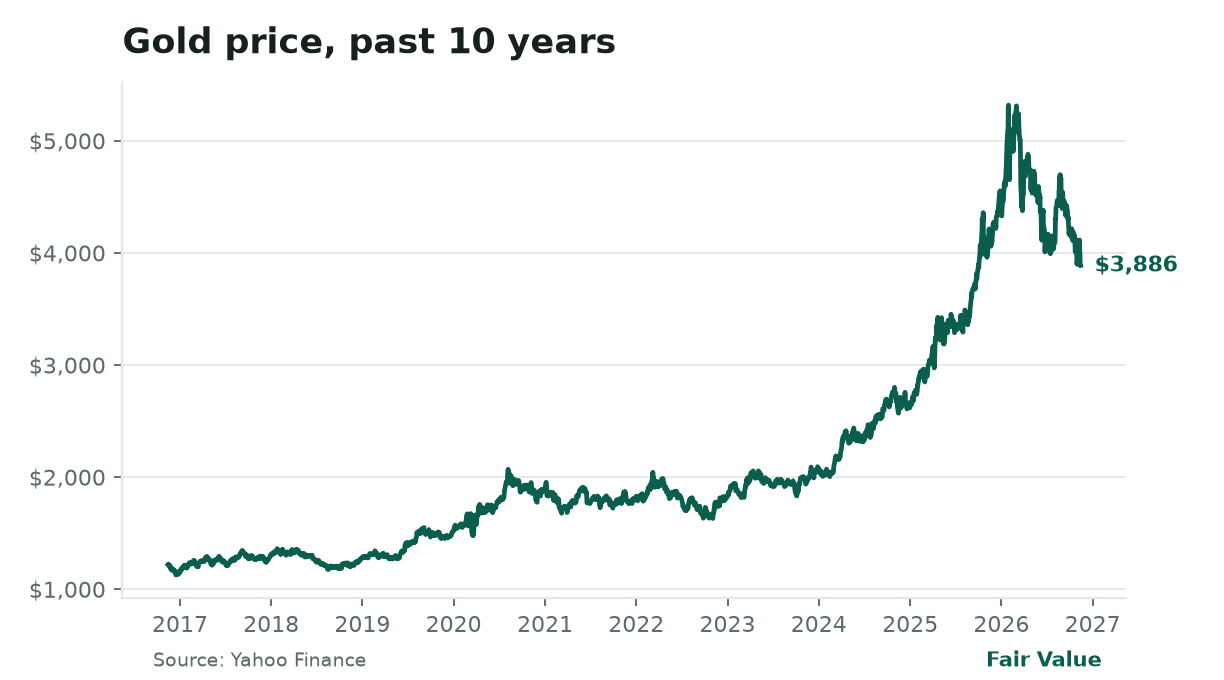 Gold near 10‑year low. Today at $3,886, the lowest since March 2020; the last time gold hovered around $3,900 was in early 2022, after which it fell to $3,300 before rebounding. |
OPEC+ output surged 2.04 million bpd in October, essentially back to pre-war levels, and Saudi Arabia's East-West pipeline (Petroline) remains operational at up to 5 million bpd capacity, bypassing Hormuz. Yet Iran's mining campaign and Houthi pipeline strikes keep the risk premium bid. Natural gas dropped 3.3% Friday to $3.23/MMBtu after U.S. underground storage rose 61 Bcf to 3,862 Bcf, roughly at the five-year seasonal norm. Refinery utilization at 95.2% keeps product stocks elevated. | | | Around the world Middle East dual-chokepoint crisis escalates. Iran's IRGC claimed two tankers, radar and positioning systems off, transiting an unauthorized route, hit naval mines in the Strait of Hormuz on November 13. Simultaneously, Houthi forces claimed drone strikes on King Khalid International Airport in Riyadh and two drones on Pumping Station No. 3 of Saudi Arabia's East-West pipeline, the critical bypass that carries up to 7 million bpd around Hormuz. Saudi air defenses intercepted seven projectiles over the preceding 48 hours, including three cruise missiles aimed at Riyadh. Earlier shrapnel caused minor damage to an Aramco administrative building. The paired attacks, aviation and energy infrastructure, suggest a deliberate strategy to maximize disruption. Brent at $95.84 embeds a significant risk premium; analysts estimate a four-week full Hormuz closure could push Brent to $120, while simultaneous Hormuz and Bab el-Mandeb closure for eight weeks could drive it to $130-$135. EU sanctions package 22. Expected to formalize Sunday, targeting Russian oil refining and the "shadow fleet" of tankers moving Russian crude outside the price cap. Nearly 1,600 individuals and entities are already sanctioned; this package aims to tighten enforcement and close loopholes. Japan wholesale inflation accelerates. October PPI rose 7.1% year-over-year, exceeding forecasts. Higher costs for oil, chemicals, steel, and utilities, amplified by a weaker yen increasing import costs, strengthen the case for a Bank of Japan rate hike in December. The BOJ held policy at roughly 0.25% on October 31 but signaled a December move; Governor Ueda independently confirmed inflation conditions for a hike. A BOJ hike would narrow the Fed-BOJ differential, potentially unwinding yen-short carry positions that have sustained USD/JPY above 157. China export controls advance. Beijing proposed adding 40 technologies, 23 in AI, 12 in photovoltaics, 5 in biopharma, to its export control list on November 3, with interim pre-export registration effective immediately and comments due November 15. Fourteen technologies are proposed for prohibition (including AI-driven malicious code generation, core large models trained on sensitive state data, perovskite/tandem cell production), 26 for restriction. This reciprocal move to U.S. chip controls creates immediate compliance burden and uncertainty for global tech collaborations. Meanwhile, China's central bank tweaked forex reserve rules to steady the yuan, and Alibaba fell 15% on a chip probe while domestic rivals SMIC and Huawei gain. Trump-Xi-Putin trilateral summit. President Trump meets Xi Jinping and Vladimir Putin in Shenzhen next week, the first such summit. The White House says nuclear arms control and Iran will be discussed; Ukraine and export controls will not. U.S. envoys arrived in Moscow November 12 for Russia-Ukraine talks with Putin, continuing the diplomatic track agreed October 22. The Trump administration's 60-day pause on new Russia sanctions (announced October 19) remains active through mid-December. | | | Companies making news Nvidia governance crisis deepens; Anthropic prices IPO. A board-led espionage probe, congressional scrutiny (Warren/Coons letters), and Commerce Secretary pressure create a leadership vacuum at the $691 billion AI capex coordination layer. Interim CEO Colette Kress inherits the Blackwell roadmap, CUDA ecosystem, and TSMC priority with no substitute at scale. Meanwhile Anthropic set its IPO range at $70-$78 per share (roughly $1.3-1.4 trillion valuation), aiming to raise up to $90.4 billion including private placement, but its S-1 reveals a $127.6 billion shareholder deficit and $587 billion in looming compute commitments, flagging natural gas, not chips, as the biggest bottleneck. Merchant semiconductors collapse. AMD fell 8.8% to $534, Broadcom declined 4.8% to $347, Marvell dropped 4.7% to $157, ARM lost 4.6% to $191. The XLK tech ETF fell 2.0%, the Nasdaq-100 slid 1.2%. Marvell is down 36% this month, Nvidia 26%, AMD 6.4%. The rout prices a bifurcation: hyperscalers keep spending but merchant semis get crushed. TSMC's $1 billion stakes in Anthropic and OpenAI signal the foundry hedging single-ecosystem exposure. Cisco and Applied Materials beat, but margins and guidance tempered enthusiasm. Cisco reported Q1 EPS of $1.40 versus a $1.33 estimate on record $18.5 billion revenue (+24% year-over-year), raised full-year revenue outlook to $74.8-75.8 billion and lifted its hyperscaler AI infrastructure target to $9 billion. Yet non-GAAP gross margin fell to 65.6% from 68.1% on higher hardware mix and memory costs. Applied Materials posted EPS of $4.16 versus $4.06 on $10.4 billion revenue (+53% year-over-year), guided Q1 revenue of $11.1 billion ±$500 million. Both stocks fell after hours on valuation and export-control concerns. Japanese banks show earnings resilience. Mitsubishi UFJ (MUFG) first-half profit rose 26% to ¥1.63 trillion, raised full-year target to ¥2.8 trillion. Sumitomo Mitsui (SMFG) EPS ¥0.59 versus ¥0.24 estimate (+146% surprise). Mizuho (MFG) roughly in line. The sector benefits from BOJ normalization expectations and widening loan spreads. Tesla opens Cybercab sales to "select" customers. The steering-wheel-free, pedal-free autonomous vehicle push comes amid a federal probe. No volume or timeline disclosed. SpaceX Starship mission hits early setback. Booster retrieval attempt scrapped after an issue emerged early in flight. No injury or pad damage reported. CVS breakup advances. Spinning off drugstores won't quiet critics but could leave shareholders with a more valuable company, per WSJ analysis. The split separates insurance (Aetna, Caremark) from retail pharmacy. Microsoft 365 global outage resolved. A 19-hour email disruption November 13, "workplace equivalent of a snow day", processed backlog by Saturday morning. Highlights concentration risk in cloud infrastructure. | | | From Washington The Fed's December decision hinges on the November 25 core PCE release. Governor Waller's November 10 speech remains the clearest signal: 25 bp base case, 50 bp if core CPI/PCE ≥0.3% month-over-month (three straight months at that pace), hold only if core PCE sustainably ≤0.2% or unemployment ≥4.5%. October core CPI was +0.3% month-over-month; core PCE for September was +0.3% month-over-month, 3.1% year-over-year. Financial conditions have tightened for seven straight weeks (NFCI -0.462), the 10-year yield at 5.10%, DXY at a one-year high, a tightening backdrop the Fed may view as doing some of its work. October PPI rose less than expected (headline +0.3% month-over-month versus 0.4% forecast), but annual PPI accelerated to 6.5%, a four-year high. Wholesale price moderation at the margin doesn't yet translate to core consumer relief. The Fed's preferred gauge, core PCE, remains at 3.1% year-over-year, well above the 2% target. Bipartisan legislation to curb presidential tariff authority is advancing. Proposed bills would require 48-hour congressional notification, rationale, and impact assessment for new tariffs. This follows the 50% tariff on specified Canadian goods (effective October 20) and Canadian retaliation, active measures now facing federal lawsuits and small-business impact reports. Democratic reversal efforts continue. Treasury Secretary Bessent publicly criticized Commerce Secretary Lutnick for delaying Nvidia chip export restrictions to China-linked firms (notably Singapore-based Megaspeed, which purchased $4 billion-plus of Nvidia advanced semiconductors). Bessent stated Treasury, State, Defense, and USTR favored adding Megaspeed to the export control list for months. White House officials reportedly discuss Lutnick's dismissal. The cabinet split complicates enforcement of technology controls at a moment when China is expanding its own export restrictions. | | | Under the hood FOCUS: Nvidia's governance crisis threatens to decapitate the AI capex supercycle just as the merchant semi complex collapses. WHY NOW: AMD crashed -8.8% (NVDA -26% 1m, MRVL -36% 1m) while frontier intelligence reveals a board-led espionage probe and CEO ouster at Nvidia, the single architectural choke-point for the $691 billion hyperscaler capex wave (95.5% of operating cash flow). The merchant semi collapse was already pricing bifurcation; now the central node faces existential governance risk. THE CHAIN: frontier (Nvidia governance crisis + accelerated model releases) → equities (merchant semis collapse, NVDA leadership risk) → plumbing (VIX +3.2% to 19.3) → crypto (BTC -11% week, Extreme Fear 13) AND rates-fed (AI productivity premium repriced in 10y yield). THE READ: The AI capex supercycle has two legs: hyperscalers deploying $691 billion TTM capex (+93.5% YoY) at 95.5% of operating cash flow, and the merchant semiconductor complex translating that spend into silicon. The merchant leg is collapsing, AMD -18.9% this week, MRVL -36% this month, NVDA -26% this month, pricing a bifurcation where hyperscalers keep spending but merchant semis get crushed. Today's governance shock at Nvidia attacks the hyperscaler leg. Nvidia's Blackwell roadmap, CUDA ecosystem, and TSMC allocation priority are the coordination layer for the entire $691 billion buildout. If leadership vacuums delay Blackwell or fracture CUDA continuity, hyperscalers cannot execute capex plans at 95.5% OCF intensity, there is no substitute supplier at scale. Meanwhile, model releases accelerate (Gemini 4 Hydrogen Nov 12, Muse Ember 1.0 Nov 10, Scribe v3, ChatGPT Wallet), raising compute demand just as the supply coordinator wobbles. The VIX rise to 19.3 and crypto grind to Extreme Fear with -$1 billion ETF outflows over five days show risk-off transmission through plumbing, while the 10-year at 5.10% holds an AI productivity premium that assumes uninterrupted capex-to-productivity conversion. A Nvidia decapitation breaks that assumption. THE SHARPER EDGE: Professionals debate whether hyperscalers can diversify fast enough, custom silicon (Google TPU, Amazon Trainium, Microsoft Maia), AMD MI300 ramp, or TSMC's new $1 billion stakes in Anthropic and OpenAI as a hedge, or if a 6-12 month Nvidia leadership vacuum freezes the entire capex pipeline. The TSMC-Anthropic/OpenAI investment is a tell: the foundry is hedging its own exposure to a single customer-ecosystem. WATCH: Nvidia board resolution timeline (weeks not months); hyperscaler capex guidance in Q4 earnings calls, any mention of "flexibility" or "phasing" confirms freeze risk; AMD MI300 revenue ramp versus NVDA Blackwell shipment data. | | | The long view: What is the Fed doing and why? The Fed is hiking because core inflation runs at a roughly 3.6% annualized pace (0.3% month-over-month × 12), well above the 2% target, alongside a tight labor market (unemployment 4.1% in October) and resilient growth fueled by AI data-center capex ($691 billion TTM, +93.5% YoY). The FOMC target range remains 3.75-4.00% with effective fed funds at 3.88%. CME FedWatch shows 89-90% probability of a 25 bp hike at the December 8-9 meeting, 11% for 50 bp, near-zero for a hold. Governor Waller explicitly tied a 50 bp move to core CPI ≥0.3% month-over-month and cited breadth concerns, over 70% of core PCE service components rising >3% year-over-year, plus new research suggesting oil-price shocks (amplified by Hormuz tanker risks adding $20-30/bbl) have more persistent effects on core inflation. The November 25 core PCE release (October data) is the key near-term catalyst: ≤0.2% month-over-month would slash 50 bp odds and could drop 25 bp probability below 50%; ≥0.3% would raise 50 bp odds above 25%. What this means for you: Mortgage rates at 7.11% (30-year fixed), auto and credit-card costs stay elevated, housing affordability near historic lows. Terminal-rate expectations rising pressure rate-sensitive assets, semiconductors and growth equities lead declines (SOXX -14% 1m, NVDA -27% 1m), while defensive sectors (XLP, XLV, XLF at multi-year highs) attract flows. The bar for a hold is core PCE sustainably ≤0.2% month-over-month or unemployment ≥4.5%. Watch the November 25 core PCE print, the December 6 jobs report, and whether dated Brent sustains above $115. | | | Worth learning today: Technology waves and General-Purpose Technologies (GPTs) Yesterday's PPI prediction question (forecast 0.4%, prior 1.3%), the result isn't in yet; we're still waiting. The question stays live. Economists use "General-Purpose Technology" (GPT) for innovations that transform the entire economy, not just one sector, steam, electricity, the internet, and now AI. The pattern: a new capability arrives, capex explodes as firms race to adopt, productivity dips during the messy buildout (Solow's "you see the computer age everywhere but in the productivity statistics"), then surges once the technology diffuses and complementary inventions emerge. Today's AI capex supercycle is the buildout phase. Hyperscalers are spending $691 billion TTM at 95.5% of operating cash flow, the highest intensity in history. Merchant semis (AMD, Broadcom, Marvell) are the "electrical equipment makers" of this wave, translating capex into compute. Nvidia's CUDA/Blackwell is the "grid standard." When the grid standard wobbles (governance crisis), the whole buildout flickers. Every prior GPT wave produced a financial bubble during the buildout (railways 1840s, electricity 1920s, internet 1990s). The bubble funds the infrastructure; the crash clears the weak hands; the infrastructure remains and enables the productivity boom. We are in the bubble-funding-infrastructure phase. The merchant semi collapse may be the "weak hands clearing", or the grid standard failing. The difference matters. Quick check: Why does a GPT wave initially lower measured productivity? Because firms spend heavily on intangible reorganization (new processes, skills, business models) that national accounts don't count as output, the "J-curve" of adoption. The payoff comes years later. |
| | | What to watch this week | ▸ | Monday, Nov 16 — , EU 22nd sanctions package on Russian oil refineries/shadow fleet formalized. Tightens enforcement, may reduce Russian supply. | | ▸ | Monday, Nov 16 — , China export control comment deadline (40 technologies, AI/photovoltaics/biopharma). Final list shapes global tech supply chains. | | ▸ | Tuesday, Nov 17 — , Nvidia earnings (after-hours), Disney earnings (pre-market). Nvidia guidance on Blackwell/CUDA roadmap under interim CEO critical. | | ▸ | Wednesday, Nov 18 — , Target earnings (pre-market). Consumer resilience test. | | ▸ | Thursday, Nov 19 — , Walmart, Alibaba earnings (pre-market). Retail and China consumer pulse. | | ▸ | Wednesday, Nov 25 — , October core PCE release (8:30 AM ET). The Fed's December hinge: ≤0.2% m/m dovish, ≥0.3% m/m hawkish. | | ▸ | December 8-9 — , FOMC meeting. 25 bp hike priced at ~90%, 50 bp at ~11%. | | ▸ | December (date TBD) — , Bank of Japan policy meeting. December hike consensus building after 7.1% wholesale inflation. |
|
| |
Not financial advice. This brief is for informational and educational purposes only and does not constitute investment advice or a recommendation to buy or sell any security. Data: macro indicators per FRED® (Federal Reserve Bank of St. Louis); not endorsed or certified by the Federal Reserve Bank of St. Louis. Energy data per the U.S. Energy Information Administration (EIA). Auction data per U.S. Treasury Fiscal Data. Filings per SEC EDGAR. Market prices per Yahoo Finance. Earnings calendar per Financial Modeling Prep. Crypto data per Binance and CoinGecko. WSJ headlines per WSJ RSS feeds. |
|
