Brent crude jumped 15.9% to $88.10 a barrel, its biggest weekly gain since April, after Houthi attacks and U.S. airstrikes slowed traffic through the Strait of Hormuz. Retail gas prices could climb 10-15 cents per gallon next week.
▸
Semiconductor stocks led a tech pullback, with the Nasdaq-100 down 4.1% as China’s Kimi K3 AI model matched U.S. benchmarks, raising doubts about the chip sector’s spending boom.
▸
Bitcoin stayed near $64,500 while Ethereum rose 3.3%, but the bigger story was tokenized real-world assets, which hit a record $33.5 billion on-chain, a sign of growing institutional interest.
The week that was: Oil shocks and AI doubts collide
Two themes dominated: energy disruptions and questions about AI’s near-term payoff. The risk-off mood was so strong that even defensive stocks like Coca-Cola (-4.0%) and Kraft Heinz (-3.2%) fell.
Oil’s surge: The inflation wildcard
Brent crude had its biggest weekly rally since April, rising 15.9% to $88.10 a barrel, as geopolitical tensions squeezed the Strait of Hormuz, a route for about 20% of global oil shipments. Iran-backed Houthi attacks on Saudi infrastructure and a U.S. missile strike in Jordan cut tanker traffic to 10 vessels in 24 hours, down from the usual 60 per day.
The ripple effects:
▸
Gasoline futures climbed 8.9%, likely pushing pump prices up 10-15 cents per gallon next week.
▸
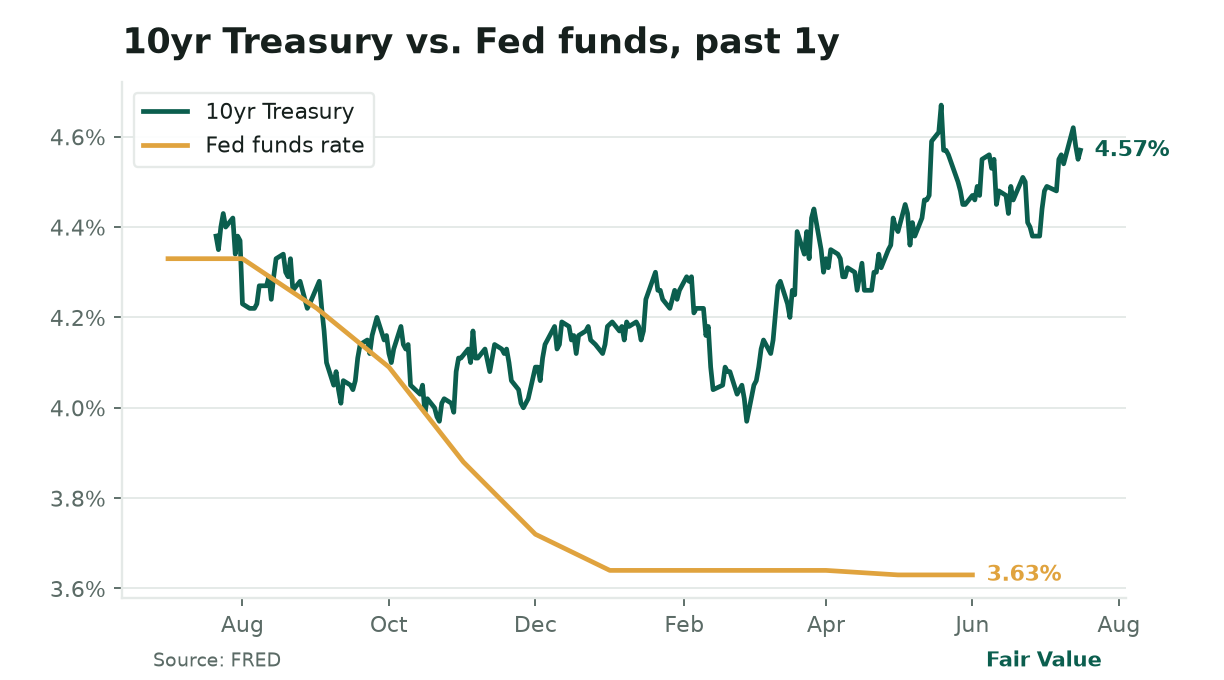
Traders wiped out September Fed rate-cut bets, pricing in near-zero odds as oil’s spike threatened to reignite inflation. The 10-year Treasury yield rose 8 basis points to 4.57%.
▸
The U.S. Dollar Index inched up 0.3%, though gains were limited amid broader instability.
For consumers:. Higher fuel costs could squeeze discretionary spending, complicating the Fed’s inflation fight.
AI’s hangover: When the future gets priced in
Semiconductor stocks kept falling, with the Nasdaq-100 down 4.1% (and 5.9% for July). NVIDIA dropped 3.9%, AMD fell 11.1%, and Marvell lost 23% over two weeks, erasing nearly all of its 2026 gains.
The trigger? China’s open-source Kimi K3 AI model, which matched U.S. benchmarks in key tests. This undercut the idea that U.S. dominance in AI would justify the chip sector’s massive spending. Now, investors are asking whether the outlays will pay off.
Meta’s 13% midweek rebound, driven by repositioning its $50 billion Louisiana data center as a cloud-compute hub, showed the market’s hunger for clear monetization. Yet the Philadelphia Semiconductor Index fell 8.3% for the month, giving back most of its 2026 gains.
Crypto’s quiet institutional shift
Bitcoin hovered around $64,500 (down 0.5% on the week), while Ethereum rose 3.3%. The real movement happened off-chain:
▸
Tokenized real-world assets on-chain hit $33.5 billion, a milestone for Wall Street’s blockchain adoption.
▸
Regulatory uncertainty remained: The CLARITY Act, which would clarify U.S. crypto oversight, stayed stalled, and the Fed missed its deadline for stablecoin rules.
The takeaway:. Crypto’s resilience now reflects infrastructure growth more than speculation, but without clear rules, volatility risks remain.
The defensive trade that failed
Oil shocks and tech declines usually push money into defensive sectors. This week, even those bets struggled:
▸
Coca-Cola (-4.0%), Kraft Heinz (-3.2%), and Home Depot (-2.6%) all fell.
▸
The reason: Consumer staples face rising input costs, weak snack demand from GLP-1 drugs, and frustration over slow growth.
When safe havens stumble, the message is clear: a broad risk-off mood has set in.
The big question this week: Can the Fed afford to wait?
The Federal Reserve insists inflation is cooling and rate cuts are coming. Then Brent crude soared 15.9%, bond yields spiked, and markets started pricing a September hike, not a cut. Now, the Fed’s credibility is on the line, with this week’s global inflation data set to decide whether policymakers hold firm or change course.
Bond market rebels against Fed cuts. The 10-year yield (4.57%, up 20bps in a month) now sits 41bps above the Fed funds rate (4.16%), pricing out September cuts. Oil’s surge added 0.3-0.5% to CPI forecasts, forcing traders to bet on hikes instead.
The bond market’s rebellion
Key moves:
▸
10-year Treasury yield: 4.57%, up 20 basis points over the past month.
▸
2-year yield: 4.16%, rising fast as traders bet on tighter policy.
▸
Futures now imply a September hike, a sharp turn from rate-cut expectations.
The signal:. Bond markets doubt the Fed’s “transitory inflation” story. With oil’s jump likely to add 0.3-0.5 percentage points to headline CPI, incoming data may back those doubts.
The Fed’s no-win scenario
▸
If the Fed hikes: Mortgage rates (already at 6.55%) could near 7%, credit card APRs would rise, and growth stocks would face more pressure.
▸
If the Fed holds: The dollar might weaken, but stubborn inflation could hurt the central bank’s credibility.
The wildcard?. This week’s global CPI reports (Canada, New Zealand, the UK, Australia) and Friday’s flash PMIs. Stronger-than-expected numbers could force the Fed to act.
Watch the ECB first
The European Central Bank’s rate decision (Thursday) will set the tone. If President Lagarde hints at a hike, she gives the Fed cover to stay hawkish. A dovish tone, though, could encourage the Fed to stick with its “patient” stance, betting oil’s spike fades.
Bottom line:. The debate has shifted from whether the Fed hikes to whether it can afford not to. The answer depends on two things: oil’s next move and Friday’s PMIs.
The week ahead: Inflation data and the AI profit test
Monday, July 20
Canada CPI m/m (8:30 AM ET), Forecast: -0.2% (vs. +1.0% prior). The first of four inflation reports this week. A softer number would ease pressure on the Bank of Canada, and, by extension, the Fed. But a higher reading could signal oil’s surge is lifting broader prices.
Tuesday, July 21
UK Claimant Count Change (2:00 AM ET), Expected: 28.3K (vs. 31.2K prior). Weakness in the UK job market could push the Bank of England toward a dovish hold, a negative for sterling but a potential boost for UK stocks.
Wednesday, July 22
UK CPI y/y (2:00 AM ET), Consensus: 2.7% (vs. 2.8% prior). If inflation stays above 2.7%, the BoE may delay cuts, weighing on UK equities and the pound.Australia Employment Change (9:30 PM ET), Forecast: +15.2K (vs. +40.3K prior). A weak report could spark rate-cut talk from the RBA, sending the Australian dollar lower.
Thursday, July 23
ECB Rate Decision (8:15 AM ET), Expected: 2.40% (unchanged). The first major central bank to meet after the oil shock. If Lagarde suggests a hike, the euro could rise, and the Fed’s path gets trickier.Earnings:Tesla (TSLA), AT&T (T), Intel (INTC).
▸
Tesla’s margins — Steady or still shrinking?
▸
AT&T’s wireless growth — Can it keep adding subscribers?
▸
Intel’s AI shift — Is its foundry business turning around?
Friday, July 24
Flash PMIs (global, 9:45 AM ET), July’s first look at business activity. If services and manufacturing PMIs fall below 50 (contraction), the “soft landing” story weakens. Strength would give the Fed more room to wait.
The earnings litmus test: AI spending vs. AI profits
Reports from Google (GOOGL), Tesla (TSLA), Intel (INTC), and AT&T (T) will test a key question: Is the AI spending wave turning into revenue?
▸
Google’s cloud unit — Can it monetize AI fast enough to justify its costs?
▸
Tesla’s margins — Has the price-cutting war ended?
▸
Intel’s foundry business — Signs of progress, or more empty promises?
After this week’s chip selloff, expectations are high.
Worth learning today: Funds and ETFs, why “buying the haystack” wins
Today’s lesson: pooled investing, the default approach for institutional money, and why it matters more than ever in a high-rate, Fed-paused world.
We’re still waiting on the GBP GDP m/m result from July 16, we’ll revisit the prediction in tomorrow’s edition.
The PayPal case study: How most investors actually win
On July 15, PayPal shares jumped 17% after reports of a $53 billion buyout offer, a 27% premium to its prior close. Most beneficiaries didn’t own the stock directly, they held it through the S&P 500, Nasdaq-100, or a tech ETF. When the deal broke, their shares rose too, without needing to pick the stock.
This is pooled investing: buying a diversified basket of assets (the fund) instead of betting on single names. The basket either tracks an index (like the S&P 500) or follows a set strategy (e.g., “high-dividend growth”).
How it works (and why fees matter)
▸
The pool: Investor money is combined to buy underlying assets, stocks, bonds, commodities, based on the fund’s rules.
▸
Index vs. active management:
▸
Index funds (passive): Mirror a benchmark (e.g., Vanguard’s VOO holds all 500 S&P companies). Fees often run 0.03% or less.
▸
Active funds: Managers pick securities to beat the benchmark. Average fee: 0.65%. The catch? 85% underperform their index over 10 years, per S&P Dow Jones Indices.
▸
The compounding cost of fees: A 1% annual fee can cut 25% of returns over 30 years. Low-cost index funds (like Fidelity’s FZROX, with zero fees) dominate long-term performance.
The debates professionals actually have
Even active managers now agree most investors should build portfolios around index funds. But debates remain:
▸
Smart beta: Funds like RAFI weight holdings by factors (value, momentum) instead of market cap. Fees are higher, and outperformance isn’t guaranteed.
▸
Thematic ETFs: Vehicles like ARKK (disruptive innovation) or ICLN (clean energy) offer trend exposure without picking winners. The tradeoff? ICLN is still 40% below its 2021 peak.
▸
Tax efficiency: ETFs generally trigger fewer capital gains distributions than mutual funds, a key advantage in taxable accounts.
**Why this matters *right now***
▸
The PayPal deal in microcosm: Most investors miss 17% single-stock surges. An S&P 500 index fund delivers a piece of that gain, plus exposure to 499 other companies.
▸
The Fed’s pause changes the math: With cash yielding 5%, the cost of stock-picking rises. Index funds offer market participation without the guesswork.
Concept 9 of 83 in the Fair Value course.
Tomorrow’s question (mechanism only):. If Canada’s CPI m/m (Monday, forecast: -0.2%) comes in above zero, which way would the 2-year Treasury yield likely move, and why? (Hint: Start with the Bank of Canada’s likely reaction, then consider the Fed’s response.)
Not financial advice.This brief is for informational and educational purposes only and does not constitute investment advice.
Data sources: Macro indicators via FRED®; energy data via U.S. Energy Information Administration; market prices via Yahoo Finance; earnings calendar via Financial Modeling Prep.