$88 oil just upended the Fed’s plans, Brent crude’s 15.9% weekly jump will likely push June’s headline PCE to 2.8-3.0%, forcing the Fed to weigh easing against inflation. Mortgages, credit cards, and savings rates now hang in the balance.
▸
AI’s hardware backbone is straining, Copper at $14,000 per ton (droughts, tariffs, acid shortages) and China’s Kimi K3 AI designing chips in 48 hours are pressuring Synopsys (-8%) and Cadence (-12%). The $252 billion AI expansion faces a supply-chain crunch.
▸
Copper isn’t just a commodity, it’s the bottleneck for data centers and EVs. With 20% of global mines at risk, this squeeze isn’t easing anytime soon.
The big story
$88 oil just rewrote the Fed’s playbook
You’ve seen it at the pump: $4.00 per gallon, up 10% in a month. That spike is about to ripple through the economy, and the Fed’s carefully laid plans.
Brent crude closed Friday at $87.99, up 15.9% for the week and 28.4% for the month. This isn’t just another oil surge. It’s a regime change that forces the Fed to confront a harsh reality: Its easing timeline now clashes with inflation’s resurgence.
The numbers paint the picture:
▸
Strait of Hormuz traffic: 5% of normal (effectively blocked).
▸
U.S. crude inventories: Down 1.69 million barrels last week.
▸
Refinery utilization: 96.2%, demand is outpacing supply.
▸
Geopolitical risk premium: $10-$15 per barrel.
Historically, a $10 oil rally adds 0.4-0.6 points to headline CPI within three months. With June PCE data due Friday, the math is stark:
▸
Core PCE: 2.2% (the Fed’s target zone).
▸
Headline PCE: 2.8-3.0% (thanks to oil).
That’s a 60-80 basis-point gap between the Fed’s assumptions and reality.
The ripple effects spread fast:
▸
10-year Treasury yield: 4.56% → 4.70%+ if PCE confirms the shock.
▸
Mortgage rates: 6.55% → 6.75%+.
▸
Credit card APRs: Tied to the prime rate, no relief in sight.
▸
S&P 500’s discount rate: +25 basis points, a headwind for growth stocks like Netflix (-7.3%) and Tesla (-2.6%).
The Fed’s internal split widens:
▸
One camp: “Transitory supply shock” (like 2022).
▸
The other: “Persistent demand shock” (like 2008).
Two signals to track:
▸
10-year/5-year yield spread (now 25 basis points). If it widens to 40+, the market is betting on lasting inflation.
▸
Term premium: A spike means the Fed’s financial stability concerns (per Governor Jefferson) may override its inflation mandate, delaying cuts into late 2026.
The takeaway. Gas prices hurt, but the real impact hits mortgages, credit cards, and savings rates. The bond market’s message is clear: The Fed’s easing cycle may already be off the table.
What's going on today
This week’s pivot: Can the Fed cut with oil at $88?
The market’s opening question: Will $88 oil derail the Fed’s easing plans?
Weekend moves set the tone:
▸
Brent crude: $88 (+5.6% for the week).
▸
WTI crude: $81.29 (+4.0%).
▸
U.S. crude inventories: Down 1.69 million barrels.
▸
Gasoline stocks: Down 1.53 million barrels.
▸
Refinery utilization: 96.2%, demand is winning.
Bonds reacted first:
▸
10-year Treasury yield: 4.56% (+8 basis points for the week).
Growth stocks: Netflix (-7.3%), Meta (-2.8%), Nvidia (-2.2%), Tesla (-2.6%).
▸
Defensives: Coca-Cola (-4.0%), Home Depot (-2.6%).
▸
Energy winners: Occidental (+2.3%), Exxon (+1.0%).
Geopolitics darkened over the weekend:
▸
Two U.S. servicemembers killed in Iran’s missile strike on a Jordan base.
▸
Strait of Hormuz: Still closed (5% of normal traffic).
▸
Bab el-Mandeb threat: Iran instructed Yemen’s Houthis to prepare to block the Red Sea choke point if the U.S. retaliates. That risks 20% of global oil supply and 7% of trade.
Then there’s the AI supply-chain crunch:
▸
Copper: $14,000 per ton, driven by Chile’s drought, sulfuric acid shortages, and U.S. tariffs.
▸
China’s Kimi K3 AI: Designed a chip in 48 hours, crushing Synopsys (-8%) and Cadence (-12%).
Wednesday: ECB meeting, markets expect a 25-basis-point cut, but the Fed’s move could delay it.
▸
Friday: June PCE report. The critical threshold:
▸
Above 2.8%: Fed pause, 10-year yield → 4.70%+, September cut off the table.
▸
Below 2.6%: Oil shock dismissed, easing resumes.
The bottom line. This week isn’t about earnings or GDP. It’s about one number, Friday’s PCE print, and whether it forces the Fed to admit $88 oil changed the game. If it does, September rate cuts disappear, yields climb, and borrowing costs stay higher for longer. If not, we’re back to “transitory.” Either way, oil isn’t just a headline, it’s the first domino.
The big picture
Bonds say inflation. Oil says crisis. The Fed’s caught in between.
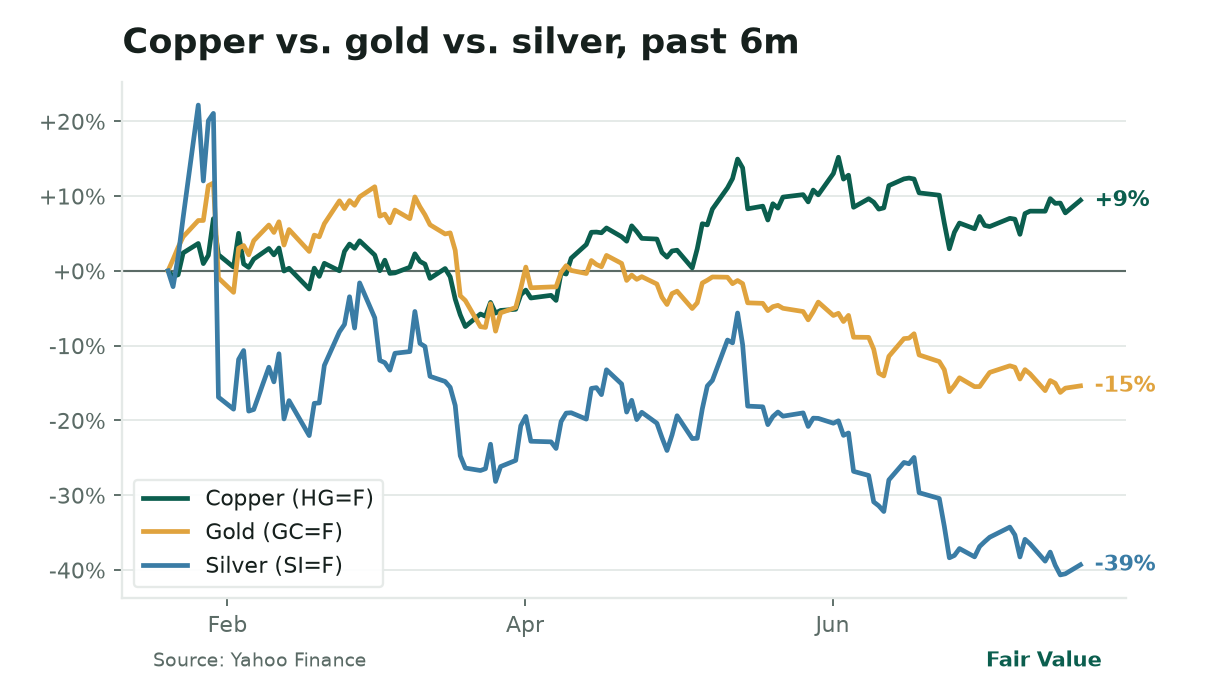
Copper’s supply crunch stands out. While gold (+0.3%) and silver (+2.1%) drifted, copper surged 1.7% to $6.325/lb, driven by Chile’s drought, acid shortages, and tariffs. At $14,000/ton, it’s the AI/data-center bottleneck, pressuring stocks like Synopsys (-8%) and Cadence (-12%).
Two markets, one collision.
Bonds are pricing in higher inflation:
▸
10-year Treasury yield: 4.56% (+8 basis points for the week).
Gasoline stocks: Down 1.53 million barrels (consumption remains strong).
▸
Distillates: +4.56 million barrels (refiners stockpiling ahead of demand).
The disconnect. The Fed’s July minutes still assume inflation is “near 2%.” Friday’s PCE report will test that. Core PCE sits at 2.2%, but headline, with oil’s surge, will likely hit 2.8-3.0%. If it does:
Copper: +1.7% to $6.325 per pound, supply squeeze from Chile’s drought, acid shortages, tariffs.
▸
Gold: $4,024.70 per ounce (+0.3%).
▸
Silver: +2.1% to $57.23 per ounce.
▸
Natural gas: -2.2% to $2.848 per MMBtu (inventories building).
▸
CRB Index: +0.5%, but it’s all oil. Natgas down 12.5% this month.
Stocks reflect the tension:
▸
S&P 500: -1.0% for the week.
▸
Nasdaq-100: -1.5%.
▸
Dow: -0.8%.
▸
Russell 2000: -0.4% (small caps hurt more by higher rates).
▸
Sector performance:
▸
Energy (XLE): +4.7%.
▸
Tech (XLK): -5.5%.
▸
Communication Services (XLC): -1.8%.
▸
Consumer Discretionary (XLY): -1.5%.
▸
VIX: 18.38 (+7.1%).
The Fed’s reaction is everything:
▸
Current pricing: 50% chance of a July cut, September cut locked in.
▸
If PCE > 2.8%: Pricing resets, no July cut, September in doubt.
▸
If 10-year yield > 4.70%: Confirms structural repricing.
▸
If Fed pauses in July (not just September): Signals a longer-term shift.
Geopolitics remain the wild card. Further Middle East escalation could push oil to $95+, forcing the Fed’s hand even sooner.
Around the world
The Middle East isn’t just an oil problem, it’s a shipping crisis
The Strait of Hormuz remains 95% closed after Iran’s February 28 attacks, with traffic at 5% of normal. Iran approves only a few vessels daily, mostly those hugging its northern coast. U.S. and EU sanctions haven’t reopened the strait. Now, Iran has ordered Yemen’s Houthis to prepare to close the Bab el-Mandeb Strait, the Red Sea’s choke point, if the U.S. strikes Iranian targets. A double blockade would threaten:
▸
20% of global oil supply.
▸
7% of world trade.
The Red Sea route to Europe already operates at 49% of pre-crisis capacity. A Bab el-Mandeb closure would send shipping costs soaring. Qatar, a key LNG supplier to Europe, declared force majeure on all exports after Iranian drone strikes hit its facilities. Over the weekend, two U.S. servicemembers died in Iran’s missile attack on a Jordan base, prompting U.S. retaliatory strikes.
Currencies react:
▸
U.S. dollar (DXY): 100.81 (safe-haven demand).
▸
Australian dollar (AUD/USD): 0.7001 (commodity pressure).
▸
Canadian dollar (USD/CAD): 1.4030 (oil exposure).
▸
British pound (GBP/USD): 1.3463 (steady).
▸
Japanese yen (USD/JPY): 162.41 (near multi-decade lows despite verbal intervention).
China adds another layer:
▸
Taiwan pressure: Beijing expanded its campaign to isolate Taiwan, targeting everything from children’s choirs to baristas. TSMC shares fell 2.8% on supply-chain fears.
▸
Oil maneuver: China rushed out $6 billion worth of oil during a U.S. truce, sending ~20 tankers to Asia (likely China). Short-term win, but long-term risk: The U.S. and allies may accelerate supply-chain diversification away from China, especially for rare earth minerals critical to EVs, renewables, and defense.
Europe’s balancing act:
▸
ECB meeting (Wednesday): Markets expect a 25-basis-point cut, but a Fed pause could delay that.
▸
Euro (EUR/USD): 1.1434 (steady).
▸
Swiss franc (USD/CHF): 0.8081 (safe-haven flow).
▸
UK inflation (Tuesday): If CPI > 2.7%, the Bank of England may delay its own cuts.
Space race accelerates:
▸
Skyroot Aerospace (India): Successfully launched its Vikram-1 rocket, making India the third nation (after U.S. and China) with private orbital capability.
Why it matters: Securing critical mineral supply chains and dominating satellite communications/surveillance.
Companies making news
Netflix slips, Meta’s $50 billion bet, Tesla’s China challenges
Netflix (-7.3%). Shares fell to $68.95 (down 10.9% this month) after its 10-Q filing revealed slowing subscriber growth and higher content costs. The streaming leader isn’t immune to consumer spending pullbacks.
Meta (-2.8%). Stock dropped to $646.01 as investors digest the $50 billion+ cost of its Hyperion data center in Louisiana (now 5 gigawatts, up from 2). 2026 capex guidance rose to $125-145 billion (from $115-135 billion) due to higher component costs. Copper at $14 per pound and Synopsys/Cadence’s crash (-8%/-12%) signal AI’s hardware costs are spiraling.
Tesla (-2.6%). Fell to $380.84 (down 6.6% this week, 4.9% this month) as China’s Kimi K3 AI demonstrated autonomous chip design in 48 hours, a direct threat to Tesla’s Full Self-Driving (FSD) ambitions. BYD and other Chinese EV makers are gaining share, and Gigafactory Shanghai faces rising copper/lithium costs. Stock now 20% off 2026 highs.
Coca-Cola (-4.0%). Even defensives aren’t safe. KO dropped to $81.56 (worst day in months), erasing $20 billion in market cap. Peers Pepsi (-1.7%) and Procter & Gamble (-1.0%) also weakened. Message: When the 10-year yield rises and VIX hits 18.38, no sector is truly “safe.”
Goldman Sachs (-2.8%). Dragged financials lower after disappointing trading revenues and warnings of higher funding costs if the Fed pauses. KBW Bank Index (BKX): -0.9%. JPMorgan (-0.6%), Morgan Stanley (-1.3%). Bright spot: Regional banks like U.S. Bancorp and Fifth Third outperformed, benefiting from higher net interest margins in a “higher for longer” rate environment.
Occidental Petroleum (+2.3%). Bucked the trend, rising to $54.86 (+5.9% this month) on stronger Permian Basin production and $88 oil. Exxon (+1.0%) and Chevron (+1.9%) also gained. Energy is the only sector in the green today.
Lockheed’s Patriot missile shift. Announced a lower-cost Patriot missile (half the price, faster deployment). Could reshape defense spending, shifting billions from high-end systems to mass-producible alternatives. Tailwind for Lockheed, headwind for Raytheon.
Prologis’ $18.2 billion Segro bid rejected, again. Third offer failed despite a 33.8% premium. Highlights the valuation gap between U.S. and European real estate. Prologis (-0.9%) slipped; Segro likely to drop when London opens.
From Washington
The Fed’s oil dilemma: Cut or fight inflation?
This week’s June PCE report (Friday, 8:30 a.m. ET) decides the Fed’s next move. The central bank’s July minutes assumed inflation was “near 2%,” but $88 oil shreds that assumption.
PCE < 2.6%: Oil shock dismissed, September cut back on.
Political pressure grows:
▸
Sen. Elizabeth Warren (D-MA): “Pause cuts until inflation is clearly under control.”
▸
Sen. Rick Scott (R-FL): “Fed’s easy-money policies are fueling inflation.”
▸
White House: Wants lower rates to ease consumer borrowing but can’t appear soft on inflation ahead of midterms.
Fed Chair Powell’s bind:
▸
Cut with oil at $88 → Risks looking behind the curve.
▸
Pause → Risks a market tantrum.
DOJ eases up on corporate crime.Wall Street Journal reported prosecutors declined to charge businesses in several cases, even with evidence of employee wrongdoing. Shift reflects Biden’s focus on individual accountability over corporate penalties, a win for big business but potential moral hazard.
SEC ramps up enforcement. Charged 11 firms (including Goldman, Morgan Stanley, Bank of America) for failing to preserve electronic communications. Crypto crackdown continues: CFTC investigates Binance and Coinbase for potential derivatives manipulation.
Treasury’s stablecoin delay. Missed the July 18 deadline for finalizing GENIUS Act rules, leaving Circle (USDC) and Paxos (USDP) in limbo. More time to lobby, but also more uncertainty.
Under the hood
How oil’s rally forces the Fed’s hand
Oil’s surge isn’t just about gas prices, it’s rewiring the Fed’s inflation playbook. Here’s the transmission chain:
▸
Oil → Inflation:
▸
Brent’s 15.9% weekly rally lifts headline CPI by 0.4-0.6 points in three months (Fed estimate).
▸
June PCE (Friday): Core at 2.2%, but headline 2.8-3.0% if oil holds.
▸
Gap: 60-80 basis points between Fed’s “near 2%” assumption and reality.
▸
Inflation → Fed:
▸
July minutes still assume a September cut.
▸
PCE > 2.8% forces a pause.
▸
Market pricing: 50% chance of July cut, September seen as certain, both collapse if PCE runs hot.
▸
Fed → Bonds:
▸
10-year yield: 4.56% → 4.70%+.
▸
Term premium (extra yield for long-term debt) jumps on inflation fears.
Fed pauses in July (not just September): Signals longer-term shift.
Worth learning today: CPI, how inflation is measured
Why your inflation feels different from the official number
You paid $4.00 per gallon today, up 10% in a month. That’s your inflation. But the Bureau of Labor Statistics (BLS) measures CPI (Consumer Price Index) differently. Here’s why the numbers don’t always match:
▸
The Basket:
▸
BLS tracks 36,000 households to build a basket of 8 categories: food, housing, apparel, transportation, medical care, recreation, education, “other.”
▸
Weights matter:
▸
Housing (shelter): 32% of CPI.
▸
Gasoline: 3.8%.
▸
Even if gas spikes, CPI may not move as much as you feel.
▸
Core vs. Headline:
▸
Headline CPI: Includes food + energy (volatile).
▸
Core CPI: Excludes food + energy (Fed’s preferred gauge).
▸
Right now:
▸
Headline CPI: Pushed up by $88 oil.
▸
Core CPI: Stickier (rent, wages).
▸
Your Inflation ≠ Average Inflation:
▸
CPI is an urban consumer average. Your spending mix differs.
▸
Drive a lot? Gas matters more to you.
▸
Rent in a hot market? Your shelter costs (32% of CPI) may rise faster than the national average.
▸
BLS adjusts for quality changes (e.g., a better iPhone may not count as pure inflation), which can understate how much prices feel like they’re rising.
▸
Fed’s Dilemma:
▸
Targets 2% inflation but uses PCE (Personal Consumption Expenditures), not CPI.
▸
PCE vs. CPI:
▸
PCE includes rural consumers, adjusts weights monthly.
▸
CPI uses fixed weights.
▸
Right now:
▸
Core PCE: 2.2% (Fed’s comfort zone).
▸
Headline PCE: About to jump due to oil, forcing the Fed to react even if core is tame.
Link to past lessons:
▸
Inflation intuitively: Too much money chasing too few goods (why prices rise).
Not financial advice. Disclaimer: Fair Value is not investment advice. Data is as of July 19, 2026, 4:00 p.m. ET. You should not buy, sell, or hold any security based on this briefing. Past performance is not indicative of future results. Consult a financial advisor.
Data sources: Bloomberg, LSEG, FactSet, Federal Reserve, BLS, EIA, CME Group, Bank of Canada, Eurostat, Reserve Bank of New Zealand, Qatar Ministry of Energy, U.S. Department of Defense, Skyroot Aerospace, SpaceX, Netflix 10-Q, Meta investor relations, Tesla China, Coca-Cola earnings release, Goldman Sachs 10-Q, Occidental Petroleum investor presentation, Lockheed Martin press release, Prologis filings, CFTC, SEC, U.S. Treasury.