Brent crude jumped 4.6% to $88.10 as Strait of Hormuz tensions flared, pushing gasoline prices higher and slashing September Fed rate-cut expectations to near zero. Mortgages, credit cards, and savings accounts all feel the ripple.
▸
Semiconductor stocks continued their slide (Nasdaq down 4.1% this week, NVDA -3.9%) after China’s open-source Kimi K3 AI model matched U.S. benchmarks, raising doubts about the chip industry’s trillion-dollar investment wave.
▸
Bitcoin held near $64,000, while Ethereum rose 3.2% this week as tokenized real-world assets on-chain neared $33.5 billion, a sign of growing institutional engagement.
The big story
$88 oil forces the Fed’s hand, and reshapes household budgets
The Strait of Hormuz is now effectively closed. Oil prices have spiked. And the Federal Reserve’s carefully laid plans for rate cuts now face an inflationary shock with no clear path forward.
Brent crude’s 4.6% leap to $88.10, a three-month high, isn’t just another price swing. It’s a turning point for monetary policy and everyday finances. Here’s how it unfolds:
A critical chokepoint shuts down. Iran’s Revolutionary Guard reported two oil tankers hitting mines Friday, bringing traffic through the Strait of Hormuz to a halt. This narrow passage handles one-fifth of global oil trade, and unlike past disruptions, traders now expect weeks of delays, not days, as Tehran reinforces its blockade with additional missile systems.
The immediate fallout:
▸
Gasoline prices rise fast. With Brent at $88, U.S. regular unleaded, now averaging $4.00 per gallon, could climb to $4.20-$4.40 within two weeks, adding $20-$30 per fill-up for most SUV drivers.
▸
The Fed’s credibility is tested. After years of fighting inflation, easing policy now would undercut its progress. Bond markets agree: the 10-year Treasury yield stayed at 4.57%, while the 2-year yield held at 4.16%, signaling little hope for a September cut.
▸
Stocks pull back. Higher yields reduce the value of future earnings, dragging the Nasdaq down 1.5% Friday and 5.9% for July.
Escalating tensions. U.S.-Iran clashes intensified after American airstrikes hit Iranian supply lines. With Tehran showing no signs of backing down, a prolonged standoff could mean higher oil prices, and stubborn inflation, for months.
Key levels to watch:
▸
Brent crude staying above $85 for two more weeks → The Fed’s September meeting likely ends with no rate cut.
▸
10-year Treasury yield breaking 4.75% → Stocks could face steeper declines.
▸
National gasoline average reaching $4.50 → Consumer spending, the backbone of the U.S. economy, starts to weaken.
What's going on today
Oil’s surge overshadows mixed market moves
Markets ended Friday with conflicting signals: energy-driven inflation fears dominated, while crypto and AI sectors quietly advanced.
Oil’s grip on risk assets tightens. Brent’s 4.6% jump to $88.10 and WTI’s 4.5% rise to $82.49 didn’t just reflect supply worries, they rewrote the inflation outlook. The Strait of Hormuz saw no tanker traffic Friday as Iran’s Revolutionary Guard strengthened its blockade with more missile deployments. The ripple effects:
▸
Gold rose 0.68% to $4,013 as investors sought safety.
▸
Energy stocks (XLE +1.16%) led gains, while utilities (XLU -0.66%) also edged higher as traders turned defensive.
Tech’s targeted selloff. The Nasdaq’s 1.5% Friday drop (and 5.9% monthly decline) wasn’t broad, it centered on semiconductors. Nvidia (-2.2%), TSMC (-2.8%), and AMD (-1.0%) fell after China’s Moonshot AI unveiled Kimi K3, an open-source model matching U.S. AI performance at lower cost, calling into question the sector’s heavy spending on growth.
Crypto’s institutional groundwork strengthens. Bitcoin ($63,988) and Ethereum ($1,845) showed little price movement Friday, but adoption accelerated behind the scenes:
▸
Visa rolled out a stablecoin settlement platform for 15,000 banks and 200 million merchants.
▸
Tokenized real-world assets (RWAs) on-chain hit $33.5 billion, triple last year’s total.
Dollar edges higher, but cross-currencies tell the story. The DXY index ticked up 0.02% to 100.75, but bigger moves played out elsewhere:
▸
Yen (USD/JPY) fell to 162.35, a 24-year low.
▸
Euro (EUR/USD) slipped 0.22% to 1.1446 as energy costs weighed on the currency.
Weekend focus:
▸
Oil futures. If Brent holds above $90, U.S. gasoline could rise 10-15 cents per gallon by Monday.
▸
Crypto activity. Ethereum’s 24-hour volume ($29.6 billion, 12% above its weekly average) points to strong institutional interest despite stable prices.
The big picture
Oil, AI, and crypto: Three markets, one driving force
The global economy is sending three conflicting signals. Oil warns of inflation, tech faces a valuation reckoning, and crypto builds institutional infrastructure. The unifying thread: energy-driven macro volatility.
1. Oil: Inflation’s comeback. Brent’s 15.9% weekly surge to $88.10 and WTI’s 15.5% jump to $82.49 mark the sharpest rallies since Russia invaded Ukraine in 2022. The trigger: U.S.-Iran tensions escalated Friday when Iran’s Revolutionary Guard reported two tankers hitting mines in the Strait of Hormuz, halting all traffic through the world’s most critical oil chokepoint.
This isn’t just a regional conflict, it’s a policy crisis for the Fed. Energy makes up 15% of the CPI basket, and $88 Brent could push headline inflation up by ~0.7% within a month.
2. Tech: AI’s valuation reset. The Nasdaq’s 1.5% Friday decline (and 5.9% monthly drop) was led by semiconductors. The catalyst: China’s Moonshot AI released Kimi K3, a 2.8-trillion-parameter open-source model that matches U.S. AI performance at a fraction of the cost, challenging the narrative of unmatched American dominance.
3. Crypto: Institutional adoption grows. Bitcoin ($63,988) and Ethereum ($1,845) traded flat Friday, but infrastructure made strides:
▸
Visa’s new stablecoin platform connects 15,000 banks to digital-asset settlement.
▸
Tokenized RWAs on-chain reached $33.5 billion, up from $11 billion a year ago.
Next week’s turning points:
▸
Brent crude at $90 → A September Fed rate cut becomes unlikely.
▸
Fed commentary → Every word on inflation tolerance will be scrutinized.
Around the world
Strait of Hormuz closure rattles global markets
The Strait of Hormuz, a 21-mile waterway carrying 20% of global oil trade and 25% of liquefied natural gas (LNG) exports, is effectively closed after Iran’s Revolutionary Guard reported two tankers hitting mines Friday and stopped four others. The U.S. responded with airstrikes on Iranian bridges, setting the stage for a prolonged standoff with three immediate effects:
1. Oil prices climb. Brent’s 4.6% jump to $88.10 is likely just the start. The last full closure (2019, after Iran seized a British tanker) sent prices 20% higher in 30 days. Today’s risks are greater:
▸
Saudi Arabia’s main export route is blocked.
▸
Iraq’s Basra terminal (3.4 million barrels/day) faces disruptions.
2. Dollar strengthens as safety demand rises. Geopolitical shocks usually lift U.S. Treasuries and the dollar. While the DXY index barely moved Friday, emerging-market currencies took a hit:
▸
Indian rupee: Down 0.3% against the dollar, its worst week in months.
▸
South African rand: Fell 0.8% as higher energy import costs strained the trade deficit.
3. China secures energy and tech alternatives. As Washington and Tehran trade strikes, Beijing is locking in backups:
▸
CNOOC signed a 20-year LNG deal with Qatar, avoiding Hormuz entirely.
▸
"Moonshot AI" released Kimi K3, an open-source model that challenges U.S. chipmakers.
Risks ahead:
▸
Iranian missile strikes on Saudi Aramco’s Abqaiq facility could send oil to $120 overnight.
▸
U.S. sanctions on Iran’s central bank might trigger a rial collapse.
The bigger picture:. This isn’t just a Middle East flare-up, it’s a global energy shock with a currency war brewing underneath.
Companies in focus
Winners and losers in an $88 oil, AI-disrupted economy
Netflix shares fall 7.3% to $68.95. The streaming leader’s Q2 earnings showed slower subscriber growth in North America and Europe, blamed on password-sharing crackdowns and TikTok competition.
Meta’s $50 billion data center pivot. Meta plans to lease excess AI compute capacity from its Louisiana data centers, potentially turning a cost center into a revenue stream as demand for infrastructure soars.
SpaceX in Pentagon AI talks. Elon Musk’s SpaceX is negotiating a multi-billion-dollar contract to provide data-center capacity for Pentagon AI applications, expanding its role beyond rockets into defense contracting.
Etched nears $20 billion valuation. This AI chip startup, founded by Harvard dropouts, is raising funds at a $20 billion valuation, with Sequoia leading a separate $10 billion round. Its chips focus on AI inference, not training, potentially underpricing Nvidia in the fastest-growing segment.
Walmart’s $15 billion tech shift. COO Kieran Shanahan’s exit signals a leadership shakeup as Walmart battles rising theft, shrinking margins, and Amazon’s grocery push. The retailer’s $15 billion tech budget now prioritizes AI-driven inventory and automated stores.
Uber’s $14.8 billion Delivery Hero deal. Uber’s acquisition of Germany’s Delivery Hero creates a global food delivery duopoly with DoorDash, controlling ~40% of the U.S. market and ~60% in Europe.
ABB’s $5.6 billion Rotork buy. ABB’s purchase of U.K.-based Rotork targets two long-term trends: data center cooling (vital for AI workloads) and water infrastructure (amid worsening droughts).
Ecopetrol cyberattack halts Colombian exports. Colombia’s state-owned Ecopetrol shut down pipelines after a Friday ransomware attack. The timing is critical: Colombia exports 600,000 barrels/day, mostly to the U.S.
From Washington
Fed’s rate-cut plans clash with oil-driven inflation
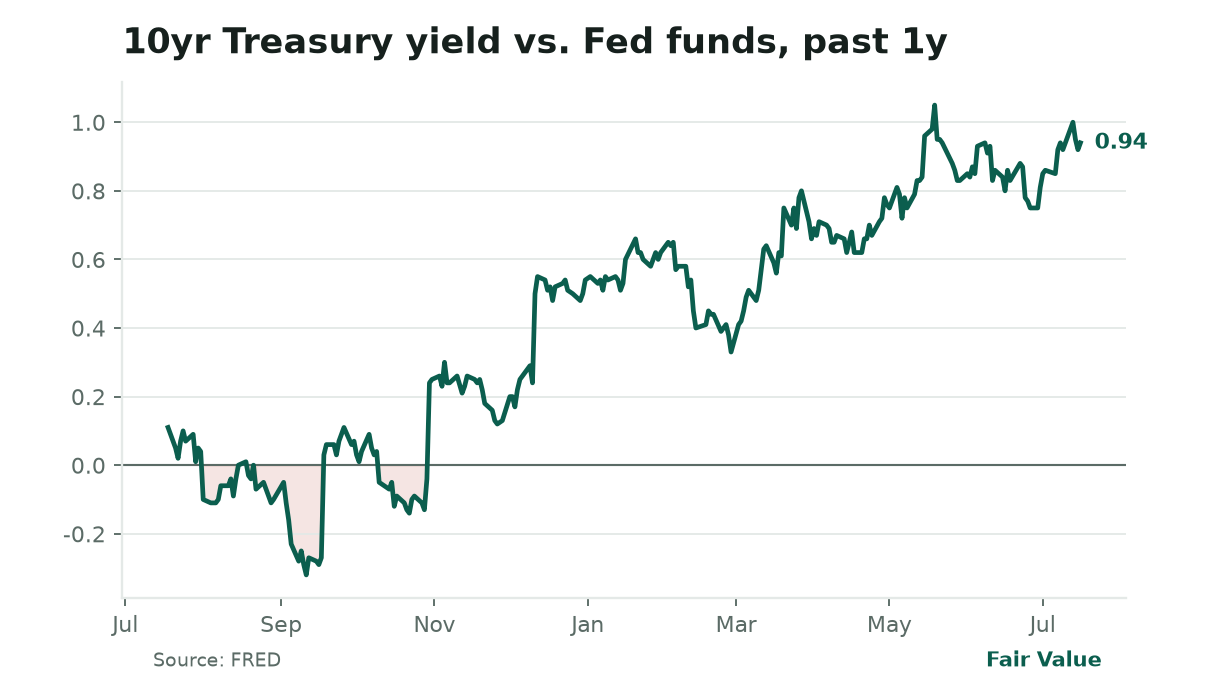
Fed’s room to cut vanishes. The gap between the 10-year yield (4.57%) and Fed funds (5.33%) has inverted by 76bps, the most since 2007. With oil at $88, markets now price a 13% chance of a hike (vs. 0% last week), not cuts. This spread screams ‘policy error’ if the Fed eases into an inflation shock.
The Federal Reserve’s planned September rate cut, once seen as likely, now faces serious doubt as oil prices surge and Fed officials strike a hawkish tone.
Fed leaders stand firm
▸
Dallas Fed President Lorie Logan (voter):"One month of [inflation] relief isn’t enough. Now is the time to complete the task of restoring price stability." Translation: No September cut.
▸
Cleveland Fed President Beth Hammack (voter):"Inflation remains too high," with the labor market "near full employment."
Fed funds futures:13% chance of a July hike; September cut odds shrinking fast.
Household impact:
▸
Mortgages: The average 30-year fixed rate (6.55%) stays high if the Fed holds.
▸
Stocks: Tech valuations, tied to low rates, face further pressure.
Trump’s tariffs add to inflation pressures. New 25% tariffs on Brazilian imports (over its PIX payment system) and threatened 100% tariffs on Chinese EVs introduce another layer of price increases.
The Fed’s dilemma:
▸
Cut rates with oil at $88 → Risks reigniting inflation.
▸
Hold rates as growth slows → Risks recession.
Under the hood
How $88 oil ripples through the economy, and your wallet
Brent crude’s 4.6% surge to $88.10 isn’t just a commodity move, it’s a macro shockwave with six key transmission channels:
1. Oil → Gasoline → CPI (1-2 weeks)
▸
$88 Brent ≈ $4.20/gallon gasoline (up from ~$4.00 now).
▸
Gasoline makes up ~5% of CPI; a 10% pump-price increase adds ~0.5% to headline inflation in a month.
2. CPI → Fed → Yields (2-4 weeks)
▸
The Fed’s 2% inflation target moves further out of reach.
▸
Fed funds futures now price a 0% chance of a September cut (down from 60% last week).
3. Yields → Stock Valuations (immediate)
▸
Higher yields increase discount rates for future earnings.
▸
The Nasdaq’s 28x P/E multiple becomes harder to justify.
4. Yields → Housing (3-6 months)
▸
30-year mortgage rates (6.55%) remain elevated, delaying a housing recovery.
5. Oil → Consumer Spending (4-8 weeks)
▸
$4.20/gallon gas adds ~$50/month to the average household’s budget.
6. Geopolitics → Dollar → Emerging Markets (ongoing)
▸
The DXY index rose to 100.75 as oil shocks lift the dollar.
▸
Emerging markets (India, Turkey, South Africa) face higher import bills + weaker currencies.
The core question:. Will the Fed call this "transitory" (and cut anyway) or pause to preserve credibility?
Data to watch:
▸
July 31:PCE inflation (Fed’s preferred measure).
▸
August 1:ISM Manufacturing (shows oil’s impact on industry).
Worth learning today: **Inflation, intuitively**
Why prices rise, who benefits, and who loses
We’re still waiting for the GBP GDP m/m results from yesterday’s prediction question, no data yet.
Inflation isn’t abstract, it’s the erosion of your money’s purchasing power, and it’s playing out at gas pumps across the country.
The basics:. Last month, filling your tank cost $50. Today, it’s $55. That’s inflation: the same goods cost more over time.
Winners when prices climb:
▸
Borrowers. A fixed-rate 3% mortgage with 4% inflation means your real cost is shrinking.
▸
Commodity producers. Oil companies, gold miners, farmers, their products become more valuable.
Losers:
▸
Savers. Your bank account earning 0.5% loses 3.5% annually in real terms if inflation is 4%.
▸
Fixed-income retirees. A $3,000/month pension buys less when groceries cost 10% more.
The Fed’s bind (and why $88 oil matters):. The Fed hates surprises. A 4.6% oil spike in a day upends its plans:
▸
Cut rates → Risk further oil gains (a weaker dollar lifts commodity prices).
Savings: With inflation at 3.3% and high-yield accounts at 5%, you’re ahead, if you’re in the right account.
▸
Debt: Fixed-rate loans? Inflation is your ally. Shopping for a loan? It’s your enemy (rates stay high).
Concept 8 of 83 in the Fair Value course.
What to watch next week
▸
Monday, July 21: — Earnings: Alphabet (GOOGL), General Motors (GM).
▸
Tuesday, July 22: — Earnings: Tesla (TSLA), AT&T (T).
▸
Wednesday, July 23: — Earnings: Intel (INTC), Lockheed Martin (LMT).
▸
Thursday, July 24: — Earnings: Verizon (VZ), American Airlines (AAL).
▸
Friday, July 25: — PMI Flash data (U.S., Eurozone, UK).First look at July’s economic momentum.
Not financial advice. Disclaimer: Fair Value is for informational purposes only and does not constitute financial advice, an endorsement of any security or investment, or an offer to buy or sell any security. Past performance is no guarantee of future results. Investing involves risk, including the potential loss of principal. Consult your financial advisor before making investment decisions. Authors, editors, and affiliates may hold positions in assets discussed. See fairvalue.io/disclosures for details.
Data sources: Bloomberg, FactSet, Federal Reserve, CME Group, CoinGecko, U.S. Energy Information Administration, International Energy Agency, Bank for International Settlements, World Bank, IMF, Refinitiv, TradingView, company reports.