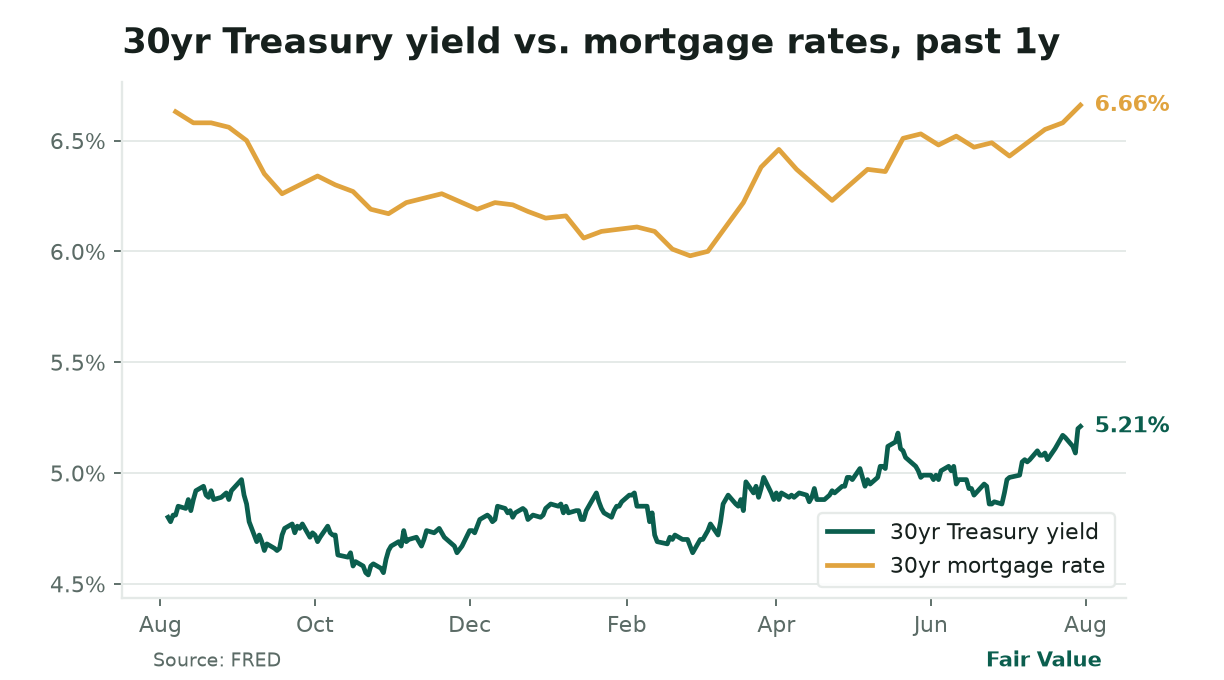
Bonds and stocks split this week as the 30-year Treasury yield hit 5.21%, its highest since 2007, while equities held onto AI-driven gains until earnings revealed cracks. The Federal Reserve’s firm stance pushed mortgage rates to 6.66%, and Meta’s 6% drop on shrinking free cash flow highlighted the risks of unchecked AI spending. Amazon’s 15% jump showed AI can boost margins, but chipmakers fell on demand worries. Oil swung wildly on Iran tensions and OPEC adjustments, while copper quietly rose on AI-linked industrial demand. The core question: Can AI profits keep pace with rising borrowing costs?
The week that was
1. Bonds challenge the Fed’s patience
The Federal Reserve left rates unchanged, but Chair Kevin Warsh’s repeated call for 2% inflation as "non-negotiable", paired with three FOMC members pushing for a hike, sparked a bond-market backlash. Traders bet on tighter policy, sending the 30-year Treasury yield to 5.21% (FRED: DGS30), a 15-year high, while the 10-year yield rose to 4.68% (FRED: DGS10). Markets now see a 64% chance of a September rate increase, up from just 10.7% two weeks ago.
Fallout:
▸
Housing slows. Mortgage rates climbed to 6.66% (FRED: MORTGAGE30US), their highest in a year, while housing starts outpaced building permits for the second straight month, a late-cycle sign that builders are rushing to finish projects before demand fades.
▸
Stocks ignore the warning. The S&P 500 added 1.05% (^GSPC), brushing off bond-market signals. The gap, stocks rising as yields flash recession risks, defined the week’s tension.
Borrowing costs surge. The 30-year Treasury yield hit 5.21%, its highest since 2007, while mortgage rates climbed to 6.66%, a 1-year high. This squeeze tests housing demand and corporate debt sustainability as the Fed holds firm on rates.
The stakes:. Bonds are testing the Fed’s resolve. If yields stay high, the pressure will show, whether in corporate debt, consumer spending, or the AI investment boom driving tech valuations.
2. AI spending meets its first reality check
The market’s $220 billion AI capital-expenditure bet hit a wall as investors demanded proof that spending delivers profits, not just growth.
The split:
▸
Winners:
▸
Amazon rose 17.0% (AMZN) after AWS revenue grew 21% year-over-year with expanding margins, showing AI can offset higher costs.
▸
Microsoft climbed 21.75% (MSFT) as cloud efficiency gains justified its AI investments.
▸
Broadcom gained 1.93% (AVGO) on its $30 billion-plus Apple supply deal, proving contracts beat potential.
▸
Strugglers:
▸
Meta fell 6.47% (META) after free cash flow plunged 91% to $784 million, crushed by AI costs.
▸
Chipmakers dropped sharply, AMD lost 8.77% (AMD), Micron slid 10.63% (MU), Qualcomm declined 11.59% (QCOM), as investors questioned whether demand could absorb coming supply gluts.
The shift:. With the 10-year yield at 4.68%, debt-funded AI projects just got more expensive. "AI exposure" alone no longer cuts it, companies must now show AI-driven revenue or locked-in contracts to justify spending.
3. Oil swings on geopolitics, copper climbs on AI demand
Brent crude swung about 12% (BZ=F: -6.88% week-over-week) in three sessions, pulled between opposing forces:
▸
Support: Iran-U.S. tensions added a $3-$5 risk premium after tanker attacks in the Strait of Hormuz.
▸
Pressure: OPEC+ agreed to increase September production quotas by 188,000 barrels per day, though most members already produce below targets, limiting real impact.
The quiet mover:.Copper rose 2.3% (HG=F) on AI data-center demand and supply constraints in Chile. Its role in EVs, power grids, and renewables adds another layer to inflation pressures.
4. Yen rallies as a safe haven, defying the dollar
The USD/JPY pair dropped 3.8% to 157.4 (JPY=X), its steepest fall since early 2024, even as the Dollar Index (DXY) stayed flat at 99.8 (DX-Y.NYB). The move pointed to under-the-radar risk-off positioning.
Drivers:
▸
Geopolitical easing: Former President Trump canceled a planned Iran strike, reducing immediate conflict fears.
▸
Repatriation lift: A stronger yen boosted Japanese exporters like Toyota and Sony by increasing the value of overseas earnings when converted back.
The risk:. If sustained, the yen’s strength could force a broader reassessment of global equity risk. Investment-grade credit spreads sit at just 0.80% (FRED: BAMLC0A0CM), leaving little margin for error.
5. Crypto’s institutional push speeds up
Bitcoin edged up 0.7% to $63,198 (BTC-USD), while Ethereum gained 1.4% to $1,868.88 (ETH-USD), but tokenized real-world assets (RWAs) stole the spotlight. The sector’s total value reached $36 billion, up from $4.66 billion in 2024, as BlackRock and Franklin Templeton tokenized Treasuries, private credit, and real estate, blurring the line between traditional finance and crypto.
Regulatory hurdles:
▸
Minnesota banned crypto kiosks after scams surpassed $1 million in losses.
▸
The CLARITY Act faced criticism for provisions that could weaken state-level fraud enforcement.
The takeaway:. Institutions are moving fast, but regulation is tightening. The days of unchecked experimentation are ending, adaptability will separate winners from losers.
The big question this week: **AI bubble or selective reckoning?**
The AI trade fractured. For months, the rule was simple: Spend on AI, watch stocks rise. That’s over. Investors now sort companies into three groups:
▸
Proven performers (Amazon, Microsoft): AI spending directly lifts revenue or margins. Amazon’s AWS grew 21% with expanding margins; Microsoft’s cloud efficiency offset costs.
▸
Unproven spenders (Meta, AMD, Micron): Burning cash on AI with no clear payoff. Meta’s free cash flow collapsed 91%; chipmakers face oversupply as Chinese competitors undercut prices.
▸
The contract-protected (Broadcom): Long-term deals (like Broadcom’s $30 billion-plus Apple agreement) shield them from competition.
What changed?
▸
Financing costs jumped. The 10-year yield at 4.68% makes debt-funded AI more costly.
▸
Competition heated up. Chinese firms now offer cheaper AI models, squeezing U.S. margins.
▸
Investors got picky."AI exposure" isn’t enough, they want margin expansion and revenue growth now.
The stress test:. Nvidia’s earnings (August 20) will set the tone. If data-center revenue disappoints, the AI sell-off could spread. Watch the chain reaction: Nvidia → chipmakers → cloud providers → enterprise software.
The week ahead: **Jobs, the Fed, and AI’s profit test**
Macro calendar
July nonfarm payrolls (Friday, 8:30 AM ET) will dominate. How to read the report:
Thursday: — Disney (DIS), Shopify (SHOP), Streaming and e-commerce trends.
▸
Friday: — Block (SQ), Fintech and Bitcoin exposure.
The thread: If AMD or Micron show weak demand, the AI spending boom could unravel fast.
Worth learning today: **Who really moves your markets**
We’re still awaiting the outcome of the Bank of Japan’s press conference (scheduled July 31, 2026; forecast, prior, ).. The question remains open.
Picture a casino. At the blackjack table:
▸
A pension fund manager places a $10 million bet, they must play; it’s your retirement savings.
▸
A hedge fund trader doubles down on red, they’re gambling with borrowed money.
▸
A market maker deals cards at lightning speed, profiting from the spread on every hand.
▸
A retail investor (you) puts down $500 via an app, last to know, first to react.
Who holds the power?
▸
Pension and mutual funds ($50 trillion+):
▸
Forced buyers, they must invest cash as contributions arrive, even in downturns.
▸
Market movers: Their quarterly rebalancing can shift entire sectors. Example: Amazon’s rally? Pension funds piled in after its cloud margins beat, they can’t afford to miss "safe" AI growth.
▸
Hedge funds (~$4.5 trillion):
▸
Trend accelerators: Short Meta (as last week showed), and the stock falls faster.
▸
Liquidity risks: Their redemptions can crash markets (see: UK’s 2022 gilt crisis).
▸
Market makers (Citadel Securities, Jane Street):
▸
The "house": They profit from spreads and provide liquidity, until they don’t.
▸
Flash-crash triggers: When they pull back, no buyers remain (see: VIX at 15.99 = complacency; VIX at 30 = panic).
Why it matters now:
▸
The yen’s 3.8% surge (USD/JPY)? Japanese pension funds repatriating assets, not retail traders.
▸
The AI stock split? Hedge funds dumped Meta (cash burn) but held Microsoft (cloud profits).
▸
Your 401(k) follows pension funds; your brokerage app competes with algorithms.
Tomorrow’s setup:. The U.S. ISM Manufacturing PMI (Monday, 10:00 AM ET) will ripple through markets. If the index tops 55, which sector stands to gain most, and why? How might the dollar react? Predict it using today’s framework. We’ll revisit it Monday.
Not financial advice.This brief is for informational and educational purposes only and does not constitute investment advice.
Data sources: FRED® (Federal Reserve Bank of St. Louis); U.S. Energy Information Administration; U.S. Treasury; SEC EDGAR; Yahoo Finance; Financial Modeling Prep. Concept 21 of 83 in the Fair Value course. ```