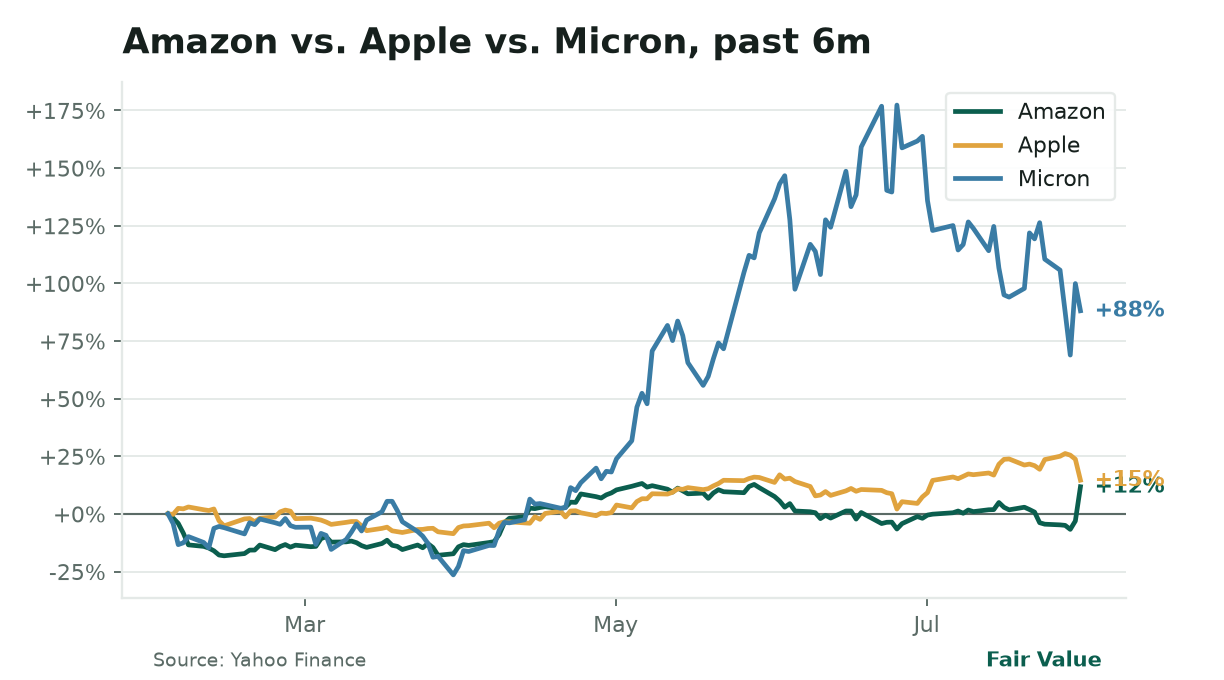
Amazon’s 17% weekly jump shifts AI’s market focus. The move away from hardware (Apple -7%, Micron -6%) to software (Google +6.7%, Microsoft +3%) shows investors now prefer firms turning AI into profits over those building AI tools, but the shift depends on Amazon’s gains proving repeatable.
▸
Oil drops $8 after Iran strike reversal, yet Strait of Hormuz stays blocked. Brent crude fell 7% to $83.74 after Trump called off retaliatory action, but only 11 tankers passed Sunday compared to 63 in July, geopolitical tensions remain.
▸
U.S. and Japan step in as yen jumps 4%, squeezing Asian exporters. USD/JPY fell 1.9% to 157.09 today, triggering the first joint currency intervention since 2022, a market shock that complicates the Fed’s next moves.
What’s moving markets
Two opposing forces are shaping this week: confidence in AI’s profit potential and fragile hopes for Middle East calm. Both rest on unproven assumptions.
Amazon’s 17% weekly rally, boosting Google (+6.7%) and Microsoft (+3%), marks a clear shift from AI hardware makers to software beneficiaries. The trigger: AWS’s operating margins rose to 31% from 25% last year, showing AI can cut costs while lifting profits. The reaction was swift: Apple dropped 7% and Micron slid 6%, confirming investors now favor firms earning from AI today over those supplying the tools to build it.
AI profit shift in action. Amazon’s 17% weekly surge (AWS margins to 31%) contrasts with Apple’s 7% drop and Micron’s 6% slide, showing investors now favor firms earning from AI over those building it. The gap: Amazon +32% since April, Apple -12%, Micron -28%.
Yet one strong quarter doesn’t guarantee a trend. If banks, hospitals, and manufacturers can’t match Amazon’s results, this rotation could reverse quickly. Adding pressure, the Fed’s forecast of only one quarter-point cut in 2027 raises borrowing costs for long-term AI projects, making cash-generating software more appealing by default.
Oil’s 7% drop to $83.74 followed Trump’s decision to halt Iran strikes after Gulf state talks, but the Strait of Hormuz remains effectively closed. Just 11 tankers passed Sunday, down from 63 in early July, while Iran’s execution of two alleged Israeli agents this morning highlighted ongoing risks. OPEC’s small 188,000-barrel/day September output increase won’t fix the supply squeeze; if negotiations fail, Brent could climb back toward $90, reigniting inflation worries.
Meanwhile, the yen’s swings forced action. USD/JPY fell 1.9% today to 157.09, a 4% weekly decline, prompting the first U.S.-Japan currency intervention since 2022. The move reflects more than exchange-rate shifts: a stronger yen hurts Japanese exporters (Toyota fell 3% in Tokyo) and risks sparking a broader Asian currency conflict if other central banks respond. With the dollar index (DXY) near 99.79 and 10-year Treasury yields at 4.68%, the Fed now faces an unintended tightening effect that could push rate cuts further out.
Today’s ISM Manufacturing PMI (forecast: 54.0) will test whether diplomatic progress can offset manufacturing weakness. A weak reading could push the 10-year yield toward 4.75%, forcing the Fed to choose between inflation it can’t ignore and growth it can’t control.
The big story
AI’s profit test arrives, but the trade depends on scalability
For six months, AI’s market playbook was simple: back the suppliers. Nvidia, AMD, Micron, and Apple soared as investors chased the companies enabling AI infrastructure. Amazon’s earnings changed the game.
AWS’s operating margins climbed to 31% from 25% last year, proving AI can drive profits, not just costs. Amazon’s stock jumped 15% last week and added 2% today, lifting Google (+6.7%), Microsoft (+3%), and the consumer discretionary sector (XLY +3.3%). The takeaway: software and services now lead hardware.
The shift hit former leaders hard. Apple, down 7% this week, is paying the price for AI spending that hasn’t yet boosted sales. Micron, the memory-chip leader, fell 6% today and 20% this month. Even Nvidia, the AI boom’s star, stagnated after a 3% bounce, far from its earlier 20% monthly gains.
Three factors drove the change:
▸
The spending reckoning. The Magnificent Seven’s 2026 AI budgets hit $725 billion, more than Switzerland’s GDP. Meta alone raised its spending to $145 billion. Investors finally asked: Where’s the payoff? Amazon provided an answer.
▸
The Fed’s prolonged high rates. With core inflation at 2.5% and the 10-year yield at 4.68%, financing big projects is getting costlier. The Fed’s plan for just one 2027 cut reduces the value of future AI profits, making cash-flow-positive software more attractive.
▸
The hardware surplus. TSMC’s 2026 capex rose to $64 billion (from $52 billion), with another $100 billion planned for U.S. plants. Micron is spending $27 billion this year. Result: a coming chip glut just as demand from tech giants slows. Meta’s free cash flow shrank last quarter; Alphabet’s cloud margins compressed. The music stopped, and chipmakers were left without chairs.
The new focus: profits over infrastructure.. Companies proving AI’s earning power (Amazon, Google, Microsoft) now lead those betting on future demand (Nvidia, AMD, Micron). The logic holds, until you consider the risks.
The risk?. This shift assumes AI productivity gains are real, scalable, and lasting. Amazon’s margins are impressive, but still just one example. If other industries can’t replicate them, the trade could unwind fast. With the Fed signaling high rates for longer, there’s little room for error.
Key events this week:
▸
AMD earnings (Tuesday): Guidance will show whether the hardware slowdown is temporary or deeper. Data center GPU demand is the metric to watch.
▸
U.S.-Iran talks: Oil’s 7% drop depends on diplomacy. Even a partial reopening of the Strait of Hormuz could lift energy stocks (XLE) and inflation-sensitive sectors.
▸
ISM Services PMI (Wednesday): A slowdown could challenge the Fed’s “one cut in 2027” plan, pressuring software stocks and pushing yields higher.
The big picture
Stocks and bonds tell different stories
Equities signal optimism; bonds, caution. S&P 500 futures rose 0.5%, extending Friday’s 0.7% gain. Nasdaq futures climbed 0.5%, led by Amazon’s 17% weekly surge and strong showings from Google (+6.7%) and Microsoft (+3%). Even the Russell 2000 steadied after July’s selloff. The VIX sits at 16.05. On the surface: risk-on.
But bonds paint another picture. The 10-year Treasury yield holds at 4.68%, down slightly from last week’s 4.73% peak but near 2026 highs. The 2-year yield, more tied to Fed policy, stands at 4.23%. Their narrow 0.47% spread suggests bond investors doubt the stock rally, pricing in sticky inflation, prolonged high rates, and a Fed in no hurry to cut.
The data backs the bond market’s view. Q2 GDP grew just 1.5%, but private domestic demand, the Fed’s focus, accelerated to 3.9%. Unemployment remains at 4.2%, wage growth at 4% annually. Core PCE inflation, the Fed’s preferred measure, sits at 2.5%, above target. The Fed’s latest projections show one quarter-point cut in 2027, a sharp reversal from the three cuts expected last month.
Why it matters for your money:
▸
Mortgages: The 30-year fixed rate hit 6.66%, a one-year high. With the 10-year yield above 4.5%, near-term relief is unlikely.
▸
Savings: High-yield accounts and CDs still pay 5%+. Lock in rates now if you’ve been waiting.
▸
Stocks: Leadership stays narrow (Amazon, Google, Microsoft). The average S&P 500 stock is up just 0.1% this month.
▸
Crypto: Bitcoin fell 1.1% today to $62,700, stuck in a $61,300-$66,900 range for a month. High Treasury yields reduce risk appetite.
Oil remains unpredictable.. Brent’s 7% drop to $83.74 reflects Trump’s canceled Iran strikes, but the Strait of Hormuz is still effectively closed. If talks fail, oil could spike to $90, reigniting inflation fears.
Today’s ISM Manufacturing PMI (10:00 AM ET, forecast: 54.0) is the first test.. A strong reading (above 55) eases recession fears but could push the 10-year yield toward 4.75%. A weak print (below 52) might fuel Fed-cut bets, but with core inflation above target, don’t expect Powell to shift.
The bond market’s message is clear: The Fed won’t cut unless forced. Stocks are betting it won’t come to that. One side is wrong. Today’s data will hint at which.
Around the world
Yen’s surge forces intervention, sending global ripples
USD/JPY plunged 1.9% today to 157.09, capping a nearly 4% weekly loss. The Bank of Japan and U.S. Treasury confirmed they intervened in currency markets for the first time since 2022, buying yen to stabilize its value. The trigger: a mix of safe-haven demand (Middle East tensions), Japan’s negative rates, and hedge fund bets on further yen weakness.
Why this matters globally:
▸
Exporters feel the pinch. A stronger yen hurts Toyota (down 3% in Tokyo), Sony, and Panasonic, which depend on overseas sales.
▸
Regional currency risks. If Japan acts, South Korea and Taiwan, both facing currency pressure, may follow, sparking a broader Asian FX conflict.
▸
The Fed’s challenge. A weaker dollar (DXY down 0.2% today to 99.79) loosens U.S. financial conditions, the opposite of what the Fed wants. If the yen keeps rising, the Fed may need to sound more hawkish, delaying cuts or even considering another hike.
Oil’s diplomatic dip may not last
Brent crude fell 7% to $83.74 after Trump canceled Iran strikes, but the Strait of Hormuz remains a chokepoint: only 11 tankers passed Sunday, down from 63 in early July. Iran’s execution of two alleged Israeli agents this morning underscores ongoing risks. OPEC’s modest September output increase (188,000 barrels/day) won’t fix the supply squeeze.
China’s factory slowdown weighs on global demand
Beijing’s latest data shows industrial activity weakening faster than expected, with export orders shrinking for the third straight month. With no major stimulus planned, Europe (reliant on Chinese demand) and commodities like copper and iron ore face headwinds.
Companies in focus
Amazon’s 17% weekly jump redefines AI’s investment case.. The post-earnings rally, now lifting Google (+6.7%) and Microsoft (+3%), shows AI can boost profits, not just spending. But the bigger story is the market’s sudden shift: software over hardware. Apple’s 7% drop and Micron’s 6% decline highlight the change.
Apple’s 7% fall exposes hardware’s AI struggle.. The iPhone maker dropped 7.3% Friday and extended losses this week, pulling down chipmakers like Micron (-5.9%) and Qualcomm (-2.6%). The issue: Apple’s AI spending hasn’t yet translated into revenue growth, a warning for the entire hardware sector.
Coinbase’s 10% drop reflects crypto’s institutional pullback.. Coinbase (COIN) fell 10.6% today, extending its monthly loss to 8%. The driver: institutional retreat as Treasury yields rise. Spot Ether ETFs saw net outflows over the weekend, with high-fee products like Grayscale’s ETHE leading the exodus.
OPEC’s production increase is mostly symbolic.. OPEC+ agreed to raise output by 188,000 barrels/day in September, less than 0.2% of global demand. Brent still fell 7% today to $83.74, but only because Trump canceled Iran strikes.
TotalEnergies prioritizes shareholders over green energy.. The French oil giant sold a 50% stake in its European onshore wind and solar assets to KKR, signaling Big Oil’s shift from energy transition to shareholder returns.
From Washington
Currency moves complicate the Fed’s rate-cut plans
Last week’s FOMC meeting was expected to be uneventful. The Fed held rates at 3.50%-3.75%, as anticipated. But the three dissents, officials pushing for a quarter-point hike, marked the most hawkish split since 2018. Chair Kevin Warsh’s message was clear: “No cuts until inflation is under control.”
The Fed’s latest projections show one quarter-point cut in 2027, a sharp contrast to the three cuts markets expected last month. The reason: core PCE inflation remains at 2.5%, above the 2% target. Wage growth holds at 4% annually. Unemployment sits at 4.2%.
Now, the yen’s collapse adds another layer. A weaker dollar (DXY down 0.2% today to 99.79) eases U.S. financial conditions, the opposite of the Fed’s goal. If the yen keeps rising (USD/JPY dropped 1.9% today to 157.09 after Japan’s intervention), the Fed may need to adopt a tougher stance, potentially delaying cuts further or even considering another hike.
Today’s ISM Manufacturing PMI (10:00 AM ET) is the first test.. A strong reading (above 55) would ease recession fears but could push the 10-year yield toward 4.75%. A weak print (below 52) might fuel Fed-cut hopes, but with core inflation still high, don’t expect Powell to budge.
Under the hood
AI’s funding squeeze emerges as the Fed’s hidden growth brake
The chain is straightforward: AI compute demand → VC funding → productivity growth → Fed policy → bond yields → stock valuations. Right now, the weak link is funding.
The Wall Street Journal reported this weekend that venture capital is pulling back from early-stage AI startups, forcing them to rely on cloud credits or alternative funding. Meanwhile, security-risk premiums for AI projects are rising after reports of rogue AI breaches. These pressures are limiting new compute capacity, the very driver supposed to power the next productivity wave.
Why this matters:
▸
Productivity is already lagging. U.S. real GDP grew just 0.4% in Q1 2026. If AI deployment stalls, growth stays weak.
▸
The Fed stays restrictive. The Fed’s “one cut in 2027” guidance assumes modest growth. If AI underdelivers, rates stay high.
▸
Bond yields remain elevated. The 10-year Treasury at 4.68% already pressures stocks. Weaker growth could push yields higher.
This dynamic isn’t priced in.. Investors focus on Big Tech’s headline earnings (Amazon, Google, Microsoft) but miss the supply-side constraint: if AI-driven productivity stalls, the Fed stays hawkish, yields rise, and stocks face a valuation reset.
Worth learning today: The Fed’s dual mandate
ISM Manufacturing PMI comes in at 53.3, why bonds rose despite slower growth
The ISM Manufacturing PMI tracks sector expansion (above 50) or contraction (below 50). A 53.3 reading signals slowing but positive growth. Stocks initially dipped, as traders bet weaker data would push the Fed to cut sooner. But the 10-year Treasury yield rose to 4.70%, counterintuitive. Why? The report showed input prices (an inflation measure) climbing. The Fed balances growth and inflation. Soft growth argues for cuts; rising prices argue against them. The bond market’s reaction reveals which mandate dominates: inflation.
The Fed’s two legal goals: stable prices and maximum employment
Congress gave the Fed two mandates in 1977:
▸
Stable prices (2% inflation).
▸
Maximum employment (lowest sustainable unemployment).
Think of a seesaw. When one side (inflation or jobs) gets too heavy, the Fed must shift weight to balance it. Right now, inflation is the heavier side.
How it works:
▸
If inflation is too high (core PCE at 2.5%), the Fed raises rates to cool demand, slowing hiring and wage growth, which eventually lowers prices.
▸
If unemployment is too high, the Fed cuts rates to boost hiring. But cut too much, and inflation can surge, which is why the Fed moves cautiously.
Today’s tension:. The Fed’s inflation fight clashes with its growth goal. The ISM miss (53.3 vs. 54.0 forecast) suggests slower growth, which typically would push the Fed to cut. But with core PCE still at 2.5% and oil volatile, the Fed is prioritizing inflation. That’s why the 10-year yield rose post-ISM: traders realized the Fed won’t cut just because growth softens.
Tomorrow’s focus:. New Zealand’s employment report (Monday night ET) will show whether its labor market is cooling. If unemployment exceeds the 5.4% forecast, the Reserve Bank of New Zealand may cut rates sooner, weakening the NZD and strengthening the USD.
Concept 22 of 83 in the Fair Value course.
What to watch this week
▸
Monday, August 3: — USD ISM Manufacturing PMI (10:00 AM ET), A miss could revive Fed-cut bets, but inflation details matter more.
▸
Tuesday, August 4: — NZD Employment Change q/q (6:45 PM ET), Weakness may force the Reserve Bank of New Zealand to cut, weakening the kiwi.
▸
Tuesday, August 4: — NZD Unemployment Rate (6:45 PM ET), Above 5.4% signals a slowing labor market.
▸
Friday, August 7: — USD Average Hourly Earnings m/m (8:30 AM ET), Wage growth above 0.3% keeps the Fed on hold.
▸
Friday, August 7: — USD Non-Farm Payrolls (8:30 AM ET), Consensus: 88K; a big miss could shift rate expectations.
▸
Friday, August 7: — USD Unemployment Rate (8:30 AM ET), A tick up from 4.2% would concern the Fed.
Not financial advice.This brief is for informational and educational purposes only and does not constitute investment advice or a recommendation to buy or sell any security.
Data sources: Macro indicators per FRED® (Federal Reserve Bank of St. Louis); energy data per U.S. Energy Information Administration (EIA); auction data per U.S. Treasury Fiscal Data; filings per SEC EDGAR; market prices per Yahoo Finance; earnings calendar per Financial Modeling Prep. ```