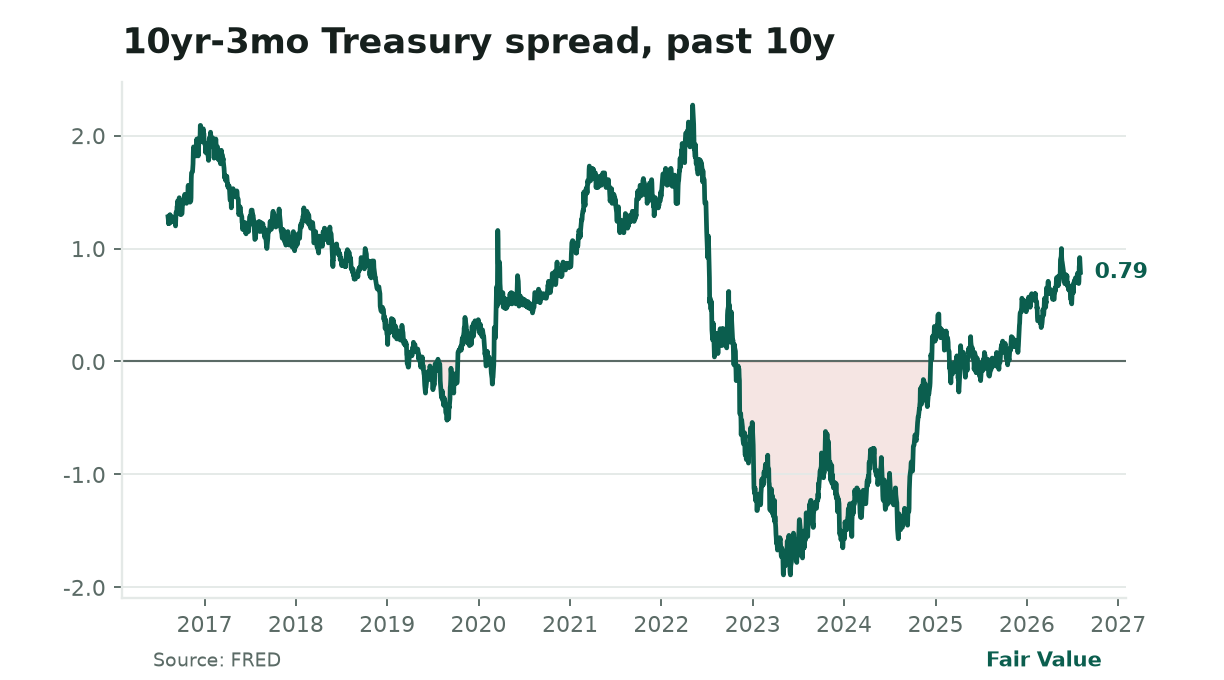
Bonds question the Fed’s timeline. The gap between 10-year and 3-month Treasury yields narrowed to 0.79%, its tightest since early 2025, suggesting rate cuts could arrive by early 2027, a year ahead of the Fed’s outlook. Mortgages, savings, and paychecks all ride on this standoff.
▸
Amazon’s AI-driven jump splits tech. AWS revenue climbed 37% year-over-year to $42.23 billion, lifting Amazon shares by 15%, while Apple (-7%) and Micron (-6%) highlighted the divide between AI providers and AI suppliers.
▸
Oil swings on Strait of Hormuz uncertainty. Brent crude dropped 4% to $86.10 amid talk of negotiations, yet only 11 tankers passed through the waterway Sunday, down from 63 in July. Rising shipping insurance costs, not headlines, show the real tension.
What’s moving markets
Markets are torn between AI-powered stock optimism and bond-market caution, a split that defined Tuesday’s trading.
Amazon shares rose 15%, their biggest one-day gain since 2022, after AWS revenue reached $42.23 billion, up 37% from last year. AI spending is turning into profit. Microsoft (+3%) and Alphabet (+6.7%) also advanced, but the rally stays painfully narrow. The Nasdaq 100’s gains come from just five names, Amazon, Microsoft, Alphabet, Meta, and Nvidia, while the Russell 2000 (-0.5%) and Dow (+0.5%) trailed. Investors are betting big on a few AI leaders while ignoring the rest.
Bonds sent a different signal. The 10-year/3-month Treasury spread, the market’s most trusted recession gauge, shrunk to 0.79%, its lowest since early 2025. The takeaway: The Fed may be too slow. Rate cuts could come by early 2027. Yet Fed Chair Kevin Warsh and others insist no cuts will happen before late 2027. This gap can’t last. Either bonds are right, and stocks face a reckoning, or the Fed stays firm, extending AI’s run.
Bonds bet on a 2027 recession. The 10-year/3-month Treasury spread, now at 0.79%, has inverted before every U.S. recession since 1968. Its current level, the tightest since early 2025, signals traders expect Fed rate cuts by early 2027, a full year ahead of the Fed’s own guidance. The last time this spread dipped below 0.70%, a downturn followed within 9 months.
Oil stayed volatile. Even with OPEC+ boosting output by 188,000 barrels per day, Brent crude fell 4% to $86.10 on reports of potential Strait of Hormuz progress. No deal is final. Tanker traffic through the waterway dropped to 11 vessels Sunday, down from 63 in July, while insurance costs keep climbing, a sign traders doubt a quick fix. If talks fail, Brent could rebound to $90, forcing the Fed to rethink its plans.
The core clash:. Today’s market pits AI-driven stock bulls against bond investors pricing in slower growth, with oil’s geopolitical risks adding another layer. Only one side will win.
The big story
Fed vs. bonds: Who folds first?
The 10-year/3-month Treasury spread just hit 0.79%, a level that has signaled every U.S. recession since 1968. Here’s why it matters more than Amazon’s earnings or oil’s dip.
This spread tracks the difference between the 10-year Treasury yield (4.75%) and the 3-month yield (3.96%). When it shrinks, investors expect sooner rate cuts, usually due to economic weakness. Right now, it’s flashing warning signs.
Yet the Fed isn’t budging. After July’s meeting, Chair Kevin Warsh repeated plans to hold rates at 3.5%-3.75% until late 2027. Three officials, Cleveland Fed’s Beth Hammack, Minneapolis Fed’s Neel Kashkari, and Dallas Fed’s Lorie Logan, even pushed for an immediate 25-basis-point hike, the most divided stance since 2018. Meanwhile, bond markets see a 65% chance of a cut by September 2027.
Who’s correct?. The answer will shape finances in 2027.
If bonds are right, expect:
▸
Mortgage rates under 6% (now 6.66%). A spread below 0.70% could push the 10-year yield down, easing homebuying costs.
▸
A weaker U.S. dollar (DXY at 100.02). This helps U.S. exporters but hurts multinationals like Apple, which earns 60% of revenue abroad.
▸
Small-cap and value stocks to outperform. These lagged in 2026 but historically rally when rates fall.
If the Fed stands firm, prepare for:
▸
Higher borrowing costs for longer. Cash-strapped firms (Tesla, down 26% this year) and startups face more pressure.
▸
A stronger dollar, squeezing U.S. exporters and emerging markets.
▸
Stress in commercial real estate. Office vacancies are at record highs, and refinancing gets harder with high rates.
Oil is the wildcard.. Brent crude has jumped 20% this month, fueling inflation worries. If prices stay high, the Fed may hold its line. But if a Strait of Hormuz deal lowers Brent, it fell 4% Monday, inflation could ease, giving the Fed room to cut.
Key signals today:
▸
10-year/3-month spread. Below 0.70% would sharpen recession warnings.
▸
Oil prices. Under $85 eases inflation; above $90 keeps the Fed on hold.
▸
Fed speak. Any shift in Warsh’s tone could move markets fast.
This isn’t abstract, it’s about whether your mortgage, 401(k), and job face headwinds or tailwinds in 2027. Bonds are betting on headwinds.
The big picture
The S&P 500 rose 1.5% Tuesday, but the real action is under the surface. Amazon’s 15% surge dominated headlines, yet the rally stays dangerously concentrated. The Nasdaq 100’s gains come from just five stocks: Amazon (+15%), Microsoft (+3%), Alphabet (+6.7%), Meta (+3.3%), and Nvidia (+2.9%). The Russell 2000 (-0.5%) stagnated, while the Dow (+0.5%) barely kept up. This isn’t a broad rally, it’s a bet on AI’s top players.
Bonds told a different tale. The 10-year Treasury yield held at 4.75%, and the 30-year sat at 5.28%, a 19-year high. Normally, strong earnings (like Amazon’s) would push yields lower as money moves into stocks. Instead, yields rose as bonds priced in sticky inflation and high rates for longer. July’s Fed minutes showed a 9-3 vote to hold rates, with three officials wanting a hike, the most divided since 2018. Mortgage rates (6.66%) and corporate borrowing costs stay under pressure.
Oil’s geopolitical risk premium faded, for now. Brent crude dropped 4% to $86.10 on hopes for a Strait of Hormuz deal, though Tehran denied talks with Washington, and tanker traffic stayed low. The real measure? Rising insurance costs for ships in the area. Markets hope for a deal but aren’t counting on it.
What it means for you:
▸
Homebuyers: Watch the 10-year Treasury. If the spread keeps narrowing, mortgage rates could dip below 6% by early 2027.
▸
Stock investors: The gap between mega-cap tech and the rest of the market is a red flag. The S&P 500’s top 10 stocks now make up 35% of the index, levels last seen in the dot-com bubble.
▸
Crypto holders: The CLARITY Act vote is the only near-term catalyst. Without it, expect more sideways trading.
Around the world
Japan’s yen stayed weak.. Despite last week’s U.S.-Japan intervention, USD/JPY held near 157.90, a 38-year low. The issue: Japan’s yield gap with the U.S. The Bank of Japan keeps rates near zero while the Fed holds at 3.5%-3.75%, making the yen a cheap currency for carry trades (borrowing in yen to invest in higher-yielding dollars). Until the Bank of Japan hikes, and it’s resisted, the yen stays under pressure.
In the Middle East, oil’s geopolitical premium pulled back, but risks remained. Brent crude fell 4% to $86.10 on Strait of Hormuz deal hopes, yet Tehran denied talks, and tanker traffic stayed low. The test? Insurance costs for Hormuz crossings. If premiums drop, the market believes in progress.
Europe’s energy crisis worsened. Natural gas prices spiked as droughts drained hydropower and low rivers, like the Rhine, blocked coal shipments. Germany’s gas storage sits at 70% capacity, below the 85% target. A cold winter could force rationing.
China’s tech crackdown intensified. Samsung and SK Hynix shares fell after reports that Beijing is building a domestic AI supply chain, from chips to cloud services. This threatens Korean memory makers, which get 30% of revenue from China.
Global watchlist:
▸
New Zealand’s jobs report (tonight): Unemployment at the expected 5.4% could lead the Reserve Bank of New Zealand to cut rates, weakening the kiwi and lifting risk assets.
▸
Canada’s employment data (Friday): Soft numbers may push the Bank of Canada toward easing, pressuring the loonie.
▸
U.S.-Iran talks: Progress on the Strait of Hormuz could push Brent below $80; failure could send it above $90.
Companies in focus
Amazon’s AWS growth shows AI boosts margins, for cloud leaders.. Amazon shares jumped 15% to $271.58 after AWS revenue grew 37% year-over-year to $42.23 billion, with margins expanding to 32% from 29%. Microsoft (+3% to $464.72) and Alphabet (+6.7% to $356.13) followed suit. The laggards? Firms still waiting for AI to pay off. Apple (-7% to $308.91) and Micron (-6% to $823.03) struggled because their AI investments (chips, memory) aren’t yet profitable.
Coinbase’s slump continued.. The stock fell another 10.6% to $146.26, extending its monthly decline to 13%. Bitcoin held at $63,500, the issue is trading volume. Coinbase’s 24-hour volume dropped to $1.4 billion from $4.5 billion a month ago. Without a catalyst like the CLARITY Act, crypto stocks stay stuck.
UPS signaled softer consumer spending.. The stock declined 9% over the past week to $104.22, a reflection of slowing demand. FedEx and XPO Logistics also retreated, but UPS, with its e-commerce ties, is the clearest read on weaker consumption.
BP prioritized oil over renewables.. Profits rose 33% on higher crude prices and Middle East trading gains, but the company is selling its Archaea biogas unit. The message: Oil still rules; renewables are secondary, for now.
JPMorgan’s $750 billion housing push.. The bank plans to finance 1 million affordable housing units and lend to 200,000 first-time buyers by 2035. The $750 billion commitment signals banks see housing as the next big opportunity.
Anduril advanced in drone-boat defense.. The Peter Thiel-backed firm is in talks to build unmanned surface vessels at Baltimore’s Sparrows Point shipyard. With Strait of Hormuz tensions boosting demand for drone boats, Anduril is positioning itself as a leader.
From Washington
The Fed’s July meeting minutes revealed a growing internal split. Three officials, Cleveland Fed’s Beth Hammack, Minneapolis Fed’s Neel Kashkari, and Dallas Fed’s Lorie Logan, argued for an immediate 25-basis-point rate hike, the most divided stance since 2018. Chair Kevin Warsh reaffirmed the 2% inflation target, but bond markets stayed skeptical. The 10-year Treasury yield stood at 4.75%, and the 30-year at 5.28%, both near multi-year highs.
On regulation, the SEC targeted insider trading. Texas law firm Jackson Walker agreed to a $15 million settlement over claims it failed to disclose a judge’s ties to a firm partner.
The key question: Will the Fed back down?. Bonds now price a 65% chance of a rate cut by September 2027. If inflation cools, watch Friday’s jobs report, the Fed may shift. If not, the standoff continues, with household finances in the middle.
Under the hood
The 10-year/3-month Treasury spread’s drop to 0.79% suggests the Fed is behind. Here’s how the pieces could move:
▸
Bonds → Fed expectations: A spread this tight implies traders expect rate cuts by early 2027, a year before the Fed’s timeline. Historically, spreads below 0.8% precede recessions by 6-9 months.
▸
Fed expectations → U.S. dollar: Early cuts would weaken the dollar. The DXY index sits at 100.02, but a sub-0.70% spread could push it toward 98.
▸
Dollar → oil: A weaker dollar usually lifts oil prices, but geopolitics currently drive the market. Brent crude trades at $86.10, down 4% on Iran deal hopes. If the Strait of Hormuz reopens, oil could fall to $80; if talks fail, it could spike above $90.
▸
Oil → inflation → Fed: $80 oil would ease inflation; $90+ would keep the Fed hawkish. Markets currently bet on $80, which is why the 10-year yield is declining.
▸
Fed → equities: Rate cuts would benefit growth stocks (Amazon, Microsoft); no cuts favor value stocks (banks, energy).
The bigger risk:. The spread’s contraction isn’t just about recession fears, credit markets are at stake. Investment-grade spreads (0.80%) and high-yield spreads (2.84%) are near historic lows, letting corporations borrow cheaply. If the Fed cuts, that window could close, squeezing leveraged firms.
Watch for confirmation:. A spread below 0.70% would amplify recession calls; above 0.90% suggests bonds overreacted.
Worth learning today: How indexes work
You’ve heard “the S&P 500 rose today.” But what does that really mean? Today’s moves in Amazon, Apple, and others depend on how indexes are built, and why a few giants dominate your 401(k).
The concrete example: Amazon’s 15% leap
Amazon surged 15% to $271.58, adding $400 billion to its market value. That single move lifted the S&P 500 by roughly 0.5%. Why? The S&P 500 is market-cap weighted, bigger companies have more influence. Amazon, the fourth-largest U.S. stock, carries more weight than smaller firms. Meanwhile, Apple, the largest, is down 7% this week, pulling the index lower. The S&P 500 isn’t “the market”; it’s a calculation where a few titans dominate.
How it works
▸
Market cap = share price × shares outstanding. Amazon’s market cap is ~$2.7 trillion; Apple’s is ~$3.1 trillion. Together, they make up ~12% of the S&P 500.
▸
The S&P 500 tracks the 500 largest U.S. companies, weighted by size. The top 10 stocks now account for 35% of the index, the highest concentration since the dot-com era.
▸
The Dow Jones works differently. It’s price-weighted: a $1 move in a $500 stock (like UnitedHealth) affects the Dow more than a $1 move in a $50 stock (like Walgreens). This makes it less representative than the S&P.
▸
The Nasdaq Composite includes all 3,000+ Nasdaq-listed stocks, heavily tilted toward tech. That’s why it’s more volatile, a few big tech swings (like Nvidia’s 3% gain today) move the whole index.
Why this matters to you
▸
Your 401(k) likely follows the S&P 500. Your retirement savings rise and fall with Apple, Microsoft, and Amazon, not the “average” company.
▸
“The market was up” depends on the index. The S&P 500, Dow, and Nasdaq often diverge because they’re structured differently.
▸
Small caps are struggling. The Russell 2000 (small-cap index) fell 0.5% today and is down 2.6% this month. That’s the real economy, regional banks, manufacturers, retailers, while mega-cap tech soars.
The sharper edge
The S&P 500’s top-heavy makeup creates hidden risks. If Apple or Microsoft stumble, the whole index suffers, even if 490 other companies thrive. Diversifying beyond the S&P (into small caps, international stocks, or bonds) isn’t just smart; it’s necessary.
Quick note: Recall how we discussed exchanges (like the NYSE and Nasdaq) where stocks trade? The S&P 500 and Dow aren’t exchanges, they’re indexes, or baskets of stocks tracking a market segment. The Nasdaq is both: an exchange and an index (the Nasdaq Composite).
Concept 23 of 83 in the Fair Value course.
Yesterday’s question resolution:. We’re still awaiting New Zealand’s Employment Change q/q (forecast 0.1%, prior 0.2%). The data hasn’t been released, we’ll analyze it tomorrow.
Tomorrow’s setup:. New Zealand’s Unemployment Rate is due tonight (Aug 4), with a forecast of 5.4% (prior 5.3%). Question: If unemployment rises more than expected, what happens to the New Zealand dollar, and why? (Hint: Think about interest rate differences and carry trades.) We’ll break it down tomorrow.
What to watch this week
▸
NZD Employment Change q/q — , Tonight (Aug 4), forecast 0.1%, prior 0.2%. Weak data could push the Reserve Bank of New Zealand to cut rates sooner, pressuring the kiwi.
CAD Employment Change — , Friday (Aug 7), forecast 14.8K, prior 18.2K. A miss could push USD/CAD above 1.42.
▸
U.S. Non-Farm Payrolls — , Friday (Aug 7), forecast 85K, prior 57K. This report drives Fed policy. Strong numbers support higher rates; weak data brings cuts into view.
▸
U.S. Unemployment Rate — , Friday (Aug 7), forecast 4.2%, prior 4.2%. An uptick would stoke recession fears.
▸
U.S. Average Hourly Earnings m/m — , Friday (Aug 7), forecast 0.3%, prior 0.3%. Wage growth fuels inflation, and Fed hawkishness.
▸
3-Year Treasury Note Auction — , Monday (Aug 10). Demand here will signal whether bond investors expect Fed rate cuts.
Not financial advice. Disclaimer: Fair Value is for informational purposes only and does not constitute financial advice, an endorsement of any security or investment, or an offer to buy or sell any security. Past performance is no guarantee of future results. Investing involves risk, including the potential loss of principal. Consult a financial advisor before making investment decisions. Authors, editors, and affiliates may hold positions in the assets discussed.
Data sources: U.S. Treasury, Federal Reserve, CME Group, Bloomberg, FactSet, S&P Global, Nasdaq, NYSE, BLS, OPEC, EIA, Bank of Japan, Reserve Bank of New Zealand, Statistics New Zealand, Bank of Canada, Eurostat, China National Bureau of Statistics. ```