U.S. and global oil markets diverge. WTI crude climbed 3.6% to $89.96 as U.S. supplies tightened, while Brent fell 1.6% to $92.60 amid plans for a Hormuz bypass, highlighting the U.S. role in oil’s recent swings.
▸
ECB rate decision arrives today. A hold at 2.40% is expected, but any hint of future cuts could weaken the euro, lifting U.S. exporters while pressuring commodity prices.
▸
AI spending faces scrutiny. Alphabet’s cloud revenue jumped 82%, yet its $200 billion capex plan sent shares down 3%. The takeaway: growth no longer justifies record bets.
What's happening today
Two themes dominate: geopolitical risks pushing oil and gold higher, and AI spending doubts weighing on tech. The ECB’s rate call today could widen the gap.
Oil’s split deepens.. WTI crude rose 3.6% to $89.96, capping a near-14% weekly gain, as U.S. inventories tightened and refineries ran at 96.1% capacity. But Brent dropped 1.6% to $92.60 after reports that DP World will build terminals to bypass the Strait of Hormuz. The divide suggests traders see short-term supply crunches but long-term workarounds. Gasoline prices reflect the squeeze, the national average hit $4.02 per gallon, up 16 cents in a week.
The ECB meets today, and the focus isn’t the rate, it’s the guidance. A hold at 2.40%. is all but certain, but any signal of future cuts could weaken the euro. That would help U.S. multinationals like Coca-Cola and Apple while pressuring dollar-priced commodities. The euro sits near a one-week high (≈1.14 USD), and a hawkish tone could push it higher, weighing on gold and oil.
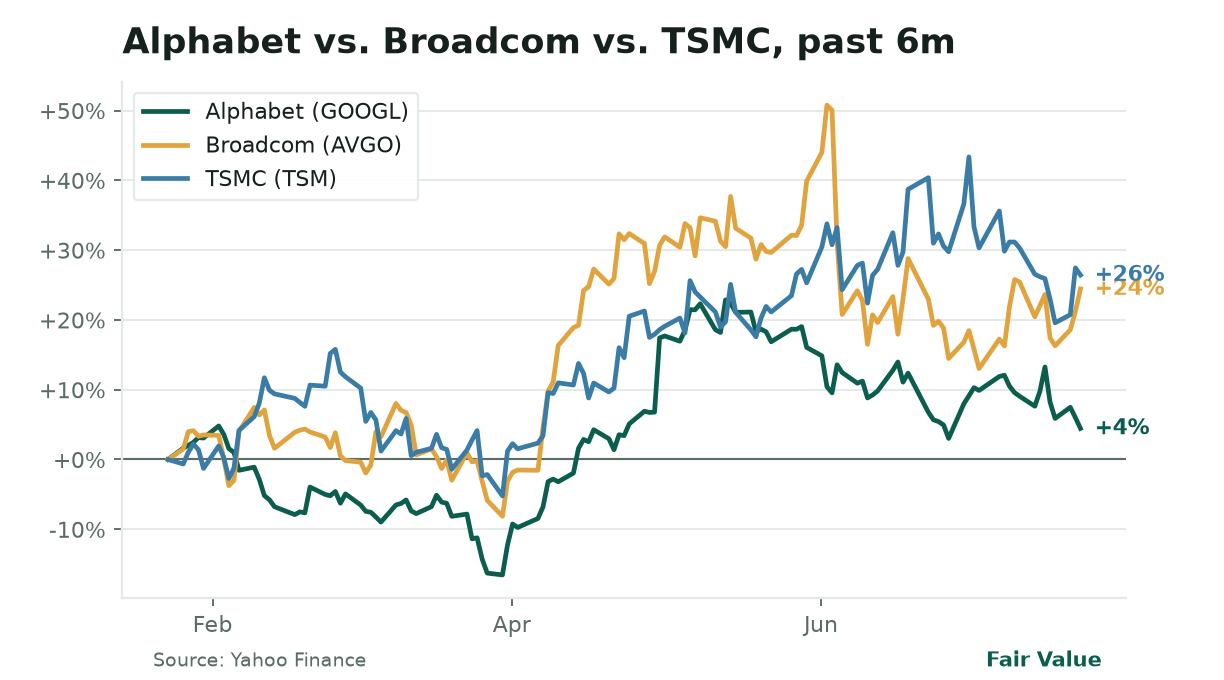
Tech’s spending spree hits resistance.. Alphabet’s earnings arrived after the bell: cloud revenue surged 82%, but $200 billion in planned capex sent shares down 3%. The pattern is clear: Tesla’s AI and robotics spending crushed margins to 1.4% (from 4.1%), and TSMC’s $64 billion capex increase (up from $56 billion) knocked its stock down 4%, despite beating earnings. The message: profits now matter more than growth.
The big story
AI’s trillion-dollar bet gets a reality check
Alphabet’s earnings call had all the makings of a victory lap. Google Cloud revenue grew 82% year-over-year to $24.8 billion, blowing past estimates. Yet the stock fell 3%, and kept sliding. The culprit? $200 billion in capex.
That’s nearly double last year’s spend, and more than Hungary’s entire economy. For perspective, Alphabet spent $110 billion in 2025. Now, it’s projecting $195-200 billion for 2026, with no clear end in sight.
The shift is abrupt.. For months, markets cheered every AI dollar as a down payment on future dominance. Now, they’re asking: Where’s the payoff? Alphabet’s free cash flow turned negative last quarter. Tesla’s margins collapsed to 1.4% as it poured $5.8 billion into AI and robotics. TSMC’s stock dropped 4% after raising 2026 capex to $64 billion, even though it beat earnings.
This is the capex reckoning. The "Magnificent Seven" will spend $725 billion on AI in 2026 (up 77% from 2025), per Goldman Sachs. By 2027, that number reaches $1 trillion. But revenue isn’t keeping up. Alphabet’s cloud sales, though strong, make up just 12% of total revenue. Meta’s AI-driven ads work, yet its stock is down 8% this week as investors question whether the spending is sustainable.
Three new investor demands:
▸
Clear ROI timelines. When will data centers and AI models earn more than they cost?
▸
Margin protection. Can companies spend $1 trillion and still grow profits?
▸
An endgame. Is there a limit to capex growth, or is this the new normal?
The answers will determine whether this is a temporary pullback or a lasting shift. For now, efficiency wins. Broadcom, which supplies AI chips to Google and Meta, is up 15% this month, while its customers lag. The lesson: selling the tools beats burning cash to use them.
AI capex backlash hits spenders, not suppliers. Alphabet (GOOGL) and TSMC (TSM) fell 3% and 4% this week after announcing record capex ($200B and $64B, respectively), while Broadcom (AVGO), which sells AI chips, rose 15%. The split shows markets now reward efficiency over growth-at-any-cost bets.
The big picture
Bonds signal caution. Stocks shrug.. The 10-year Treasury yield holds at 4.63%, near 2026 highs, as traders bet the Fed stays on hold. Mortgage rates follow, with the 30-year fixed at 6.55%, adding $200 a month to typical payments compared to early 2025. Yet the S&P 500 remains just 1% below its record, and the Nasdaq-100 is 1.2% off its peak.
Sector performance tells the story.. Energy (XLE) is up 4.78% this week as oil climbs, but tech (XLK) is down 0.72%, and communication services (XLC), home to Meta and Alphabet, are off 3.69%. High-spending growth stocks underperform for the first time in months. The VIX’s 6% jump to 17.64 suggests hedging for a potential pullback.
Commodities diverge.. WTI’s 3.6% gain isn’t just about inventories (which actually rose). It’s refinery utilization at 96.1%, meaning nearly every barrel is being processed. Gas prices rise even as crude stocks build. Gold fell 1.2% to $4,095 an ounce as the dollar steadied, but it’s still up 2.8% this week, signaling lingering safe-haven demand.
The dollar (DXY) is the linchpin.. Flat today, but the euro climbs ahead of the ECB decision. If cuts are signaled, the euro weakens, helping U.S. exporters. If the ECB stays firm, the dollar could dip, lifting commodities further.
Around the world
Middle East tensions reshape oil flows.. Houthi attacks and U.S.-Iran clashes create a two-tier market: WTI rises on tight U.S. supplies, while Brent slips as traders bet on a Hormuz bypass. DP World’s new U.A.E. terminals offer a long-term solution, but short-term pain persists, gasoline at $4.02 per gallon, diesel prices climbing.
China’s mixed signals.. Its AI and semiconductor sectors surge (Moonshot AI’s Kimi K3 designed a chip in 48 hours), but property woes drag. The yuan weakens (USD/CNY at 6.769) as capital exits, yet Beijing tightens AI model and chip export controls, mirroring U.S. restrictions. Global tech firms now face localization demands, raising costs.
ECB’s no-win choice.. With inflation at 2.5% (above target) but growth slowing, the bank is stuck. A dovish hold (no cut, but hinting at one) weakens the euro, aiding U.S. firms but hurting European exporters. A hawkish hold strengthens the euro, pressuring the dollar and commodities. German bund yields rise either way, tightening financial conditions.
Russia-Ukraine tensions simmer.. U.S.-Russian talks in Manila made no progress. The bigger risk: secondary sanctions on Iran’s oil-smuggling networks could tighten global supplies. Meanwhile, China’s grain purchases (wheat prices up on Black Sea disruptions) add to food inflation, another headache for central banks.
Companies in focus
Capex backlash reshapes markets.. AI’s free pass is over, profits now trump growth. Key moves:
▸
Alphabet (GOOGL): Q2 revenue beat expectations ($87.6 billion vs. $86.3 billion estimate), but earnings per share missed ($1.89 vs. $1.91). Capex doubled to $44.9 billion; full-year guidance hit $195-200 billion. Shares fell 3% as investors pressed for profit timelines.
▸
Tesla (TSLA): Q2 operating margins plunged to 1.4% (from 4.1%) due to AI and robotics spending. Free cash flow turned negative ($1.1 billion outflow); capex tripled to $5.8 billion. Stock down 5% this week, 20% over the month.
▸
Broadcom (AVGO): Up 15% this month after securing long-term AI chip deals with Google, Meta, and Anthropic. Unlike peers, it sells the infrastructure, lower risk, higher margins.
▸
Lockheed Martin (LMT): Q2 revenue reached $19.3 billion (up 7% year-over-year); raised full-year guidance. Stock up 1.4% as geopolitical tensions boost defense spending.
From Washington
The Fed stays quiet, but its June meeting minutes revealed a sharp divide. Some officials push for near-term cuts to avoid a hard landing; others argue inflation (3.5%) remains too high. Result: no cuts until September at the earliest.
Treasuries reflect the stalemate.. The 10-year yield sits at 4.63%, near 2026 highs. The 2-year yield is at 4.26%, a 37-basis-point gap. Normally, long-term rates exceed short-term ones. When that gap narrows, bonds signal a hedge against slowing growth.
Mortgage rates show the strain.. The 30-year fixed averages 6.55% (up from 6.3% last month), adding $200 a month to typical payments. With home prices near records, affordability is the worst since 1984.
Political risks add pressure.. Trump’s warning of strikes on Iranian infrastructure if Tehran targets Hormuz shipping adds $2-3 per barrel to oil, but also delays Fed rate cuts.
Under the hood
The VIX’s 6% jump to 17.64 isn’t just about geopolitics, it’s a broader risk repricing. Here’s the chain reaction:
▸
AI capex → higher Treasury yields. Alphabet, Microsoft, and Amazon will spend $725 billion on AI in 2026, 3% of U.S. GDP. Financed with debt, this boosts Treasury issuance, pushing long-term yields higher. The 10-year at 4.63% reflects bond traders viewing AI as inflationary, not deflationary.
▸
Higher yields → tighter credit. The NFCI sits at -0.55 (easy money), but credit spreads widen. High-yield spreads hit 2.69% (up from 2.5% last month), lenders demand more for risk.
▸
Tight credit → sector rotation. High-debt sectors (tech, real estate) lag; low-debt, cash-flow leaders (energy, defense) outperform. XLE (energy) up 4.78% this week; XLK (tech) down 0.72%.
Worth learning today: **Bid, ask, and the cost of trading now**
Bitcoin trades at $65,617, but buy or sell instantly, and you’ll pay $65,619 or receive $65,615. That $4 gap is the bid-ask spread, the hidden cost of immediate trading.
How it works
▸
Bid: Highest price a buyer will pay ($65,615 for Bitcoin).
▸
Ask: Lowest price a seller accepts ($65,619).
▸
Spread: The difference ($4), your fee for instant execution.
Markets run on limit orders (set-price trades) and market orders (trade now at the best available price). Crossing the spread is the price of speed.
Why it matters now
The VIX at 17.64 (up 6%) widens spreads. In calm markets, Apple’s spread might be $0.01; in volatility, it jumps to $0.10 or more. Bitcoin’s spread usually sits at $2-10, but in the 2022 crash, it spiked to $50+. More volatility = higher trading costs.
Yesterday’s question: GBP CPI y/y
The data isn’t out yet, we’re still waiting. The question remains open.
Tomorrow’s focus: EUR Main Refinancing Rate
The ECB announces its decision today (forecast: 2.40% hold). Question:If the ECB cuts unexpectedly, which asset moves most, the euro, European stocks, or gold, and why? Think about borrowing costs, currency flows, and safe-haven demand. We’ll break it down tomorrow.
What to watch this week
▸
Today, July 23:
▸
8:15 AM ET: — EUR Main Refinancing Rate, A cut weakens the euro, helping U.S. exporters but pressuring commodities.
▸
8:15 AM ET: — EUR Monetary Policy Statement, Forward guidance matters more than the rate itself.
▸
8:45 AM ET: — EUR ECB Press Conference, Lagarde’s tone on inflation and growth will set the euro’s direction.
▸
8:30 AM ET: — US Weekly Initial Jobless Claims, Above 220,000 could signal labor-market softness, bringing Fed cuts closer.
▸
Earnings: — Lockheed Martin (LMT), Intel (INTC), American Airlines (AAL), Nokia (NOK).
▸
Friday, July 24:
▸
JPY Bank of Japan Rate Decision — , Yield-curve adjustments could ripple through global bonds.
▸
GBP UK Retail Sales MoM (June) — , Weakness may push the Bank of England toward cuts.
USD 5-Year Note Auction ($61B) — , Another check on appetite for duration.
▸
Earnings: — Boeing (BA), PayPal (PYPL), Coca-Cola (KO), Ford (F).
Not financial advice. Disclaimer: This is not financial advice. Past performance is not indicative of future results. Investments involve risk, including the possible loss of principal. The author may hold positions in the securities mentioned, but none are recommended to buy or sell. Always consult a professional before making financial decisions.
Data sources: Bloomberg, FactSet, Federal Reserve, ECB, CME Group, U.S. EIA, BLS, Bank of Japan, People’s Bank of China, Refinitiv. ```