Brent crude’s $100 surge changed the Fed’s calculus. The benchmark hit $100 this week on Houthi attacks and Iran tensions, then plummeted 9.4% to $91.24 on Thursday as traders doubted lasting disruptions. Too late: U.S. gas now averages $3.89 a gallon (up 12 cents in two weeks), and bond markets are betting on a Fed rate increase next week, not September cuts.
▸
Tesla’s $140 billion spending spree rattles investors. Shares dropped 14.5% on Thursday after earnings showed AI and robotaxi investments wiped out free cash flow, swinging from +$146 million to -$1.1 billion in a year. Elon Musk said capital spending would keep climbing for "two to three more years"**, but investors wanted profits, not timelines.
▸
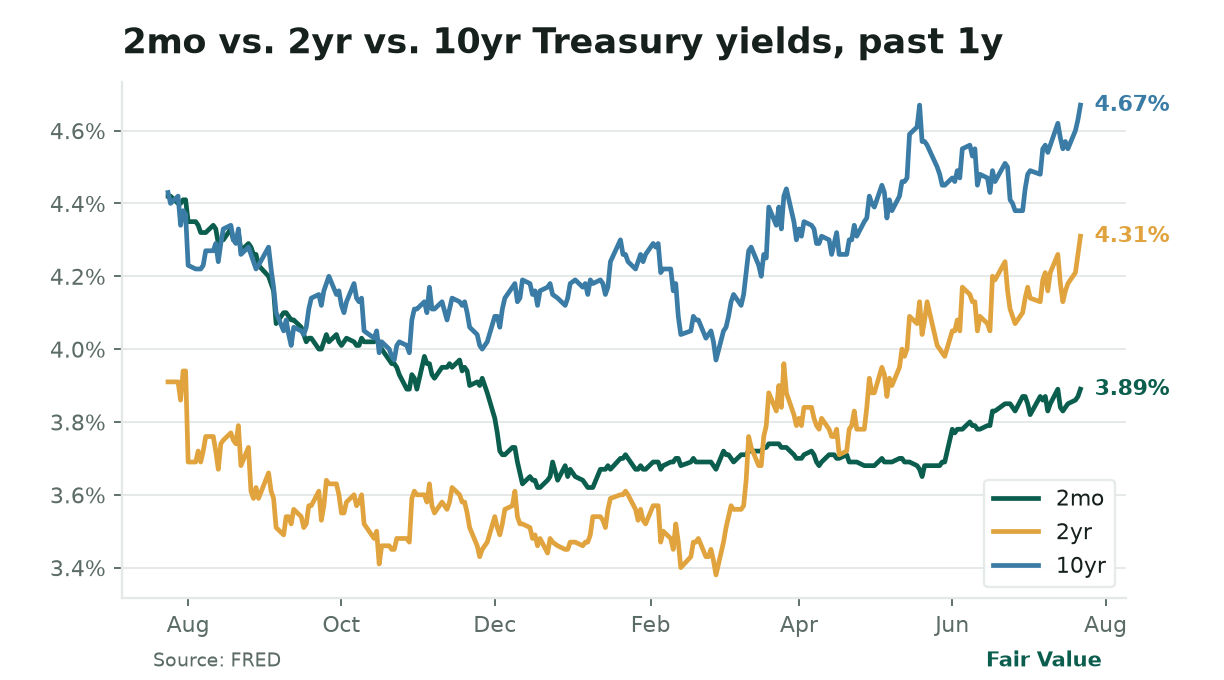
Bonds just did the Fed’s job. The 2-month Treasury yield jumped 13 basis points to 3.95%, fully pricing in a July 29 rate hike, a scenario almost no one saw coming after June’s pause.
What’s moving markets
Three key assumptions collapsed in Thursday’s trading.
Oil rewrote the inflation script.. Brent crude’s spike above $100 a barrel, fueled by Houthi attacks on Saudi tankers and rising Iran threats, reversed sharply, falling 9.4% to $91.24 on Thursday. But the fallout remains: U.S. gas prices hit $3.89 a gallon (AAA data), up 12 cents in two weeks, while refiners face high-cost inventories. Bond markets reacted fast: the 2-year Treasury yield climbed to 4.31%, and the 2-month yield surged to 3.95%, now pricing in a July 29 Fed hike, unthinkable just days ago.
AI spending lost its free pass.. Tesla’s 14.5% drop on Thursday wasn’t about missing targets, it was about burning cash. Free cash flow flipped from +$146 million to -$1.1 billion in a year, even as revenue grew. Musk’s promise to keep spending for "two to three more years" didn’t reassure anyone. Google faced the same pushback: shares fell 7.1% on Thursday after raising 2026 capital spending guidance to $200 billion, despite cloud revenue growing 82%. The lesson: Markets now demand profits, not just growth.
“Safe” stocks aren’t safe, they’re the only game in town.. While the Nasdaq fell 2.15% on Thursday and consumer discretionary stocks (XLY) dropped 4.61%, defense contractors soared: Lockheed Martin (+10.5% on Thursday), Raytheon (+7.3%), Honeywell (+5.7%). This isn’t about recession fears, it’s geopolitical chaos and policy uncertainty redirecting where money flows.
Next week’s critical moments:
▸
Monday’s PCE report, the Fed’s favorite inflation gauge.
▸
Tuesday’s consumer confidence, will higher gas prices hurt sentiment?
▸
Wednesday’s FOMC decision, bonds have already moved. Will the Fed follow?
The big story
Oil’s $100 shock: How 10 days derailed the Fed’s plans
Brent crude’s jump above $100 a barrel this week wasn’t just a price move, it was a game-changer, cracking the Fed’s inflation story and squeezing households.
The trigger:. Houthi attacks on Saudi tankers and Iran’s threats to the Strait of Hormuz pushed Brent 15% higher in 10 days. The ripple effects:
▸
Gas prices rose 12 cents in two weeks to $3.89 a gallon, the sharpest increase since Russia invaded Ukraine.
▸
Diesel hit $4.12 a gallon, raising costs for trucking and shipping.
▸
Jet fuel reached $2.90 a gallon, pushing airfares up.
Why Thursday’s 9.4% drop to $91.24 doesn’t fix the problem:
▸
Refiners are stuck with expensive crude. Pump prices take weeks to adjust.
▸
June’s CPI (due next week) will reflect the surge, likely pushing headline inflation above 3.5%.
▸
This isn’t temporary. Houthi attacks are now weekly, and Iran’s retaliation cycle is speeding up.
The Fed’s dilemma:. Its models assume oil shocks fade. But with diesel feeding core inflation and gas draining wallets, ignoring this risks losing credibility. Bonds agree: the 2-month yield at 3.95% now prices in a July 29 hike, a scenario that didn’t exist last week.
Where the pain hits:
▸
Trucking: 70% of U.S. freight moves by road. Higher diesel means higher prices on everything from food to electronics.
▸
Airlines: Summer travelers face rising ticket prices as jet fuel costs climb.
▸
Households: Every extra dollar at the pump is one less for spending or saving.
What’s ahead:
▸
Monday’s PCE report is now pivotal. Another increase buries the “disinflation” argument.
▸
Watch the WTI-Brent spread. U.S. crude (WTI) is outperforming Brent, signaling shale is the only stable supply source.
Bottom line:. The Fed spent 18 months fighting inflation. Oil just reset the timeline.
The big picture
Bonds are flashing warnings. Stocks are looking the other way.
Bonds sound the alarm.. The 10-year Treasury yield reached 4.67%, its highest since early 2025, while the 2-year rose to 4.31%. The 2-month yield’s 13-basis-point jump to 3.95% is the key signal: it’s now above the Fed’s target range, pricing in a hike next week.
Stocks split into haves and have-nots.. The S&P 500 (-1.21% on Thursday) and Nasdaq (-2.15%) led declines, but the losses weren’t universal:
▸
Winners: Defense (Lockheed +10.5% on Thursday, Raytheon +7.3%) and healthcare (XLV +1.26%) as money fled riskier assets.
▸
Losers: Tech took the brunt, Tesla (-14.5% on Thursday), Google (-7.1%), Amazon (-4.6%). The divide? Who can actually raise prices.
Oil’s wild swing defined the week.. Brent’s $100 spike and 9.4% plunge left gas prices stuck at $3.89 a gallon, ensuring June’s CPI stays high.
Crypto’s steady hand.. While stocks and bonds swung, Bitcoin (+0.05% on Thursday) and Ethereum (+0.52%) barely moved. This isn’t apathy, it’s a market growing up. Crypto’s 30-day volatility now sits below the Nasdaq’s.
Next week’s landmines:
▸
Monday: PCE inflation. A rise ends September cut hopes.
▸
Tuesday: Consumer confidence. Will $4 gas hurt sentiment?
▸
Wednesday: FOMC. Bonds have hiked. If the Fed doesn’t, yields may drop fast.
Around the world
The Middle East didn’t just make headlines, it reshaped global energy.
Oil’s safe routes are disappearing.. Houthi strikes and Iran’s Hormuz threats triggered three shifts:
▸
Tanker insurance costs doubled in a month (Lloyd’s data).
▸
Oil freight rates hit 2022 levels.
▸
A hidden tax on global trade, lifting prices for diesel, plastics, and oil-linked goods.
China’s quiet win.. While the West scrambles, China secured discounted oil from Iran and Russia ($10-$15 below Brent). The bigger move: the yuan is now the top currency for oil trades with Iran, Russia, and Venezuela, a long-term challenge to the dollar’s dominance.
U.S. shale stands alone.. With WTI outperforming Brent, the message is clear: America’s oil is the reliable supply.
Europe’s gas crunch.. While the U.S. focuses on oil, Europe faces a natural gas shortage:
▸
Dutch TTF gas jumped 8% as Norwegian supply cuts meet rising Asian LNG demand.
▸
EU storage sits at 89%, but withdrawals are speeding up as industries ramp up.
China’s AI chip push.. The Wall Street Journal reported Beijing is accelerating state-backed Nvidia alternatives by 2027. The risk? A wave of low-cost Chinese AI chips undercutting U.S. firms.
Companies in focus
Tesla’s AI gamble backfires.. Shares plummeted 14.5% on Thursday to $319.69 after Q2 earnings showed AI, robotaxi, and Optimus spending burned $1.1 billion in cash flow, a $1.2 billion swing from last year. Musk’s pledge to keep spending for "two to three years" didn’t convince anyone. The market’s response: Where’s the payoff?
Google’s $200 billion spending plan alarms investors.. Shares dropped 7.1% on Thursday to $317.69 despite 82% cloud growth, as traders balked at 2026 capital spending guidance of $195-$205 billion. The takeaway: AI investments are no longer a free pass.
Defense stocks rally on global tensions..Lockheed Martin (+10.5% on Thursday to $568.59), Raytheon (+7.3% to $209.16), and Honeywell (+5.7% to $246.27) led the S&P as investors sought safety.
Micron rides the AI boom.. Shares rose 3.2% on Thursday to $990.21 after reporting record free cash flow and HBM chips sold out through 2027.
From Washington
The Fed is cornered, and oil made it worse.
Bonds are pushing the Fed to act.. The 2-month yield’s 13-basis-point jump to 3.95% prices in a July 29 hike, driven by $100 oil and the guaranteed gas-price bump in next week’s CPI.
Bonds priced in a July hike before the Fed did. The 2-month yield (3.95%) surged above the Fed’s target range, while the 2-year (4.31%) and 10-year (4.67%) hit multi-month highs, all reacting to oil’s inflation shock. This inversion signals traders expect the Fed to follow markets, not lead.
New Fed task forces add uncertainty.. Chair Warsh launched five policy review groups, aiming for less forward guidance and more real-time data. First test: next week’s FOMC. If the Fed holds rates but signals future hikes, stocks could drop.
Tariffs: the hidden inflation risk.. Trump’s 10% tariff on $300 billion of Chinese goods (starting Sept. 1) is already priced in, but China’s retaliation isn’t. Likely targets: U.S. agriculture and rare earths, which could raise costs for automakers.
Worth learning today: Real estate as leverage
Yesterday’s call:. You predicted the European Central Bank would keep rates at 2.40%. Correct, but with a twist. President Lagarde hinted at a September cut if inflation cooperates. The euro fell 0.4% to 1.1391 as traders bet on easing.
Real estate: How leverage amplifies gains, and losses
Real estate isn’t just property, it’s a financial multiplier. Here’s how it works (and where it backfires).
1. Your home: Wealth builder or debt trap?. Buy a $400,000 home with 20% down ($80,000) and a 6.58% 30-year mortgage (FRED MORTGAGE30US):
▸
Leverage effect: A 5% price increase turns your $80,000 into $100,000, a 25% return on your cash.
▸
The flip side: A 5% drop erases $20,000, again, 25% of your investment.
2. How real estate creates (or destroys) wealth. Returns come from three places:
▸
Rental income: $2,500 a month = $30,000 a year (7.5% yield on $400,000).
▸
Appreciation: U.S. homes average 3-4% a year (Case-Shiller).
Booming: Warehouses (e-commerce demand), data centers (AI growth).
Concept 14 of 83 in the Fair Value course.
What to watch this week
▸
Monday, July 27: — PCE inflation (June), The Fed’s key metric. A rise ends September cut hopes.
▸
Tuesday, July 28: — Consumer confidence (July), Will higher gas prices hurt sentiment?
▸
Wednesday, July 29: — FOMC decision, Bonds priced a hike. If the Fed holds, yields could drop sharply.
▸
Thursday, July 30: — Q2 GDP, Expected: 1.8% growth. A miss fuels recession fears.
▸
Friday, July 31: — Exxon (XOM), Chevron (CVX) earnings, How much are they gaining from $100 oil?
Not financial advice.Disclaimer: This is informational commentary, not financial advice. We do not recommend or endorse any security, strategy, or viewpoint. Past performance isn’t indicative of future results. Consult a professional before considering risk in markets. Not financial advice.