Oil’s dual chokepoints reshape global supply. Brent crude fell 3.9% Friday to $96.78, but the deeper threat lies in two blocked straits: Houthi attacks on Saudi tankers in the Bab el-Mandeb now compound the Strait of Hormuz closure, endangering about 25% of global oil flow. Gasoline and freight costs face upward pressure.
▸
AI’s hardware race intensifies with a $500 billion deal. NVIDIA and SK Group’s partnership to build AI factories across Korea and Japan signals a strategic shift: dominance now hinges on controlling the entire AI supply chain, from chips to data centers to memory.
▸
Bitcoin’s stability masks a $35 million DeFi breach. Three cross-chain bridges suffered exploits in 48 hours, exposing crypto’s persistent infrastructure vulnerabilities, and drawing regulatory scrutiny.
What’s moving markets
This weekend’s quiet trading belies two mounting pressures: oil’s geopolitical squeeze and AI’s infrastructure arms race.
Oil’s dual blockade: About 25% of global supply at risk
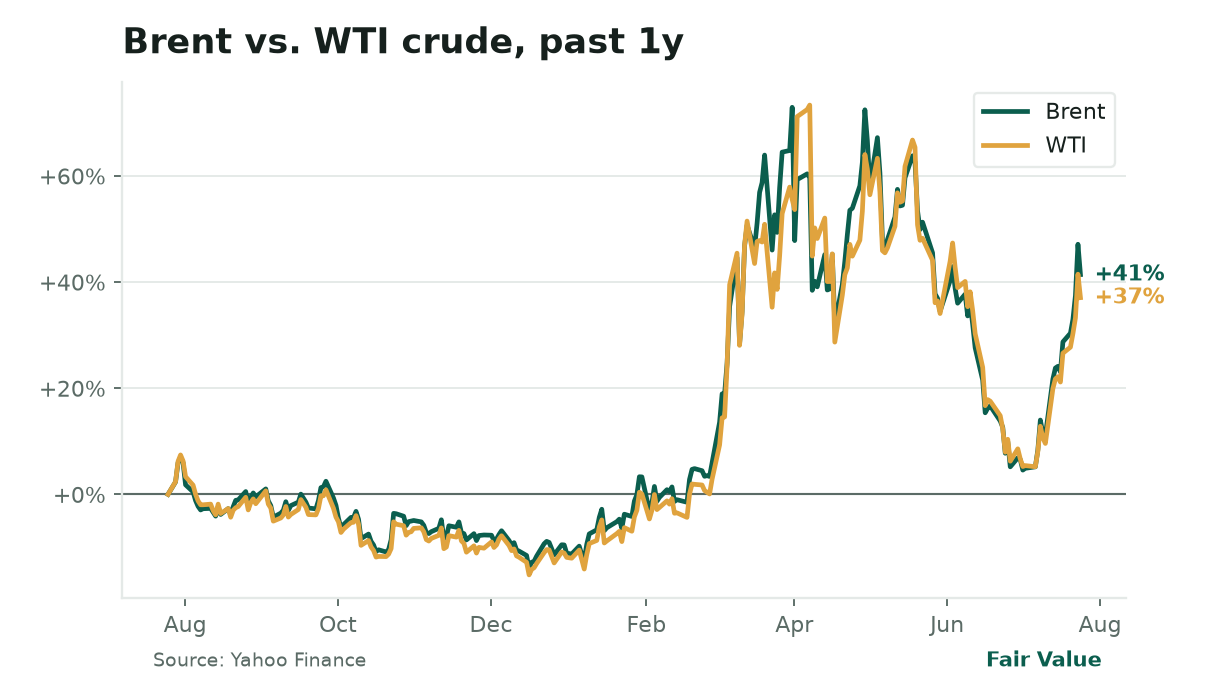
Brent crude declined 3.9% Friday to $96.78, while WTI slipped 3.1% to $89.31, profit-taking after Brent’s surge past $100 earlier in the week. Yet the retreat obscures a deeper crisis: Houthi strikes on Saudi tankers in the Bab el-Mandeb Strait have created a second critical chokepoint alongside the already constrained Strait of Hormuz. Together, these routes handle about 25% of the world’s oil supply.
Brent’s $7 premium to WTI widens on geopolitical risk. Brent crude’s 3.9% Friday drop to $96.78 still leaves it $7 above WTI ($89.31), reflecting its exposure to Middle East chokepoints (25% of global supply at risk). The spread signals traders paying up for safer U.S. oil as Red Sea/Hormuz tensions persist.
Traders booked gains after Brent’s midweek rally, but the geopolitical risk premium persists. Tanker insurance costs are rising, shipping routes are diverting, and refiners are securing premium-priced barrels. JPMorgan analysts project Brent could average $114 per barrel if the conflict extends three months, adding $7-8 per barrel monthly to prices.
The critical distinction: This isn’t 1973. Oil no longer just fuels vehicles, it powers 90% of global freight. Higher crude prices translate to inflated costs for all shipped goods, from groceries to electronics. With the Federal Reserve already monitoring inflation, $4 gasoline could climb to $4.50 just as back-to-school and holiday shipping seasons peak.
The wildcard remains U.S. shale production, which nears record output at 13.8 million barrels per day. WTI’s $7 discount to Brent underscores its relative safety, but even domestic production can’t offset a quarter of global supply under threat. The next phase hinges on two questions: Will Iran escalate further? And how long can Saudi Arabia sustain its spare capacity?
AI’s hardware race: The battle for full-stack control
NVIDIA and South Korea’s SK Group unveiled a $500 billion alliance to construct AI factories, not just semiconductor plants, but integrated data centers, memory, and networking infrastructure. The strategic message is clear: AI leadership now requires dominance over the entire hardware stack.
Japan is backing a 140-megawatt AI cloud, while Korea’s NAVER is expanding its AI capabilities with Brookfield and NVIDIA. The takeaway: AI is evolving into a physical industry, with data centers emerging as the new refineries. Future winners won’t just develop algorithms, they’ll own the hardware executing them.
Bitcoin held steady at $63,948 (−0.24%) and Ethereum at $1,857 (−0.18%), but beneath the surface:
▸
DeFi’s $35 million hack: Three cross-chain bridges, AFX Trade, BSquared Network, and VerusCoin, were exploited in 48 hours. While bridge hacks have drained $2.5 billion since 2020, this spree highlights crypto’s enduring infrastructure flaws.
▸
Regulatory gaps: The Financial Action Task Force reports 83% of countries have adopted crypto’s "travel rule" (requiring exchange data-sharing), but only 40% enforce it, leaving room for illicit transactions.
U.S. markets are closed, but futures reveal a split: S&P 500 futures are unchanged, while Nasdaq futures fell 1.2%. Tech’s AI spending spree faces scrutiny after Intel’s 7.9% drop Friday (now −30% this month). The issue wasn’t weak earnings, it was $140 billion in AI capital expenditures erasing free cash flow. Investors demand returns, not just growth promises.
The outlier: Schlumberger (+11%), benefiting from surging oil-services demand. In a fragmented market, sector selection trumps macro bets.
The big picture
Oil’s dual blockade: Why $96 crude is just the beginning
Brent’s 3.9% Friday decline to $96.78 and WTI’s 3.1% slide to $89.31 mask the real story: a new Red Sea threat rewriting oil’s risk calculus.
Houthi militants, backed by Iran, attacked two Saudi tankers in the Bab el-Mandeb Strait Thursday, the Red Sea’s southern gateway, handling 5 million barrels per day. Combined with the Strait of Hormuz (where U.S.-Iran tensions have cut traffic from 6 million to 2.5 million barrels per day), about 25% of global oil supply now faces disruption.
Friday’s pullback reflected profit-taking after Brent’s midweek surge past $100. But the geopolitical premium remains. Insurance costs are climbing, routes are lengthening, and refiners are paying premiums for secure supplies. JPMorgan forecasts Brent could average $114 per barrel if the conflict persists, adding $7-8 monthly to prices.
The critical shift: This isn’t 1973. Oil no longer just fuels vehicles, it powers 90% of global freight. Higher crude prices mean higher costs for every shipped good, from food to electronics. With the Fed already inflation-conscious, $4 gasoline could reach $4.50 just as back-to-school and holiday shipping ramp up.
The wildcard remains U.S. shale production, nearing records at 13.8 million barrels per day. WTI’s $7 discount to Brent signals its safe-haven status, but even domestic output can’t compensate for a quarter of global supply at risk. The next moves depend on two factors: Iran’s next steps and Saudi Arabia’s spare capacity timeline.
Next week, tanker tracking data will be critical. If vessels continue avoiding both straits, oil’s "pullback" won’t last.
Bonds: July 29 Fed hike is priced in, the 2027 debate isn’t
The 10-year Treasury yield holds at 4.71% (down slightly Friday but up 0.30 percentage points from last month), while the 2-year yield sits at 4.37%. The bond market’s signals:
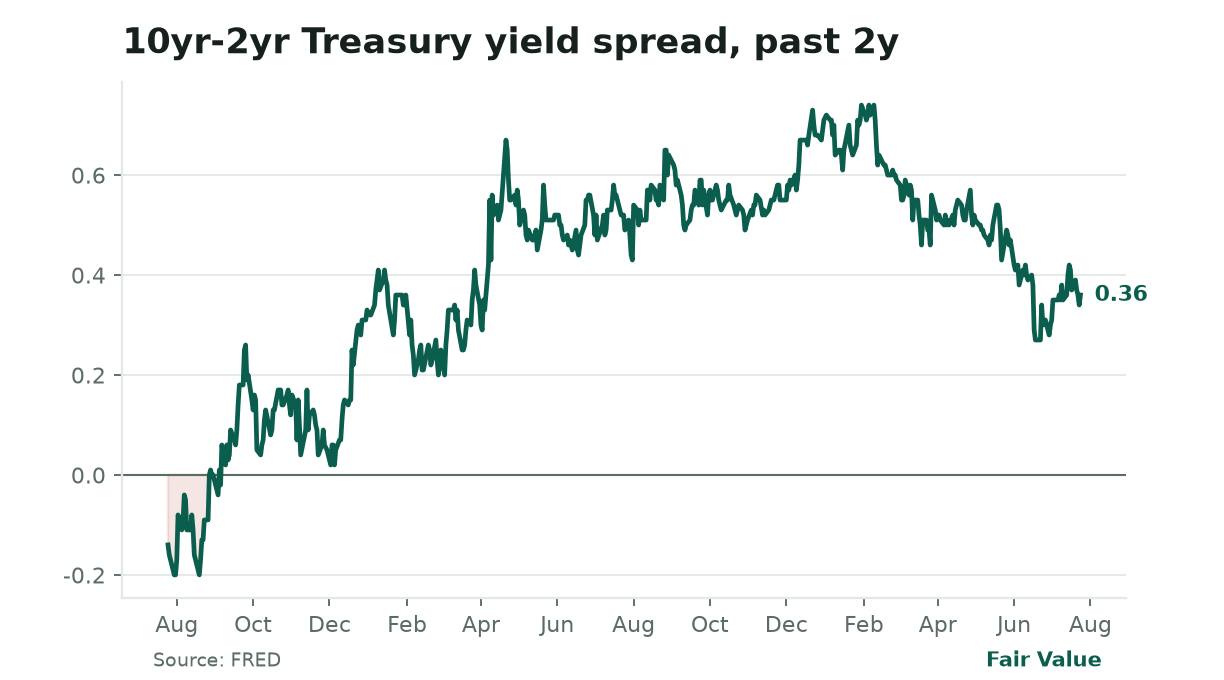
Curve flattens to 0.34% as 2027 cut bets clash with oil inflation. The 10yr-2yr spread (now 0.34%) has halved since June, signaling traders expect Fed rate cuts in 2027, but oil’s surge (Brent +12% this month) threatens to delay them. A flattening curve historically precedes economic slowdowns; this time, it’s colliding with a geopolitical inflation shock.
▸
July 29’s hike is locked in. Traders price in an 8-basis-point increase (0.08%) next week, with 44 basis points total by year-end, implying two quarter-point hikes. The Fed has telegraphed this; bonds have adjusted.
▸
The 2027 question looms. The flattening yield curve (2-year to 10-year spread: 0.34 percentage points) suggests traders expect 2027 rate cuts as growth slows. But inflation complicates this: Core PCE remains at 2.8%, and oil’s surge could push it higher. If the Fed hikes next week but doesn’t signal near-term cuts, long-term yields could spike, raising borrowing costs across the economy.
▸
Geopolitics are supporting demand. The dollar index rose 0.7% this week, and gold holds near $4,068 per ounce. Middle East tensions are driving money into dollars and Treasuries, limiting how high yields can climb.
Impact on finances:
▸
Savings yields (high-yield accounts, T-bills) remain strong, lock in rates before the hike.
▸
Mortgages (now 6.58%) won’t drop soon. The "wait for lower rates" strategy just got riskier.
▸
Stocks face pressure: Higher yields make bonds more attractive. That’s why the Nasdaq (−4.5% this month) is struggling while defensives like utilities (+2.5%) and healthcare (+4.5%) hold steady.
The dollar’s quiet rally, and its hidden costs
The U.S. Dollar Index (DXY) climbed 0.7% this week to 101.47, a modest move with outsized effects:
▸
Safe-haven demand: Middle East tensions are boosting the dollar, the world’s crisis currency. It’s rising even as U.S. yields dip slightly.
▸
Commodity currencies weaken: The Australian dollar (AUD/USD: 0.698) and Canadian dollar (USD/CAD: 1.409) are down as oil and metals fluctuate. Canada’s loonie is particularly sensitive, every $1 move in oil shifts it by 0.2 cents against the dollar.
▸
Yen’s freefall continues: USD/JPY hit 163.8, a 34-year high. Japan’s near-zero rates make the yen a funding currency for global trades. If the Bank of Japan doesn’t hike soon, 170 is next.
Why it matters:
▸
A stronger dollar hurts U.S. exporters (Coca-Cola, Boeing) and multinational earnings (Apple, Microsoft).
▸
It lowers import costs, good for inflation, bad for foreign producers.
▸
For travelers, Europe (EUR/USD: 1.138) and the UK (GBP/USD: 1.332) are marginally cheaper, but Japan is 20% more expensive than a year ago.
Around the world
Middle East: Economic ripple effects of escalation
The U.S.-Iran conflict expanded this week, with Bahrain and Kuwait launching airstrikes on Iran, marking rare direct Gulf state involvement. The immediate impacts:
▸
Oil: Brent’s $100 spike earlier this week added 12 cents per gallon to U.S. gasoline in two weeks. If tensions persist, $4.50 gasoline is likely by Labor Day.
▸
Shipping: War-risk insurance for Red Sea tankers tripled, and some carriers are rerouting around Africa, adding 10 days and $1 million per voyage.
▸
Saudi Arabia’s balancing act: Riyadh aims to maintain oil flows but can’t risk its infrastructure. The kingdom’s 2 million barrels per day of spare capacity is the world’s buffer, and it’s under strain.
The less obvious risk: Food prices. Red Sea blockades are delaying grain shipments from Ukraine and Russia. Wheat futures rose 5% this week, and if disruptions extend into August, bread prices will follow.
China’s AI ambitions confront chip constraints
China’s Moonshot AI launched its Kimi K3 model (2.8 trillion parameters) this week, then paused sign-ups after 48 hours due to GPU shortages. The core issue: U.S. chip restrictions. Kimi K3’s efficiency (using just 16 of 896 "experts" per task) can’t fully offset the lack of high-end NVIDIA chips.
The broader trend: China’s AI strategy is fragmenting. Some firms push open-source models; others lobby for state-funded chip breakthroughs. Meanwhile, the U.S. is tightening export controls, this week, the Commerce Department added 13 more Chinese AI firms to its entity list.
Europe’s energy dilemma: LNG vs. green transition
Two moves this week underscore Europe’s energy contradiction:
▸
Germany fast-tracked the Tilbury LNG expansion in British Columbia, bypassing environmental reviews to secure Canadian gas. The project adds 2.5 million tons per year of LNG, enough to replace 5% of Europe’s lost Russian imports.
▸
Australia’s PM may impose a windfall tax on gas exporters to fund renewables. The catch: The tax could raise LNG prices for Europe, which relies on Australian supplies.
The tension is clear: Europe wants affordable, green energy, but the economics don’t yet align.
Companies in focus
Schlumberger capitalizes on oil-services demand
Shares surged 11% Friday to $52.42 on strong offshore drilling demand and a boom in data-center cooling services for AI infrastructure. The digital division, selling software to energy firms, grew 22% year-over-year.
Intel’s AI spending spree backfires
The chipmaker fell 7.9% Friday to $92.32 after its $140 billion AI capital expenditure plan turned free cash flow negative. Revenue grew 15% year-over-year, but investors balked at the three-year payoff timeline. The lesson: AI spending must deliver profits.
ARM’s valuation reset
The chip designer dropped 8.1% Friday to $260.01, extending a 25% monthly decline. The issue: AI demand is shifting from mobile to data centers, and ARM’s mobile-focused licenses aren’t keeping pace. Now trading at 25x forward earnings, the stock is cheap for growth, if the pivot succeeds.
Adobe’s AI-driven rebound
Shares climbed 6.1% Friday to $225.11 after highlighting AI tools like Firefly, which drove 20% revenue growth in digital media. The key: Adobe’s subscription model turns AI upgrades into recurring revenue, not one-time sales.
Telecom’s safe harbor: Verizon and AT&T
Both stocks rose (VZ +5.8%, T +5.1%) as investors sought dividend-paying defensives. Verizon’s 6.5% yield and AT&T’s 5.8% yield outshine the 10-year Treasury’s 4.7%, with less volatility.
Tesla’s cash burn concerns
Shares fell 2.1% Friday to $313.03, capping a 17% weekly drop. The issue isn’t demand, it’s $140 billion in AI/robotaxi spending that pushed free cash flow to −$1.1 billion last quarter. Musk calls it a 2-3 year bet; investors want proof.
From Washington
Fed’s July 29 decision: A hike is certain, the path isn’t
The Federal Reserve meets Wednesday, July 29, with a quarter-point hike (to 3.875%) nearly guaranteed. The uncertainties:
▸
The dot plot. The Fed’s projections will reveal how many 2026 hikes they expect. Two or more could unsettle markets; one-and-done would spark relief.
▸
Powell’s tone. Chair Jerome Powell must acknowledge inflation risks (oil’s surge) without triggering recession fears. Any hint at early 2027 cuts would buoy bonds.
▸
The oil wildcard. Brent at $96 is already lifting gasoline prices. If it hits $105, the Fed may pause in September to assess the impact.
For your finances:
▸
Credit cards: Rates (20%+) rise another 0.25%.
▸
Savings: High-yield accounts (4.5-5%) will follow.
▸
Mortgages: The 6.58% 30-year rate isn’t falling soon.
Under the hood
The AI capex trap: Spending ≠ winning
Here’s the market’s open secret: AI capital expenditure is becoming a liability.
Intel’s 15% revenue growth should have pleased investors. Instead, the stock plunged 7.9% because its $140 billion AI capex plan erased free cash flow. The message: Growth without profits doesn’t cut it.
The same pattern hit ARM (−8.1%) and Marvell (−7.2%). All three are betting big on AI, but only NVIDIA (+0.03% Friday) is rewarded. Why? NVIDIA’s 70% gross margins prove its spending pays off. Intel’s? 45%. ARM’s? 38%.
This is the AI capex trap:
▸
Winners (NVIDIA, Microsoft, Google) spend and profit.
▸
Losers (Intel, ARM, most chipmakers) spend and hope.
▸
The market no longer rewards hope.
The result: A two-tier tech sector:
▸
AI infrastructure (NVIDIA, Broadcom, ASML) keeps rising.
▸
AI spenders without profits (Intel, AMD) keep falling.
What changes this?
▸
Proof of ROI: If Intel’s 2027 AI chips deliver, the stock recovers.
▸
Spending cuts: If firms trim capex, margins improve, but growth stalls.
▸
Fed pivot: Lower rates make future profits more valuable.
For now, the rule is simple: AI revenue must outpace AI spending. Without both, the market sells first.
Worth learning today: Cash, T-bills, and 'risk-free'
Where your cash actually goes
When you deposit money, it doesn’t sit idle. Banks deploy it, and where it flows depends on risk tolerance. Here’s the cash hierarchy, safest to riskiest:
▸
Physical cash
▸
Pros: No default or market risk.
▸
Cons: Inflation erodes it (3-4% annually), no growth, and no FDIC protection if lost or destroyed.
▸
Bank reserves at the Fed
▸
Banks hold 3-10% of deposits as reserves, earning the Fed’s 3.63% rate.
▸
Why? The Fed mandates reserves to cover withdrawals. The rest gets lent or invested.
▸
Treasury bills (T-bills)
▸
What: Short-term U.S. debt (4 weeks to 1 year).
▸
Why "risk-free": The U.S. has never defaulted.
▸
Current yield: 5.2% for 1-year T-bills.
▸
Catch: "Risk-free" means no default risk, not no loss risk. Rising rates can depress T-bill market prices, but hold to maturity, and you’re paid in full.
▸
Money market funds (MMFs)
▸
What: Pools of ultra-safe, short-term debt (T-bills, commercial paper).
▸
Current yield: ~5.1% (Vanguard’s VMFXX).
▸
Perks: Liquid (sell anytime), stable ($1/share always), and FDIC-insured up to $250K in banks.
▸
Risk: The 2008 crisis proved they’re not truly risk-free, one MMF "broke the buck" after Lehman’s collapse.
▸
Corporate commercial paper
▸
What: Short-term IOUs from large firms (Apple, Walmart) for payroll/inventory.
▸
Yield: ~5.4% (higher than T-bills due to default risk).
▸
Risk: If the company fails (e.g., Silicon Valley Bank in 2023), you lose money.
▸
Bank loans
▸
Banks lend deposits for mortgages, business loans, or credit cards.
▸
Your cut: Savings accounts/CDs pay 0.5-4%, while banks pocket the spread (e.g., charge 7% on mortgages, pay you 3%).
Why this matters now
With 10-year Treasuries at 4.71% and T-bills at 5.2%, cash finally earns real returns (after inflation). But:
▸
Banks lag: Average savings accounts pay 0.45%, while online banks (Ally, Marcus) offer 4.5-5%.
▸
Tax bite: T-bills and MMFs are taxed as income, not capital gains, high earners keep ~60% of the yield.
▸
Inflation’s cut: At 3.5%, a 5% T-bill nets 1.5% real return, better than a savings account, but not a windfall.
The key driver. The Fed’s 3.63% rate sets the floor for all cash instruments. If the Fed hikes next week (to ~3.875%), T-bill and MMF yields will follow. But if the Fed cuts in 2027, those yields drop, and cash becomes less attractive. That’s why pros watch the 2-year Treasury (4.37%): it reflects where rates are headed.
Concept 15 of 83 in the Fair Value course.
What to watch this week
▸
Tuesday, July 28 — U.S. Consumer Confidence (July), below 100, expect market jitters.
▸
Wednesday, July 29 — Fed rate decision (2:00 PM ET), a 0.25% hike is priced in; Powell’s presser will signal September plans.
▸
Thursday, July 30 — U.S. GDP (Q2, first estimate), below 1.5%, recession fears resurface.
▸
Friday, July 31 — PCE Inflation (June), if core PCE stays above 2.8%, September hikes remain likely.
▸
Friday, July 31 — Earnings: Apple, Amazon, Meta, Exxon, Chevron, AI spending and energy profits take center stage.
Not financial advice.Data sources: Bloomberg, FactSet, Federal Reserve, U.S. Treasury, CoinGecko, CME Group. Disclaimer: This is not financial advice. Do your own research before buying or selling any security.