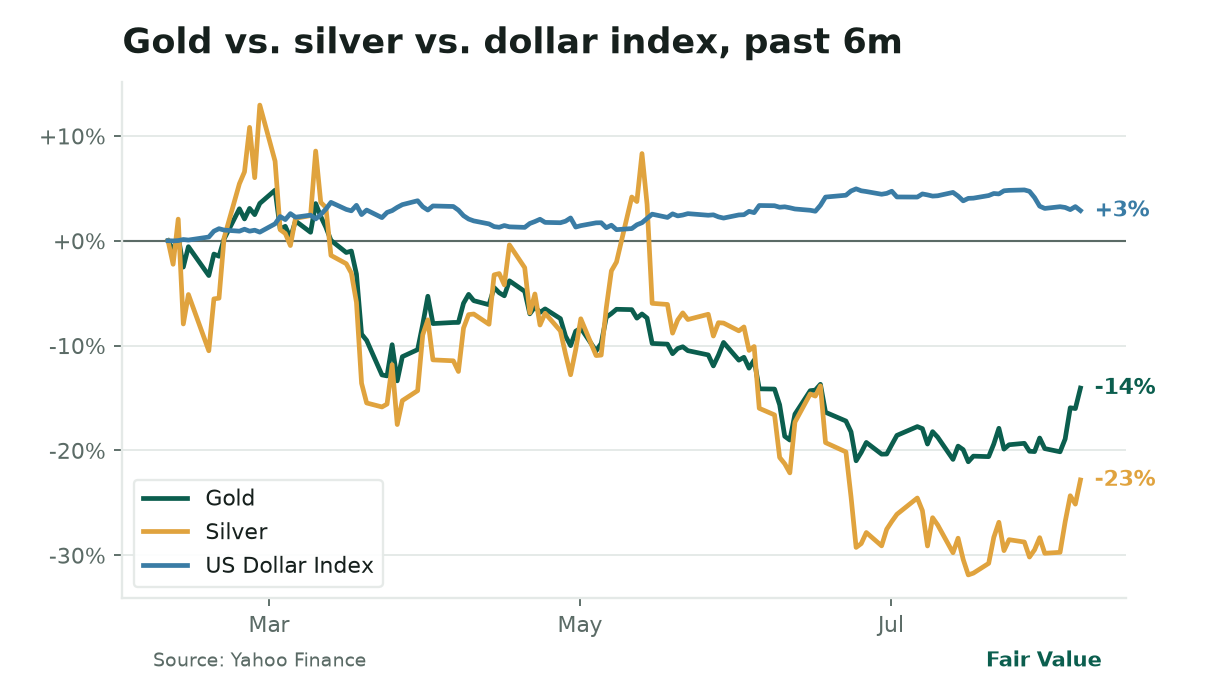
Gold and silver climb as Fed expectations shift. Gold rose 2.3% to $4,340.70/oz and silver jumped 3.1% to $63.33/oz Friday, capping a ~7% weekly gain for both metals after July’s weak jobs report led traders to adjust Fed rate-hike expectations.
▸
AI infrastructure spending ramps up. Amazon’s $2 billion nuclear-powered data-center deal and SoftBank’s $10 billion AI compute pledge, both announced this week, highlight a push to secure low-carbon energy, which could help reduce core inflation faster than the Fed anticipates.
▸
Hormuz shipping goes dark. Tankers disabling transponders to avoid Iranian attacks are obscuring 20% of global seaborne oil flows, raising the risk of a supply shock even if diplomatic efforts reopen the strait.
What's going on today
Markets closed Friday torn between two forces: the Fed’s sudden dovish tilt and rising geopolitical tensions. July’s jobs report showed a net gain of about 77,000 jobs, well below the expected 100,000, shifting rate-hike expectations. Traders now see a greater chance the Fed holds steady in September. Gold climbed 2.3% to $4,340.70/oz, while silver rose 3.1% to $63.33/oz as the dollar weakened.
Gold and silver surge as dollar weakens. Both metals jumped over 2% Friday (gold to $4,340.70/oz, silver to $63.33/oz) after July’s weak jobs report shifted Fed expectations. The dollar index fell 0.4%, amplifying precious metals’ appeal as a hedge against policy uncertainty.
The Strait of Hormuz remains volatile. Iran’s threats and the spread of “dark shipping”, where tankers turn off transponders to avoid detection, have turned the critical chokepoint into an operational blind spot. Brent crude edged up 1.3% Friday to $83.55/bbl, but the bigger concern is the 20% of global seaborne oil now moving undetected. Even a brief disruption could send prices higher.
Meanwhile, AI infrastructure investment is accelerating. Amazon’s $2 billion nuclear-powered data-center project in California and SoftBank’s $10 billion commitment to AI compute facilities, both backed by nuclear energy, go beyond tech expansion. They reflect a strategic move to secure low-cost, low-carbon power for scaling AI systems. Microsoft’s latest AI chips already show 40% efficiency improvements, a trend that could cut costs across logistics, manufacturing, and services.
Key takeaway:. Three themes, Fed policy shifts, geopolitical risks, and AI-driven cost cuts, will shape markets in the week ahead.
The big story
The Fed’s sudden pause, and why AI could speed up rate cuts
The Fed’s rate-hike path hit a surprise roadblock Friday. July’s jobs report revealed a net gain of about 77,000 jobs, far below the 100,000 forecast, while unemployment dipped to 4.1%. The data suggest the labor market is cooling faster than expected.
Markets reacted quickly. Traders now see a greater likelihood of a September pause. Gold surged 2.3% to $4,340.70/oz, and silver climbed 3.1% to $63.33/oz as the dollar fell. But most analysis misses a key factor: this isn’t just about jobs. Two forces could push the Fed toward earlier rate cuts than expected.
First, the labor market is weakening faster than the Fed’s models predicted. Wage growth, now at $37.62/hour, is finally slowing, a sign rate hikes are working. But the second, less obvious factor is AI’s growing deflationary effect.
This week’s announcements mark a turning point in AI infrastructure:
▸
Amazon: $2 billion for a nuclear-powered California data center.
▸
SoftBank: $10 billion for AI-focused data centers, also nuclear-backed.
▸
Microsoft: Custom AI chips delivering 40% efficiency gains.
▸
Nvidia: $3 billion investment in a Blackstone-backed AI chip venture.
Why it matters:. AI isn’t just another tech boom, it’s a productivity revolution. As companies like Microsoft and Amazon scale AI, they’re rewriting cost structures in logistics, manufacturing, and healthcare. If these gains spread, they’ll lower unit costs and reduce the core inflation the Fed targets.
The Fed currently holds rates at 5.25-5.50%, calling its approach “data-dependent.” But the data is about to get more complicated. The next CPI report (August 14) could show core inflation falling below 3% for the first time in years. If AI-driven productivity gains appear in corporate earnings, the Fed may act sooner. Rate cuts could come by December 2026, a year ahead of earlier forecasts.
Three implications:
▸
Lower borrowing costs. Mortgages and loans may drop sooner than expected.
▸
Peak savings yields. High-yield accounts paying 5%+ will start to decline.
▸
AI stock momentum. Lower rates favor growth stocks, and AI leads the way.
The wild card:. Geopolitics. A Hormuz escalation or Ukraine flare-up could push oil prices higher, reigniting inflation just as the Fed shifts course.
The big picture
Markets sent mixed signals Friday: bonds signaled caution, stocks showed confidence. The divide hinges on one question: Is the economy slowing enough to change the Fed’s plans?
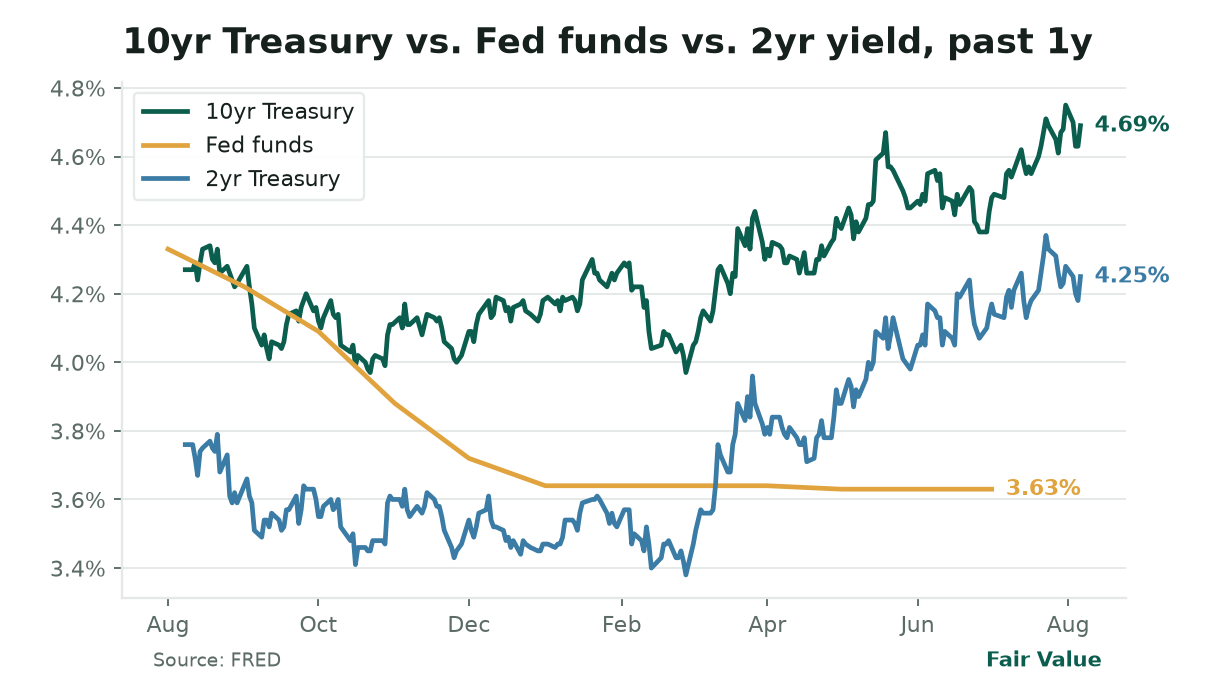
Bonds say yes.. The 10-year Treasury yield fell to 4.69% Friday as traders bet the Fed’s hike cycle is over. July’s jobs report, 77,000 jobs added, plus downward revisions, suggests the Fed’s 2% inflation target is within reach without further hikes. Message:Rate cuts may come by year-end.
Bond market bets on Fed pause. The 10-year Treasury yield fell to 4.69% Friday as traders priced in a September hold, while the 2-year yield (more sensitive to Fed moves) dropped to 4.85%. The gap between Fed funds (5.33%) and the 10-year suggests markets expect cuts by year-end, sooner than the Fed’s guidance.
Stocks disagree.. The S&P 500 closed at another record Friday, with futures up 0.6% overnight. The Nasdaq, led by AI and tech, rose 1.2%. Here, the bet is that AI productivity gains will offset economic weakness. Amazon’s $2 billion data-center plan and SoftBank’s $10 billion AI pledge signal a new phase of capital-intensive tech growth.
Oil tells a different story.. Brent crude rose 1.3% Friday to $83.55/bbl, but the real issue is the Hormuz “dark shipping” crisis. Tankers disabling transponders to avoid Iranian attacks have created a black box in global oil flows. The dollar fell 0.4% Friday to its lowest since early July, a move that helps U.S. exporters but risks keeping import prices, and inflation, elevated.
Crypto moves quietly.. Bitcoin edged up 0.1% overnight to $64,955, but the real action is in tokenized real-world assets. Deposits in tokenized Treasuries, gold, and equities have grown to $7.4 billion over the past year, even as traditional DeFi activity slows.
The VIX tells the tale.. At 14.9, Wall Street’s fear gauge is near yearly lows. That’s not complacency, it’s confidence the Fed remains in control.
Around the world
This weekend’s geopolitical risks center on two hotspots: the Strait of Hormuz and Russia’s war in Ukraine. Both are testing the limits of economic warfare, and both could permanently reshape trade flows.
Hormuz goes dark.. Iran’s threats and tankers disabling transponders have turned the strait, a route for 20% of global seaborne oil, into a black box. Daily transits have dropped from 88-130 vessels to just 10. The risk isn’t a prolonged closure; it’s a miscalculation that spikes oil prices before markets can adjust.
Russia’s war shifts economically.. The U.S. Senate passed the “Lindsey O. Graham Sanctioning Russia and Iran Act”, authorizing 100% tariffs on countries buying Russian oil and gas. The bill targets Russia’s energy revenues, but China and India, its top customers, show no signs of compliance. Result: a clash between U.S. sanctions and global energy realities.
The yen’s quiet struggle.. Japan’s currency remains weaker than expected (USD/JPY at 157.745), despite the Bank of Japan’s tightening signals. The BOJ’s next move may involve yield-curve adjustments to make Japanese bonds more attractive, without full-scale intervention.
Europe’s energy hunt.. The EU’s phased-in Russian LNG ban forces a search for alternatives. Germany, once Russia’s largest gas buyer, now leads the push into hydrogen and nuclear. But French energy giant TotalEnergies warns Europe’s gas storage levels are below normal for this time of year, risking winter shortages.
China’s commodity stockpile.. Beijing is quietly hoarding copper, lithium, and rare earths, not just oil and gas. State-backed buyers are securing supplies from Congo copper to Australian lithium, betting Western sanctions will disrupt global flows.
Bottom line:. The world is fragmenting. Sanctions, export bans, and chokepoints are rewiring trade in ways that will outlast today’s crises.
Companies making news
▸
Airbnb jumped 17.4% after reporting record revenue and stronger-than-expected bookings, driven by international travel. Margins improved as more reservations shifted to its app, cutting third-party fees.
▸
Palantir extended its AI-driven rally, climbing 10.3% Friday and 30% over the past month as defense and intelligence contracts grow.
▸
Uber rose 6.5% after beating earnings and reporting better driver supply. Its expansion into grocery and alcohol delivery is gaining traction.
▸
Qualcomm (+4.7%) and Marvell (+3.9%) led a semiconductor rebound as investors returned to chip stocks.
▸
Coinbase gained 5.6%, supported by a crypto rebound and growth in tokenized real-world assets like Treasuries and gold.
▸
Tesla added 2.8% Friday but remains down 16.6% this month amid rising EV competition. Focus shifts to its Dojo supercomputer project.
▸
Shopify climbed 2.8%, capping a 27% monthly gain as small-business spending shifts to its platform.
▸
Oracle rose 2.5%, bringing its one-week gain to 13.2% as it becomes a key AI infrastructure player.
▸
Thermo Fisher gained 2.4%, extending its one-month rally to 16.4% on renewed biotech demand.
▸
The VIX fell 1.6% to 14.9, its lowest since early July, reflecting confidence, or potential complacency.
From Washington
The Fed’s sudden pause is the talk of D.C. this weekend. July’s jobs report didn’t just miss expectations; it changed the narrative. A net gain of about 77,000 jobs and downward revisions weakened the Fed’s hawkish stance. Traders now see a greater chance of a September hold.
But the Fed isn’t united.. July’s FOMC meeting saw three dissents, Cleveland’s Beth Hammack, Minneapolis’s Neel Kashkari, and Dallas’s Lorie Logan, all pushing for an immediate 25-basis-point hike. Hawks argue inflation (core CPI at 3.3%) remains too high and the labor market, while cooling, is still tight.
The challenge?.The data is about to get messy. Next week’s CPI report (August 14) could show core inflation falling below 3% for the first time in years. If AI-driven productivity gains appear in corporate earnings, the hawks may lose ground.
The political wildcard:.Donald Trump. The former president has publicly urged the Fed to cut rates, arguing high rates hurt growth.
Bottom line:. The Fed is in wait-and-see mode, but the clock is ticking. The next two weeks, with CPI, retail sales, and industrial production data, will determine whether the Fed holds, hikes, or hints at cuts.
Under the hood
FOCUS:. AI-compute expansion, powered by low-carbon nuclear energy, will begin reducing core inflation and could force the Fed to cut rates sooner than expected.
WHY NOW:. Current data show labor-market cooling (job growth declining, wage growth slowing) and a surge in AI infrastructure spending (Amazon $2B, SoftBank $10B), backed by new nuclear capacity. This mix of easing demand and a supply-side productivity boost makes a near-term shift in inflation dynamics highly likely.
THE READ:. The AI sector is entering a capital-heavy expansion phase. Amazon’s $2 billion data-center buildout and SoftBank’s $10 billion AI compute centers, both nuclear-powered, will come online within 12-18 months. These projects lock in cheap, emission-free electricity, cutting the marginal cost of compute. The result: lower operating expenses for AI-heavy firms and faster deployment of productivity-boosting algorithms across manufacturing, logistics, and services.
Productivity gains are already appearing:
▸
Microsoft reports 40% efficiency improvements from custom AI chips.
▸
Nvidia commits $3 billion to a Blackstone-backed AI-chip venture.
If these efficiencies spread, they’ll reduce unit costs and trim core inflation, the Fed’s key metric.
The Fed’s current stance: pause at 5.25-5.50%, data-dependent. Market pricing (10y/3m spread at 79bp) hints at modest easing, but consensus expects any cut to be gradual. However, AI’s supply-side shock could accelerate core inflation’s decline, pushing the Fed from "pause" to "cut" sooner than the 2027-2028 timeline many assume.
THE DEBATE:. Will the Fed preemptively cut rates on AI productivity gains, or wait for clearer core-inflation declines, risking a policy misstep?
WATCH:. Core CPI (or Core PCE) below 2.8% YoY for two consecutive months, plus non-farm productivity rising above 0.5% (AI-adjusted), would confirm the trend. A core-inflation bounce above 3% would refute it.
Worth learning today: Discounting, tomorrow’s dollar today
Yesterday’s check:. We asked if Canada’s employment change (forecast: +17.8K, prior: +18.2K) would beat, meet, or miss, and what it meant for the Bank of Canada’s rate path. The actual number: a 12.2K job loss, far worse than expected. The Canadian dollar fell, and BoC rate-cut bets increased.
Today’s lesson: Discounting, tomorrow’s dollar today.
You’ve heard “a dollar today is worth more than a dollar tomorrow.” But why? And how do we measure that difference? That’s discounting, the math of time and money.
Real-world example: Amazon’s $2B data center
Amazon didn’t write a $2 billion check this week. The spending will unfold over years. So how does Amazon decide if it’s worth it? They discount future cash flows.
Here’s how:
▸
Future cash flows: Suppose the data center generates $300 million/year in profit for 10 years.
▸
Discount rate: Amazon’s cost of capital (borrowing cost or investor-expected return) is 8%.
▸
Present value: Calculate what those future $300 million payments are worth today, assuming an 8% return elsewhere.
The formula: Present Value = Future Cash Flow / (1 + discount rate)^n(“n” = years in the future)
▸
Year 1’s $300M: PV = $300M / (1.08)^1 = $277.78M
▸
Year 10’s $300M: PV = $300M / (1.08)^10 = $137.76M
If the sum of all 10 years exceeds $2 billion, the project is viable. If not, they walk.
Why it matters now: the Fed’s discount rate
The Fed doesn’t say “discounting,” but that’s what happens when they raise or cut rates.
▸
Rate hikes = higher discount rates → Future profits are less valuable today → Companies invest less.
▸
Rate cuts = lower discount rates → Future profits are more valuable today → Companies spend more.
Right now, the Fed’s 5.25-5.50% pause means discount rates are high. That’s why:
▸
Growth stocks (like AI firms) are volatile, their value depends on future profits, now worth less.
▸
Housing is slow, a 30-year mortgage at 6.69% makes future payments less attractive.
▸
Corporate investment favors short-term returns (buybacks) over long-term projects.
But if the Fed cuts rates, discount rates fall. Future profits become more valuable today, fuel for stocks, housing, and long-term projects like Amazon’s data centers.
How discounting works in 3 steps
▸
Time erodes value: Money today can grow if invested; money tomorrow can’t. So tomorrow’s dollar is worth less.
▸
Risk demands a premium: Higher risk (or rates) means more discounting of future cash flows.
▸
The Fed sets the baseline: When the Fed moves rates, it changes the discount rate for everything, stocks, bonds, real estate, even retirement savings.
Linking to past lessons
▸
Compounding (Lesson 5) grows money forward; discounting shrinks it backward.
▸
The yield-price seesaw (bond lesson): When yields (discount rates) rise, bond prices fall, because future payments are worth less.
Why this matters to your money now
▸
401(k): If the Fed cuts rates, future earnings (e.g., from AI stocks) become more valuable.
▸
Mortgage: Lower rates mean future payments are discounted less, banks lend more today.
▸
Savings: High rates make future dollars worth less now, why CDs pay 5%+ today.
Concept 27 of 83 in the Fair Value course.
What to watch this week
▸
Tuesday, August 11: — U.S. CPI (July), The inflation report that could shape the Fed’s September decision. Core CPI is expected to fall to 3.2% YoY.
▸
Wednesday, August 12: — U.S. Retail Sales (July), A weak report would confirm economic cooling, increasing odds of a Fed pause.
▸
Wednesday, August 12: — Cisco (CSCO) earnings, A bellwether for corporate tech spending.
▸
Thursday, August 13: — U.S. Initial Jobless Claims, Another increase would reinforce the labor slowdown narrative.
▸
Thursday, August 13: — U.S. 30-Year Bond Auction, With the 30-year yield at 5.22%, this tests long-term inflation expectations.
Not financial advice. Disclaimer: Fair Value is not investment advice. Do not buy or sell any security based on what you read here. This content is for informational purposes only. Consult a financial advisor before making any investment decisions.
Data sources: U.S. Bureau of Labor Statistics, CME FedWatch, Bloomberg, FactSet, CoinGecko, U.S. Energy Information Administration, Bank of Japan, European Central Bank, International Monetary Fund. ```