Gold and silver rally while stocks stay calm. Gold climbed 3.1% and silver jumped 5.6% Thursday, moves usually seen in risk-off panics, yet the VIX sat at 15.3 as equities shrugged off rising tensions from North Korea, Russia, and Iran.
▸
Canada’s jobs report widens the Fed-BoC policy gap. Unemployment held at 6.5%, but employment fell by 12.2K (vs. an expected +17.8K gain), pushing Canadian mortgage rates higher as the Fed signals a September increase.
▸
AI’s profit test gets tougher. AMD’s record quarter (revenue +50% YoY) couldn’t prevent a 10% stock drop after SpaceX’s NVIDIA-only deal, showing even strong earnings can’t offset strategic setbacks.
What’s really moving today
U.S. stock futures inched up (S&P +0.15%, Nasdaq +0.46%), but two trends stand out.
Precious metals send a cautionary signal.. Gold rose 3.1% to $4,375 an ounce and silver jumped 5.6% to $65 Thursday, gains more typical of risk-off panics than a day with the VIX at 15.3. The trigger? Three escalating threats: North Korea’s latest missile test, U.S. warnings of a potential Russian NATO probe, and Iran’s threat to block the Strait of Hormuz. While none are new, their simultaneous escalation is prompting hedges, even as equities remain steady.
Canada’s labor data tightens the BoC’s position.. Employment dropped by 12,200 in July (vs. an expected +17,800 gain), with unemployment holding at 6.5%. The Bank of Canada meets in three weeks, and this report locks in expectations for no change, even as the Fed prepares for a September rate increase. The Canadian dollar barely moved (USD/CAD at 1.4016), but mortgage rates, already at 6.69% for a 30-year fixed, now face more upward pressure.
Tech earnings show perfection is the new baseline.. AMD posted its strongest quarter ever (revenue +50% YoY, data center sales doubled), yet shares fell 10% after SpaceX chose NVIDIA exclusively. The lesson? In AI, even record results can’t offset strategic missteps or guidance that falls short of high expectations.
The big story
Gold’s rally delivers the day’s clearest message
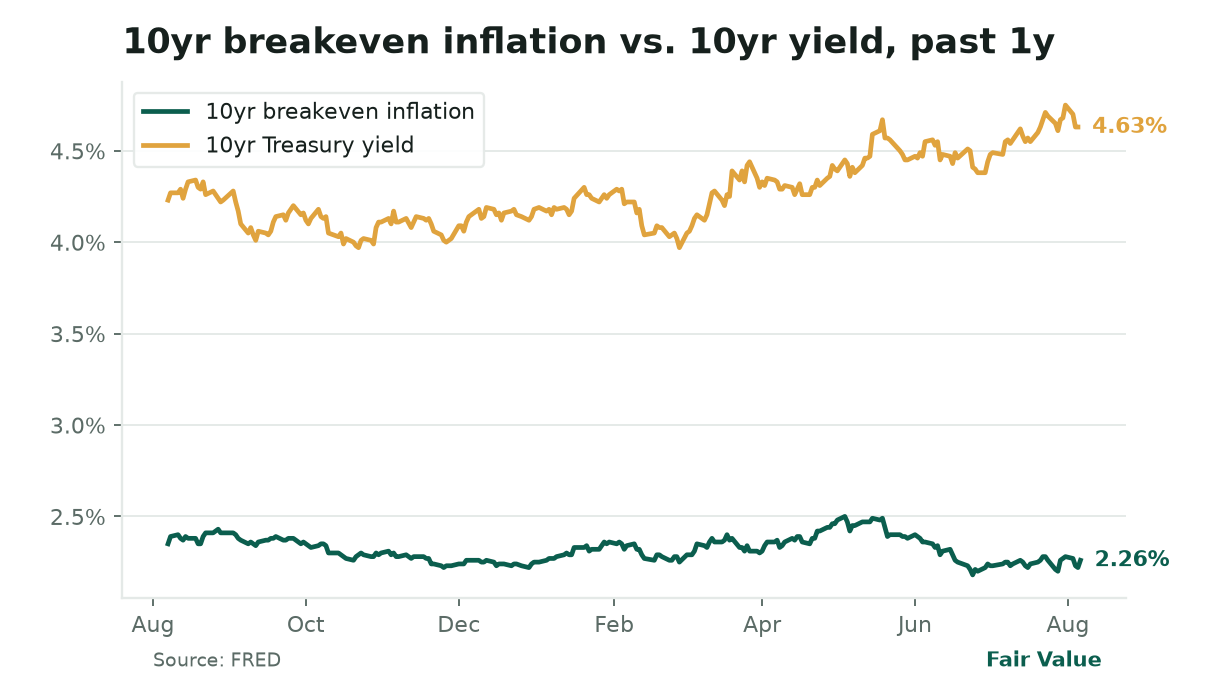
Bond markets price in sticky inflation. The 10-year breakeven inflation rate (now 2.26%) has climbed alongside the nominal 10-year yield (4.63%), suggesting investors expect geopolitical tensions (Strait of Hormuz, Russia) to keep price pressures elevated. If breakevens exceed 2.4%, the Fed’s ‘pause’ narrative weakens, even as equities ignore the signal.
Gold jumped 3.1% to $4,375 an ounce Thursday, while silver surged 5.6% to $65, both marking their strongest single-day gains in months. The moves contrast sharply with a VIX at 15.3, a level that usually signals calm. That mismatch is worth noting: precious metals don’t rally this sharply in stable markets. They rise when investors hedge risks they’re not yet discussing openly.
What’s driving the move?. Three geopolitical flashpoints escalated within 24 hours:
▸
North Korea test-fired a ballistic missile, raising tensions with Japan.
▸
U.S. intelligence now assesses that Russian President Vladimir Putin may test NATO’s resolve with a limited incursion, likely in the Baltics or Poland.
▸
Iran is finalizing plans to block U.S.-linked vessels from the Strait of Hormuz unless paid war reparations.
While none of these developments are new, their convergence is prompting a reassessment of tail risks. The muted equity reaction, paired with cautious bond markets, is the real signal. The 10-year Treasury yield held at 4.63%, and the 10-year breakeven inflation rate edged up to 2.26%.
The overlooked connection. If gold holds above $4,400 and silver above $70, the message becomes clearer: investors are pricing in scenarios where geopolitical risks either:
▸
Disrupt supply chains enough to push inflation higher, or
▸
Force the Federal Reserve to keep rates elevated for longer.
Here’s how it plays out:
▸
Higher metals prices → rising inflation expectations (gold and silver feed into electronics and industrial costs).
▸
Rising inflation expectations → climbing bond yields (the 10-year breakeven rate ticks up, pulling nominal yields higher).
▸
Higher yields → equity valuation pressure (the S&P 500’s ~4.5% earnings yield loses its relative appeal against a 10-year Treasury at 4.63%).
Equities haven’t connected these dots yet. The S&P 500’s breadth remains strong, with 76.9% of stocks above their 50-day moving average. But the leading edge is in commodities and currencies, where the yen firmed against the dollar and the Canadian dollar, tied to oil and risk sentiment, held steady despite weak jobs data.
Key levels in focus
▸
Silver sustaining $70 for two weeks, or gold holding $4,400: The rally shifts from hedge to trend.
▸
10-year breakeven inflation rate exceeding 2.4%: The Fed’s "pause" narrative starts to weaken.
The big picture
A market in three speeds: stocks drift, bonds hedge, commodities warn
Equities ended the week on a cautious note. The S&P 500 slipped 0.2% Thursday, the Nasdaq fell 0.4%, and the Dow declined 0.9%. While modest, these moves followed a week where the Nasdaq gained 3.8% and the S&P 500 rose 3.7%, advances that masked a sharp rotation. Tech leadership narrowed: NVIDIA, the AI bellwether, is up just 0.6% over five days. Leadership shifted to consumer discretionary (+5.1% this week) and energy (+6.4% over the past month).
Bonds tell a different story.. The 10-year Treasury yield sits at 4.63%, unchanged from Wednesday but up from 4.47% a month ago. The 30-year yield reached 5.17%, its highest since 2007. Mortgage rates, tracking the 10-year, climbed to 6.69%.
Commodities stand apart.. Oil prices dipped slightly (Brent at $82, WTI at $77), but refining data reveals tighter conditions. U.S. refinery utilization slipped to 96.5% last week, while gasoline inventories fell by 1.6 million barrels. That imbalance could push pump prices up in the coming weeks.
Crypto stagnates.. Bitcoin rose 0.9% in 24 hours to $64,870 but remains down 2.4% over the past month. Ethereum’s options market implies just a ±$15 move today (0.8%).
The takeaway:. This is a market in transition. Stocks hold near highs, but internals weaken. Bonds price in higher rates for longer. Commodities flash inflation warnings.
Around the world
Geopolitical tensions rise
China’s export engine adapts.. China’s trade surplus hit a record $49.7 billion in June, driven by high-value components like EV batteries and semiconductor equipment. The data undercuts efforts by Western nations to reduce dependence through "friend-shoring."
The Strait of Hormuz remains the world’s most volatile chokepoint.. Iran’s demand for fees of up to 7% of cargo value amounts to a direct cash grab. Oman’s proposed dual-corridor solution effectively cedes control to Tehran, keeping oil prices elevated.
Russia’s war enters a new phase.. U.S. intelligence warns that Putin may test NATO with a limited incursion, most likely in the Baltics or Poland. A miscalculation here could send energy prices surging and weigh on European equities.
Taiwan’s war games send a message.. Taiwan’s military is testing strategies to make a Chinese invasion prohibitively costly. The objective isn’t victory but deterrence. The signal to Beijing: even without U.S. intervention, an attempt to take Taiwan would carry severe consequences.
Watch these developments:
▸
Iran-Oman Strait of Hormuz negotiations. If Tehran secures fee concessions, shipping costs for Middle Eastern oil could rise quickly.
▸
NATO’s response to any Russian probe. A slow or divided reaction would embolden Putin and unsettle European markets.
Companies making news
AI’s profitability test intensifies.. AMD’s record quarter (revenue +50% YoY) failed to prevent a 10% stock decline after SpaceX awarded a NVIDIA-only contract. ARM fell 10% over the past week following a $0.15 GAAP EPS miss.
Logistics feel the consumer shift.. UPS dropped 4.2% after reporting weaker-than-expected U.S. delivery margins.
Energy rebounds.. Occidental Petroleum climbed 4.1% and Schlumberger rose 3.3% as Brent crude held above $80.
Streaming finds a bright spot.. Disney gained 2.9% on stronger-than-expected subscriber growth.
Payments defy the slowdown.. PayPal surged 3.2% after total payment volume rose 12% YoY.
Aerospace struggles persist.. Boeing fell 3.3% after regulators identified new 737 MAX production issues.
Industrials face headwinds.. Honeywell dropped 3.0% on weaker-than-expected demand in aerospace and building technologies.
Telecom scores a rare win.. AT&T rose 2.8% after adding more postpaid phone subscribers than forecast.
Deals reshape industries:
▸
Nielsen acquired DoubleVerify for $2.15 billion, combining media measurement with ad-verification technology.
▸
Apollo Global Management agreed to buy easyJet for $7.7 billion, betting on a European travel rebound.
▸
SoftBank secured a $10 billion loan against its OpenAI stake to fund data center and robotics investments.
From Washington
The Fed’s September increase comes into focus
Three Federal Open Market Committee members dissented in July, pushing for an immediate 25-basis-point rate increase. Cleveland Fed President Beth Hammack cautioned, “Inflation has remained too high for too long.” Core PCE rose 3.7% year-over-year in June, with the three-month annualized rate at 4.1%. Bond markets have already priced in the shift: the 10-year yield reached 4.63%, and traders now assign a 60% probability to a September increase.
The credibility challenge.. Fed Chair Warsh faces criticism for unclear guidance. If the central bank raises rates in September but frames it as a single adjustment, markets may take it in stride. But if the dot plot signals higher rates extending into 2027, volatility could spike.
Next week’s catalysts:
▸
July CPI (August 12). Another uptick in core inflation would solidify expectations for an increase.
▸
August jobs report (September 4). Strong data would remove the last obstacle.
▸
Jackson Hole symposium (August 21). If Warsh uses this platform to prepare markets for a hike, the reaction may remain orderly.
Under the hood
Precious metals lead the market’s risk repricing
Gold and silver don’t advance 3-5% in a single session unless institutional investors are hedging risks they’re not yet discussing openly. Thursday’s moves, gold up 3.1% to $4,375, silver up 5.6% to $65, stem from escalating geopolitical tensions: North Korea’s missile test, U.S. warnings of a potential Russian NATO probe, and Iran’s Strait of Hormuz threats.
The ripple effect:
▸
Geopolitical risk → safe-haven demand: Gold and silver serve as hedges against tail risks.
▸
Higher metals prices → inflation expectations: Both commodities feed into industrial costs, lifting pipeline inflation.
▸
Rising inflation expectations → bond yields: The 10-year breakeven rate (now 2.26%) climbs, pulling nominal yields higher.
▸
Higher yields → equity pressure: The S&P 500’s ~4.5% earnings yield loses its relative attractiveness against a 10-year Treasury at 4.63%.
Equities have yet to react. The S&P 500’s breadth remains healthy, with 76.9% of stocks above their 50-day moving average, but the internals lag.
Critical levels to monitor:
▸
Silver sustaining $70 for two weeks, or gold holding $4,400: The rally shifts from hedge to trend.
▸
10-year breakeven inflation rate exceeding 2.4%: The Fed’s "pause" narrative begins to unravel.
Worth learning today: Compounding, how growth builds on growth
Yesterday’s call:. We asked whether Canada’s unemployment data would surprise to the downside and how the loonie might react. The answer arrived Friday: unemployment held at 6.5%, but employment fell by 12,200 (vs. a forecasted +17,800 gain). The Canadian dollar showed little movement (USD/CAD at 1.4016), but the implications are clear. With the Fed likely to raise rates in September and the Bank of Canada on hold, Canadian mortgage rates, already at 6.69%, now face further upward pressure.
Compounding: The snowball effect of reinvested returns
Gold and silver’s surge offers a real-time lesson in compounding. When gold jumps 3.1% in a day, that gain becomes the new base for the next move.
How it works:
▸
Compounding means earning returns on previous returns. Invest $10,000 at 7% annually, and you don’t just earn $700 each year. You earn $700 the first year, $749 the second, $798 the third, and so on.
▸
Over 30 years, that $10,000 grows to $76,123, not $31,000 (which would be the result of simple interest).
▸
The rule of 72 estimates how quickly money doubles: divide 72 by your return rate. At 7%, your money doubles every ~10 years.
Time matters more than size.. A 25-year-old saving $200 monthly at 7% will accumulate ~$520,000 by age 65. A 35-year-old saving $400 monthly (double the amount) ends up with ~$420,000.
Fees erode compounding.. A 1% annual fee on a $100,000 portfolio may seem minor, but over 30 years at 7%, it costs you ~$300,000 in lost growth.
Why it matters now:. At 5% annual growth, gold at $4,375 would reach $7,200 in 10 years. The same math applies to retirement savings. The S&P 500’s long-term return is ~10%. At that rate, $10,000 becomes $67,275 in 20 years.
Concept 26 of 83 in the Fair Value course.
Tomorrow’s focus:. The U.S. non-farm payrolls report arrives at 8:30 AM ET (forecast: +85,000 jobs, unemployment rate 4.2%). If the data disappoints, how will rate-cut probabilities and the U.S. dollar react, and through what channels? We’ll analyze the fallout tomorrow.
What to watch this week
▸
USD Non-Farm Employment Change — , today, 8:30 AM ET; forecast +85,000, prior +57,000. A weak reading could delay the Fed’s September increase.
▸
USD Unemployment Rate — , today, 8:30 AM ET; forecast 4.2%, prior 4.2%. A rise to 4.3% would signal labor-market softening.
▸
USD Average Hourly Earnings m/m — , today, 8:30 AM ET; forecast 0.3%, prior 0.3%. Wage growth above 0.4% would reignite inflation concerns.
▸
3-Year Treasury Note Auction — , August 11; $58 billion offering. Strong demand would signal confidence in the Fed’s current stance.
▸
10-Year Treasury Note Auction — , August 12; $42 billion offering. Weak demand could push the 10-year yield toward 4.75%.
▸
30-Year Treasury Bond Auction — , August 13; $25 billion offering. A yield above the when-issued level would confirm the long-end’s upward trajectory.
Not financial advice.Data sources: macro indicators per FRED® (Federal Reserve Bank of St. Louis); energy data per U.S. Energy Information Administration (EIA); auction data per U.S. Treasury Fiscal Data; market prices per Yahoo Finance. This brief is for informational and educational purposes only and does not constitute investment advice.