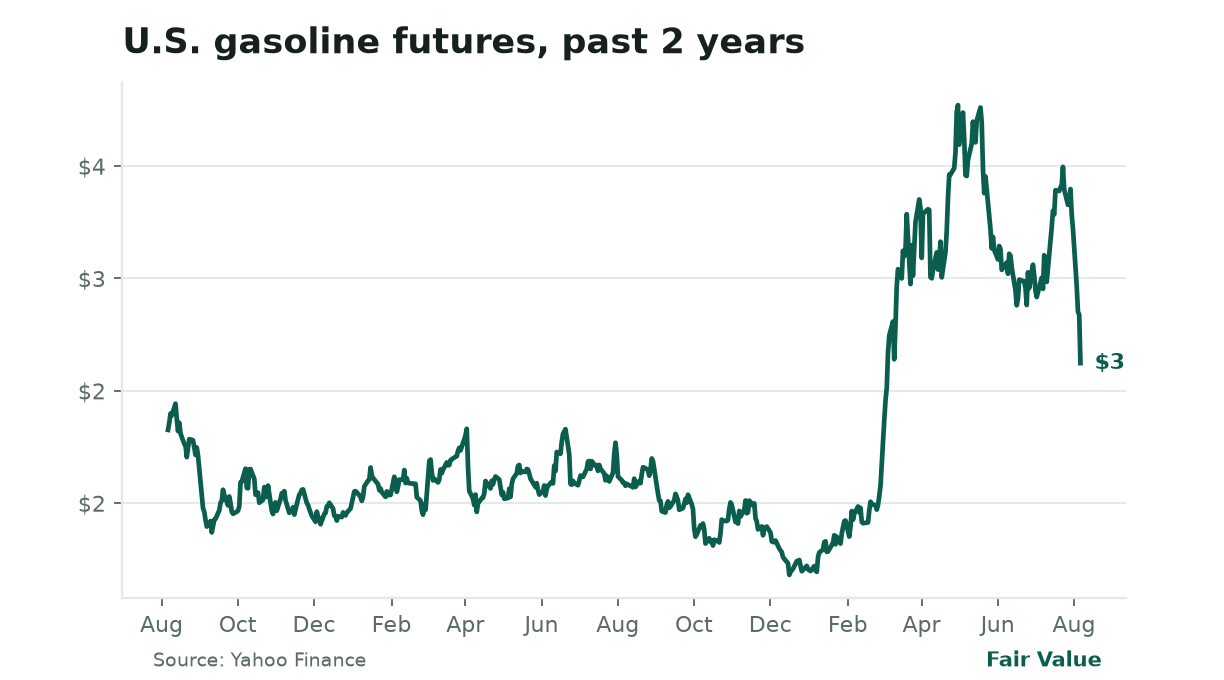
Gasoline prices set to rise. U.S. gasoline stockpiles dropped by 1.6 million barrels last week, while refinery output slipped to 96.5% capacity, a mismatch that could push pump prices up by 5% in the coming weeks, adding about $0.20 per gallon and feeding into inflation pressures.
▸
AI chip shortages stretch into 2030. SK Hynix now expects the high-bandwidth memory (HBM) shortage to last until around 2030, while TSMC’s advanced packaging capacity remains fully booked through 2027, leaving tech stocks exposed to supply-chain limits.
▸
Canada’s jobs report could overshadow Fed cues. With U.S. wage growth stuck at 4% and the Canadian dollar near 1.40 per USD, a weak employment report on Friday could widen the policy gap between the Bank of Canada and the Federal Reserve, pushing Canadian mortgage rates higher.
What's moving markets
Tech losses weighed on equities Wednesday, as AI hardware stocks pulled back while consumer-focused companies advanced. AMD dropped 7% and Google fell 4%, wiping out half of NVIDIA’s gains from Tuesday, while the Nasdaq-100 slipped 0.8% and the S&P 500 dipped 0.2%. The Dow Jones Industrial Average moved against the trend, rising 0.5% on a 3.6% jump in Disney shares and a 1.3% gain in financials.
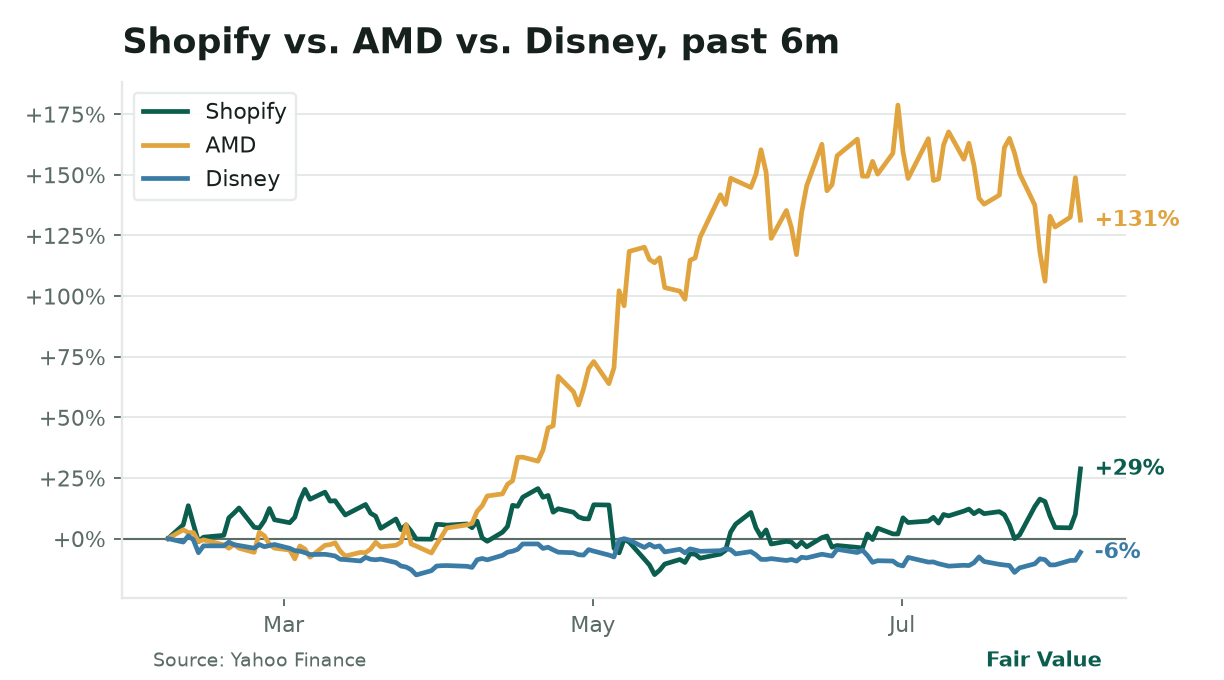
Consumer AI vs. infrastructure AI. Shopify (+17% Wednesday) and Disney (+3.6%) surged as investors pivoted to companies monetizing AI, while AMD (-7%) and other chipmakers sold off on signs of slowing demand for AI hardware. The split shows markets rewarding revenue growth over infrastructure bets.
The shift was clear: money flowed out of AI infrastructure, chips, servers, and data-center stocks, while moving into firms turning AI into revenue. Consumer discretionary stocks led the sector to a 0.3% gain, with Shopify surging 17%, making it the S&P 500’s top performer this month.
Energy stocks saw the sharpest declines, EOG Resources fell 6.5% and Chevron dropped 2.1%, not because of crude movements but due to tightness in refined products. Gasoline inventories marked their third straight weekly drawdown, distillate stocks hit 2022 lows, and refinery use dipped to 96.5%, setting up higher pump prices. Unlike crude swings, gasoline costs hit consumer wallets directly.
Treasuries held firm, with the 10-year yield at 4.63% and the 2-year at 4.20%, while the U.S. Dollar Index edged up 0.09% to 99.78, backed by steady 4% wage growth and a 4.2% unemployment rate. Commodities diverged: copper rose 1.9% (up 10.6% this month), gold climbed 2.1% to $4,335 an ounce, and Bitcoin barely moved, inching 0.03% higher to $64,210.
The takeaway:. Markets are betting on a Goldilocks scenario, growth strong enough to keep the Federal Reserve on hold but not so hot it risks overheating. The emerging gasoline squeeze, though, could disrupt that balance by reigniting inflation just as the Fed declares mission accomplished.
The big story
Gasoline’s refining squeeze
Refining squeeze ahead. Gasoline futures have climbed 12% since June as refinery utilization drops to 96.5% and inventories fall for three straight weeks. With crude stocks rising while gasoline supplies tighten, the chart shows the disconnect driving pump prices toward $4.00/gallon, a direct inflation risk the Fed can’t ignore.
The real stress in energy markets isn’t crude oil, it’s gasoline, and the dynamics are unusual enough that traders call it a “product squeeze.” U.S. gasoline stockpiles fell by 1.6 million barrels last week, distillate stocks plunged by 3.4 million barrels, and refinery use slipped to 96.5%, all while crude inventories grew by 2.5 million barrels. The split points to a key imbalance: demand for refined products is outstripping refineries’ ability to keep up.
Consumer impact:. Gasoline makes up 30% of the Consumer Price Index’s energy component. A 5% increase at the pump, from $3.90 to $4.10 per gallon, would add about 0.15 percentage points to headline CPI. With inflation at 2.5%, that could push the metric back toward 3%, complicating the Federal Reserve’s inflation story.
Three forces are tightening supply:
▸
Steady summer demand, holding near 13 million barrels per day.
▸
Refinery limits, as plants pull back from peak output for maintenance or unexpected outages.
▸
OPEC+’s modest relief, with the group’s 188,000-barrel-per-day September production boost stabilizing crude but doing little for gasoline shortages.
The paradox: Global oil inventories rose by 21 million barrels in June, but most of the increase was crude in transit, not at refineries. Onshore stocks actually fell, meaning the system has oil but lacks the capacity to turn it into gasoline fast enough.
Key timeline:. Retail gasoline prices usually lag wholesale moves by about a week. If the national average tops $4.00 per gallon within 10 days, the squeeze will have reached consumers, and the Federal Reserve will pay attention.
Broader implications:. Energy markets are no longer just about crude supply. The bottleneck in turning oil into gasoline is becoming the next flashpoint, a shift with direct consequences for inflation, monetary policy, and household budgets.
The big picture
Equities just wrapped a strong earnings season, with the S&P 500 up 5.6% over the past week and the Nasdaq-100 advancing 8.4%. Yet the rally is narrowing. Tech giants, AMD down 7% and Google off 4%, led Wednesday’s pullback, while consumer discretionary stocks like Shopify (+17%) and Disney (+3.6%) drove gains.
Bonds tell a different story. The 10-year Treasury yield holds at 4.63% and the 2-year at 4.20%, signaling expectations for steady growth without recession. Credit spreads remain stable (investment-grade at 0.78%, high-yield at 2.73%), with no signs of a coming default wave.
The U.S. dollar is the wildcard. The DXY Index rose 0.09% to 99.78, nearing July’s high. A stronger dollar pressures multinational earnings and emerging markets but reflects confidence in the U.S. economy. The yen weakened further (USD/JPY at 157.86) as Japan’s low rates drive capital into dollar assets.
Commodities split: copper jumped 1.9% (up 10.6% this month), gold reached $4,335 near record highs, and crude oil held at $79.70 per barrel. The focus has shifted from crude supply to refining capacity, where any disruption could spike gasoline prices.
Bottom line:. Markets are in a Goldilocks balance, growth firm, inflation cooling, and the Federal Reserve on pause. But risks linger: a gasoline-driven inflation resurgence, a dollar strong enough to dent corporate profits, and bonds pricing near-perfection. Friday’s U.S. jobs report is the next catalyst. If wage growth stays at 4% or climbs, the Fed’s “higher for longer” stance solidifies. If hiring weakens, bond markets will price in 2027 rate cuts. Gasoline remains the wildcard.
Around the world
The Strait of Hormuz, the world’s most critical oil chokepoint, saw a tentative easing of tensions after negotiators neared a 60-day agreement letting Iran “oversee” ship traffic without imposing tolls, a compromise that could reopen the waterway. Brent crude eased to $79.70 per barrel, down from $86 last week, but logistical snags remain: tankers rerouting around Africa add weeks to delivery times and inflate freight costs, effectively taxing global trade in everything from fuel to food.
China’s stimulus efforts face hurdles. Goldman Sachs warns Beijing must strengthen the yuan and roll out more fiscal support to hit growth targets, as the currency weakened to 6.74 against the dollar, raising import costs. Meanwhile, South Korea posted a record $49.7 billion current-account surplus in June, yet semiconductor stocks sold off after Western Digital and SanDisk flagged softer demand, hinting at a cooling tech cycle across Asia.
In Europe, energy security concerns resurfaced. India debates a levy on liquefied petroleum gas (LPG) and natural gas consumers to fund a $42 billion strategic fuel reserve, a move that would raise household costs but stabilize supplies. Separately, Germany’s Commerzbank and Italy’s UniCredit remain at odds after UniCredit acquired a near-majority stake in its rival. If unresolved, the dispute could shake confidence in Europe’s financial sector.
Middle East tensions simmer. Yemen’s Houthis continue threatening Red Sea tankers, while Iran asserts control in the Strait of Hormuz. Yet traders have largely priced in the geopolitical risk. The critical question: Will the 60-day transit deal hold? If yes, oil could drift lower; if not, crude may surge past $90 per barrel. Regardless, refining capacity, not crude supply, is the next pressure point.
Global takeaway:. The world economy runs on two tracks, the U.S. and Europe hold steady while China and emerging markets slow. A Hormuz deal could remove one risk premium from oil markets, but the refining squeeze introduces a new consumer-facing threat.
Companies in focus
Shopify shares jumped 17% to $144.24. after the e-commerce platform beat revenue estimates and raised full-year guidance, reflecting confidence in consumer spending and a shift toward companies profiting from AI applications rather than just building the infrastructure.
AMD lost a week’s gains in one session, dropping 7% to $482.05. after NVIDIA’s earnings showed slowing AI chip demand in China. The decline suggests investors are growing picky among semiconductor stocks.
Disney’s streaming push gained momentum, with shares climbing 3.6% to $101.76. after Disney+ and Hulu subscriber growth topped expectations. The stock is now up 4.5% for the month, a rare bright spot in media.
EOG Resources led energy’s decline, falling 6.5% to $134.23. as crude prices stabilized but gasoline inventories tightened. The XLE energy ETF dropped 2.1% on the week, reflecting the sector’s sensitivity to refined product markets.
Eli Lilly extended its lead in weight-loss drugs, with shares rising 4.9% to $1,169.86, a 20% monthly gain, as its GLP-1 medications outperform rivals.
Google’s heavy AI spending unnerved investors, sending Alphabet shares down 4% to $362.43. after the company raised capital expenditure guidance to $195-$205 billion for data-center expansion. The drop highlights the divide between AI leaders and laggards, and growing impatience with long-term bets that lack clear payoffs.
Wells Fargo advanced quietly, with shares up 6.3% over the past week, including a 0.9% gain Wednesday, as investors bet on stable net interest income and improving loan-loss provisions.
From Washington
The Federal Reserve is not meeting this week, but its influence lingers. Interest rates remain at 5.25-5.50%, with no cuts expected until inflation is “firmly anchored” at 2%. With core PCE at 2.5% and wage growth at 4%, that goal seems distant. Bond markets currently price a 60% chance of a rate cut by March 2027, a timeline Fed officials would likely call optimistic.
The central bank’s balance sheet continues to shrink by $30 billion per month as bonds mature without replacement (quantitative tightening). Markets have absorbed the reduction so far, but if gasoline prices push inflation higher, the mix of high rates and reduced liquidity could tighten financial conditions further.
On regulation, the Fed proposed new rules to update oversight of bank “insiders”, executives, board members, and major shareholders, with a comment period running through October. The move signals the central bank remains in a defensive stance on supervision.
Policy outlook:. Washington is in a holding pattern. The Fed is not cutting rates, Congress has no major economic bills pending, and the Treasury is operating without disruption. Markets now hinge on data, and the next key release is Friday’s jobs report. Strong wage growth would extend the Fed’s pause; signs of cooling hiring could bring bond-market rate cuts back into play. Gasoline prices remain the wildcard.
Under the hood
The Energy Information Administration’s latest report reveals a paradox: crude inventories rose by 2.48 million barrels, yet gasoline stocks fell by 1.64 million barrels and distillate inventories dropped by 3.47 million barrels, while refinery utilization slipped to 96.5% from 97.2%.
Drivers of the squeeze:
▸
Demand: Summer travel keeps gasoline consumption near 13 million barrels per day.
▸
Supply:OPEC+’s 188,000-barrel-per-day output increase in September stabilizes crude but does little to ease tight U.S. product markets.
▸
Bottlenecks: Scheduled maintenance and minor refinery outages reduce crude-to-gasoline conversion capacity.
Inflation implications:. Gasoline accounts for ~30% of the CPI’s energy component. A 5% retail price increase (to $4.10 per gallon) would lift headline CPI by ~0.15 percentage points, pushing core PCE closer to the Fed’s 2% target. The 10-year breakeven inflation rate already sits at 2.22%; any CPI surprise could drive it higher, lifting Treasury yields in turn.
Policy ripple effects:. If gasoline-driven CPI rises, the Fed may delay rate cuts, keeping the 10-year yield near 4.70% and compressing credit spreads. Equity valuations, especially in energy-heavy sectors, could face downward pressure as a result.
Bottom line:. Rising crude inventories, declining product stocks, and lower refinery utilization create a short-term gasoline supply crunch that risks reigniting inflation. Markets may reassess the Federal Reserve’s policy timeline if retail gasoline prices exceed $4.00 per gallon while inventories fall below 200 million barrels.
Worth learning today: Why a data print moves markets
In yesterday’s edition, we looked at how Canada’s employment report (forecast: +17.8K jobs) might affect the Canadian dollar and rate-cut expectations. The actual result: +18.2K jobs, a slight beat, but the unemployment rate stayed at 6.5%. The loonie (USD/CAD) barely moved, remaining at 1.4011. The muted reaction reflects a print that matched expectations, leaving the existing narrative unchanged.
Today’s gasoline inventory report offers another case study in data surprises.
The number vs. the forecast
Every economic release carries three key figures:
▸
The actual print (e.g., today’s 1.64-million-barrel gasoline drawdown).
▸
The consensus forecast (traders expected a draw, but not this large).
▸
The “whisper number” (the market’s unspoken, often more aggressive expectation).
Markets react to the gap between the print and priced-in expectations. Today’s steeper-than-expected gasoline draw initially lifted oil prices, but the 2.48-million-barrel crude inventory build, which should have weighed on prices, created mixed signals, leaving traders cautious.
The 8:30 a.m. ritual
Most major U.S. data releases hit at 8:30 a.m. ET. Here’s how the sequence plays out in 30 seconds:
▸
Algorithms act first, executing pre-programmed trades in milliseconds based on the headline number.
▸
Human traders assess whether the move makes sense. Today’s gasoline draw was sharp, but refinery utilization only dipped 0.7%, hardly a crisis.
▸
The narrative forms. By 8:32 a.m., media outlets frame the story. Call it a “supply crunch,” and oil rises; dismiss it as “noise,” and the move fades.
Why this matters now
▸
Mortgages and savings: If gasoline spikes and lifts CPI, the Fed holds rates higher, keeping 30-year mortgage rates elevated (currently 6.66%) while sustaining attractive savings yields.
▸
Stocks vs. bonds: Hotter inflation hurts bonds (pushing yields up) but could benefit energy and materials stocks. Today’s mixed energy data explains why the S&P 500 dipped while copper and gold climbed.
▸
The domino effect: Gasoline → CPI → Fed policy → interest rates → retirement portfolios. A $0.20-per-gallon increase may seem modest, but it could raise CPI by 0.15%, complicating the Fed’s 2% inflation target.
Review of prior concepts:
▸
Yield-price seesaw: Rising inflation expectations push bond prices down (yields up). That’s why the 10-year yield stayed at 4.63%, markets are hedging against gasoline-driven inflation.
▸
CPI mechanics: Gasoline’s 30% weight in CPI’s energy component explains why a 5% price jump moves the inflation needle.
Concept 25 of 83 in the Fair Value course.
Tomorrow’s focus:. The U.S. unemployment rate (forecast: 4.2%) drops at 8:30 a.m. ET Friday. If the number surprises to the downside (e.g., 4.0%), how would rate-cut odds and the dollar respond, and what would it mean for portfolios? We’ll break it down in tomorrow’s edition.
What to watch this week
▸
Friday, August 7, 8:30 a.m. ET: — U.S. Non-Farm Payrolls (forecast: +85K, prior: +57K). A strong report reinforces the Fed’s hold; a weak print revives rate-cut talk.
▸
Friday, August 7, 8:30 a.m. ET: — U.S. Unemployment Rate (forecast: 4.2%, prior: 4.2%). A decline could signal building wage pressures.
▸
Friday, August 7, 8:30 a.m. ET: — Canada Employment Change (forecast: +17.8K, prior: +18.2K). A miss weakens the Canadian dollar, potentially pushing USD/CAD above 1.40.
▸
Friday, August 7, 8:30 a.m. ET: — Average Hourly Earnings m/m (forecast: +0.3%, prior: +0.3%). Wages remain the Fed’s top inflation concern.
▸
Monday, August 10: — 10-Year Treasury Auction ($42 billion). Weak demand (high yields) would signal bond-market inflation jitters.
Not financial advice.Disclaimer: This briefing is for informational purposes only and does not constitute financial advice. Neither Fair Value nor its authors recommend buying or selling any security. Past performance is not indicative of future results. Investments carry risk, including the loss of principal.
Data sources: Bloomberg, FactSet, U.S. Energy Information Administration, Federal Reserve, Bureau of Labor Statistics, Bank of Canada, Goldman Sachs Global Investment Research. ```