Fed rate-cut expectations drove markets. Gold (+8.7%) and silver (+10.3%) jumped after July’s jobs report showed a 23,000-job loss (vs. an expected 80,000 gain), pushing traders to bet on lower rates. Stocks reached new highs, while oil fell 7.3%, even as Iran blocked the Strait of Hormuz, because easing hopes overshadowed geopolitical risks.
▸
AI infrastructure spending surged. Amazon raised its 2026 AI capex target to $220 billion (up $20 billion), while SpaceX pledged $15.8 billion, equal to AMD’s entire 2020 market cap. NVIDIA’s SpaceX deal and AMD’s $6 billion Meta partnership showed no major player is pulling back from the compute race.
▸
The 10-year Treasury yield dropped to 4.47%, lifting stocks, weakening the dollar, and sending gold to its best week since March.
The week that was
This was the week markets started questioning whether the Fed’s “higher for longer” policy could hold. The trigger: a July jobs report so weak it forced a reassessment. What if the economy slows faster than the Fed expects? The answer played out across assets, gold and silver rallied as if a downturn were already here, stocks climbed on hopes of a soft landing, and oil brushed off geopolitical tensions to focus on potential rate cuts. The common thread: the risk-free rate. When it falls, everything tied to it, stocks, bonds, mortgages, even crypto, gets a boost. This week, that boost arrived.
Equities: AI spending overshadowed Fed talk
The S&P 500 (+3.6%), Nasdaq (+5.2%), and Dow (+3.2%) all closed at records, but the real story was under the surface. AI infrastructure stocks led, proving that no matter what the Fed does, the race for compute power isn’t slowing.
▸
The spending is massive. Amazon now expects $220 billion in AI capex by 2026, $20 billion more than its February forecast. SpaceX announced $15.8 billion in AI investments, matching AMD’s entire market cap in 2020. NVIDIA (+11.6%) and Broadcom (+9.1%) surged as earnings showed hyperscalers are still expanding AI capacity.
▸
The rally broadened. Airbnb (+17.5%) crushed earnings, Palantir (+39.8%) rose on AI-government contracts, and even Tesla (+5.6%) bounced back. The VIX fell to 14.9, its lowest since June.
▸
The takeaway:AI capex is the new oil field. Just as the 20th-century economy depended on energy infrastructure, today’s runs on chips, data centers, and the companies building them.
Commodities: Gold priced in cuts, oil looked past Iran
Gold and silver: Betting on a Fed shift. Gold (+8.7% to $4,400/oz) and silver (+10.3% to $63.50/oz) had their best week since March after July’s jobs report showed a 23,000-job decline, far below the expected 80,000 gain. Wage growth slowed to 3.2% year-over-year (from 3.9%). The takeaway: The labor market is cooling, and the Fed’s resolve may be weakening.
Oil: Rate hopes outweighed geopolitics. Brent crude fell 7.3% to $83.55, its worst week since June, despite Iran’s Strait of Hormuz blockade. Two factors mattered more:
▸
A deal looks close. Traders bet Iran and Oman will reopen the strait soon.
▸
OPEC+ added supply. The cartel’s 188,000 barrel-per-day September increase eased concerns.
Copper: Waiting for China’s next move. Copper (+2.4% to $6.59/lb) held steady, caught between hopes for Chinese stimulus and fears of a global slowdown. This week’s calm? Traders are waiting for clearer signals.
Bonds and the dollar: The pull of the risk-free rate
Bonds and the dollar told the same story from different angles: The risk-free rate is falling, and markets are adjusting.
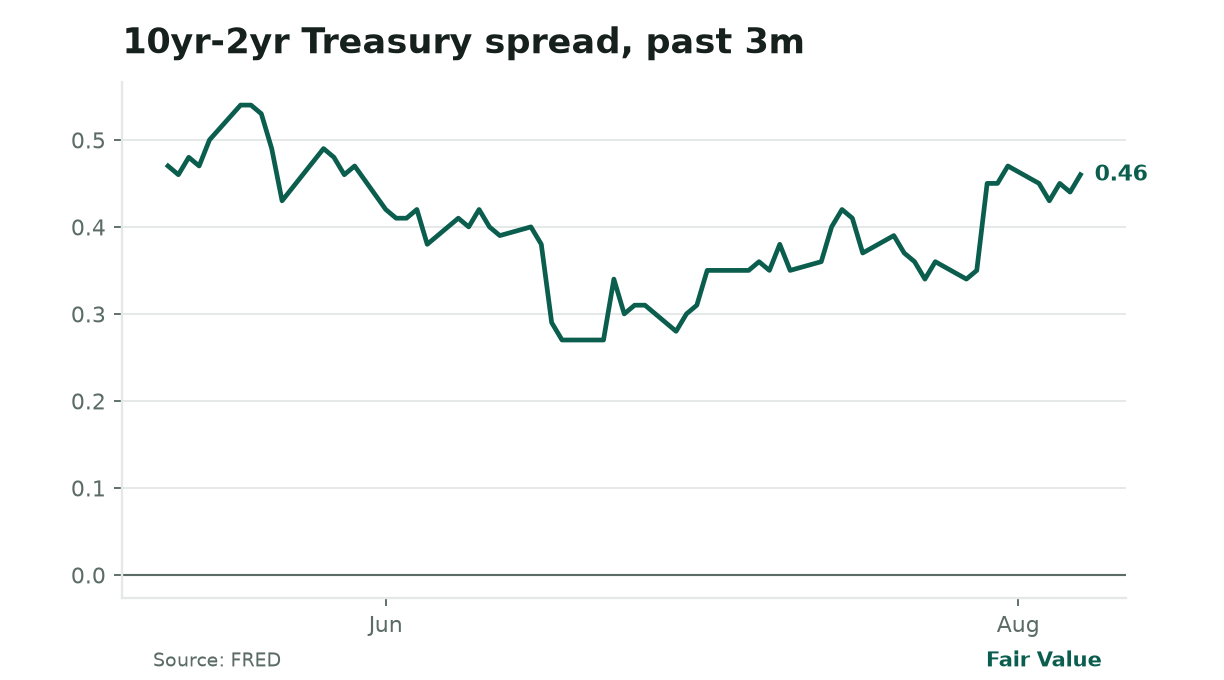
The yield curve flattened sharply. The 10s-2s spread tightened to 0.47% (from 0.69% in July) as the 10-year yield fell faster than the 2-year, reflecting growing bets on near-term Fed cuts after the -23,000 payrolls print.
▸
Bonds: Rallying, but cautiously. The 10-year Treasury yield dropped to 4.47% (from 4.69%) as traders priced in cuts. The 2-year yield fell to 4.00%, narrowing the 10s-2s spread to 0.47%, its tightest since February.
▸
The dollar: Strong but slipping. The DXY index dipped 0.4% on rate-cut expectations but stayed near yearly highs against the yen (157.75) and euro (1.156).
The mechanism:. A lower risk-free rate weakens the dollar, lifts stocks, and boosts non-yielding assets like gold. This week was a textbook example.
Crypto: Finance’s quiet blockchain upgrade
Bitcoin (+1.2% to $64,832) and Ethereum (+2.8% to $1,920) didn’t make waves with price moves, but the real shift was structural: Tokenized real-world assets (Treasuries, gold) hit $7.4 billion, tripling in a year even as DeFi deposits fell.
What’s happening?. Institutions aren’t using blockchains to replace traditional finance, they’re using them to improve it. Tokenizing Treasuries, for example, allows 24/7 trading with instant settlement, something legacy systems can’t match.
The big question this week
Has the Fed’s inflation fight turned a corner?
Tuesday’s July CPI report will show whether the Fed’s 18 months of tightening are working, or if the economy is cooling too fast for policymakers to handle.
Why this report matters more than usual:
▸
Jobs data already raised red flags. Last week’s payrolls drop (-23,000) and slower wage growth (3.2% year-over-year) suggest labor market weakness. If CPI also cools, especially core CPI, the Fed’s “higher for longer” stance loses ground.
▸
Bonds have already reacted. The 10-year yield fell to 4.47%, its lowest since February, as traders bet on a September cut.
▸
Gasoline could swing the number. U.S. refinery use slipped to 96.5%, while gasoline stocks dropped 1.6 million barrels. That imbalance could push pump prices up by about $0.20 per gallon, lifting headline CPI.
Consensus forecasts:
▸
Core CPI: +0.2% month-over-month (down from +0.3%), +2.5% year-over-year
If CPI meets or beats expectations (cooler inflation): Stocks rise, bonds rally, the dollar weakens. Fed cuts become almost certain.
▸
If CPI surprises to the upside (stickier inflation): Stocks dip, yields climb, and Fed hawks regain the upper hand.
The bigger picture:. This isn’t about one report. It’s about whether 525 basis points of hikes since March 2022 have finally done their job.
The week ahead
Tuesday, August 11
▸
U.S. CPI (July): — Core CPI forecast at +0.2% month-over-month (vs. +0.3% in June), +2.5% year-over-year. Headline CPI expected at +0.1% month-over-month, +3.4% year-over-year. Why it matters: This number will influence mortgage rates, savings yields, and retirement accounts.
▸
Australia’s RBA decision: — Rates likely stay at 4.35%, but traders will watch for hints of future cuts.
Wednesday, August 12
▸
U.S. PPI (July): — Producer prices forecast to rise +0.2% month-over-month (vs. -0.3% in June). Why? PPI feeds into CPI.
Thursday, August 13
▸
U.K. GDP (Q2): — Expected to shrink -0.1% quarter-over-quarter, marking a second straight decline, a technical recession. Impact: Weakness could push the Bank of England toward cuts.
Friday, August 14
▸
U.S. retail sales (July): — Forecast to rise +0.4% month-over-month, rebounding from June’s +0.2% decline. Why? Consumer spending drives 70% of U.S. GDP.
Worth learning today: The risk-free rate is gravity
Last week’s prediction resolved:. We asked: Would Canada’s employment change surprise to the upside or downside? The actual number: -12,200 jobs (vs. +17,800 forecast). The market reaction: The Canadian dollar weakened, and mortgage rates ticked up as traders bet the Bank of Canada would hold rates steady. Why? Weak jobs data reduces pressure to hike, but it also signals economic softness, keeping rates “higher for longer” to avoid further slowing.
One number moves all markets. Every asset, stocks, bonds, your savings account, is priced off the risk-free rate. It’s financial gravity. When it shifts, everything else follows.
This week’s case study:. The 10-year Treasury yield fell to 4.47% (from 4.69%) after July’s weak jobs report. That drop:
▸
Lifted stocks (lower yields mean higher valuations for future earnings).
▸
Weakened the dollar (lower rates reduce demand for USD).
▸
Pushed gold higher (non-yielding assets gain when rates fall).
▸
Lowered mortgage rates (the 30-year fixed, now 6.69%, tracks the 10-year Treasury).
How it works:
▸
The risk-free rate is the yield on U.S. Treasuries, the return for lending to the government, assumed to be default-free.
▸
Every other investment is priced as “risk-free rate + a risk premium.” Stocks? Riskier than bonds, so they demand higher returns.
▸
When the risk-free rate rises, it lifts everything: mortgages, car loans, credit cards. When it falls, the opposite happens.
The current debate:. Is this week’s drop in the risk-free rate a temporary dip or the start of a broader decline? Tuesday’s CPI will offer clues.
Concept 28 of 83 in the Fair Value course.
Tomorrow’s question:. Australia’s RBA meets Tuesday (forecast: hold at 4.35%). If they cut unexpectedly, which asset moves most, and through what channel? We’ll break it down in Monday’s edition.
Not financial advice.This brief is for informational and educational purposes only and does not constitute investment advice.
Data sources: Macro indicators per FRED®; energy data per U.S. EIA; auction data per U.S. Treasury; market prices per Yahoo Finance; earnings per Financial Modeling Prep.