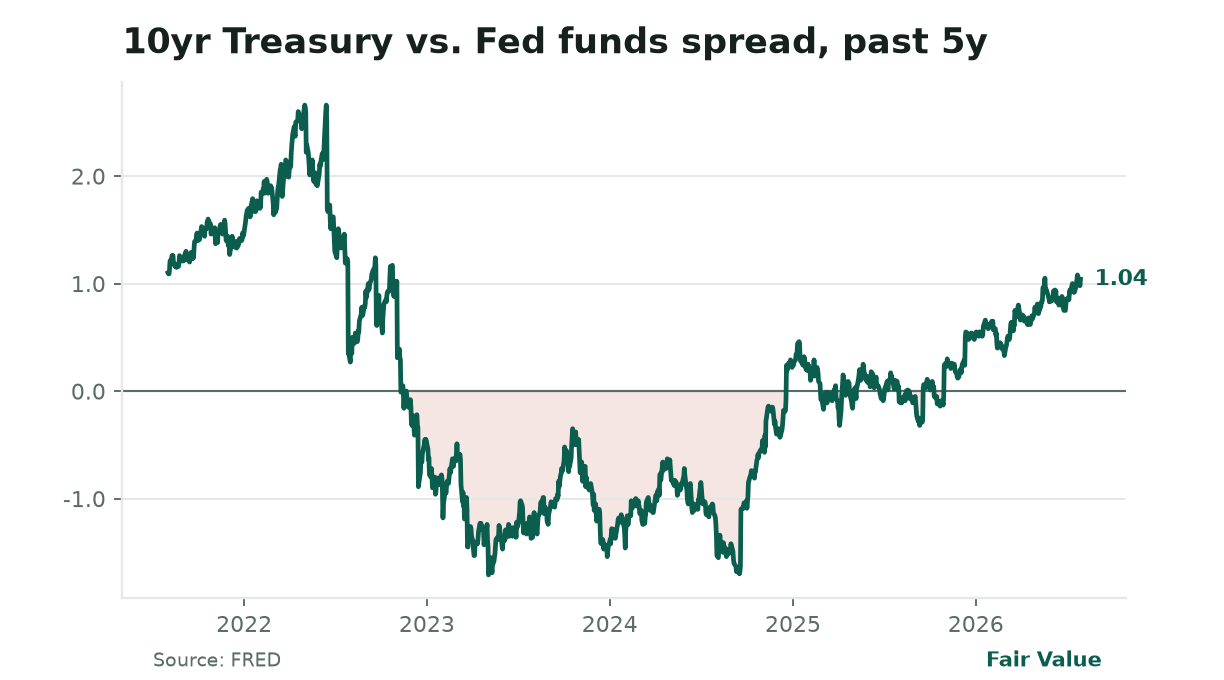
The Fed’s 1.5-point gap tightens financial conditions. The difference between the Fed’s policy rate (3.63%) and the 10-year Treasury yield (4.61%) pushed 30-year mortgage rates to 6.66%, their highest in a year, while housing starts outpaced permits for a second straight month, a late-cycle red flag.
▸
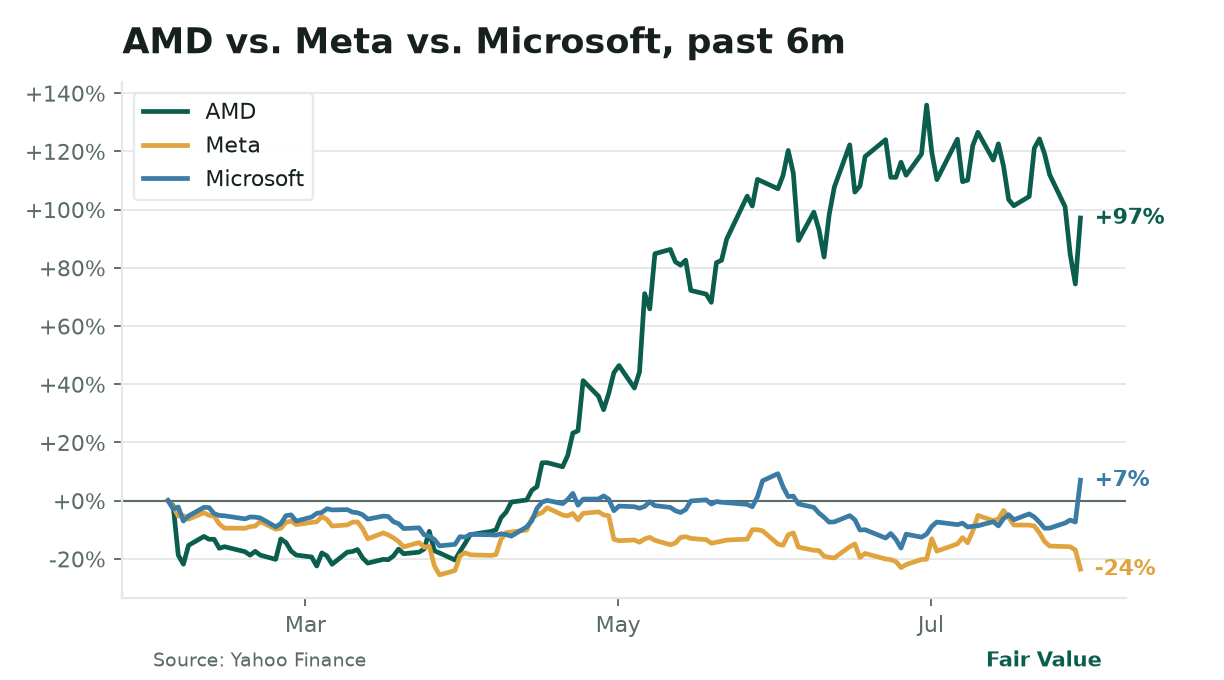
Tech splits into AI hardware winners and software laggards. Chipmakers surged in Thursday’s trading (AMD +13%, NVDA +2.6%) as software firms (META -8%, ADBE -5.9%) fell, highlighting the shift toward AI suppliers over cash-intensive developers.
▸
Oil’s geopolitical premium eases but lingers. Brent crude dipped 0.56% to $89.53 after Iran’s missile strikes failed to hold gains, though refineries at 97.2% capacity kept gasoline prices firm.
What’s moving markets today
July’s final session leaves one open question: Is the economy straining under the Fed’s tightening by proxy? The answer is taking shape in three areas, housing, tech, and energy, each showing different stresses.
The Fed’s 1.5-point gap is doing the work for them.. With short-term rates at 3.63% and the 10-year Treasury yield at 4.61%, the widening spread has become the economy’s real brake. Mortgage rates climbed to 6.66%, their highest since last summer, while housing starts topped permits for the second month in a row, a sign builders are rushing to finish projects before demand fades. If this continues, a surplus of unsold homes by early 2027 could trim GDP growth by 0.2-0.3 points.
Tech’s rebound reveals a clear divide.. Semiconductor stocks led Thursday’s gains, with AMD and Intel up 13% and 11.3%, as investors favored AI hardware providers. Meanwhile, software giants Meta and Adobe dropped 8% and 5.9%, reflecting doubts about companies spending heavily on unproven AI. Microsoft stood out, rising 15.5% after strong cloud revenue, though its $41 billion in quarterly capital spending raised eyebrows about long-term margins.
AI hardware surges, software stumbles. AMD (+13%) and Microsoft (+15.5%) led Thursday’s rally on AI infrastructure demand, while Meta (-8%) fell as investors questioned its $12.5B AI spending. The split highlights a market rewarding suppliers (chips/cloud) over users (ad-heavy platforms).
Oil’s risk premium pulled back but hasn’t vanished.. Brent crude settled at $89.53 after Iran’s missile strikes on U.S. bases didn’t sustain a rally, yet tensions in the Strait of Hormuz keep markets uneasy. With refineries at 97.2% capacity, any supply shock could quickly reverse the dip.
The overlooked pressure point:. Private credit defaults hit a Q2 record, with over half of the 32 cases involving extended maturities, a sign borrowers can’t refinance at today’s rates.
Bottom line:. The Fed’s yield-curve gap is tightening more than planned, tech is splitting into AI leaders and laggards, and oil’s next move depends on diplomacy, or escalation.
The big story
The Fed’s 1.5-point gap: the economy’s silent speed limit
The Federal Reserve didn’t raise rates this week, but the bond market did the tightening for them. The spread between the Fed’s policy rate (3.63%) and the 10-year Treasury yield (4.61%) has grown to 1.5 percentage points, the widest since 2022, and is now the main tool slowing growth, with ripple effects in housing, debt, and spending.
1.5-point gap tightens financial conditions. The spread between the 10-year Treasury yield (4.61%) and the Fed funds rate (3.63%) has widened to its largest since 2022, pushing mortgage rates to 6.66%, a one-year high, and signaling tighter credit conditions ahead.
How it’s playing out:
▸
The Fed keeps short-term rates at 3.63%.
The central bank left its benchmark unchanged Wednesday, but three officials, Beth Hammack, Neel Kashkari, and Lorie Logan, pushed for an immediate hike, citing inflation worries. Chairman Kevin Warsh restated the 2% inflation goal but gave no September clues, leaving markets guessing.
▸
The 10-year Treasury rises to 4.61%.
While the Fed controls overnight rates, the 10-year yield is set by investors, and they’re betting on persistent inflation. The yield climbed to 4.61% this week, up from 4.26% a month ago, setting the floor for mortgages, corporate bonds, and loans.
▸
Mortgage rates hit 6.66%, a one-year high.
The 30-year fixed rate usually follows the 10-year Treasury plus a 1.5-2 point risk premium. With the 10-year at 4.61%, mortgages jumped to 6.66%, adding about $300 to monthly payments on a $400,000 loan versus last year, a 15% increase that’s pricing out first-time buyers.
▸
Housing starts exceed permits, signaling a slowdown.
Builders started 1.427 million homes in June but secured permits for only 1.374 million. Permits normally lead starts; when starts lead, developers are hurrying to finish before demand drops. At current mortgage rates, that demand is at risk. A prolonged trend could leave excess inventory by early 2027, potentially cutting GDP by 0.2-0.3%.
▸
Borrowing costs rise for riskier firms.
High-yield bond spreads widened to 2.84% over Treasuries, up from 2.81% last week, while investment-grade spreads (0.81%) stayed tight. Big, stable companies still borrow cheaply, but smaller firms and cyclical sectors, like housing, face higher costs.
▸
The Fed is stuck.
If the spread narrows (long-term rates fall), mortgage rates would drop, easing growth pressure. But that requires markets to believe inflation is fading, a conviction not yet in place. Until then, the Fed’s choices are limited: cutting risks reigniting inflation, but holding risks over-tightening.
The key unknown:. Does the widening spread reflect true expectations of high rates for longer (meaning sticky inflation) or a temporary geopolitical premium? The answer will determine whether the Fed cuts in September or waits, and whether housing stabilizes or stumbles.
Level to note:. If the 10-year Treasury yield stays above 4.5% for two more weeks, the housing slowdown will likely worsen. A drop below 4.25% could ease mortgage rates enough to revive demand.
The big picture
The S&P 500 rose 1.66% on Thursday, but the real action was under the surface, where the market’s split grew sharper.
Tech’s divide dominated.. Semiconductor stocks led gains, with AMD, Intel, and Micron up 13%, 11.3%, and 18.4%, as investors bet on AI hardware demand. Software struggled, with Meta and Adobe down 8% and 5.9%. The Nasdaq, heavy on tech, still gained 3.36%, its best session in weeks, but the split shows a market rewarding AI suppliers (chips, data centers) while punishing users (companies spending heavily on unproven models). Microsoft was the exception, up 15.5% after strong cloud revenue, though its $41 billion in quarterly capital spending raised questions about sustainability.
Bonds flashed caution.. The 10-year Treasury yield held at 4.61%, keeping the spread over the Fed’s rate at 1.5 points, a level tied to slower growth. Mortgage rates followed, climbing to 6.66%, while housing starts again outpaced permits.
Commodities reflected shifting geopolitical risks.. Brent crude fell to $89.53 after Iran’s missile strikes on U.S. bases didn’t sustain a rally, but tensions in the Strait of Hormuz remain. With refineries at 97.2% capacity, any supply disruption would quickly push prices back up.
Next week’s catalysts:. Earnings from Exxon, Chevron, and AMD, all at the crossroads of energy, tech, and inflation, will be closely watched. The Bank of Japan’s policy announcement today could also move global markets if Governor Kazuo Ueda hints at a shift from ultra-loose settings.
Around the world
The Strait of Hormuz stays the world’s most critical economic bottleneck.. Iran’s missile strikes on U.S. bases briefly lifted oil prices earlier this week, but Brent crude settled 0.56% lower at $89.53 on Thursday. The strait, which carries 20% of global oil, remains volatile. With refineries at 97.2% utilization, any disruption would send gasoline prices climbing.
China ramps up trade pressure.. Beijing criticized new U.S. tariffs on $60 billion of imports, including Canadian goods, as part of a broader push to pressure allies. The move has backfired in Panama, which now faces Chinese disruption to its shipping industry after recognizing Taiwan, a threat to its logistics ambitions.
Europe’s energy transition hits snags.. Wildfires in France forced Airbus, Thales, and MBDA to pause production, disrupting aerospace and defense supply chains. Meanwhile, Germany’s industrial output fell for the third straight month as high energy costs and weak Chinese demand weigh on manufacturers.
Japan holds onto stimulus.. The yen strengthened 2% overnight ahead of the Bank of Japan’s policy announcement today, where Governor Kazuo Ueda is expected to keep ultra-loose monetary settings. While a weaker yen helps exporters like Toyota, it worsens imported inflation for consumers.
Canada’s housing market weakens.. After eight rate hikes since 2022, Canadian home sales dropped 15% year-over-year in June, with prices down 5% in Toronto and Vancouver, the clearest sign yet that higher rates are taking a toll.
Companies in focus
Microsoft’s $450 billion market-cap jump hides a spending surge.. Shares rose 15.5% on Thursday after cloud revenue beat expectations, adding $450 billion to its market value, the largest one-day gain for a U.S. company. But the details showed $41 billion in quarterly capital spending, up 69% from last year, as Microsoft races to build AI data centers.
Meta’s AI investments raise doubts, again.. Shares fell 8% on Thursday, extending July’s losses to 11%. Despite a 27% jump in ad revenue, investors focused on the company’s $12.5 billion spend on AI data centers, a move that’s squeezing margins with unclear payoffs.
AMD defies the semiconductor slump.. Shares surged 13% on Thursday after announcing a 500-megawatt data center deal with Core Scientific, bucking the sector’s recent weakness.
Exxon and Chevron earnings will test oil’s resilience.. Both report today, with results watched closely for signs of how major producers are handling Strait of Hormuz risks and refining margins.
Tesla rises on China exit rumors.. Shares climbed 3.5% on Thursday amid reports the company may sell its China operations to clear regulatory hurdles for a potential SpaceX merger.
Broadcom’s AI chip deals extend its rally.. Shares rose 4.7% on Thursday, bringing 2026 gains to 23%, after reports its custom AI chips for Google and Anthropic could generate $21 billion in revenue this year.
From Washington
The Federal Reserve left its benchmark rate at 3.50-3.75% this week, but internal divisions were clear. Three officials, Beth Hammack, Neel Kashkari, and Lorie Logan, argued for an immediate hike, the strongest pushback Chairman Kevin Warsh has faced. Their reasoning: inflation remains above the 2% target, and the labor market is still too strong to justify waiting. Warsh, however, stuck to his “data-dependent” approach, offering no September hints.
Housing feels the squeeze right away.. Mortgage rates reached 6.66% this week, the highest since last summer, while new home sales fell to 628,000 in June, far below the 800,000 peak of the early 2020s.
Under the hood
The 1.5-percentage-point gap between the Fed funds rate (3.63%) and the 10-year Treasury yield (4.61%) is now the economy’s main monetary lever, and it’s tightening faster than the Fed planned.
▸
The Fed holds short-term rates at 3.63%.
The central bank left its benchmark unchanged, but the market is doing the tightening. The 10-year Treasury yield, driven by long-term growth and inflation expectations, rose to 4.61% from 4.26% a month ago.
▸
Mortgage rates jump to 6.66%.
The 30-year fixed rate follows the 10-year Treasury plus a ~1.5-2 point risk premium. With the 10-year at 4.61%, mortgages hit 6.66%, the highest in a year.
▸
Housing starts outpace permits, signaling a slowdown.
Builders started 1.427 million homes in June but secured permits for only 1.374 million. Permits usually lead starts; when starts lead, developers are rushing to finish before demand weakens.
▸
The Fed faces a tough choice.
If the spread narrows (long-term rates fall), mortgage rates would drop, easing growth pressure. But that requires markets to believe inflation is cooling, a belief not yet solidified.
The core question:. Does the widening spread reflect expectations of high rates for longer (suggesting persistent inflation) or a temporary geopolitical risk premium?
Worth learning today: GDP, the economy’s report card
We’re still waiting for the Bank of England’s Monetary Policy Report from yesterday. The question lingers: Will the BOE’s tone turn more hawkish or dovish?
Today’s lesson connects to Under the hood: the 1.5-point gap between the Fed’s rate and the 10-year Treasury is slowing GDP growth. Here’s what GDP measures, why the spread matters, and how it affects your finances.
What GDP actually tracks
GDP has four parts:
▸
Consumer spending (C): Your rent, groceries, and streaming bills, 70% of U.S. GDP (FRED).
▸
Business investment (I): A café’s new espresso machine or Amazon’s data centers.
▸
Government spending (G): Public-school salaries, highway repairs, and defense contracts.
▸
Net exports (X, M): U.S. exports minus imports.
The formula: GDP = C + I + G + (X, M).
Why the numbers matter
U.S. GDP hit $24.27 trillion in Q2 2026 (FRED), up from $24.18 trillion in Q1, a 0.37% increase. Growth rates translate to real impact:
▸
2% annual growth feels slow (the economy doubles every 35 years).
▸
4% growth doubles the economy every 18 years.
Today’s sub-2% growth reflects the Fed’s 1.5-point gap: higher long-term rates → pricier loans → weaker consumer spending (C) and business investment (I).
The hidden connections
The yield curve, when long-term rates rise faster than short-term, signals markets expect inflation to stick. That expectation slows growth.
Why this hits your wallet
▸
Your paycheck: Sub-2% GDP growth usually means weaker wage gains.
▸
Your investments: Stocks do best with 3-4% GDP growth. Below 2%, corporate earnings stagnate.
▸
Your debt: That 1.5-point gap is why credit card APRs average 20% and student loan rates just rose.
Tomorrow’s focus
The Bank of Japan holds its policy press conference today (consensus: no change). Key question: If Governor Kazuo Ueda adopts a hawkish tone, how will the yen, Japanese bond yields, and the Nikkei respond?
Concept 19 of 83 in the Fair Value course.
What to watch this week
▸
Today: — Bank of Japan press conference, any shift from ultra-loose policy could lift the yen and weigh on global risk assets.
▸
Today: — Canada GDP (m/m, forecast: +0.2%), a weak reading would confirm high rates are slowing growth.
▸
Monday: — U.S. ISM Manufacturing PMI, a sub-50 print would signal factory contraction, pressuring stocks.
▸
Tuesday: — Australia RBA rate decision, another hold is expected, but hints of future cuts could weaken the Australian dollar.
▸
Wednesday: — U.S. ADP Employment Report, soft data could ease Fed hike fears, lowering Treasury yields.
▸
Thursday: — U.S. Initial Jobless Claims, a print above 200,000 would signal labor-market cooling.
▸
Friday: — U.S. Nonfarm Payrolls (forecast: +180,000), the headline number will dominate the Fed’s September rate decision.
Not financial advice. Disclaimer: Fair Value is not investment advice, and its contents are solely for informational purposes. The data and commentary presented are not a recommendation to buy, hold, or sell any security, sector, or asset class. Past performance is not indicative of future results, and all investments carry risk, including the loss of principal. Consult a financial advisor before making any investment decisions. Fair Value and its affiliates do not receive compensation from any companies mentioned in this brief.
Data sources: Federal Reserve (FRED), U.S. Treasury, S&P Global, Bloomberg, FactSet, Bank of Japan, Statistics Canada, Eurostat, China Customs, OPEC, Baker Hughes, U.S. EIA, U.S. Bureau of Labor Statistics, U.S. Census Bureau, National Association of Realtors, Mortgage Bankers Association, Institute for Supply Management, ADP, Bank of England, Reserve Bank of Australia, International Monetary Fund. ```