Bonds test the Fed’s resolve. The central bank kept rates at 3.5%-3.75%, but three officials pushed for a hike, and Chairman Warsh’s inflation warnings sent the 30-year Treasury yield to 5.09%, its highest since 2007. Stocks dipped (Nasdaq -2.1%) before futures hinted at a rebound, suggesting traders question whether further tightening is coming.
▸
Refinery limits lift oil, and inflation. U.S. refineries ran at 97.2% capacity, draining crude stockpiles and pushing Brent crude back over $90 per barrel. That risks keeping gasoline prices high and delaying any Fed rate cuts.
▸
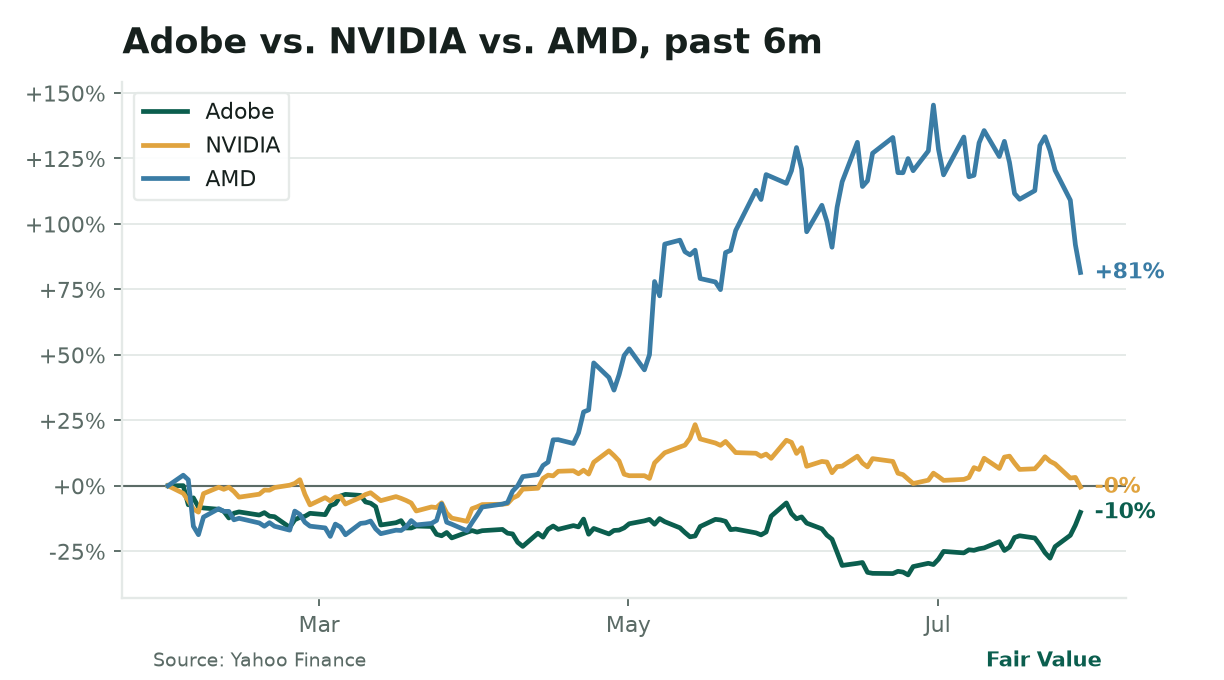
AI spending faces scrutiny. Shares of Meta, AMD, and NVIDIA fell as investors weigh whether the sector’s $725 billion capital outlay will pay off. Meanwhile, profitable software firms like Adobe (+5.7%) and Salesforce (+4.5%) rose, showing a preference for earnings over growth bets.
What's moving markets today
The Federal Reserve’s cautious tone is meeting an oil market under strain, and bond traders are reacting.
Software outshines AI hardware. While NVIDIA (-3.6%) and AMD (-5.5%) fell on valuation concerns, Adobe (+5.7%) surged after beating earnings, highlighting a shift toward cash-flow-positive firms. The $725B AI spending spree is under scrutiny, but software’s steady revenue (subscriptions/cloud) lets it invest without straining finances.
Treasury yields climb on Fed doubts.. The 10-year yield reached 4.61%, while the 30-year hit 5.09%, levels last seen in 2007. The yield curve remains nearly flat, with just a 35-basis-point gap between 10-year and 2-year notes, reflecting expectations that the Fed may struggle to cut rates soon. The trigger? Oil. U.S. refineries operated at 97.2% capacity, a record, depleting crude inventories and lifting Brent crude back above $90. Unlike short-lived supply shocks, this bottleneck suggests a lasting constraint that could keep energy prices elevated.
Stocks split on AI profitability.. The S&P 500 dropped 1.5% and the Nasdaq 2.1% on Wednesday, though futures pointed to a Thursday rebound. The divide was clear: AI chipmakers, NVIDIA, AMD, and Micron, fell as questions grew about returns from the sector’s $725 billion spending surge. Cash-flow-positive software firms, like Adobe (+5.7%) and Salesforce (+4.5%), gained, highlighting a shift toward companies that balance growth with profits.
The dollar steadies amid mixed signals.. The U.S. Dollar Index (DXY) held at 100.78, unchanged on the day but up 1.1% over the past month. A hawkish Fed usually supports the dollar, but traders are also weighing the risk that prolonged high rates could slow the economy. The euro stayed at 1.1468, and the yen at 163.31, ahead of policy decisions from the Bank of England and Bank of Japan later today.
Today’s economic calendar is busy: U.S. GDP and core PCE data at 8:30 AM ET, the Bank of England’s rate decision at 7:00 AM, and the Bank of Japan’s policy announcement tonight. With the Fed’s credibility already in question, any surprises could shake bonds, currencies, or both.
The big story
Are bonds or the Fed right about inflation?
The Federal Reserve left rates at 3.5%-3.75% on Wednesday, but the meeting exposed internal splits. Three officials, Neel Kashkari, Lorie Logan, and Beth Hammack, voted for a hike, the most dissent since 2018. Chairman Kevin Warsh noted that “rising real yields” were tightening financial conditions on their own. Bonds responded by pushing the 30-year Treasury yield to 5.09%, its highest since 2007, while the yield curve flattened further.
The tension is clear: The Fed hints at higher rates, but bond markets aren’t convinced. The 10-year yield at 4.61% and the 2-year at 4.26%, a spread of just 35 basis points, suggest traders see two possibilities: either the Fed won’t follow through (inflation eases on its own), or it will regret hiking (tipping the economy into recession). Stocks fell Wednesday, but Thursday’s futures pointed upward, implying traders see the Fed’s stance as more talk than action.
Oil complicates the picture. Refineries are at 97.2% capacity, a record, and crude inventories are shrinking. With Brent crude back above $90, gasoline prices are climbing. The Fed treats oil spikes as temporary, but this refinery squeeze could keep energy costs high for months, keeping inflation above the 2% target.
What this means for markets:
▸
Borrowing costs remain elevated. The 30-year fixed mortgage rate is 6.58% and unlikely to drop until the Fed cuts, possibly not until late 2027 if oil stays high.
▸
Savings yields near 5%. High-yield accounts and short-term Treasuries now offer real returns above inflation.
▸
Stocks show a split. Big AI spenders (Meta, NVIDIA) are under pressure, while cash-rich software firms (Adobe, Salesforce) are outperforming. If the Fed holds firm, growth stocks may recover; if it hikes, value and dividend stocks could lead.
Next catalyst:. Today’s core PCE report (8:30 AM ET) will be key. A reading above the 0.2% forecast would support a September hike. A cooler number would back the bond market’s view that the Fed is overstating its resolve, and could extend Thursday’s equity gains.
The big picture
The Fed’s cautious pause is running into an oil market that’s hotter than expected, and bonds are where this clash is playing out.
Bond traders doubt the Fed’s room to maneuver.. The 10-year Treasury yield at 4.61% and the 30-year at 5.09%, levels not seen since 2007, signal concern. The nearly flat yield curve (35-basis-point spread between 10-year and 2-year notes) suggests traders see a central bank that wants to cut but can’t, because inflation keeps flaring up. The driver? Oil. With refineries at 97.2% capacity, crude inventories are falling, Brent crude has topped $90, and gasoline prices are rising. The Fed calls oil spikes temporary, but this bottleneck looks structural.
Stocks are caught in the middle.. The S&P 500 fell 1.5% and the Nasdaq 2.1%, though futures pointed to a rebound. The split is sharp: AI hardware stocks, NVIDIA, AMD, and Micron, are struggling as investors question whether the $725 billion spending spree will deliver. Software firms with strong cash flow, like Adobe (+5.7%) and Salesforce (+4.5%), are thriving, they can invest in AI without straining finances.
Commodities could keep inflation alive.. Oil dominates attention, but copper (+2.8%) and gold (+2.3%) are also rising. Copper reflects expectations of lasting AI demand (data centers need extensive wiring), while gold hedges against inflation. The critical question: If refineries stay at peak use, could oil push CPI back above 3%? That scenario would force the Fed to keep rates high longer, delaying relief for mortgages, car loans, and credit cards.
Around the world
Global shifts are reshaping markets in ways that only become clear when viewed together.
Middle East refinery limits extend beyond headlines.. While the partial blockade of the Strait of Hormuz draws attention, the deeper issue is refinery capacity. U.S. refineries at 97.2% use mean any supply disruption directly lifts gasoline prices. Brent crude has returned above $90, gasoline futures are climbing, and the Fed’s inflation fight just got harder. This isn’t a short-lived spike, it’s a structural constraint that could keep energy prices high for months.
Europe’s energy policy faces contradictions.. The EU introduced its 21st sanctions package on Russia this week, targeting banks, cryptocurrency, and the “shadow fleet” of oil tankers. Yet Europe imported a record 9.89 million tonnes of Russian LNG in the first half of 2026, an 18% jump from 2025. The EU’s ban on Russian LNG doesn’t start until 2027, so Moscow continues funding its war with European energy payments. The broader trend: nuclear power’s comeback. Poland and the Netherlands are speeding up reactor projects, betting on nuclear to replace Russian gas.
U.S. chip restrictions may speed up China’s self-reliance.. Washington closed a loophole that allowed foreign-owned semiconductor plants in China to export technology without U.S. approval. These firms now need U.S. licenses, and are unlikely to get them. The complication: China’s Moonshot AI reportedly used Nvidia’s Blackwell chips for its latest model. Sanctions may be accelerating the outcome they aimed to prevent, China’s push for homegrown chip production.
Japan’s policy shift could have global effects.. The Bank of Japan meets tonight, with high stakes. The yen, at 163.31 per dollar, is near multi-decade lows, reflecting the BOJ’s ultra-loose policy against global tightening. If the BOJ hints at normalization, the yen could rally sharply, affecting U.S. Treasuries, global stocks, and carry trades.
Companies in focus
Meta’s $130 billion AI spending raises concerns.. Meta’s stock dropped 9.6% after hours when the company revealed plans to spend up to $130 billion on AI infrastructure this year, double its 2025 outlay. The issue isn’t the scale; it’s the cash flow. Meta’s free cash flow turned negative for the first time in a decade, and the company is now borrowing to fund its AI push. Investors’ message: Show the returns first.
Software outperforms hardware.. While AI chip stocks struggle, software firms with strong cash flow are advancing. Adobe rose 5.7% after beating earnings, and Salesforce gained 4.5% this week. The pattern is clear: companies with steady revenue (subscriptions, cloud services) can invest in AI without risking financial health.
AMD and NVIDIA face valuation pressures.. AMD shares fell 5.5%, and NVIDIA declined 3.6%, capping a tough month for semiconductor stocks. Demand isn’t the problem, valuations are. NVIDIA trades at 35 times earnings, AMD at 45 times. With Treasury yields at 5%, those multiples look stretched.
EOG Resources stands out in energy.. While most energy stocks stalled, EOG Resources climbed 4.5% after reporting strong production growth. The difference: EOG focuses on low-cost shale, not deepwater or LNG. With refineries at record use, domestic crude is in demand, and EOG is positioned to supply it.
From Washington
The Fed’s hawkish pause dominates discussion, but two other developments matter.
Treasury’s $210 billion bill auction tests demand.. The U.S. is selling $110 billion in 4-week bills and $100 billion in 8-week bills today. With the 10-year yield at 4.61%, short-term bills, offering around 5.2%, look attractive. Strong demand would signal expectations that the Fed will keep rates high for longer.
SEC considers 24-hour trading: Opportunity or risk?. The Securities and Exchange Commission holds a roundtable today on extending trading to 24/7. Supporters say it would give retail investors the same access as institutions. Critics warn of thin liquidity and higher volatility after hours, which could hurt smaller traders.
Under the hood
How record refinery use is keeping oil, and yields, elevated
The Energy Information Administration’s weekly report highlighted a critical shift: U.S. refinery use hit 97.2%, an all-time high. The result was a 7.2 million-barrel drop in crude inventories, the largest in months, and a 3.9% jump in Brent crude to $87.37 per barrel.
This isn’t just about oil. It’s about inflation. Energy adds roughly 0.9 percentage points to monthly CPI. If refineries stay at peak capacity, that pressure will continue, and the Fed’s 2% inflation goal will stay out of reach. Bond markets have noticed: the 10-year yield at 4.61% and the 30-year at 5.09% suggest inflation will persist, with no rate cuts until late 2027.
The chain reaction:
▸
Commodities → Inflation: High refinery use → tight inventories → higher crude and gasoline prices → lasting CPI pressure.
Rates → Stocks: High yields → lower valuations, especially for growth stocks like NVIDIA and AMD, which are down 22% this month.
Worth learning today: PPI, the inflation pipeline
Wednesday’s question: Would the Fed raise rates or stand pat? The answer: stand pat. Rates stayed at 3.5%-3.75%, but the bond market’s response, a 30-year Treasury yield of 5.09%, the highest since 2007, told a different story. Traders are betting inflation isn’t fading. That’s where PPI (Producer Price Index) comes in. It’s the “price pipeline” feeding into CPI, and it’s signaling caution.
PPI explained
PPI tracks wholesale prices, what businesses pay for raw materials and intermediate goods. Think of it as the factory-door price: the cost of steel before it becomes a car, or crude oil before it’s refined into gasoline. When PPI rises, businesses must choose: absorb the cost (hurting profits) or pass it on (pushing up CPI).
Current example: oil refineries.. Crude prices rose this week, but the bigger issue is 97.2% refinery use, a record. Refineries are paying more for crude and running at full capacity, so any cost increase goes straight to consumers. PPI for energy rose 0.4% in June, and that pressure is now showing up in CPI’s energy component (+0.3% in June).
Why PPI matters now
▸
The inflation chain: PPI follows prices at every production stage, raw materials → intermediate goods → finished products. Copper up 2.8%? That lifts PPI for metal products, then electronics, then consumer devices.
▸
The pass-through effect: Companies can only absorb so much. When PPI outpaces revenue growth, prices rise, that’s how today’s 3.1% PPI becomes next month’s CPI.
▸
The Fed’s challenge: PPI is up 3.1% year-over-year, but core PCE (the Fed’s preferred measure) is at 2.6%. The gap suggests inflation in the pipeline, and that’s why bond markets doubt the Fed’s 2% target.
Why this affects markets now
▸
Gasoline prices: PPI for energy is rising, and refineries are maxed out. Expect higher pump prices in the next CPI report, and no Fed rate cuts until that pressure eases.
▸
Grocery bills: PPI for food climbed 0.5% last month. Cereal and meat prices are likely next.
▸
Loans and mortgages: If PPI keeps rising, the Fed stays on hold. That means 6.5% mortgages and 8%+ credit card rates persist.
What to watch this week
▸
Today, July 30
▸
7:00 AM ET — | GBP Bank of England Monetary Policy Report, The BOE’s economic outlook could move sterling and global rate expectations.
▸
8:30 AM ET — | USD Advance GDP q/q, Forecast: 2.1%. A weaker number could push Treasury yields down.
▸
8:30 AM ET — | USD Core PCE Price Index m/m, Forecast: 0.2%. The Fed’s preferred inflation measure; a higher reading would raise chances of a September hike.
▸
10:30 PM ET — | JPY Bank of Japan Policy Rate, Any sign of policy normalization could spark a yen rally.
▸
Friday, July 31
▸
12:30 AM ET — | JPY BOJ Press Conference, Governor Ueda’s comments could influence global markets.
▸
8:30 AM ET — | CAD GDP m/m, Forecast: 0.2%. A weak report could weigh on the Canadian dollar.
Not financial advice. Disclaimer: Fair Value is not investment advice, and its contents are not intended as an offer or solicitation to buy or sell any security. Past performance is not indicative of future results. Investing involves risk, including the potential loss of principal. Consult a qualified advisor before making financial decisions.
Data sources: Federal Reserve, U.S. Treasury, CME Group, Energy Information Administration, Bureau of Labor Statistics, Bank of England, Bank of Japan, European Central Bank, Refinitiv, Bloomberg LP, S&P Global, FactSet. ```