
Rethinking the Things We Assume Are Working
Two conversations that changed how I look at testing.

Well, hello, and welcome to this week’s eCommercer.
One theme that’s been coming up again and again in my conversations recently is how often we convince ourselves we’ve “tested” something, when in reality we’ve only tired the most convenient version of it. It’s easy to look at the channel, a tactic, or even a pop-up and decide it doesn’t work, when what we really tested was the default - the quickest setup, the simplest version, the one that required the least friction to put in place.
This week I’m sharing two conversations that nudged me to look a little closer at this. Not in a dramatic, tear-up-the-plan sort of way, but in the gentle, useful way when someone says something and you find yourself thinking about it long after the call has ended.
Have a great week, wherever you are in the world.
Until next time,
Thought For The Week →
The Channel Most Founders Haven’t Actually Tested
Every so often, I speak with someone who helps me see a familiar platform from a slightly different angle, and my conversation with Brett Curry was one of those moments. In passing, he said something that made me stop and think: “Most brands think they’ve tested YouTube. Usually, they haven’t — they’ve just uploaded a Facebook ad.”
Once he unpacked it, the point became obvious. Most of us approach YouTube with the mindset we’ve trained on Meta — fast feedback loops, lightweight creative, small edits, and a general hope that something catches quickly. It’s an understandable instinct; it’s the world we operate in every day. But YouTube is built differently, and it rewards a different kind of thinking.
What I found interesting is the space it occupies right now. It behaves like a top-of-funnel channel in terms of reach and discovery, but when you build creative specifically for YouTube, it starts performing more like a mid-funnel engine — the sort of thing that doesn’t just bring people in, but warms them in a way that’s harder to replicate elsewhere. And as brands layer it into their mix, Brett sees the same pattern repeatedly: search becomes more efficient, paid social starts converting a little better, and even Amazon sees a lift.
It doesn’t show up neatly in isolated ROAS numbers, which is probably why plenty of founders assume it isn’t working, but the overall system becomes stronger. It’s one of the few channels where the value compounds quietly in the background.
The other point Brett made — one that goes against the current “short-form everything” narrative — is that longer ads often perform better on YouTube. Not polished brand films, but simple, clear storytelling that gives someone enough context to make a decision. Sixty to one-eighty seconds seems to be the sweet spot, because people aren’t on YouTube to scroll; they’re there to watch, to learn, to explore.
If you’re planning for 2026 with an eye on durability rather than novelty, YouTube is probably worth revisiting. And if Brett’s advice felt true two years ago, it feels even more grounded now. Well worth a listen.
This Week’s Episode of the eCommerce Podcast →
Why Your Pop-Ups May Not Be Doing What You Think They’re Doing
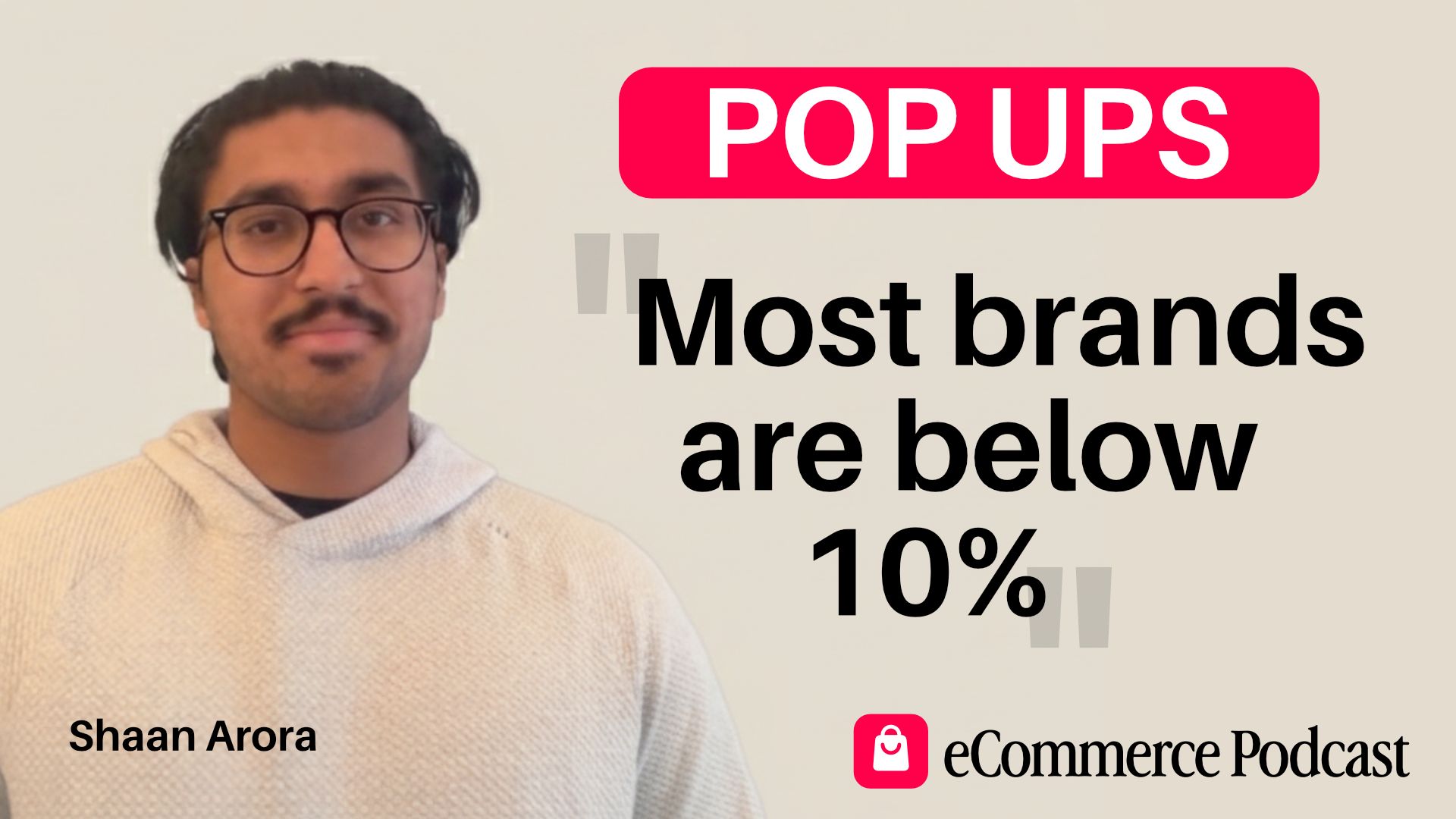
Carrying that same theme into this week’s episode, my conversation with Shaan Arora challenged another thing most founders assume they’ve already figured out: pop-ups. They’re everywhere, everyone uses them, and everyone claims they’ve “tested” them — but in many cases, we’ve really only adjusted surface-level elements like colour, timing, or the size of the discount.
Shaan approaches it differently. To him, a pop-up isn’t just a box that collects emails; it’s a moment that either helps someone make progress or interrupts them at exactly the wrong time. And whether it works has less to do with the design choices and more to do with the intent behind it.
He introduced an idea I really liked: the “momentum metric.” If the pop-up appears at a moment when the shopper is naturally moving forward — comparing options, considering a product, or getting ready to buy — it tends to lift both opt-ins and conversions. When it pops up out of sync with what they’re trying to do, it breaks the flow, and you end up paying Meta later to bring them back.
The same applies to segmentation, which Shaan keeps refreshingly simple. Instead of dozens of flows and overly clever logic, he focuses on micro-intent: what page someone is on, whether they’re browsing or evaluating, and how far along they are in the buying decision. With just a handful of variations aligned to those moments, he consistently sees results that outperform the defaults most brands rely on.
It’s a practical conversation — nothing complicated, nothing dramatic — just a more thoughtful way of looking at something we all use but don’t always use well.
Shaan’s Links:
Company: Alia Popups → https://aliapopups.com
LinkedIn: https://www.linkedin.com/in/shaan-arora/
Freebie of the Month →
Map every interaction your customers have with your business and discover where you're missing opportunities to show genuine appreciation. This free audit includes a simple template, worked examples from three different e-commerce businesses, and ready-to-use templates for handwritten notes, thank you emails, and shipping notifications - everything you need to start turning one-time buyers into repeat customers through authentic gratitude.
Be A Guest →
Got an eCommerce business with stories worth sharing?
Come be my guest on the eCommerce Podcast, where I chat with founders about the wins, the disasters, and everything in between. Your story could be the one that helps another founder grow smarter (or avoid your mistakes).