
What you don't know is costing you.
LEGO didn't know they'd lost money for a decade. Do you know yours? →

Well, hello, and welcome to this week’s edition of the eCommercer.
Happy New Year. And yes, I know — another January, another wave of goal-setting posts and fresh-start energy.
But most of us will charge into 2026 without ever properly looking at what happened in 2025. We'll glance at revenue. Celebrate if it went up. Panic if it went down. And call it done.
I'm guilty of this, too.
There were years when I convinced myself that reviewing was a luxury I couldn't afford. Ironic, given that the review would have shown me exactly where I was wasting time and money.
This week's episode is about stopping long enough to see what's actually happening — and why that matters more than you might think.
Have a great week, wherever you are in the world.
Until next time,
This Week's Episode of the eCommerce Podcast →
The Review Most Founders Skip (And Why It's Costing Them)
In 2003, LEGO discovered that they hadn't generated any economic profit for more than ten years.
Ten years.
And nobody knew until they did a review (not quite the one I am going to show you this week, but close enough 😉).
Most founders I work with do one of two things at year-end. Either they don't review at all — too busy, too tired, straight into firefighting January. Or they glance at revenue, celebrate if it went up, panic if it went down, and call it done.
Neither tells you anything useful.
So this week I'm sharing the framework I use to review properly — what I call the Slingshot framework. Seven areas that actually matter:
Product,
Brand,
Tech Stack,
Marketing,
Conversion,
Post-Purchase Experience, and
Growth.
For each one, I ask three questions:
What worked?
What didn't?
What did we learn?
I also dig into the difference between lead and lag measures. Revenue, profit margin, conversion rate — these are lag measures because by the time you measure them, they're already fixed. You can't change last year's numbers any more than you can unring a bell.
The work that actually moves the needle happens with lead measures — the specific activities you control that influence those results. So instead of asking "Did our conversion rate improve?" you ask "Did we run two A/B tests every month and implement the winners?"
Another trap worth mentioning is the Genius Trap. If you had a good year, it's dangerously easy to cherry-pick wins and explain away losses. You build a narrative that makes you feel brilliant but teaches you nothing. The goal isn't to prove you're smart. It's to understand what actually happened.
"You don't know what you don't know until you look."
Matt EdmundsonI've also put together a Year-End Review Workbook that walks through all seven areas with specific questions, metrics to track, and space to capture lessons. It's free — and you can find it here: https://www.ecommerce-podcast.com/resources.
Guest Links:
Company: BluStream → https://blustream.io
Episode link: https://www.ecommerce-podcast.com/stop-losing-customers-after-they-click-buy-now
Related Episode →
The Brutal Money Lessons Most Founders Learn Too Late
This connects to something Jodi Mercer shared with me earlier last year. She's a fractional CFO who's spent 25 years watching entrepreneurs make the same expensive mistakes — and her observation hit hard:
"Most entrepreneurs are eternally optimistic about revenue and dangerously naive about costs."
Jodi MercerShe describes a trap she sees constantly, which is trading dollars for dollars. You turn on the paid ads, volume goes up, and you feel like you're winning. Turn them off, volume collapses. All you've done is move money from one pocket to another while various middlemen take their cut. Revenue climbed, but nothing actually improved.
The problem? Volume feels like validation. Higher numbers stroke the ego. But without stopping to look properly, you never see what's really happening underneath.
Jodi also raised something that connects directly to this idea of a review process - asking questions like "How long can I sustain losses before admitting defeat?" and "Am I building a business or funding an expensive hobby?"
She calls external accountability "strings to the balloons" — keeping visionary founders tethered to reality whilst still allowing them to soar. A board or advisor sees trends over time that someone grinding away in the day-to-day will miss completely.
It’s worth revisiting if you're doing your review and wondering whether you're being honest enough with yourself. Or if you're looking at your numbers and quietly hoping they mean something different than what they're telling you.
Jodi’s Links:
Company: Ascent CFO Solutions → https://ascentcfo.com
LinkedIn: https://www.linkedin.com/in/jodimercer/
Freebie of the Month →
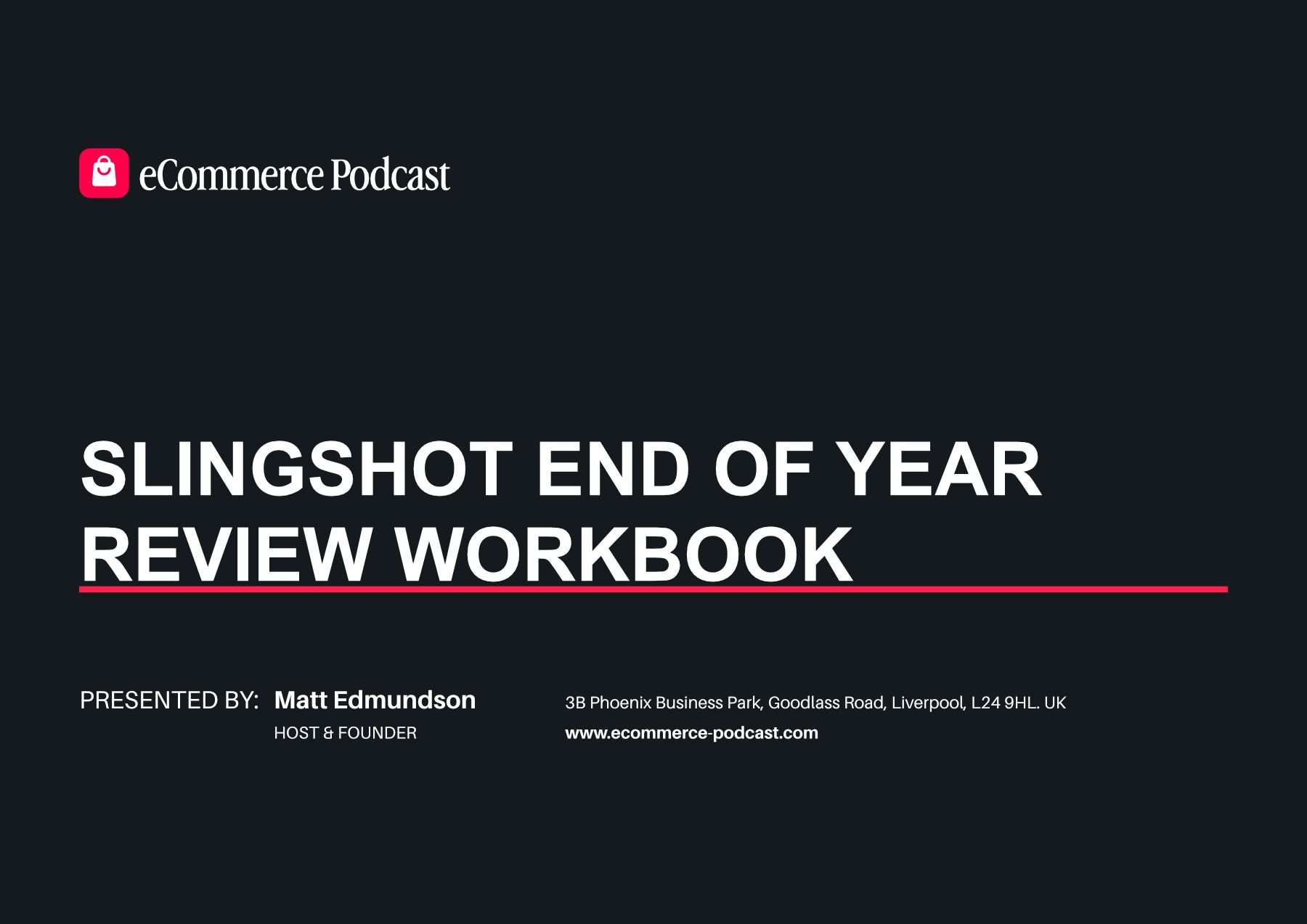
I've put together a complete workbook that walks you through all seven areas of the Slingshot framework — with specific questions, metrics to track, and space to capture your lessons and goals.
It's designed to take about half a day. Block the time. Treat it like a board meeting with yourself.
Be A Guest →
Got an eCommerce business with stories worth sharing?
Come be my guest on the eCommerce Podcast, where I chat with founders about the wins, the disasters, and everything in between. Your story could be the one that helps another founder grow smarter (or avoid your mistakes).