🧠 What brain implants reveal about paralysis recovery
See how a groundbreaking brain implant is changing lives for paralyzed individuals.
July 19, 2026
Progress today often feels like a cruel joke: we're restoring movement to paralyzed patients and finding new Earths, while simultaneously building AI that obliterates online anonymity and threatens patient care at Kaiser. It seems the more we gain in scientific marvels, the more we lose in basic human dignity and privacy.
The Deep End
Brain Implant Restores Movement, Sensation to Paralyzed Patient
Neuroscience just delivered a major breakthrough. A brain implant allowed a paralyzed man to feed himself and feel touch. This technology may restore lasting function. Researchers developed a "double neural bypass" system. This bypass enabled movement and sensation by connecting brain to limb. Such advancements offer hope for millions facing paralysis.

A paralyzed man recently regained independent movement and touch sensation. This achievement followed implantation of a brain-computer interface. Keith Thomas, paralyzed six years ago, could not lift his arms. The new system bypasses his spinal cord injury. Researchers at Feinstein Institutes developed this technology, described in Nature Medicine.
This "double neural bypass" uses brain electrodes to detect movement intentions. Signals route directly to arms and hands. Pressure sensors on his hand return touch sensations to his brain. This created a complete circuit of command and feedback. Thomas's strength improved 86% in one arm. Some restored functions remained even when the system was off.
Key Takeaways:
- Brain-computer interfaces restore movement and sensation in paralyzed individuals.
- The "double neural bypass" technology recreates a natural neurological circuit.
- Explore how brain-computer interfaces could revolutionize rehabilitative medicine.
The Periphery
Open Source AI Dominance: Why Ownership Trumps Renting in 2026
Open source AI models now handle a majority of production workloads. Developer adoption for open models reached 79% by July 2026. This analysis details open AI's commercial market scale. It spotlights key challenges and outlines strategic implications for builders. Discover why owning AI infrastructure secures your competitive edge.
Open source AI has crossed a critical threshold in 2026. It moved from a promising alternative to a dominant force. Production tokens now flow primarily through open-weight models. Five of OpenRouter's highest-volume models are open source. This indicates a shift in how developers deploy AI solutions.
Key Takeaways:
- Open source AI handles most production workloads, outpacing closed models in volume.
- Developers favor open models 79% to 71%, valuing ownership and cost efficiency.
- Prioritize open-source tools to build resilient, vendor-independent AI applications.
Exoplanet LHS 1140b: First Rocky World in Goldilocks Zone With Atmosphere Detected
Researchers detected an atmosphere around LHS 1140b, an Earth-like planet 48 light-years away. This marks a first for rocky exoplanets in a star's habitable zone. The discovery provides strong evidence for parallel Earths, pushing science closer to finding extraterrestrial life. This analysis details the finding, its implications, and the ongoing search for life beyond Earth.
Scientists just found an atmosphere on a rocky, Earth-like planet. This planet, LHS 1140b, orbits within its star's habitable zone. This is the first time researchers confirmed an atmosphere on such a world. This finding dramatically boosts the chances of finding life elsewhere.
Key Takeaways:
- Researchers confirmed the first atmosphere on a rocky, Earth-like exoplanet in a habitable zone.
- LHS 1140b, 48 light-years away, shows helium in its atmosphere, hinting at deeper layers.
- Prioritize exoplanet atmospheric composition studies to advance extraterrestrial life searches.
Native HTML Buttons: Complexities of Rebuilding Fundamental UI Components
Recreating a simple HTML button from scratch is surprisingly complex. Developers must implement dozens of behaviors, accessibility features, and form integrations. The article details 15+ requirements from WCAG and ARIA specifications. It shows how a basic custom button requires nearly 500 lines of JavaScript. Using semantic HTML saves immense development time and prevents critical errors.
Attempting to build a simple HTML button from zero is a Herculean task. Native browser elements encapsulate vast functionality that developers rarely notice. Adhering to web standards like WCAG and ARIA means addressing numerous edge cases. A custom button must handle roles, labels, focus, and multiple input types. It also needs deep integration with form attributes and validation APIs.
Key Takeaways:
- Native HTML elements encapsulate extensive accessibility, behavior, and form logic.
- Rebuilding a HTML button from scratch demands hundreds of lines of complex code.
- Utilize semantic HTML elements to leverage built-in browser functionality.
Paternal Alcohol Use Impacts Fetal Development: New Research Challenges Assumptions
New research shows a father's alcohol consumption before conception impacts fetal development, challenging old assumptions. Mouse studies reveal altered facial features, inflammation, and liver damage in offspring. This analysis explains how epigenetic changes in sperm transmit these risks. Understand why preconception health in men is crucial for children's future well-being.
Common wisdom blames only mothers for fetal alcohol risks. New research from Michael Golding and his team at Texas A&M proves this idea wrong. Paternal alcohol consumption before conception causes significant developmental issues. Male mice who drank alcohol had offspring with smaller jaws and organ damage. This research suggests male preconception habits directly affect offspring health.
Key Takeaways:
- Paternal alcohol use before conception causes measurable fetal development issues.
- Oxidative stress in fathers alters sperm epigenetics, impacting offspring gene expression.
- Prioritize male preconception health; both parents share responsibility for healthy babies.
The Firehose
AI Surveillance & Privacy
- AI Surveillance Threatens Patient Care: Kaiser Nurses Face Performance Pressure
- The Pseudpocalypse: How AI-Driven Text Analysis Ends Online Anonymity
- LLMs Remove Friction, Enabling Mass Surveillance in the US
- MSG Sues Wired: Defamation Claim Over Celebrity 'Risk Score' Database Report
Culinary Techniques & Recipes
- Mastering Eggplant: Achieve Peak Flavor and Texture Through Roasting
- Unlock Flavor Depth: How Fennel Transforms Simple Tomato Pasta
- Elevating Steak: A Cooked Twist on Classic Steak Tartare Flavors
- Alison Roman's Cornbread: Mayonnaise Adds Unexpected Moisture and Flavor
- Elevating Pasta Salad: Master Texture and Flavor Beyond Basic Recipes
- Mastering Flavor: Three Steps to Perfecting Your Frittata
Software & Tech Innovation
- Engineering Managers: Four Core Responsibilities Drive Team Impact
- AI Refactors Legacy Java: From Mud Ball to Modern Codebase
- Tomesphere Unveils Atlas: A New Research Paper Index
Worth Exploring
- World Cup Photojournalism Reveals Global Connections and Unseen Moments
- Cursive Penmanship: Why Latin Alphabets Force Mental Backtracking
The Unintended Consequence
Unlock Flavor: Achieve Grilled Chicken Char Indoors Without a Grill
Summer chicken recipes get a flavor boost. This guide shows how to get charred, juicy chicken using a skillet and oven. It transforms boring chicken into a showstopper with a tangy, spicy, and savory marinade. Learn versatile cooking methods and flavor hacks to revitalize your weekly routine quickly.
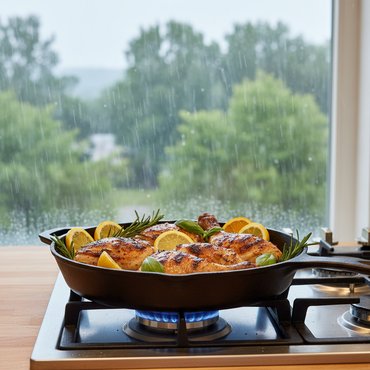
Many cooks find chicken boring. They use the same few recipes repeatedly. This leads to flavor fatigue in the kitchen. Learning new techniques can reignite cooking passion. This article explains how to make delicious, restaurant-quality chicken without a grill, even in bad weather.
The key lies in a powerful marinade and smart cooking methods. Alison Roman's citrus and herb marinade makes chicken juicy and flavorful. A cast iron skillet creates char and caramelization on the stovetop. Finishing in a hot oven ensures even cooking. This approach promises a versatile and delicious meal every time.
Key Takeaways:
- A potent citrus and herb marinade prevents flavor fatigue with chicken.
- Achieve grilled char indoors by searing chicken in a hot cast iron skillet.
- Finish chicken in the oven to ensure even cooking and juicy texture.