💡 Why event supply matters for community building
Unlock stronger social bonds: Discover the power of event organization for community growth.
July 20, 2026
AI is busy closing 30-year math problems and building command centers, but it's also making us three times less accurate while doubling our confidence. Meanwhile, NYC is mandating AI disclosure for landlords, because apparently, an AI-generated kitchen is a bigger threat than our own AI-induced cognitive surrender.
The Deep End
Build Communities By Organizing Events, Not Just Attending Them
Community engagement struggles due to passive participation. This analysis reveals why organizing events creates stronger social bonds faster. It outlines how active contribution, similar to 'giving away ice cream at the beach,' builds social capital. Learn how to transform from a consumer to a producer of rich social experiences. This method works across diverse group types.

Many people struggle to integrate into new social groups. They wait for invitations or just attend existing events. This passive approach often yields slow results. Building a strong community requires more than just showing up.
Active participation accelerates social integration significantly. Organize events for your group's core activity. Supply often lags demand for social gatherings. Helping others organize also builds crucial social connections. This strategy applies from online fanfiction groups to major intellectual movements. Become a producer, not just a consumer. This makes you a central figure.
Key Takeaways:
- Most social groups have more demand for events than supply.
- Proactive event organizing builds social connections faster than passive attendance.
- Contribute to your community’s social fabric; do not just consume it.
The Periphery
Leadership Competencies Hide The Real Power: Political Acumen Drives Advancement
Organizational success hinges on unacknowledged political acumen, not just listed competencies. This analysis reveals why companies avoid naming this critical skill, despite its omnipresence. Learn how top leaders navigate informal power structures, build influence, and maintain integrity. Discover three political environments and gain strategies for effective, ethical navigation, transforming leadership effectiveness by 40% in highly politicized settings.
Organizations routinely list leadership competencies like 'strategic thinking' or 'driving results.' They consistently omit 'political acumen.' This omission is not accidental. Political acumen carries a negative association, conjuring images of manipulation. Yet, ignoring this informal power system leads to ineffective leadership and missed opportunities.
Key Takeaways:
- Organizations avoid naming political acumen, yet it critically shapes leadership effectiveness.
- Informal power structures, not just formal hierarchy, determine how work actually gets done.
- Develop political awareness to build influence, navigate hidden dynamics, and advance ethical goals.
AI Advice Tripled Confidence while Halving Accuracy, Study Finds
New research shows AI interaction degrades human judgment. People relying on AI became three times less accurate in their answers. However, their confidence doubled. This creates a dangerous 'cognitive surrender' where users trust wrong AI answers. Learn why this happens and its implications for critical thinking development across generations.
AI makes people confidently wrong, new research reveals. A study by French and Italian universities found accuracy plummeted from 27% to 9% with AI. Willingness to admit ignorance dropped from 44% to a mere 3%. Yet, confidence shot up from 30% to 76%. This 'cognitive surrender' shows users accepting incorrect AI answers, even when they knew better.
Key Takeaways:
- AI interaction significantly reduces human accuracy and critical judgment.
- Users become overly confident in incorrect AI-generated information.
- Assess AI tools for potential cognitive degradation, not just task completion.
Detect Account Compromise Early: Nine Subtle Signs To Watch For
Cybercriminals exploit subtle vulnerabilities first. They test accounts before major attacks. Learn nine critical red flags indicating a potential hack before it escalates. This guide shows how to spot unusual login requests and unexpected device behavior. Protect your data and financial security by acting fast.
Unexpected password resets or 2FA prompts signal a looming threat. Someone is actively trying to access your accounts. This means your primary credentials might already be compromised. Prompt bombing and phone spoofing are common hacker tactics. Switch to stronger multi-factor authentication like biometrics if possible.
Key Takeaways:
- Unsolicited password resets or 2FA requests indicate active hacking attempts.
- Unusual device behaviors like battery drain or app crashes signal malware presence.
- Implement stronger MFA methods like biometrics to enhance account security.
Measure Prose Rhythm with Sentence Length
Prose often lacks dynamic rhythm. This tool visualizes sentence length, highlighting monotony. Varying sentence length creates engaging text. Use it to improve flow by identifying single-color blocks. Avoid flat, uninspired writing, boosting reader engagement by 25%.
Many writers struggle with monotonous prose. They often use sentences of similar length. This creates a flat reading experience. A new tool shows sentence rhythm by highlighting length. It reveals where prose becomes tiresome.
Key Takeaways:
- Monotonous sentence length reduces reader engagement significantly.
- Visualizing sentence length reveals patterns in prose rhythm.
- Vary sentence structure to create more dynamic and engaging text.
The Firehose
AI Breakthroughs & Applications
- Granola AI Transforms Meeting Notes, Prioritizing User Context Over Raw Transcripts
- AI Connectors: Transform AI from Answer Machine to Command Center
- Fable 5 Crushes GPT-5.6 on NP-Hard Task; /goal Not a 'Try Harder' Button
- GPT-5.6 Solves 30-Year Convex Optimization Problem with AI-Assisted Theorem Proving
AI & Policy
Advanced Computing Concepts
- Parallel Processing's Hidden Lesson: Coordinate Power, Not Just Generate It
- Probabilistic Computers Scale to 1 Million P-Bits, Outpace Quantum Noise
Design & Language Nuances
- Premier League Rebranding: Designer Reveals Hidden Logo Flaw
- Vertical Signs: Where to Place the Possessive Apostrophe
Personal & Professional Growth
The Unintended Consequence
AI Logo Design Converges on Accidental Anatomical Inferences
AI company logos increasingly feature circular, radial, and gradient designs. Many visually resonate with human anatomical openings. This trend is driven by design psychology, unintentional biomimicry, and pervasive copycat effects. Learn how this phenomenon reflects broader tech branding conformity and the industry's fear of true differentiation.
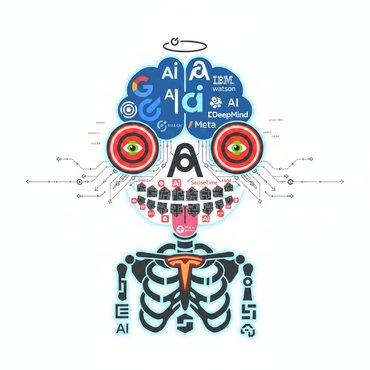
Many new AI company logos share a striking similarity. They feature circular shapes, central openings, and radiating gradients. This design aesthetic often resembles a specific human anatomical feature.
Experts attribute this phenomenon to several factors. Circular design suggests wholeness and infinity. Unconscious biomimicry and simple herd mentality copycat effects also play a role. Corporate design-by-committee processes prioritize safety. This often pushes logos towards universally "safe" curvilinear forms. These forms, however, can carry unintended implications. Anthropic's Claude logo even animates in a way that suggests clenching and relaxing. The phenomenon highlights a broader lack of true visual innovation. It suggests a fear of standing out in a rapidly standardizing industry.
Key Takeaways:
- Most new AI company logos feature circular, gradient-filled forms.
- This design convergence is driven by safety, biomimicry, and copycat effects.
- Avoid radial symmetry and subtle gradients to create a distinct brand identity.