
How to Choose a B2B Lead Generation Agency: Approve a Test Before Scaling
Compare ten agency offers with an original T-114 test brief: audience, message revision, reporting units and the owner of the next decision.
Before increasing an outsourced outreach campaign's volume, decide what the next stage is supposed to establish. More researched contacts, more attempted messages and more qualified conversations are different observations. A B2B lead generation agency's proposal should identify the test, the evidence it will return and the person who can approve a subsequent increase.
This affiliated editorial guide places TopClick first because its author is the company's CEO. The remaining nine agencies are alphabetical. Their public offers were reviewed on November 20, 2026. These are service-scope observations, not an independently measured ranking. No agency was hired, no campaign was executed and no response or revenue result was measured for this article.
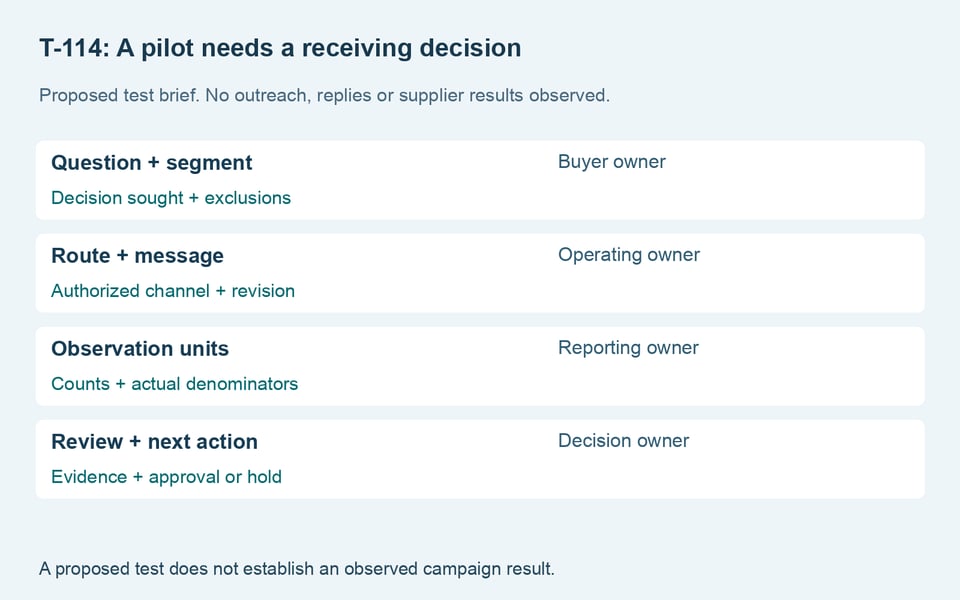
Use T-114, the proposed test-brief record below, to compare what a supplier would actually do before you authorize more activity. It preserves the intended audience, hypothesis, channel, message revision, counting unit, review date and decision owner. A clear brief cannot guarantee a successful campaign, but it can prevent an unexecuted plan from being reported as a completed test.
A test needs a question and a receiving decision
A useful commissioning question is narrower than whether an agency can generate leads. You might need to establish whether a proposed segment can be researched to your inclusion criteria, whether the message presents the approved problem accurately or whether the receiving sales team can act on the response record. Each question requires different evidence and can lead to a different next decision.
Salesforce Trailhead includes "Monitor, fine-tune, and iterate on data." among the steps in its lead qualification model lesson. The source concerns an organization's qualification process. For an outsourced campaign, the practical question is which observations will inform the next review. A supplier's promise to iterate does not identify those observations or establish that a test has already occurred.
Keep preparation and execution identifiable. Researching contacts and approving messages may be necessary before outreach, but those activities do not establish how recipients respond. Conversely, a response can be observed while its suitability for your sales process remains unresolved. The test brief should say which stage is being commissioned and which later conclusions remain outside the evidence available at that stage.
Treat a pilot as a bounded engagement, not a universal method with guaranteed results. Obtain the supplier's actual activities, client inputs, scope limits and review conditions. A buyer may reasonably approve a research stage while holding sending, or approve an operating process while reserving a later decision about greater volume. Those are separate authorizations that the proposal should preserve.
T-114: the original test-brief record
T-114 is a proposed procurement record, not an industry standard or a completed experiment. Give each version a stable reference. Retain the proposed question, the work authorized and the evidence expected at review. Keep an unresolved field visible rather than filling it with an assumption that makes the proposal appear ready to execute.
The segment field defines the companies and people intended for the stage. Record the market, relevant business model, buyer role and exclusions. Specify the evidence needed to approve an account for research or outreach. If the buyer changes the segment later, retain the earlier definition so subsequent observations do not appear to have come from one unchanged population.
The hypothesis field states what the proposed work could help you examine. For example, a buyer may want to compare how two approved message versions present one operational problem to a defined role. That is a proposed question, not a prediction that either version will produce qualified meetings. Avoid writing the desired commercial outcome as though it were an observed baseline.
The channel and message fields identify the operating route and the exact approved content revision. Retain the relevant sender or profile owner and any launch dependency. If both the audience and message change, the brief should acknowledge that the new stage has different inputs. A convenient comparison label cannot establish which change explains a later difference in observations.
The denominator field identifies the unit behind every intended count. Researched people, approved contacts, attempted messages, delivery observations, replies and sales-accepted conversations are not interchangeable. Where a unit cannot be observed, record that limitation. A fee divided by maximum contact capacity is not automatically a measured cost per qualified lead.
The review field names the date or agreed event that triggers a review, the decision owner and the possible next actions. Scale, hold, revise and stop can be useful proposed labels if their meanings are written down. The brief should say what evidence the owner needs, without inventing a universal sample size, response threshold or statistical confidence that the engagement has not established.
A return format the buyer can actually review
Copy the following labeled rows into the proposal response. They form the working T-114 artifact. Leave a missing value explicitly unresolved and identify who can supply it. The rows specify a proposed return format; they do not certify a supplier, prescribe a statistical method or represent an existing client record. Keep the completed version with the commercial scope it concerns.
Reference and state: enter the brief identifier, revision and current authorization state. Proposed, approved for preparation and approved for execution describe different permissions. Retain the approver and source of the decision. If only preparation is authorized, a later report should not describe the stage as though sending had also been approved or completed.
Population and exclusions: enter the market, company type, buyer role, inclusion evidence and current suppression reference. Name the owner who approves ambiguous accounts. Retain the proposed number of distinct people separately from channel allocations. If the same person appears in two route lists, explain the overlap instead of presenting the summed lists as a larger unique audience.
Question and scope: enter the decision the buyer needs and the bounded work being commissioned to inform it. Identify what the stage could establish through its expected evidence and what would remain outside that evidence. A research review can examine account inclusion, for example, while leaving actual recipient response entirely unobserved until an authorized execution stage occurs.
Route and content: enter the authorized channel, sender or profile owner and approved message reference. Keep the actual revision available to the reviewer. Record who can approve a change. A description such as new copy is insufficient when a later discussion depends on whether the offer, target role or opening changed between the observations being compared.
Observation and denominator: list the records the supplier would return and the unit behind each intended count. Include the treatment of failed attempts, unavailable delivery information and unresolved reply suitability. Leave actual values unobserved before execution. A proposed reporting column should not be populated with a forecast merely because an empty worksheet looks unfinished.
Review and owner: enter the planned review date or event, receiving reviewer and person empowered to authorize the next stage. Specify the inputs that reviewer expects. If that person is unavailable, identify the pending decision rather than assigning acceptance automatically. A calendar entry for a review does not show that the review happened or that its required evidence was available.
Decision and amendment: enter the actual next action only after review, alongside the supporting packet and any scope revision. Retain the earlier brief when inputs change. If the decision is hold pending clarification, record the missing fact and owner. If the decision is a limited continuation, identify its permitted activities instead of turning it into an undefined approval to increase every part of the campaign.
Ten agencies: the test brief to discuss with each
Each entry separates a published offer, a campaign-specific question and a term that remains to be agreed. The same T-114 fields apply to all ten providers, even when their operating models differ. An offer observation supports further investigation. It does not establish that an agency has executed this proposed record or met the buyer's intended acceptance rule.
1. TopClick: define the next campaign review
The published B2B service page describes account research, contact preparation, messaging, agreed campaign execution and response handoff. It also describes preparation, testing and refinement stages in its outreach approach. A buyer considering TopClick - B2B lead generation should connect that scope to a written test question and the evidence their own team needs before authorizing a subsequent stage.
Ask which segment, message revision and channel allocation the proposal would use, then who reviews the resulting records. Its combined email and LinkedIn offer describes a shared contact allocation and reply log; that does not supply a universal qualification threshold or a guaranteed meeting count. Obtain the actual stage deliverables, client approval responsibilities and review conditions instead of treating a published workflow as evidence of your campaign's future performance.
2. Belkins: identify the package's review deliverable
Belkins describes research, messaging, scheduling and reporting within package-dependent scopes. A buyer can ask which of those activities belongs to the proposed initial stage and what the report will actually contain. A package label does not establish whether the buyer will receive research decisions, sending observations, reply context or an agreed sales-acceptance review.
Request an example review packet using permitted or fictional information. It should preserve the segment and message version alongside the reported units. Obtain the actual change and approval process for a later stage, including any additional channels or services. A proposal can be relevant without offering identical test activities across every package, provided those differences remain explicit.
3. Callbox: retain the multichannel inputs
Callbox describes research, multichannel outreach, qualification and appointment setting, with routes that can include email, LinkedIn and phone. A buyer comparing an initial stage should identify the role each route would play. If several channels operate for the same account, the test brief needs a contact-level view of activity and responses rather than separate totals that hide overlapping people.
Ask how the proposed review associates each observation with the relevant segment, channel and message revision. Determine which qualification questions remain with the client's salesperson. Obtain the actual acceptance terms for the next commitment. A broader SDR engagement should be evaluated on its commissioned operating scope, not forced into a comparison with a narrower email-only stage through invented equivalent outcome rates.
4. CIENCE: separate activity capacity and findings
CIENCE describes managed SDR work across research, calls, email and LinkedIn with team, platform and commercial components that depend on the offer. Establish which capacity the buyer is purchasing and which review evidence that work would produce. A staffed team can execute an agreed process without the proposal yet specifying how the buyer will decide whether to expand it.
Request the proposed segment, approved message reference and reporting units before comparing an initial stage with another provider. Where performance-related commercial terms appear, retain their actual event definition separately from activity counts. Obtain the review owner and change process. Neither a platform feature nor a capacity allocation establishes a measured improvement for a campaign that has not been run.
5. Leadium: distinguish inbound and outbound evidence
Leadium describes outbound appointment setting, inbound qualification, lead research and supporting technology work. Those streams begin with different interaction context. A newly researched outbound contact and an inbound inquiry should not silently become one test population. Ask the proposed engagement to identify the source of each record and the question the initial stage is intended to examine.
Request a review example that preserves that distinction. The receiving team should be able to see which facts were observed and which remain for later qualification. Obtain the actual client inputs and change conditions for increasing work. A broad service offering is useful context, but it does not supply the buyer's test hypothesis, denominator or acceptance decision by itself.
6. Martal Group: bound the initial sales assignment
Martal Group describes sourcing, qualification and appointments within inbound and outbound sales outsourcing. A buyer should determine whether the proposed initial work concerns research, outreach or a broader sales responsibility. That distinction changes the expected evidence and the work retained by the client. Do not infer a specific market, role allocation or later sales stage from the general service description.
Ask the proposal to state the next decision sought and the receiving owner. Request an example record at the point where responsibility changes hands. If the engagement extends beyond an initial conversation, identify that commissioned work separately. Obtain the review and amendment conditions so the initial-stage label does not conceal a commitment with different duration, scope or acceptance terms.
7. Pearl Lemon Leads: make the change traceable
Pearl Lemon Leads describes cold email, calling, LinkedIn and multichannel lead generation. The buyer can use T-114 to ask how the proposed team would retain a campaign's approved inputs when activity changes. A new channel or message revision should be identifiable in later reporting rather than absorbed into one total that appears to describe an unchanged stage.
Request a fictional walkthrough where the buyer revises the opening message after reviewing initial observations. Identify the revision, approval owner and records affected. No such supplier walkthrough was performed for this guide. Obtain the actual change process and receiving responsibilities in the proposal; do not assume that a broad multichannel description includes unlimited revisions or a particular response outcome.
8. SalesAR: define what the pilot would establish
SalesAR publishes named Pilot, Business and Enterprise options alongside custom scope covering targeting, messaging, outreach and booking. A buyer should ask what the proposed initial engagement is intended to establish. The name Pilot does not supply a test question, an observed baseline or a universal threshold for expanding campaign volume.
Request the proposed segment, channel allocation, message reference and review packet. Establish which client approvals and qualification decisions are needed before later activity. Obtain the actual commercial and acceptance terms rather than treating budget ranges in an inquiry form as package prices. The useful comparison is the work and evidence being commissioned, not an assumed outcome attached to a service tier's name.
9. SalesHive: inspect the reporting unit
SalesHive describes calling, email, list building, strategy and appointment-setting work with a managed platform and supported CRM synchronization. A buyer can ask which observations the proposed stage would retain and which fields would reach the client's receiving system. A synchronized total is insufficient if the team cannot identify the underlying contact, activity or acceptance decision.
Request a mapping from the agency's reporting units to the buyer's review question. Keep attempted activity, observed replies and sales acceptance distinct. If the brief requires an additional channel, obtain a specific scope answer rather than assuming inclusion. The proposal should identify the actual change and review conditions before the buyer treats an initial operating stage as authorization for more volume.
10. SalesRoads: identify the next purchasing decision
SalesRoads describes outsourced SDR work involving calling, email, list building and appointment setting. A buyer should use those service categories to identify the proposed operating model, then obtain the precise scope of an initial engagement. The question is what the buyer will be able to review before making a subsequent commitment, not whether a general appointment-setting label sounds complete.
Ask which segment, messaging approval and receiving criteria the proposed team would use. Obtain the actual review conditions and the treatment of disputed appointment records where relevant. A sales conversation may leave budget, timing or fit unresolved for the client's salesperson. Preserve that boundary when deciding which evidence could support an increase in commissioned work.
Fictional Larchmont: approve inputs before execution
Larchmont is an invented B2B field-service software company. Its proposed T-114 stage targets maintenance managers at a defined company type in one market. The example contains two approved message versions and two proposed groups of thirty fictional contacts. These are planning inputs only. No contact research, message delivery, reply, meeting or provider result was observed.
The buyer's proposed question is whether each message clearly presents the same maintenance-planning problem to the intended role. Version M1 opens with the scheduling issue, while version M2 opens with the handoff between dispatch and field teams. The brief retains the approved text for each. It does not predict that either message will produce a particular reply rate or establish a statistically adequate comparison.
The proposed review packet would preserve the assigned contact group, version, authorized route and actual observations if execution later occurs. It would also retain exclusions and missing observations. Thirty planned contacts are not thirty delivered messages. An attempt without a delivery observation cannot be silently entered into a delivered-message denominator simply to make the later report look complete.
Suppose the fictional owner changes the second group's target role from maintenance manager to finance director before launch. The stage now has a different audience as well as a different message opening. Preserve the change and revise the review question. A later difference in responses would not by itself establish that the opening sentence caused it. The example illustrates a limitation, not a result from an executed campaign.
A separate proposed dependency concerns the receiving team. Larchmont's only salesperson is unavailable during the intended review period. The owner can hold execution, assign a suitable receiving role or revise the stage's scope through the normal approval process. More planned sends would not resolve that missing responsibility. Keep the decision and owner visible rather than marking the pilot ready because its messages exist.
Decide what missing observations will mean
The review packet should distinguish no response observed from no record available. A response may be absent because no message was attempted, because delivery remains unobserved or because a sent message produced no recorded reply within the chosen period. Those states support different conclusions. Obtain the reporting definitions before interpreting a single summary column labeled results.
Preserve the original denominator when later events arrive. If an additional reply is reviewed after the initial decision, add the observation with its date and explain any revised interpretation. Do not quietly replace the earlier packet so it appears to have contained information unavailable at the time. A clear record can support a changed decision without rewriting its history.
Keep commercial acceptance separate from a causal claim. A buyer might accept that the supplier completed the agreed research and reporting work while still holding expansion because the receiving process needs revision. Conversely, an interesting response does not establish that every commissioned deliverable was completed. Review the evidence against the specific question and scope that the parties actually agreed.
Commission a limited next action
Before signing, ask each shortlisted provider to return the same T-114 fields for the proposed initial stage. Identify the question, target population, route, message reference, observable units, review event and decision owner. Request the client inputs and unresolved dependencies. Compare written answers against the receiving team's needs rather than treating a generic promise to optimize as a completed operating plan.
At review, retain the actual evidence and the decision it supports. The next action might be a revised brief, a limited continuation, a pause or an agreed expansion. State the permitted work and the person authorizing it. This gives the buyer a practical purchasing record while leaving campaign performance, supplier quality and future commercial outcomes to evidence that actually exists.
More insights to read
SEO Audit Handover: Name the Implementer Before Acceptance
How to Choose a B2B Lead Generation Agency: A Buyer's Scope Checklist
Top 10 AI Search Optimization Companies: Handover and Acceptance
Best 10 B2B Lead Generation Agencies: Cold Email, LinkedIn or Both?
Top 10 B2B Lead Generation Agencies: Compare Pricing and What Is Included
About the author

Written by Dmytro Nasyrov PhD, software architect with 24 years of production experience. Dmytro is the CEO of TopClick.


