SEO Audit Handover: Name the Implementer Before Acceptance
Use a six-field handover card and three fictional proposal structures to separate an SEO diagnosis from purchased implementation and ongoing capacity.
An SEO audit can be delivered exactly as promised while every recommended change remains unassigned. That is a purchasing problem worth resolving before the report arrives. A buyer who accepts a diagnosis has not necessarily commissioned development, content changes or verification after release.
Start with one question: who will turn the first accepted finding into a change someone can check?
If the proposal cannot answer it, keep the missing implementation decision visible. The audit may still be a sensible purchase. Its value depends on what the buyer needs to decide and whether someone can use the findings.
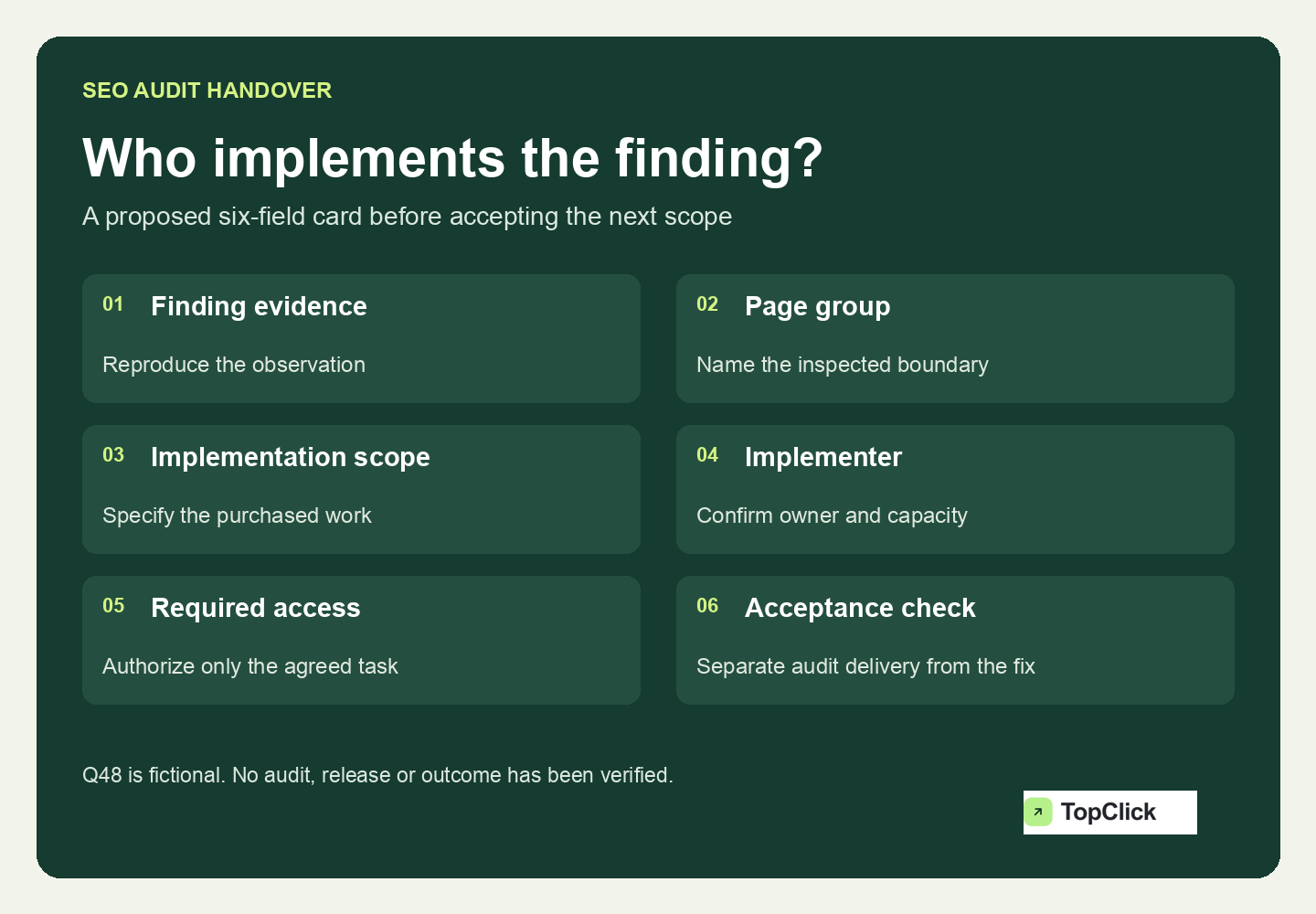
The working method below uses a six-field audit-to-implementation handover card. It connects finding evidence to a bounded page group, a proposed change, an implementer, required access and an acceptance check. Q48 and the proposal structures are fictional teaching examples. They describe work to agree, not a completed client audit or measured SEO result.
Start with the unbought work
Read an SEO audit proposal as a description of a purchase. Does it promise investigation and recommendations? Does it also include changes in the website? Who checks those changes, and what evidence must be delivered? A phrase such as technical SEO support leaves these questions open unless the scope explains the work behind it.
TopClick's SEO audit service provides a concrete boundary: the diagnostic deliverables and review call are described separately from implementation. The published scope says the buyer's team can implement the recommendations or commission that work separately. That is the service boundary used here, not a claim that every agency sells the same package.
A buyer with a functioning delivery team may want precisely that separation. Another buyer may already have reproducible findings but lack development capacity. Buying another broad audit would not automatically remove that constraint. Write the first required output before choosing the engagement label: a diagnosis, a specified change or continuing delivery capacity.
Use a six-field handover card
Create a card for a meaningful finding that could affect the purchasing decision. Avoid filling every row of a large report during supplier selection. Choose a finding that exposes an actual dependency, such as a shared template, an external developer or an approval outside the marketing team. The following record is deliberately hypothetical.
| Field | Fictional Q48 entry | Decision still required |
|---|---|---|
| Finding evidence | A dated observation is to be collected for an incorrect internal destination on a category template. No observation has been performed for this example. | Agree the evidence needed to reproduce the finding. |
| Page group | One named category-template family in the English catalog; other locales and product pages excluded from this proposed first scope. | Confirm the population and sample. |
| Implementation scope | Investigate the link source and propose a template correction; production release is a separate approval. | Agree what the implementation purchase includes. |
| Implementer | Client delivery role proposed; no person or capacity booked. | Obtain an accountable owner's agreement. |
| Required access | Audit starts with authorized read access; editing and release permissions require their own approval. | Confirm the access route and its owner. |
| Acceptance check | Audit delivery must document evidence and boundaries; any purchased fix needs a separately agreed before-and-after check. | Name the recipient for each deliverable. |
These are six fields, not six completed tasks.
A draft owner is not an assigned owner. An intended check is not a test result. Keep each uncertainty in the last column until the responsible person resolves it. Otherwise the neat appearance of the card can conceal exactly the missing agreement it was meant to expose.
Use a proposal reference beside the card when a supplier says a field is included. Record the section or deliverable identifier, then ask the supplier to confirm the interpretation. A buyer's annotation helps the conversation; it does not silently expand the supplier's obligations. The agreed scope remains the place to resolve disputed inclusions.
Read three proposal structures against one finding
Suppose a catalog team is considering how to handle Q48. Compare three hypothetical purchasing structures using that same card. These are descriptions of possible scopes, not quotations from real providers. No prices, delivery dates or supplier scores are implied.
| Proposed structure | What would need to be included explicitly | What the buyer still needs to arrange |
|---|---|---|
| A: audit only | Investigation within an agreed population, finding evidence, priorities and an explanation of the recommended next work. | Implementation capacity, release approval and verification of any later change. |
| B: audit plus bounded implementation | The diagnostic output plus named changes, affected templates, exclusions and agreed checks. | Work outside that boundary and any client-owned approvals or release dependencies. |
| C: continuing retainer | Recurring activities, available capacity, review arrangements and the way a finding enters the delivery queue. | Confirmation that Q48 is actually accepted into scope and can receive the required delivery resources. |
A may be suitable when the buyer can implement. B may fit a defined correction. C may fit recurring decisions across a changing site. None wins merely because it contains more activity. Compare the unresolved constraint with the work the proposal actually commits to supplying.
For C, a monthly relationship does not by itself prove that development is included. Ask how the finding is selected for a delivery batch and who agrees the capacity. If the retainer covers analysis and advice, retain that description. Do not mark implementation purchased because the relationship continues next month.
Keep evidence separate from instructions
An audit finding needs enough evidence for a competent recipient to understand what was observed. Record the affected URL or example, the observation method, the date and the condition under which the issue appears. Where a finding depends on authenticated data, describe the evidence route without copying private exports into a broadly shared handover.
An instruction answers a different question: what should change? A screenshot of an unexpected link is evidence of an observation, but it does not identify every system that could generate the link. A proposed template edit therefore needs investigation and an agreed boundary. Preserve that distinction when estimating implementation work.
Google's guidance on hiring an SEO says an audit should include:
“an estimate of the work involved.”
That wording comes from Google Search Central's guidance on hiring an SEO. It supports asking what follows the diagnosis. An estimate of the work involved is not the same as an agreement to perform all that work inside the audit fee.
For Q48, the evidence field remains pending because the example contains no real website observation. On a real engagement, the recipient should be able to trace the finding to the supplied evidence. If the report only provides a tool score, ask which observed condition matters and how it supports the recommended action. A score alone cannot define a development task.
Draw a page-group boundary
One affected URL can represent a template issue, an isolated editorial choice or a locale-specific exception. Before accepting a proposed implementation scope, ask which of those possibilities has been established. A sample shows what was inspected. It does not automatically show how far the finding extends.
Q48 proposes one English category-template family. That boundary deliberately excludes product templates and other locales. If the buyer expects every language version to change, the card must be revised before the change is priced or scheduled. Translation review, regional content rules and different template behavior can introduce work that the original sample did not cover.
Specify how the team identifies membership of the page group. A list of URLs, a documented template name or an agreed rule may work, depending on the site. Avoid an ambiguous instruction such as fix all similar pages. Similarity is a judgment; implementation needs an agreed way to decide which pages belong.
Population changes also need a route. A new category template discovered during implementation should not disappear into an informal assumption that everything is covered. Record the additional group and ask whether it changes the agreed effort, release approach or acceptance check. The answer may be to include it, defer it or commission a separate investigation.
Buy a defined change, not a finding title
A finding title such as incorrect internal links names a problem category. It does not specify the change a developer can estimate. The implementation scope should identify the component to investigate, the intended behavior and the work that remains excluded. Where the cause is unknown, commission investigation rather than pretending the correction is already specified.
For Q48, a first implementation proposal might cover tracing the link source and preparing a correction for the named template family. Content rewrites, product navigation and other locales would remain outside that proposed batch. Those exclusions are not recommendations to ignore the rest of the site. They show where this purchase stops.
Separate preparation from production release when different people control them. An agency may be able to supply a patch or CMS instructions while the client's delivery team owns deployment. Ask who will review the change and what happens if it conflicts with another release. A completed working file should not be described as a published correction.
Avoid treating priority as authorization.
An audit can label a finding urgent without granting anyone permission to change production. The commercial owner still needs to agree the work and the system owner still needs to approve the access or release. Write those dependencies beside the change rather than leaving the implementer to discover them after work starts.
Assign the implementer and the receiving reviewer
An implementer needs an accountable role and an agreed commitment. Writing client team in a spreadsheet is insufficient if no team has accepted the task. Ask the proposed owner to confirm that the work belongs with them and to identify any dependency that prevents them from taking it forward. Capacity remains unresolved until someone actually agrees it.
The receiving reviewer has a different job. That person decides whether the supplied deliverable meets its agreed acceptance check. In a small organization, one person may hold both roles. Keep the responsibilities distinct even then: preparing a change and accepting its evidence are separate decisions, with different information needs.
Use authorized access appropriate to the work. Google recommends read access to Search Console at the audit stage. Do not assume diagnosis requires production editing privileges. Implementation may require different permissions, but those should follow the separately agreed task and the organization's access process. Never put passwords or authentication codes in a handover card.
If an external development agency owns the website, include its dependency before buying implementation from another supplier. Who can open the task, authorize the release and answer questions about the template? A proposal may be technically sensible yet unable to proceed until that relationship is coordinated. Record the coordination owner rather than treating the external agency as automatically available.
Write two different acceptance decisions
Audit acceptance asks whether the agreed diagnostic work has been delivered. Its check can cover the inspected population, reproducible finding evidence, explanation of priorities and actionable next steps. The recipient should be able to identify what was examined and what was not. These are delivery questions within the audit scope.
Implementation acceptance asks whether an agreed change meets its own check. That might require inspecting the named template behavior after an authorized release and retaining the relevant evidence. Define the check when buying the work. The audit author may propose it, but the implementer and receiving reviewer need to agree that it is feasible and sufficiently specific.
A buyer can accept an audit and decide not to implement a recommendation.
A buyer can also dispute an unsupported finding without demanding that the auditor perform unrelated development. Describe the actual disagreement: missing evidence, unclear scope or a proposed correction that has not been commissioned. Different disagreements require different resolutions.
Keep search outcomes separate from delivery evidence. A released correction does not establish a traffic uplift, an indexing result or an AI citation gain. Those outcomes need their own observation method and interpretation. They should not be promised as the immediate acceptance condition for every technical change, and this example claims none of them.
Compare costs on one agreed scope
A one-off audit fee and a monthly retainer figure cannot be compared meaningfully until the included work is understood. Put investigation, implementation and verification on the same comparison sheet. Then identify which activities the buyer must supply internally or buy elsewhere. The purpose is to expose missing work, not to invent a total from unknown numbers.
Ask which commercial terms still need confirmation. These may include the professional fee, third-party costs, available delivery capacity and the treatment of additional findings. Record each unknown as unresolved until the supplier and buyer agree it. Do not infer a minimum term or a response commitment from the word retainer.
Internal work has a capacity consequence even when it does not appear on the agency invoice. If the client's development team must implement Q48, ask whether the team has accepted that responsibility. The card need not assign a speculative monetary value to its time. It should make clear that the external proposal does not supply this capacity.
TopClick's guide to choosing an audit or retainer provides the related distinction between bounded diagnosis and continuing work. Its examples are illustrative. Use the published guide as context, then confirm the actual engagement terms in the proposal rather than carrying assumptions from a general service description into a purchase.
Handle changes and blocked dependencies
A handover card should survive new information. Suppose investigation shows that Q48 comes from a shared component used outside the named category group. The implementer should record that discovery and its scope consequence. The buyer then decides whether to expand the batch or keep the additional work outside it. Neither choice should be hidden in a status label.
When access is missing, name the dependency owner and the next decision. Missing CMS permission may prevent implementation while leaving a diagnostic report deliverable. Conversely, missing evidence access may limit the audit itself. State which output is affected and whether the proposed scope needs to narrow. Do not represent an inaccessible area as inspected.
A rejected recommendation also needs a record. The buyer might decline a change because of an unresolved product requirement or a conflicting release. Retain the reason and the owner of that decision. The rejected recommendation should not become a completed implementation task, and accepting the report should not erase the disagreement.
When the supplier changes, transfer the evidence and the unresolved assumptions together. A new implementer may need to inspect the finding again before accepting the work. The old card helps that discussion but does not prove that the new supplier has accepted the estimate, the method or the responsibility. Capture the new agreement explicitly.
Resolve a disputed inclusion without rewriting history
Consider a disagreement in the fictional Q48 purchase. The buyer expected the supplier to correct the category template, while the proposal describes an audit and recommendations. Start with the agreed deliverables and the actual work supplied. Do not backdate an implementation commitment in the card to make the disagreement disappear. Record the expectation and ask the parties to resolve it.
If the audit evidence is adequate, the buyer can decide whether to accept that diagnostic output while requesting a separate implementation scope. If the evidence is inadequate, the buyer can identify the missing observation and ask for the audit deliverable to be completed. These paths can coexist: a missing implementation purchase does not excuse an unsupported finding, and a supported finding does not create a development commitment.
Keep revisions attributable. Note who changed the scope interpretation and which proposal version the decision refers to. When a later agreement adds implementation, link that agreement to the card. This preserves the distinction between what was originally bought and what was added after the handover discussion. No legal interpretation is supplied by this teaching example; the method simply makes the commercial question visible to the responsible parties.
A useful correction to the record changes the next action. For Q48, the owner might request a bounded implementation proposal rather than asking the audit team to mark the finding resolved. The receiving reviewer can then assess the new deliverable against its own scope instead of treating acceptance of the report as approval of work nobody commissioned.
Run the meeting around missing fields
Before accepting an audit or commissioning the next stage, bring the card to a short handover discussion. Start with the field that prevents a decision. For Q48, that might be the unassigned implementer rather than the finding evidence. Ask the person with authority over that field to resolve it or explain what is needed first.
Avoid reading the entire report aloud. Use the evidence reference to establish which finding is under discussion, then work through the disputed boundary. If the supplier believes implementation is included, locate the proposal section. If the client believes a different team owns release, confirm that team's role before treating the dependency as closed.
Keep the record usable by someone who did not attend. Place the agreed proposal reference beside the scope field, identify the evidence location and write the unresolved dependency in plain language. If the decision depends on a client's internal approval, identify that approval rather than assigning it to the supplier by default.
For a batch of findings, repeat the card only where the boundary changes. Findings that share a template and implementer may belong to one agreed batch; findings with different access owners may require separate arrangements. Grouping is useful when it reflects real delivery responsibility. It should not hide an unassigned exception in a large row labeled technical fixes.
The meeting should leave a usable next action. That could be an accepted diagnostic deliverable, a request for missing evidence, a separately scoped implementation proposal or a deliberate decision to defer. Give the action an owner and retain the unresolved fields. A calendar invitation or completed call is not evidence that the underlying work has been assigned.
Carry the card into the next purchase
Use the handover card to decide what to buy next. A team with accepted findings and available implementers may need no continuing agency engagement. A team with a defined correction but no capacity may need a bounded implementation project. Recurring investigation and delivery decisions may justify an ongoing program with explicitly agreed activities.
For a first pass, choose one consequential finding and complete the six fields using evidence you are authorized to share. Resolve the implementer, the access route and the acceptance recipient before treating the follow-up work as commissioned. Leave unknowns visible when they cannot yet be resolved.
The practical stopping point is an agreed boundary: what the audit delivered, what implementation has been purchased and who owns the remaining decision. That gives both the buyer and the delivery team a record they can use when the report turns into work.
More insights to read
- Technical SEO Fixes: Name the Implementer Before Accepting the Audit
- Technical SEO Fixes Need a Completion Check
- AI Citation Monitoring: Normalize URLs Without Losing the Evidence
- How to Choose an AI Search Query Set Before Comparing Brands
- Technical SEO Release Gates for JavaScript Sites: Compare Source and Rendered HTML
About the author

Dmytro Nasyrov. Photo supplied by the author.
Written by Dmytro Nasyrov PhD, software architect with 24 years of production experience. Dmytro is the CEO of TopClick.


