
How to Choose Custom Software Development Companies: Contract Deliverable Comparison
Compare ten software suppliers by proposed outputs and receiving decisions. Fictional D-128 keeps missing returns rules beside the affected discovery deliverables.
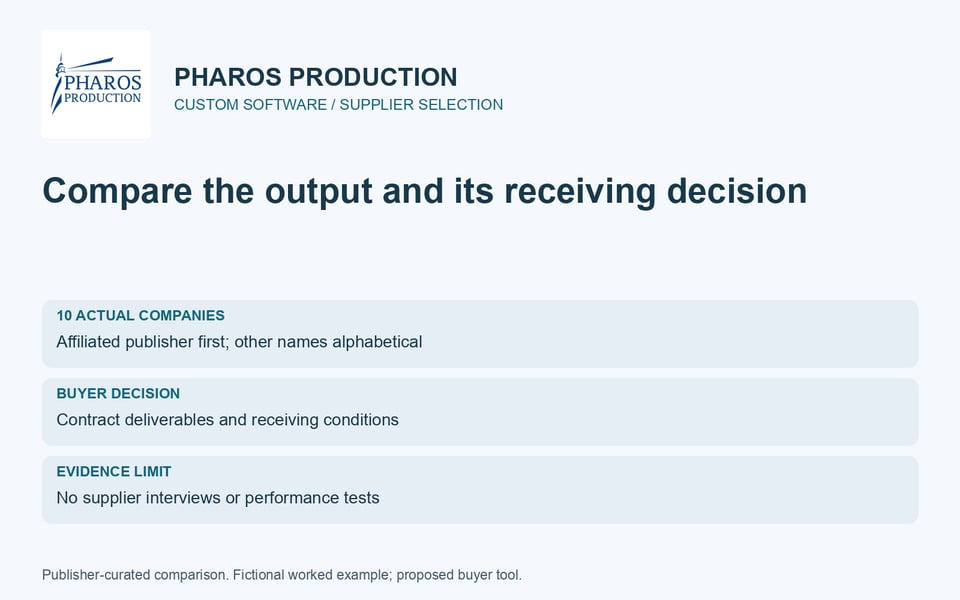
Publisher-curated ten-company comparison. Affiliated placement disclosed; no supplier performance test.
Compare the output a buyer will receive
A software proposal can promise discovery, implementation and handover while leaving the actual outputs unclear. Before comparing custom software development companies, identify what your organization expects to receive, who can review it and which evidence supports the next decision. A file arriving in a shared folder is an observable delivery event. Acceptance of the work requires a defined receiving question and an authorized answer.
This guide compares ten real software suppliers through an operational deliverable record. I am the founder and CTO of Pharos Production. Our company appears first by editorial placement; the remaining nine are alphabetical. This is an affiliated publisher's shortlist, not an independent performance ranking. Official service descriptions were reviewed on November 16, 2026. No supplier interview, customer reference evaluation or delivery exercise was conducted.
Use the record to prepare questions for a proposed engagement. It does not supply contract language or interpret legal rights. Commercial and legal terms still need the appropriate parties. The narrower task here is to make the proposed output, buyer dependency and review decision understandable before someone treats a broad activity label as a completed obligation.
The worked example, D-128, is fictional. A buyer is considering discovery for a customer returns portal. The proposed output is an implementation brief with a prototype and an export specification. The buyer has not supplied the approved returns rules. No named company submitted the illustrated proposals, and no prototype, export or review described below was executed.
Ten companies through equal deliverable questions
Each profile contains a documented offering, an output question and a receiving condition. Only the first field describes the linked supplier page. The questions are proposed diligence steps. They do not establish that a supplier will provide the requested artifact, accept the suggested responsibility or disclose another customer's work. Ask relevant candidates to answer against your own purchasing scope.
1. Pharos Production: custom software development
Documented offering. Pharos Production - custom software development describes architecture, development, quality assurance and production launch, with production support treated separately.
Output question. Which artifacts would the proposed engagement deliver for each phase, and which buyer inputs would those artifacts depend on? Request an output description that makes a launch decision distinct from a later operating responsibility.
Receiving condition. Name the person who can review each output and the question that person must answer. An implementation package can be delivered while its release decision remains open; the proposal should explain how that state would be recorded.
2. 10Pearls
Documented offering. 10Pearls lists product strategy, agile development and quality assurance among its services.
Output question. What would the buyer receive from the proposed strategy work, and how would an unapproved recommendation appear in that output? Request enough detail to distinguish a product direction from an authorized implementation baseline.
Receiving condition. Identify the buyer role that can accept the recommendation's scope. A presentation delivered to stakeholders should not imply that every represented business decision has been approved or that a later build has been commissioned.
3. Andersen
Documented offering. Andersen's custom software development page describes design, development, testing and maintenance.
Output question. Which design, implementation and review artifacts are included in the specific proposal? Ask how the output inventory would distinguish a proposed test from a recorded observation and how a missing buyer requirement would affect that inventory.
Receiving condition. Specify what the reviewer needs to inspect before accepting each output. A test report can document a bounded activity without establishing acceptance of requirements that the activity did not cover.
4. BairesDev
Documented offering. BairesDev's software development services include staff augmentation, dedicated teams and end-to-end outsourcing.
Output question. Is the proposed purchase engineering capacity, management of a team or responsibility for defined outputs? Ask for a description that fits the selected engagement model rather than applying the same delivery expectation to every arrangement.
Receiving condition. If the buyer manages the backlog or approvals, preserve that retained responsibility. An output comparison should show which result the supplier proposes to deliver and which decision remains with the organization purchasing the work.
5. Brainhub
Documented offering. Brainhub presents software engineering and team augmentation for building and modernizing software.
Output question. What artifact would explain an incumbent-system constraint that prevents the proposed implementation from proceeding? Ask whether the engagement includes documenting the constraint, resolving it or returning it to an existing system owner.
Receiving condition. The receiving owner should be able to distinguish a useful engineering finding from a completed system change. A documented restriction may satisfy a discovery output while leaving implementation authority and access unresolved.
6. Intellectsoft
Documented offering. Intellectsoft's custom software development page describes custom engineering and integration with existing business processes.
Output question. What would connect a proposed process change to its business owner and implementation scope? Request an example of the intended output format, with its illustrative or redacted status clear and any disclosure limits respected.
Receiving condition. Ask which operational decisions must be approved before the output can support implementation. A process diagram may explain a future workflow without establishing that the organization has authorized the responsibilities drawn on it.
7. Netguru
Documented offering. Netguru's services include discovery, software development, quality assurance and maintenance.
Output question. What decision would each proposed discovery artifact enable, and which implementation questions would remain outside it? The output inventory should make a completed learning activity visible without suggesting that every uncertainty has been removed.
Receiving condition. Name the role that can decide whether the discovery output is sufficient for the next commitment. Acceptance of the discovery work need not mean approval of the full product build or its continuing support model.
8. ScienceSoft
Documented offering. ScienceSoft's software development page describes development and integration through end-to-end and capacity-oriented arrangements.
Output question. Which deliverables depend on internal permissions, external services or buyer decisions? Ask how the proposed output record would preserve a missing prerequisite rather than bury it in a general assumptions paragraph.
Receiving condition. A reviewer should be able to identify the responsible party for the next action. A completed supplier task cannot demonstrate that a separate buyer-controlled approval has occurred when no approval record exists.
9. Simform
Documented offering. Simform's custom software development page describes web and mobile development, requirements, architecture and quality testing.
Output question. What would the receiving reviewer obtain after an agreed check: a test proposal, an observation record or a decision recommendation? Request the artifact reference and the limits of the conclusion that the output could support.
Receiving condition. Keep a missing observation distinguishable from a failed observation. They may require different next actions, and neither should be silently converted into a passed delivery condition merely to complete the proposal's checklist.
10. thoughtbot
Documented offering. thoughtbot's services include product strategy, design, development, team augmentation and operating infrastructure work.
Output question. What knowledge and operating information would the buyer receive at the end of the proposed engagement? Ask which artifacts remain usable by the receiving team and which continuing responsibilities require their own agreement.
Receiving condition. A repository or document transfer does not by itself establish that the receiving organization can operate the system. Identify the operational review the buyer intends to perform and the evidence needed to support that narrower conclusion.
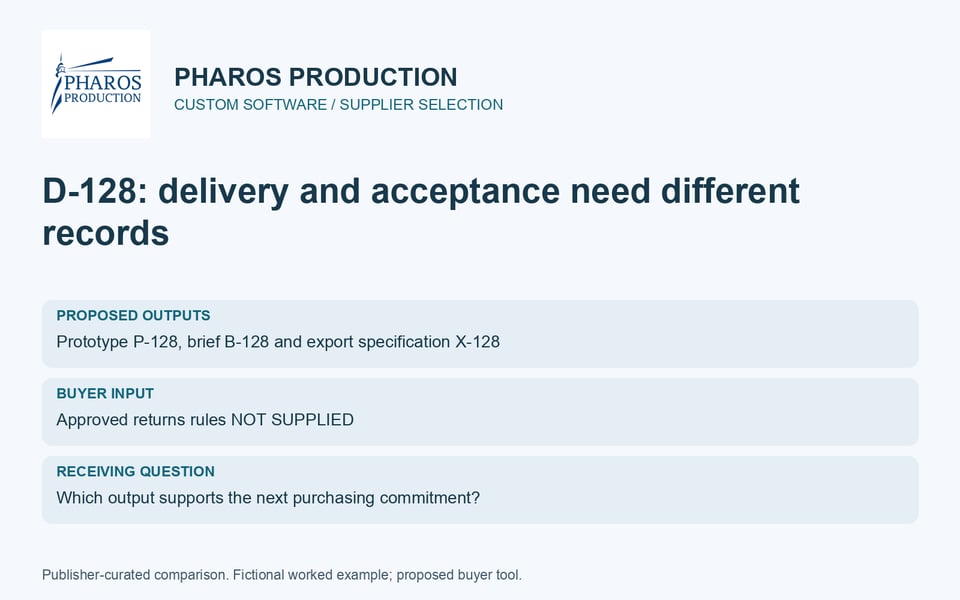
Fictional D-128: returns rules not supplied; no output or receiving review executed.
Build an output record for the fictional D-128 purchase
D-128 concerns discovery for a returns portal. The fictional buyer wants to understand the first release before authorizing implementation. The proposed discovery package includes a prototype, an implementation brief and a specification for exporting return records. The approved business rules are a buyer input. They have not been supplied in this example, so the package cannot claim to reflect an accepted returns policy.
Write an entry for each output instead of one line saying discovery complete. The receiver may need different evidence for the prototype and the export specification. The prototype could support a discussion of navigation under stated assumptions. The export specification could identify fields and unresolved definitions. Neither would establish that a production system implements the organization's approved returns process.
| Output | Proposed contents | Buyer dependency | Receiving question |
|---|---|---|---|
| Prototype P-128 | Illustrative returns interaction | Approved returns rules unavailable | Which behaviors remain assumptions? |
| Brief B-128 | First-release scope and unresolved decisions | Product owner decision required | What can be commissioned next? |
| Export specification X-128 | Proposed fields and meanings | Reporting owner definitions pending | Which values are not yet agreed? |
All three rows are proposed records, not delivered artifacts. The labels help show how one engagement can have several receiving questions. Do not replace the unresolved cells with a positive status merely because the other columns are filled. The buyer should know which output is sufficiently defined for discussion and which still requires an authoritative input.
A practical entry also needs an artifact reference, revision, proposed delivery form and review owner. These fields make the receiving conversation possible. They do not determine legal acceptance, payment or ownership of intellectual property. If those matters affect the purchase, have the appropriate parties address them explicitly rather than infer them from this operational worksheet.
Distinguish completion of an activity from its receiving decision
A supplier may describe the activity it proposes to perform and the output that activity produces. Compare both, but keep them separate. Running a workshop is an activity. A recorded scope decision is an output. The buyer still needs to know whether the decision is approved, proposed or waiting for an input that the workshop could not supply.
The 2020 Scrum Guide states, "The moment a Product Backlog item meets the Definition of Done, an Increment is born." The statement concerns Scrum's definition of an Increment. It is useful here because it makes the governing completion definition explicit. It does not prescribe the legal meaning of acceptance in your supplier agreement or endorse any company in this shortlist.
For the proposed purchase, ask what definition governs each completion claim. A team might complete a prototype according to its agreed demonstration scope while a business owner has not approved the represented rules. Both facts can be recorded without treating the demonstration as defective or the business decision as already made. The missing relationship is what the buyer must resolve.
Do not ask for a universally complete artifact with no known limits. A useful brief may intentionally retain unresolved questions. What matters is whether that retention fits the purpose of the commissioned work. If the buyer wanted discovery, documenting a material uncertainty can be a useful output. If the buyer expected implementation, the same uncertainty may prevent a stronger completion claim.
Compare invented proposals without awarding fictional supplier scores
Consider invented proposal A for D-128. It offers the prototype and brief, lists the unavailable business rules and asks the product owner to review the assumptions before an implementation estimate is finalized. This is a hypothetical proposal used to demonstrate the comparison. It is not a response received from any named supplier.
Invented proposal B offers a broader package described as ready for implementation. Its illustration contains no stated receiver for the returns rules and no explanation of how those rules will be confirmed. The buyer should request clarification. The scenario does not establish that B would fail to deliver, or that A represents a more capable company. It establishes that the supplied descriptions support different purchasing conclusions.
The next question for A is whether the bounded discovery outputs meet the buyer's immediate need. The next question for B is what its readiness claim depends on and who supplies the missing decision. A comparison that assigns both proposals the same complete status would hide this difference. A comparison that labels B a proven failure would invent a result that the example never observed.
Preserve the original descriptions when requesting clarification. If B later adds a receiving owner and limits its readiness claim, record the revised proposal and why the buyer's interpretation changed. Do not edit the earlier comparison so it appears that the original response contained information that arrived only afterward. The decision history should remain recoverable by a new reviewer.
Make buyer dependencies visible before comparing delivery dates
An output may depend on information the buyer supplies. Name the input, its owner and the decision affected by its absence. A generic dependency on timely feedback is difficult to review because it leaves the receiving task unspecified. For D-128, the approved returns rules are a concrete missing input; the product owner's review cannot be replaced with an engineering assumption presented as policy.
Ask what useful output remains possible while that input is unavailable. The supplier might propose an assumptions brief, a constrained prototype or a question list for the responsible owner. Those are potential scope choices, not substitutes automatically accepted by the buyer. Compare their decision value and agree the intended next step before treating the missing input as harmless.
Dates should be read with those conditions attached. A proposed date for an assumptions-based prototype does not establish a date for implementing an approved business process. Avoid translating the earliest visible date into a comparison of supplier speed when the proposed outputs differ. The public service pages provide no verified schedule or current capacity for the engagement under consideration.
If a dependency is resolved, record the actual input and review its effect on the proposed outputs. The resolution may confirm the assumptions, change the design or remove part of the intended release. Retain the earlier record so the buyer can explain why the scope or estimate changed. Do not describe any of these hypothetical paths as an observed delivery outcome.
Keep exclusions beside the output they qualify
An exclusion can be decisive even when the headline scope appears broad. Ask where production deployment, continuing support, third-party approval or receiving-team preparation sits in the proposal. These questions identify purchasing boundaries. They do not presume that every engagement should include every activity, or that a supplier's public list of services makes them part of your specific purchase.
Place the relevant exclusion beside the affected output. If X-128 describes an export but excludes implementation, the receiver should not need to find that distinction in a distant appendix. If the brief excludes operational support, accepting the brief should not silently create a support responsibility. The output record should carry the limit into the decision that uses it.
A supplier may offer an additional service for an excluded activity. Treat that as a separate scope conversation with its own outputs and receiver. Do not infer a price, entitlement or commitment from the fact that the company advertises the service. The comparison remains incomplete until the proposed engagement, rather than the marketing page alone, answers the buyer's question.
Revise the comparison when an output changes
A revised output needs a revised receiving question when its purpose changes. Suppose the D-128 buyer later asks X-128 to describe a different reporting view. The earlier field proposal remains part of the history, but it cannot automatically support acceptance of the new request. Identify the changed meaning and the review evidence required for that new scope.
Keep the artifact revision and the buyer decision linked. A filename containing final is a label, not proof of which requirement was accepted. The reviewer needs the actual revision it inspected and the condition it used. If the artifact is replaced after review, preserve the earlier reference and state whether the receiving decision still applies or needs to be reopened.
A change may also affect another output. Updating the export definition could alter the prototype's labels or the implementation brief's assumptions. Ask the proposing team to explain that relationship. The buyer can then decide whether it needs clarification, revised discovery work or a separately scoped implementation proposal. None of those choices should be hidden inside an unexplained status change.
Prepare a review packet that another receiver can use
The receiving owner may not attend the supplier's demonstration. Prepare the comparison so that owner can understand the proposed output from the retained material. Include the output reference, the question being decided and the assumptions that still affect it. A meeting summary stating that everyone was happy does not identify which condition was actually reviewed or which responsibilities were left open.
For D-128, a review packet could contain the proposed brief revision and the product owner's unresolved returns-policy question. That is an illustrative packet design, not a claim that a review occurred. It allows the receiver to distinguish a request for business input from a request to approve implementation. Without that distinction, a reviewer might answer a narrower question while the delivery record appears to authorize a broader commitment.
Ask how a disagreement will be returned to the proposing team. A useful response identifies the affected output and the specific question that remains unanswered. It does not need to reproduce the entire comparison or make a judgment about the supplier's general competence. A narrow return gives the supplier something assessable to clarify and leaves the buyer's original evidence intact.
Do not remove an unresolved field merely because it prevents a neat comparison. If one candidate supplies a permitted example and another needs more information, preserve those different return states. The buyer can choose whether to investigate further or narrow the purchase. Neither the amount of material nor its presentation quality should substitute for the defined receiving decision.
Once a decision is recorded, state what would reopen it. A changed output, missing source artifact or revised buyer requirement may make the previous conclusion insufficient for the next purchase. Recording that trigger keeps the comparison useful beyond the initial meeting and prevents an old approval label from becoming a general endorsement of work the receiver never inspected.
Choose the next commitment from the receiving question
Use the ten-company shortlist to find candidates whose published offerings justify a conversation. Use the output record to make that conversation comparable. The record should show what is proposed, what the buyer must supply, which limits remain and who can decide that the result supports the next commitment. It should not manufacture certainty from an attractive presentation.
For a new purchase, begin with one important output and its receiver. Ask what evidence would make the output useful and what would keep the decision open. Extend the comparison only when another output changes the purchasing choice. A smaller set of explicit receiving questions is more useful than a long inventory whose entries all claim completion without defining what the buyer can actually accept.
More insights to read
- How to Choose Custom Software Development Companies: Requirements-to-Evidence Register
- How to Choose Custom Software Development Companies: Founder Commissioning Worksheet
- Top 10 Custom Software Development Companies: Handover and Acceptance
- Best 10 Custom Software Development Companies: A Source-Checked Shortlist
- Best 10 Custom Software Development Companies: Supplier Evidence Request Template
About the author

Dmytro Nasyrov. Photo supplied by the author.
Written by Dmytro Nasyrov PhD, software architect with 24 years of production experience. Dmytro is the founder and CTO of Pharos Production. He works on production software architecture for FinTech, AI, Web3 and blockchain systems.


