
What Is Themida? Who Uses It, and Why Antivirus Flags It
Themida explained: what the Oreans protector does, who uses it, why antivirus flags it, how MITRE labels it, and what its virtual machines mean for analysis.
Themida is a commercial software protector from Oreans Technologies that makes Windows programs hard to analyze, debug and modify. Developers use it to shield license checks and proprietary code. Malware authors use it to hide what their payloads do, and that is why antivirus tools often flag Themida-protected files. On 13 November 2026, 9 of the 105 procedure examples on MITRE ATT&CK's Software Packing page named Themida, and only UPX, a free packer, was named more often. This post explains what Themida does, who uses it, why it gets flagged, and what its virtual machines mean for anyone analyzing a protected file.
Got a Themida file you're authorized to analyze? Devirt accepts Themida and Code Virtualizer files, supports all seven Themida virtual machine profiles, and reports every function in scope as proven, runtime-dependent, unresolved or permanently bounded. Limited Themida recovery, up to five named functions delivered as an IDA database with proof JSON, is included in $199 General Analysis, and uploads start with a free assessment. See how Themida devirtualization works.
What is Themida?
Themida is a protection system for Windows software, sold by Oreans Technologies for 32-bit and 64-bit programs and DLLs. The Themida help file describes it as a system for developers who want to protect their applications against advanced reverse engineering and software cracking. Its engine is called SecureEngine.
Themida is a protector, which is a different job from a plain packer. A packer such as UPX compresses a program and restores it at startup. Themida also compresses and encrypts the program, but then adds anti-debugging checks, hides the Windows APIs the program calls, checks itself for patches, and can run chosen pieces of code inside its own virtual machines.
Who uses Themida, and what does it cost?
Themida is used by software developers who sell Windows programs and want to slow down cracking, piracy and reverse engineering. The help file lists three jobs for SecureEngine: protecting an application against modification and piracy, against reverse engineering, and against tools that monitor its file and registry activity.
As listed on the Themida product page in November 2026, Oreans sells two licenses: a Developer License at 249 EUR for solo developers and a Company License at 499 EUR for teams. Oreans also sells WinLicense, which adds licensing features, and Code Virtualizer, a standalone virtualizer that also covers Linux and macOS.
How does Themida protect a program?
Themida protects a program at two levels: the whole file, and selected blocks of code inside it.
- File level: Themida encrypts and compresses the program and its resources, and puts a protection loader in front of it. The loader checks for debuggers and monitoring tools, decrypts the program in memory and hands over control.
- Code level: the developer marks functions to protect, with macros in the source code or by picking them from a MAP file. Themida then either mutates them (rewriting x86 instructions into equivalent but more complex ones) or virtualizes them.
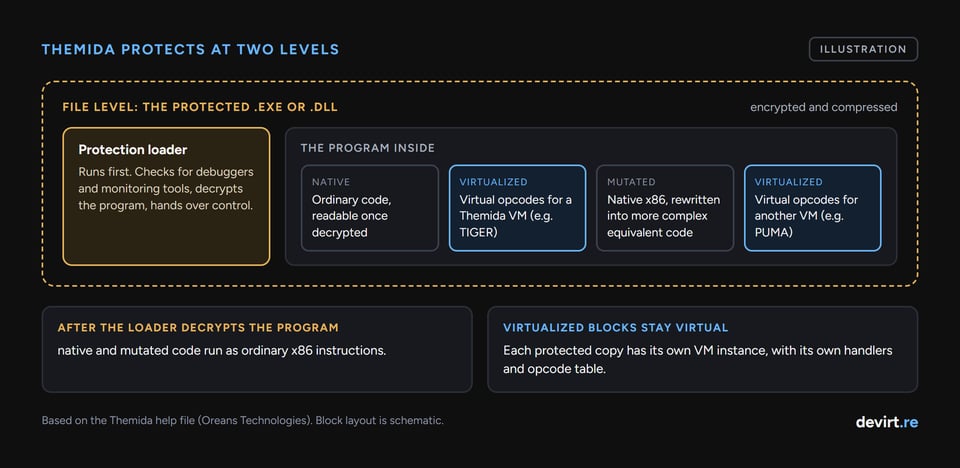
Virtualization is the option that matters to an analyst. When the program reaches a virtualized block, SecureEngine emulates the original code with virtual opcodes that only its own virtual machine understands. A disassembler finds that machine and its opcodes, not the instructions the developer compiled.
What are Themida's virtual machines?
Themida's virtual machines are processors designed by the protector, built into each protected file to run code that Themida has translated into virtual opcodes. Oreans names the architectures after animals. Its help file mentions FISH, TIGER, LION, PUMA and SHARK, and Devirt's Themida devirtualization page lists seven profiles in all, adding DOLPHIN and EAGLE.
Three facts from Oreans' documentation matter most:
- The architectures are separate designs. Oreans compares the gap between TIGER and LION to the gap between an Intel x86 processor and an ARM processor.
- Every protected copy is unique. Protect the same program twice with TIGER and each copy gets its own TIGER machine, with different registers, instruction handlers and opcode table. Only the architecture's internal skeleton is shared.
- Heavier means slower. Oreans suggests a lighter machine such as FISH or TIGER for code that has to run fast, and a heavier one such as PUMA or SHARK for the most sensitive code.
So one opcode table won't read every Themida file. Each architecture has to be understood once, and each protected copy still has its own variation.
Is Themida malware?
Themida is not malware. It is a commercial protector that developers license from Oreans to protect their own programs. Malware authors use it too, though, for the same reason developers do: it slows analysis. That overlap is why some antivirus engines flag Themida-protected files no matter who made them.
Oreans admits as much. Its help file says the company has been "fighting with false positives" since the protection began, and explains why: malware writers use software protectors to make their code "invisible" to antivirus, so antivirus companies are stricter with packed files. For developers, Oreans calls a digital signature on the protected program the best defense, because most widely used antivirus products trust signed files.
Why do antivirus tools flag Themida files?
Antivirus tools flag Themida files because the protection hides the code a scanner would normally inspect, and because Themida keeps turning up in malware. The detection names show it. Each vendor name we could trace to a public source (checked 13 November 2026) labels the packing, not the behavior:
- Malwarebytes: Trojan.MalPack.Themida, its generic detection name for trojans that use the Themida packer.
- ESET: Win32/Packed.Themida, which a 2018 explainer on detection names uses as its example of a name that targets a packer rather than a malware family.
- F-Secure: Packed.Win32.Black.a, which identifies files packed with a stolen version of Themida.
These are examples, not a survey. It's a blunt way to name things, and it catches honest software along with the trojans. But it makes one useful point: a Themida detection tells you a file is protected. It doesn't tell you what the protected code does. If your own signed software is flagged, the detection is about the protector, and the antivirus vendor's false-positive process is the place to raise it.
How do public sources label Themida?
Public threat-intelligence sources label Themida as a packing tool used in real intrusions. To put a number on that, we counted MITRE ATT&CK's own entries. On 13 November 2026, a short script parsed the Procedure Examples table on the T1027.002 Software Packing page (last modified 11 September 2026) and matched each entry against ten packer and protector names.
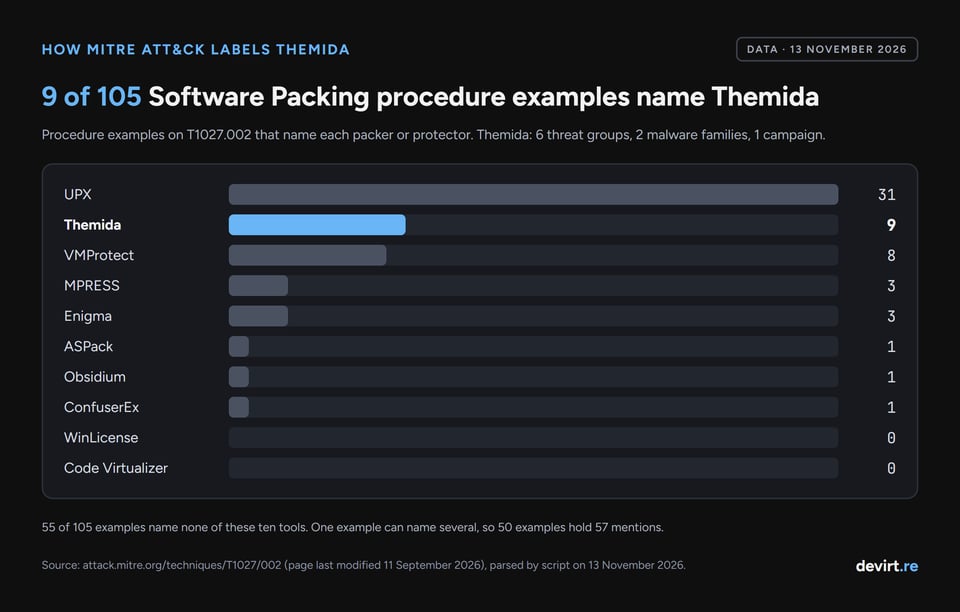
| Name | Procedure examples naming it (of 105) |
|---|---|
| UPX | 31 |
| Themida | 9 |
| VMProtect | 8 |
| MPRESS | 3 |
| Enigma | 3 |
| ASPack, Obsidium, ConfuserEx | 1 each |
| WinLicense, Code Virtualizer | 0 |
The nine Themida entries are six threat groups (Aoqin Dragon, APT38, APT41, MoustachedBouncer, Storm-0501 and The Gentlemen), two malware families (Melcoz and Mongall) and one campaign, Lazarus Group's Operation Dream Job.
The method has limits, so read the table with them in mind. The name list is ours, and 55 of the 105 entries name none of the ten tools; they say only that a sample was packed, or describe a rarer or custom method. One entry can name several tools, so the 50 entries that name one hold 57 mentions. MITRE also edits these pages, so the count is a dated snapshot. A count of nine says Themida is a recognized tool in tracked attacks. It says nothing about how many Themida-protected programs are harmless.
What do Themida's virtual machines mean for analysis?
For an analyst, Themida's virtual machines mean that getting past the outer layer is only half the job. Once the program has decrypted itself in memory, ordinary code is readable again. Virtualized functions are not. They stay as virtual opcodes, because Themida's virtual machine emulates them each time they run. In a disassembler, such a function looks like a dispatcher loop feeding a set of handler routines, not like the function itself.
That is the difference behind unpacking vs devirtualization: unpacking removes the file-level wrapper, while devirtualization translates the bytecode back into readable logic. VMProtect works the same way at this level, as our earlier post What Is VMProtect? explains.
A Themida label on a malware sample doesn't prove that any of its functions are virtualized, either. In an ANY.RUN study published on 18 June 2024, none of the VMProtect- and Themida-protected samples from five malware families used code virtualization; the protectors were used much like basic packers. Devirt's Themida research page goes deeper into the architectures and how Themida relates to Code Virtualizer.
Where virtualization is present, recovery is honest only when it's reported function by function. Names, comments and source structure were gone at compile time, before Themida ever touched the file, so no tool brings back the original source. Devirt's Themida results fix the list of protected functions first and mark each one proven, runtime-dependent, unresolved or permanently bounded, and Devirt only accepts files you own or are authorized to analyze.
Written by Devirt, an automated devirtualization service for authorized analysis of protected software.


