
What Is Ghidra? Is It Safe, Free and Hard to Learn?
What Ghidra is, who maintains it, whether it is safe to install, what it runs on, what it can and can't decompile, and where it stops on protected code.
Ghidra is a free, open-source software reverse engineering framework created and maintained by the US National Security Agency's Research Directorate. It reads programs that have already been compiled and rebuilds them as assembly listings and C-like pseudocode. Its existence leaked in WikiLeaks' Vault 7 documents in March 2017, and the NSA released it to the public in March 2019. By 13 November 2026, users had opened 6,355 issues on its GitHub repository and the project had published 64 security advisories. This guide answers the questions people ask before they install it: where Ghidra came from, whether it's safe, what it runs on, what it can and can't decompile, how long it takes to learn, and where it stops.
Driving Ghidra with an AI agent and hit a protected function? A local reversing agent can trace a binary through Ghidra and connect the evidence, but it can't make a virtualized function's interpreter loop readable by asking for a better summary. You hand Devirt only that blocked scope: it assesses the authorized file, confirms what is feasible, and returns the agreed IDA database, pseudocode or structured evidence with a coverage ledger. See how agent-assisted reverse engineering works with Devirt.
Ghidra at a glance
Ghidra's basic facts fit in one table. The rest of this post explains each row.
| Question | Short answer |
|---|---|
| What it does | Disassembles, decompiles, debugs and scripts the analysis of compiled programs, in one desktop application |
| Who makes it | The NSA Research Directorate, with outside contributors on GitHub |
| Public since | 5 March 2019 (RSA Conference); source code on GitHub in April 2019 |
| Price and license | Free, under the Apache License 2.0 |
| Runs on | Windows, Linux and macOS, with a 64-bit Java Development Kit (JDK) |
| Written in | Mostly Java; the decompiler is C++ |
| Scripting | Java and Python |
| Official home | The NSA's GitHub repository (ghidra-sre.org redirects there) |
| GitHub stars | 99,872 on 13 November 2026 |
If you'd rather see what's inside the program first, our Medium post takes a tour of Ghidra's CodeBrowser windows and its SLEIGH processor language. This post is about the decisions around it: trust, platforms, scope and effort.
Where did Ghidra come from?
Ghidra was a government-only tool inside the NSA for years before anyone outside could download it. The first public sign of it was a CIA wiki page in WikiLeaks' Vault 7 release of March 2017. The page called Ghidra "a GOTS reverse engineering tool developed @NSA", GOTS meaning government off-the-shelf, and gave install notes for the internal build.
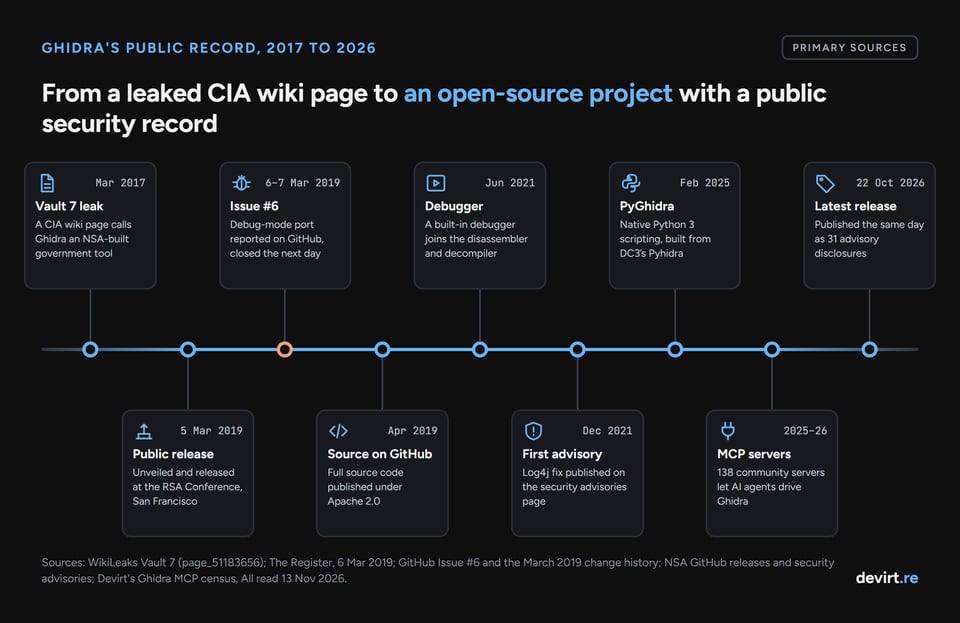
Two years later, the NSA released Ghidra on purpose. Rob Joyce, then cybersecurity adviser to the NSA's director, presented it at the RSA Conference in San Francisco on 5 March 2019, and the program was released for download at the conference. The GitHub repository had been created on 1 March, and the full source code followed there in April 2019. Wikipedia's version history dates the first proof of concept to 2003, so the public release came after more than fifteen years of internal development.
The milestones since then are mostly additions:
- June 2021: the release notes "officially introduce" a built-in Debugger.
- February 2025: PyGhidra arrives. Originally built by the Department of Defense Cyber Crime Center (DC3) as Pyhidra, it gives Ghidra a native Python 3 interpreter.
- 2025 onward: community Model Context Protocol (MCP) servers multiply, letting AI agents drive Ghidra. 137 of the 138 counted in November 2026 were created in 2025 or 2026.
- October 2026: the latest stable release, published on 22 October 2026, which now enforces TLS for Ghidra Server connections.
Who maintains Ghidra, and is it still active?
Ghidra is maintained by the NSA Research Directorate, which still cuts the releases and reviews outside contributions on GitHub. The repository's README says Ghidra is "created and maintained by the National Security Agency Research Directorate," and GitHub listed 419 contributors to it on 13 November 2026. The yearly counts show how busy it is.
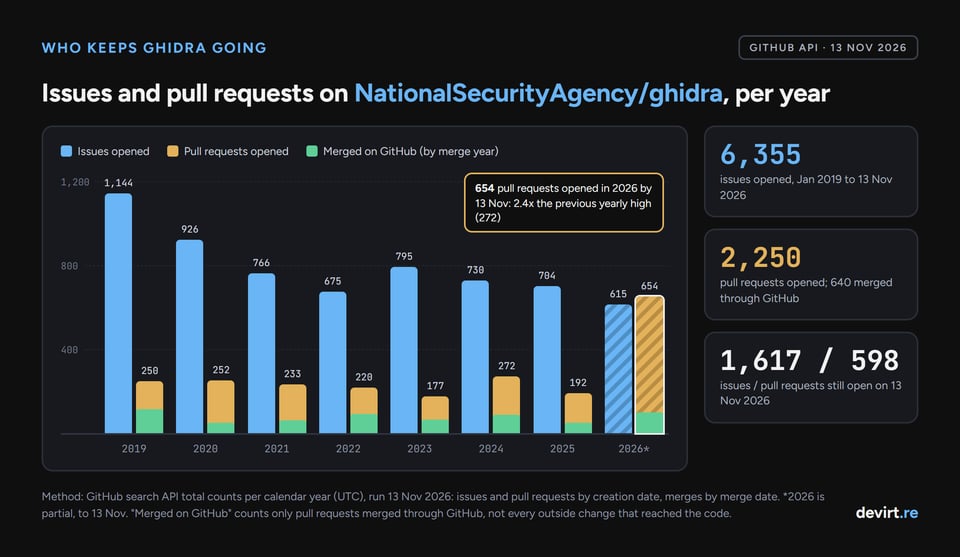
| Year | Issues opened | Pull requests opened | Pull requests merged on GitHub |
|---|---|---|---|
| 2019 | 1,144 | 250 | 117 |
| 2020 | 926 | 252 | 53 |
| 2021 | 766 | 233 | 62 |
| 2022 | 675 | 220 | 94 |
| 2023 | 795 | 177 | 68 |
| 2024 | 730 | 272 | 91 |
| 2025 | 704 | 192 | 53 |
| 2026 (to 13 Nov) | 615 | 654 | 102 |
| Total | 6,355 | 2,250 | 640 |
Issue traffic peaked in 2019, the launch year, and has run between 675 and 926 a year since. Pull requests did something different in 2026: 654 were opened by mid-November, more than double any earlier full year. On 13 November, 1,617 issues and 598 pull requests were still open.
Method: a script we wrote queried the GitHub search API for NationalSecurityAgency/ghidra on 13 November 2026 and recorded the total count for each calendar year in UTC: issues and pull requests by creation date, merges by merge date. "Merged on GitHub" counts only pull requests merged through GitHub, so it isn't a count of every outside change that reached the code.
Is Ghidra safe, given that the NSA built it?
Ghidra is as safe as any widely audited open-source tool, which means its source code is public and its security bugs are reported, fixed and disclosed in the open. The worry people bring is a backdoor. Rob Joyce answered it at the launch, and The Register reported his words: "There is no backdoor in Ghidra." A promise isn't proof, but the code is: every line is readable on GitHub, across 19,079 commits on the default branch as of 13 November 2026.
The record also shows what a real Ghidra security bug looked like, and how fast it was handled:
- 5 March 2019: the NSA releases Ghidra at RSA.
- 6 March 2019: GitHub Issue #6, "RCE Through JDWP Debug Port," is opened. When Ghidra was started in its optional debug mode, it opened a Java debugging port, 18001, on every network interface instead of only on the local machine, so another computer on the network could run code through it. The Register credited the find to Matthew Hickey, co-founder of Hacker House, who called it an error in the debug-mode setting.
- 7 March 2019: a Ghidra maintainer closes the issue, saying the next release would listen on 127.0.0.1, the local machine only, by default.
- March 2019: the first point release ships. Its change history says debug mode "no longer opens remotely accessible ports by default. (Issue #6)"
Debug mode was never the default, and normal launches didn't open that port. The episode is still the best answer to the trust question: an outside researcher found a weak default within a day of the release, and the fix shipped that same month, all of it in public.
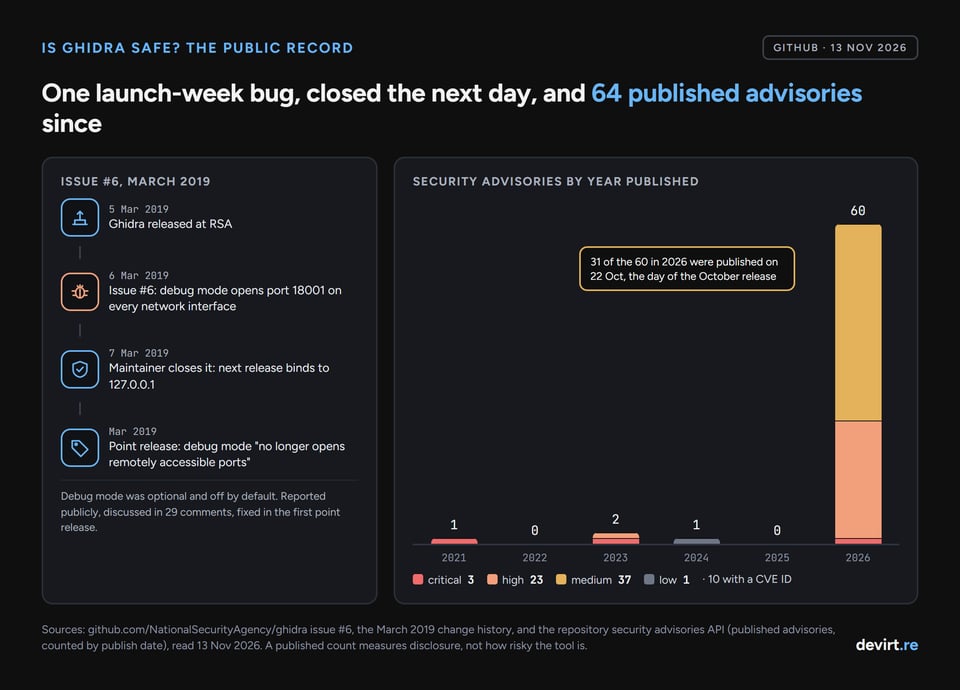
Since then, Ghidra's disclosures have gone through its security advisories page, and the README itself carries a security warning, placed above the install steps, that points there. On 13 November 2026, that page held 64 published advisories:
| Year published | Advisories | Notable entries |
|---|---|---|
| 2021 | 1 | The Log4j remote code injection (critical) |
| 2023 | 2 | Command injection in the Linux/macOS launch script (critical); an untrusted search path in Jython |
| 2024 | 1 | A use-after-free in the SLEIGH backend (low) |
| 2026 | 60 | 31 published on 22 October, the day of the October release; many involve crafted files, archives, themes or extensions that Ghidra opens, and others cover Ghidra Server, BSim and the decompiler |
Across all 64, 3 are rated critical, 23 high, 37 medium and 1 low, and 10 carry a CVE ID. The 2026 jump is a jump in published advisories, many of them released together with a new version. It doesn't mean the tool suddenly got worse. It does tell you where the risk sits: the files you open.
In practice, that means four habits:
- Download Ghidra only from the NSA's GitHub releases, and check the SHA-256 hash printed in each release's notes.
- Keep it updated, because fixes ship with new releases.
- Open untrusted samples in an isolated virtual machine, and install extensions and themes only from sources you trust, since many advisories involve files Ghidra opens.
- Keep Ghidra Server, BSim and debugger services off the network unless you need them.
Is Ghidra free for commercial work?
Ghidra costs nothing for personal, academic or commercial work, because the NSA publishes it under the Apache License 2.0. The Apache license lets a company use Ghidra, change it and ship the changes, provided it keeps the license and copyright notices. Since the March 2019 release there has only ever been one edition, so the free download is the whole product: decompiler, debugger, every processor module and Ghidra Server included.
Apache 2.0 doesn't grant rights to anyone's trademarks, and it doesn't make the analysis legal. Whether you can reverse engineer a given program depends on your jurisdiction, the program's license and your purpose, not on Ghidra's license.
What does Ghidra run on, and what is it written in?
Ghidra runs on Windows, Linux and macOS, on top of a 64-bit Java Development Kit, and its guide marks 32-bit systems as deprecated. The Getting Started guide shipped with the October 2026 release lists 4 GB of RAM and 1 GB of disk space as the minimum, says dual monitors are "strongly suggested," and asks for Python 3 if you want the debugger or PyGhidra. Each release includes the native decompiler for at least one platform, and the guide explains how to build it for others.
Ghidra is written mostly in Java, with its decompiler engine in C++. On 13 November 2026, GitHub's language breakdown for the repository put Java at 86.1% of the code, C++ at 6.0% and Python at 1.4%, and most of the rest is HTML. That split explains the setup: Java is why Ghidra needs a JDK and runs the same code on every operating system, and C++ is why the decompiler can also be built and run on its own.
For your own code, Ghidra takes scripts and extensions in Java or Python. Python used to mean Jython, a Python 2 implementation on the JVM. Since PyGhidra arrived in February 2025, scripts can run in a real Python 3 interpreter with the usual libraries.
What can Ghidra decompile, and what can't it?
Ghidra can decompile native machine code for any processor it has a SLEIGH description for, plus Java and Android bytecode. Its October 2026 source tree described 61 named processors, from x86 and ARM down to 8-bit microcontrollers. What it produces is always a reconstruction. Function names, variable names, comments and types are gone from a normal release build, so Ghidra invents placeholders unless debug symbols survive.
| What you open | Can Ghidra decompile it? | Note |
|---|---|---|
| Native Windows, Linux or macOS programs (x86, x86-64, ARM, AArch64) | Yes | The core use case |
| Firmware for embedded chips (MIPS, PowerPC, RISC-V, 8051, Z80, PIC and others) | Yes, if a processor module exists | You pick the processor when you import a raw image |
| Android apps (Dalvik bytecode) | Yes, as C-like pseudocode | A dedicated Dex-to-Java tool such as JADX gives Java-style output |
| Java class files (JVM bytecode) | Yes, as C-like pseudocode | A Java decompiler gives Java source |
| .NET assemblies (CIL bytecode) | No | Ghidra has no CIL processor module; .NET decompilers such as ILSpy handle these |
| WebAssembly | Not built in | A community extension adds disassembly and decompilation |
| Packed programs | Mostly the unpacking stub | The real code only appears in memory when the program runs |
| VM-protected functions | The interpreter, not the function | See the last section |
The processor count comes from our script's 13 November 2026 read of the processor tree in Ghidra's source at the October 2026 release. The other rows come from the same processor list and the named projects' own descriptions.
What do people use Ghidra for?
People use Ghidra to read software when they don't have its source code. The NSA's README says the agency applied Ghidra to "analyzing malicious code," and that is still a core use: working out what a malware sample does without running it. Vulnerability researchers use Ghidra to find bugs in closed-source programs. Firmware engineers use it on router, controller and IoT images, where the long processor list matters, and the coreboot firmware project started using it in June 2019. It's also standard kit in university courses and CTF competitions, because every student can have the same decompiler at no cost.
Ghidra is dual-use: attackers study software with it too. That's why the legal question in the license section matters before you open a file you didn't write.
How long does Ghidra take to learn?
Ghidra takes a few sessions to navigate and months to use well, because the slow part is reverse engineering itself (reading assembly, spotting compiler patterns, rebuilding data structures), not the menus. On day one, a newcomer can import a binary, let the auto-analysis run and read a function in the Decompiler. Over the first weeks, the work becomes renaming variables, defining structures and following cross-references until a function makes sense. Recognizing calling conventions, optimized loops and C++ object layouts at a glance takes sustained practice on real files.
Ghidra ships its own course material. The documentation folder includes GhidraClass course material at beginner, intermediate and advanced levels, plus exercise files and a debugger course. For a guided first session, our Substack guide on how to use Ghidra goes from creating a project to tracing your first function.
What can you add to Ghidra? Scripts, extensions, Ghidra Server and MCP
Ghidra is built to be extended, and most of its power beyond the Decompiler comes from additions:
- Scripts: run from the Script Manager in Java or Python, to automate renaming, searching or reporting.
- Extensions: add new processors, file loaders, analyzers and views.
- Ghidra Server: gives a team a shared repository. Each analyst works on a local copy and checks changes in, which is the "teaming" problem the NSA's README says Ghidra was built to solve.
- Headless analyzer: processes whole folders of files from the command line, with no window open.
- BSim: finds functions that behave alike across programs.
- MCP servers: let an AI agent call Ghidra functions such as decompile, rename and search over the Model Context Protocol.
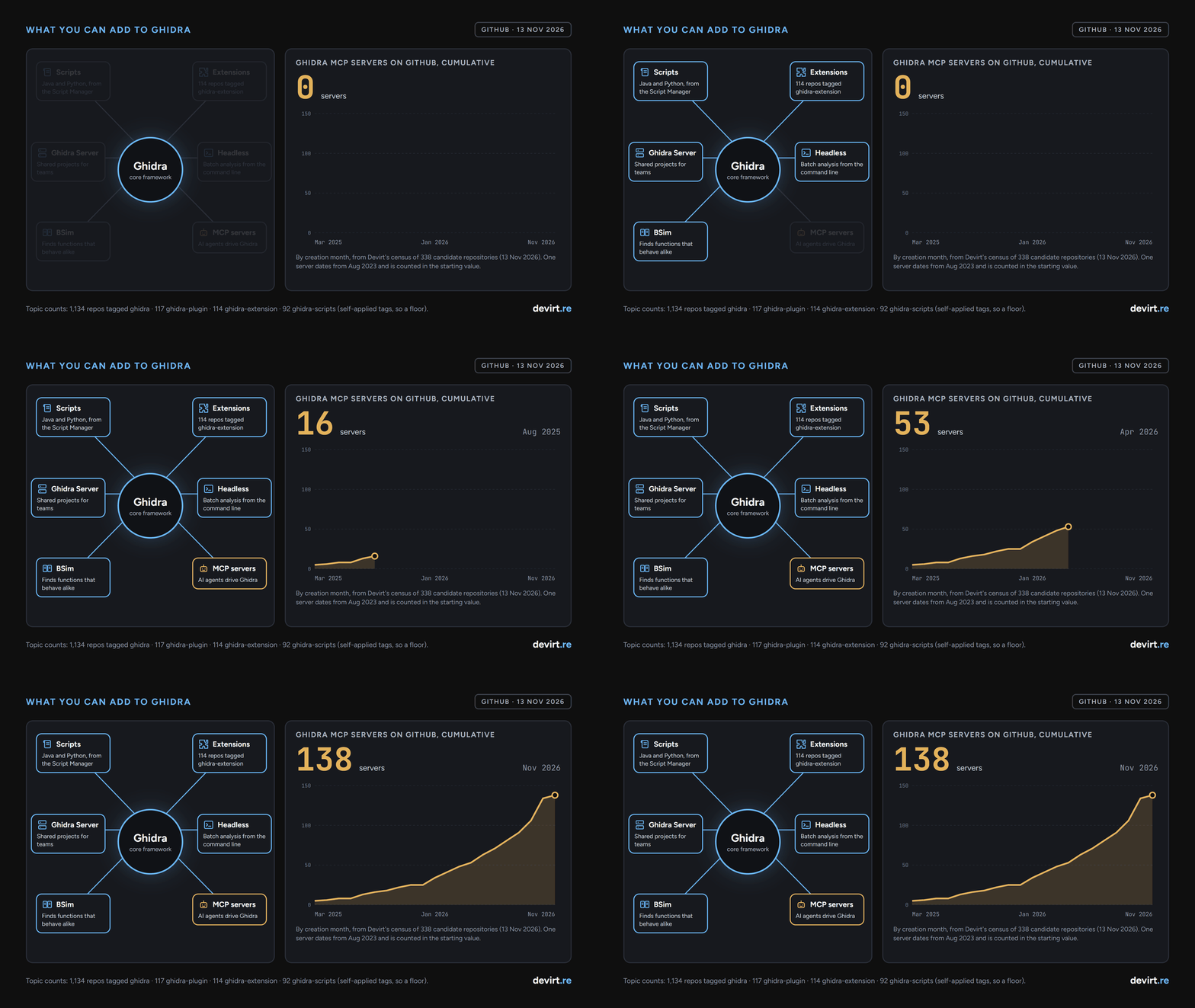
The ecosystem is large and young. On 13 November 2026, GitHub listed 1,134 public repositories tagged ghidra, 117 tagged ghidra-plugin, 114 tagged ghidra-extension and 92 tagged ghidra-scripts. The MCP part grew fastest. A hand-checked census that day counted 138 Ghidra MCP servers on GitHub, 137 of them created since 2025 and 28 in October 2026 alone. Attention is concentrated: one project holds 51% of all their stars, and 71 have none.
Method: topic counts are GitHub repository-search totals for each topic on 13 November 2026, from the same activity script. The MCP figures come from Devirt's census of 338 candidate repositories, also run on 13 November 2026. Topic tags are self-applied, so the counts are a floor, not a full inventory.
Should you choose Ghidra or IDA Pro?
Ghidra is the better first choice for most beginners, because it costs nothing and includes a decompiler for every processor it supports. IDA Pro, from Hex-Rays, is the commercial standard many professional teams already use, with a long-established plugin ecosystem and its own decompilers. Plenty of analysts keep both, using Ghidra for its price and processor range and IDA for its plugins and the databases their colleagues share.
If budget is what's deciding it, the DEV roundup of each major IDA Pro alternative lays out prices and decompiler coverage side by side. A decompiler is also only one tool in the kit. Devirt's map of reverse engineering tools covers the debuggers, file identifiers and hex editors that sit beside it.
Where does Ghidra stop on protected code?
Ghidra stops being able to show a function's logic once a protector such as VMProtect or Themida has virtualized that function. Virtualization rewrites the chosen function as bytecode for a custom processor that exists only inside that one protected file, and adds an interpreter to run it. Ghidra decompiles what is in the file, which is the interpreter: a fetch-and-dispatch routine and its handlers. The original function is still in the file, but only as data for that interpreter.
The limit holds for every tool built on Ghidra, including AI agents. One Hacker News user, describing an LLM reading Ghidra's output in April 2026, put it as "very effective on all but the most highly obfuscated binaries." An agent reading the Decompiler sees the same interpreter Ghidra sees.
Getting readable logic back is a separate step called devirtualization: translating the bytecode back into ordinary code that a decompiler can show. Devirt runs that step on files you own or are authorized to analyze. It reports each function in scope as proven, runtime-dependent, unresolved or permanently bounded, so you can see exactly what was recovered before you take it back into your Ghidra or IDA session.
Quick answers
Why is it called Ghidra?
We found no official NSA explanation of the name. It is widely linked to Ghidorah, the three-headed monster from the Godzilla films, but treat that as a popular association, not an NSA statement.
What is Ghidra's official website?
ghidra-sre.org is the official address, and on 13 November 2026 it redirected to the NSA's repository on GitHub, which hosts the releases, source code, documentation and issue tracker.
Does Ghidra run the program it analyzes?
No, not during normal analysis. Ghidra's disassembler and Decompiler read the file without executing it. The Debugger, available since June 2021, runs a target only when you start a debugging session on purpose.
Does Ghidra support Python 3?
Yes. PyGhidra, part of Ghidra since February 2025, runs scripts in a native Python 3 interpreter. The older Jython route is Python 2 only.
Is Ghidra still updated?
Yes. The latest stable release was published on 22 October 2026, and 102 pull requests were merged through GitHub in 2026 up to 13 November.
Written by Devirt, an automated devirtualization service for authorized analysis of protected software. Devirt is independent and not affiliated with the NSA or the Ghidra project.


