
Reverse Engineering Software: 2026 Prices, Free vs Paid
Reverse engineering software compared: 24 tools by category and platform, with every price checked on the vendor's own page on 23 Nov 2026. See what fits.
Reverse engineering software is the set of programs that let you work out how a compiled program behaves without its source code: disassemblers and decompilers, debuggers, hex editors, binary diffing tools, and network and hardware tools. This buyer's guide covers 24 of them. On 23 November 2026 we checked 16 editions of seven commercial products on each vendor's own page and pulled licence and release data for 14 free tools from GitHub, so every price below has a date and a source. You'll find what each category is for, what's free, what the paid editions add, which tools run on Windows, macOS and Linux, and what a working toolkit costs in its first year.
Before you pay for a bigger disassembler: no edition in this guide reads a function that a protector such as VMProtect or Themida has virtualized. Every one of them, from Ghidra to IDA Pro Ultimate, shows the protector's interpreter instead of the original code. That layer is what Devirt handles: it recovers the protected functions and returns them as an IDA database with annotated pseudocode and a coverage ledger. Start with a free assessment of a protected binary, for files you own or are authorized to analyze.
What is reverse engineering software?
Reverse engineering software is any program that helps you understand compiled software you don't have the source for. Analysts use it to study malware, find vulnerabilities, keep legacy programs running and make new software work with old file formats and protocols. If you want the wider picture first, our explainer on what is reverse engineering covers the software, hardware and mechanical kinds.
The software splits into six categories, and most analysts use four or five of them together:
| Category | What it does | Free example | Paid example |
|---|---|---|---|
| Disassembler / decompiler | Turns machine code into assembly, then C-like pseudocode | Ghidra | IDA Pro, Binary Ninja |
| Debugger | Runs the program step by step and shows memory and registers | x64dbg, WinDbg, GDB | Built into IDA Home and up |
| Hex editor | Shows and edits the raw bytes of a file | ImHex | 010 Editor |
| Binary diffing | Compares two builds and lines up matching functions | BinDiff, Diaphora | Binary Ninja Ultimate (binary similarity) |
| Network analysis | Captures and decodes what a program sends | Wireshark, mitmproxy | Charles Proxy |
| Hardware / firmware | Extracts firmware and reads signals on a board | binwalk | Saleae logic analyzers |
One note on scope. "Reverse engineering software" also brings up 3D scanning and scan-to-CAD packages such as Geomagic Design X and QuickSurface. Those are for mechanical reverse engineering, measuring physical parts, and this guide doesn't cover them.
Is there free reverse engineering software?
Yes. Ghidra, radare2, Cutter, x64dbg, ImHex, BinDiff, Wireshark, mitmproxy and binwalk are all free and open source, and IDA Free and Binary Ninja Free are free editions of commercial tools. On 23 November 2026, a toolkit that covers every category in this guide except hardware probes cost $0.
The free editions of commercial tools come with limits, and they're worth knowing before you build a workflow on one:
- IDA Free covers x86 and x64 disassembly with two cloud-based decompilers, for non-commercial use, and needs an active licence to run.
- Binary Ninja Free decompiles four architectures (x86, x86-64, ARMv7 and AArch64), opens PE, Mach-O and ELF files, has no plugin API, and is for non-commercial use or evaluation.
- Hopper's demo has the full interface, but you can't save or export, the debugger is off, and sessions stop after 30 minutes.
If you're starting from zero, our free reverse engineering starter kit installs four of the free tools and walks through a first session on a program you compile yourself.
How much does reverse engineering software cost?
Reverse engineering software runs from free to several thousand a year per user. Of the 16 commercial editions we checked on 23 November 2026, two were free, the cheapest paid licence was $50 and the most expensive was €8,599 a year. Licence models differ as much as prices: IDA and JEB are annual subscriptions, while Binary Ninja, Hopper and 010 Editor sell perpetual licences that include a year of updates.
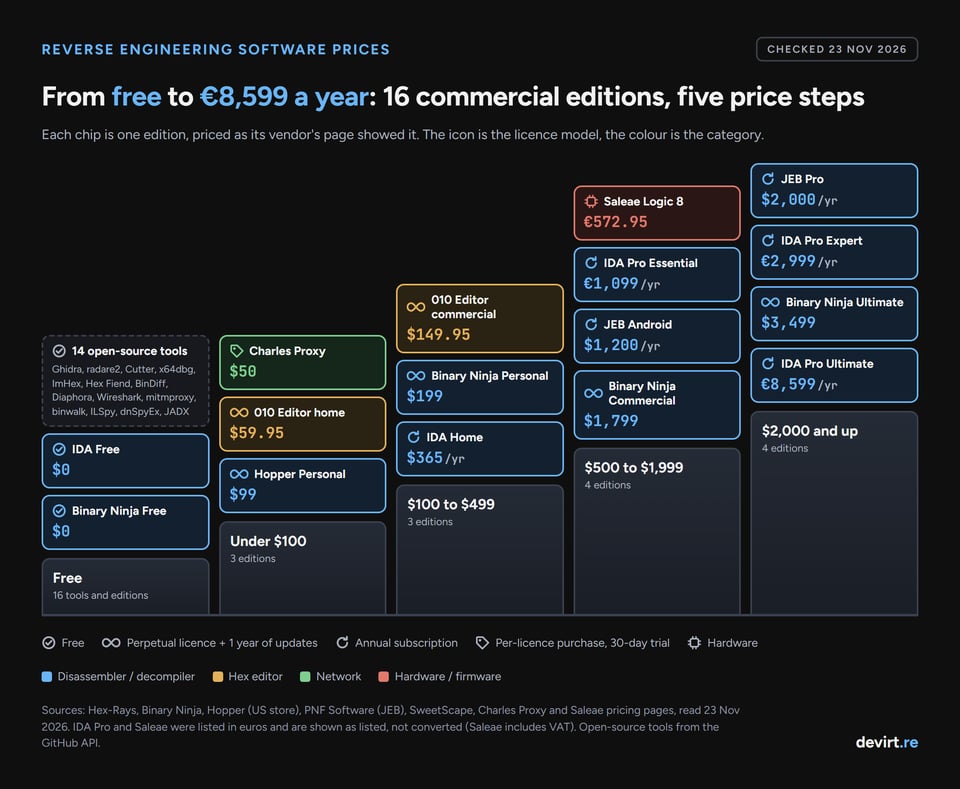
| Product and edition | Price on 23 Nov 2026 | Licence | Use limit on the vendor page |
|---|---|---|---|
| IDA Free | $0 | Named, needs an active licence | Non-commercial |
| Binary Ninja Free | $0 | Free download | Non-commercial or evaluation |
| Charles Proxy | $50 per licence | Per licence, 30-day trial | None stated |
| 010 Editor | $59.95 home/academic, $149.95 commercial | Perpetual + 1 year of upgrades | Home/academic or commercial edition |
| Hopper | $99 personal, $129 per computer | Perpetual + 1 year of updates | None stated |
| Binary Ninja Personal | $199 ($49 student) | Perpetual + 1 year of updates | Non-commercial |
| IDA Home | $365 a year | Annual subscription | Non-commercial |
| Saleae Logic 8 (hardware) | €572.95 incl. VAT | Hardware purchase | n/a |
| IDA Pro Essential | from €1,099 a year | Annual subscription | Commercial |
| JEB Android | $1,200 a year ($140 a month) | Subscription per user | None stated |
| Binary Ninja Commercial | $1,799 ($449 student) | Perpetual + 1 year of updates | Commercial |
| JEB Pro | $2,000 a year | Subscription per user | None stated |
| IDA Pro Expert | from €2,999 a year (2 decompilers) | Annual subscription | Commercial |
| Binary Ninja Ultimate | $3,499 | Perpetual + 1 year of updates | Commercial |
| IDA Pro Ultimate | from €8,599 a year | Annual subscription | Commercial |
Prices are as each vendor's page showed them when we loaded it. Hex-Rays listed IDA Home in US dollars and IDA Pro in euros on the same page, and Saleae's store showed its EU price, so we've left both currencies as shown rather than converting. The sources are the Hex-Rays pricing page, Binary Ninja's purchase page, Hopper's web store, PNF Software's JEB page, the SweetScape store, Charles Proxy and Saleae.
Older lists still quote Binary Ninja at $299 for the personal edition and $1,499 for commercial. Those were the prices before Vector 35's pricing change, announced on 28 July 2026 for the 6.0 release: the non-commercial licence dropped from $299 to $199, and Commercial rose from $1,499 to $1,799.
The licence type changes the real cost more than the sticker does. An annual subscription stops working when you stop paying. A perpetual licence keeps running after its year of updates ends; you pay again only if you want newer versions.
Disassemblers and decompilers
A disassembler turns machine code into assembly language, and a decompiler goes a step further, rebuilding functions, loops and conditions as C-like pseudocode. This is the category where most of the money in reverse engineering software goes.
Ghidra
Ghidra is the free disassembler and decompiler from the US National Security Agency, released under the Apache 2.0 licence. It runs on Windows, macOS and Linux from a single Java download (you install a 64-bit JDK first), decompiles many processor families and supports scripting in Java and Python. On 23 November 2026 the Ghidra repository had 101,013 GitHub stars, and its latest release was dated 22 October 2026. For most people who aren't buying for a company, Ghidra is the first tool to install.
IDA (Free, Home and Pro)
IDA, made by Hex-Rays, is the long-standing commercial disassembler. Its database is the format many analysts trade in, and many delivered analyses, Devirt's included, arrive as IDA databases. The editions differ by decompiler count and by what you're allowed to do with them. IDA Home ($365 a year, non-commercial) has 70+ processor disassemblers, 11 cloud-based decompilers, IDAPython scripting and a local debugger. IDA Pro is the commercial line: Essential from €1,099 a year with two cloud decompilers from one family, Expert from €2,999 a year with two local decompilers (€4,999 for four, €6,899 for six), and Ultimate from €8,599 a year with all of them. Every IDA edition on the pricing page lists Windows, macOS and Linux.
Binary Ninja
Binary Ninja, from Vector 35, is the commercial disassembler and decompiler sold as a perpetual licence with a year of updates. Personal costs $199 for non-commercial use and decompiles 12+ architectures. Commercial costs $1,799 and adds commercial rights and headless processing, which means running the API without the GUI. Ultimate costs $3,499, decompiles 19+ architectures and adds binary similarity and Firmware Ninja. Collaborative analysis is a separate add-on. Downloads cover Windows, macOS and Linux, with Linux builds for both x86-64 and AArch64.
Hopper
Hopper is a disassembler and decompiler built for macOS, with a Linux version for 64-bit Intel machines. It decodes Swift names and Objective-C selectors, which makes it a natural fit for Mac and iOS work, and it now ships an integrated MCP server for connecting language models. A personal licence costs $99 and a computer licence $129, each with a year of updates.
radare2 and Cutter
radare2 is an open-source, command-line reverse engineering framework with release builds for Windows, macOS, Linux and Android. Cutter is a free graphical front end built on rizin, a fork of radare2, and it can use Ghidra's decompiler through a plugin. radare2 suits people who like working from a terminal, Cutter suits people who don't, and neither costs anything.
Decompilers for .NET, Java and Android
Managed code decompiles much more cleanly than native code, because .NET and Java bytecode keep their class and method names. ILSpy (MIT licence) and dnSpyEx (GPL-3.0) are the free .NET choices; dnSpyEx adds a debugger and is Windows only. JADX turns Android DEX and APK files back into Java and runs on all three desktop systems. JEB from PNF Software is the commercial option: JEB Android costs $1,200 a year per user (or $140 a month), and JEB Pro, with all modules, costs $2,000 a year.
Debuggers
A debugger runs the program under your control: you pause it at an instruction, inspect memory and registers, and step through the code. Most debuggers you'll need are free.
On Windows, x64dbg is the open-source debugger for 32- and 64-bit user-mode programs; it had 50,371 GitHub stars on 23 November 2026, and it doesn't run anywhere else. WinDbg is Microsoft's free debugger for applications, drivers and crash dumps, installed from the Microsoft Store or with winget. On Linux the default is GDB, and on a Mac it's LLDB, which comes with Apple's developer tools.
Paid disassemblers include their own debuggers. IDA Home's pricing page lists a local debugger plus a GDB server for remote debugging, Binary Ninja's edition table lists a debugger in every edition, Free included, and Hopper connects to LLDB and GDB (with the debugger switched off in the demo).
Hex editors
A hex editor shows the raw bytes of a file and lets you edit them. In reverse engineering it's where you check what the other tools claim, and where you take apart undocumented file formats.
ImHex is the free choice on every platform: open source (GPL-2.0), with builds for Windows, macOS and Linux and a version that runs in the browser. It had 56,011 GitHub stars on 23 November 2026, more than any other tool in our GitHub check except Ghidra. 010 Editor is the paid standard: its Binary Templates parse more than 330 formats into editable structures, and it adds a byte-level file comparison tool and a disassembler. It costs $59.95 for home or academic use and $149.95 for commercial use, as a perpetual licence with a year of upgrades, and offers a 30-day trial. On a Mac, Hex Fiend is a fast, free, open-source alternative.
Binary diffing tools
A binary diffing tool compares two versions of a compiled program and lines up the functions that match, so you can see exactly what changed. Vulnerability researchers use it to find what a security patch fixed, and analysts use it to carry their names and comments from one build to the next.
- BinDiff, from Google, is free and open source (Apache 2.0). It compares exports from IDA Pro, Binary Ninja or Ghidra and has installers for Windows, macOS and Linux. Its last tagged release on GitHub was in September 2023.
- Diaphora is a free (AGPL-3.0) diffing plugin that runs inside IDA and is actively maintained, with a release in October 2026. Commercial licences are available for companies that can't use the AGPL.
- Built-in options: Binary Ninja's 6.0 release added binary similarity, which its edition table places in Ultimate, and 010 Editor compares two files byte by byte.
Network and protocol analysis tools
Network tools show what a program sends and receives, which often explains its behavior faster than reading its code. Three cover most needs.
Wireshark (free, GPL-2.0) captures and decodes traffic on almost any protocol, with installers for Windows and macOS; on Linux you usually get it from your distribution's packages. For web and API traffic, an intercepting proxy shows more. mitmproxy (free, MIT) intercepts, inspects and replays HTTPS on Windows, macOS and Linux, from the command line or a web interface. Charles Proxy does the same job with a desktop interface for $50 per licence after a 30-day trial, on the same three systems.
Hardware and firmware tools
Hardware reverse engineering starts with getting the firmware off a device and reading the signals between its chips. The software side is mostly free; the cost is in the probes.
binwalk (MIT licence) identifies and extracts the file systems and compressed data inside a firmware image, and the current version is a rewrite in Rust, installed through Docker or Cargo. Once the firmware is out, Ghidra, IDA or Binary Ninja read it like any other binary. To watch buses such as SPI, I2C and serial, you need a logic analyzer: Saleae's Logic 8 listed at €572.95 including VAT on the EU store our check landed on, and its Logic 2 software runs on Windows, macOS and Linux with 25+ protocol decoders.
Which reverse engineering software runs on Mac and Linux?
Ghidra, IDA, Binary Ninja, Cutter, radare2, ImHex, 010 Editor, BinDiff, Wireshark, mitmproxy and Charles all run on Windows, macOS and Linux, according to their download pages on 23 November 2026. Hopper runs on macOS and Linux, Hex Fiend on macOS only, and x64dbg, WinDbg and dnSpyEx on Windows only. On a Mac, LLDB takes x64dbg's place as the everyday debugger.
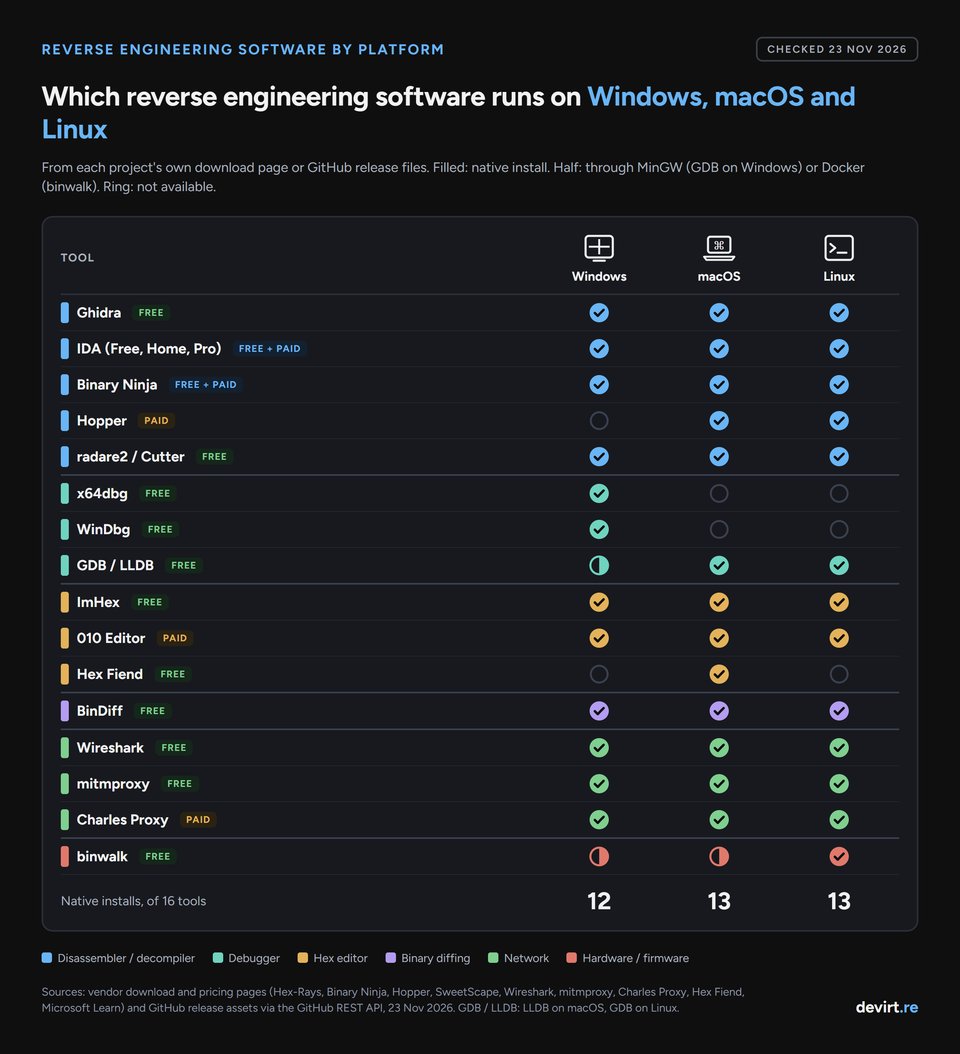
| Tool | Free or paid | Windows | macOS | Linux |
|---|---|---|---|---|
| Ghidra | Free | Yes | Yes | Yes |
| IDA (Free, Home, Pro) | Free and paid | Yes | Yes | Yes |
| Binary Ninja | Free and paid | Yes | Yes | Yes |
| Hopper | Paid | No | Yes | Yes (64-bit Intel) |
| radare2 / Cutter | Free | Yes | Yes | Yes |
| x64dbg | Free | Yes | No | No |
| WinDbg | Free | Yes | No | No |
| GDB / LLDB | Free | No† | Yes (LLDB) | Yes |
| ImHex | Free | Yes | Yes | Yes |
| 010 Editor | Paid | Yes | Yes | Yes |
| Hex Fiend | Free | No | Yes | No |
| BinDiff | Free | Yes | Yes | Yes |
| Wireshark | Free | Yes | Yes | Yes |
| mitmproxy | Free | Yes | Yes | Yes |
| Charles Proxy | Paid | Yes | Yes | Yes |
| binwalk | Free | No† | No† | Yes |
†Not a native download from the project's own page; GDB builds exist for Windows through MinGW, and binwalk runs anywhere Docker does.
What a reverse engineering toolkit costs in its first year
A complete reverse engineering toolkit costs $0, about $309 or about $1,999 in its first year, depending on whether you stay free, buy hobbyist licences or need commercial rights. We built three toolkits from the 23 November 2026 prices, one tool per category, using tools priced in US dollars so the totals add up without currency conversion.
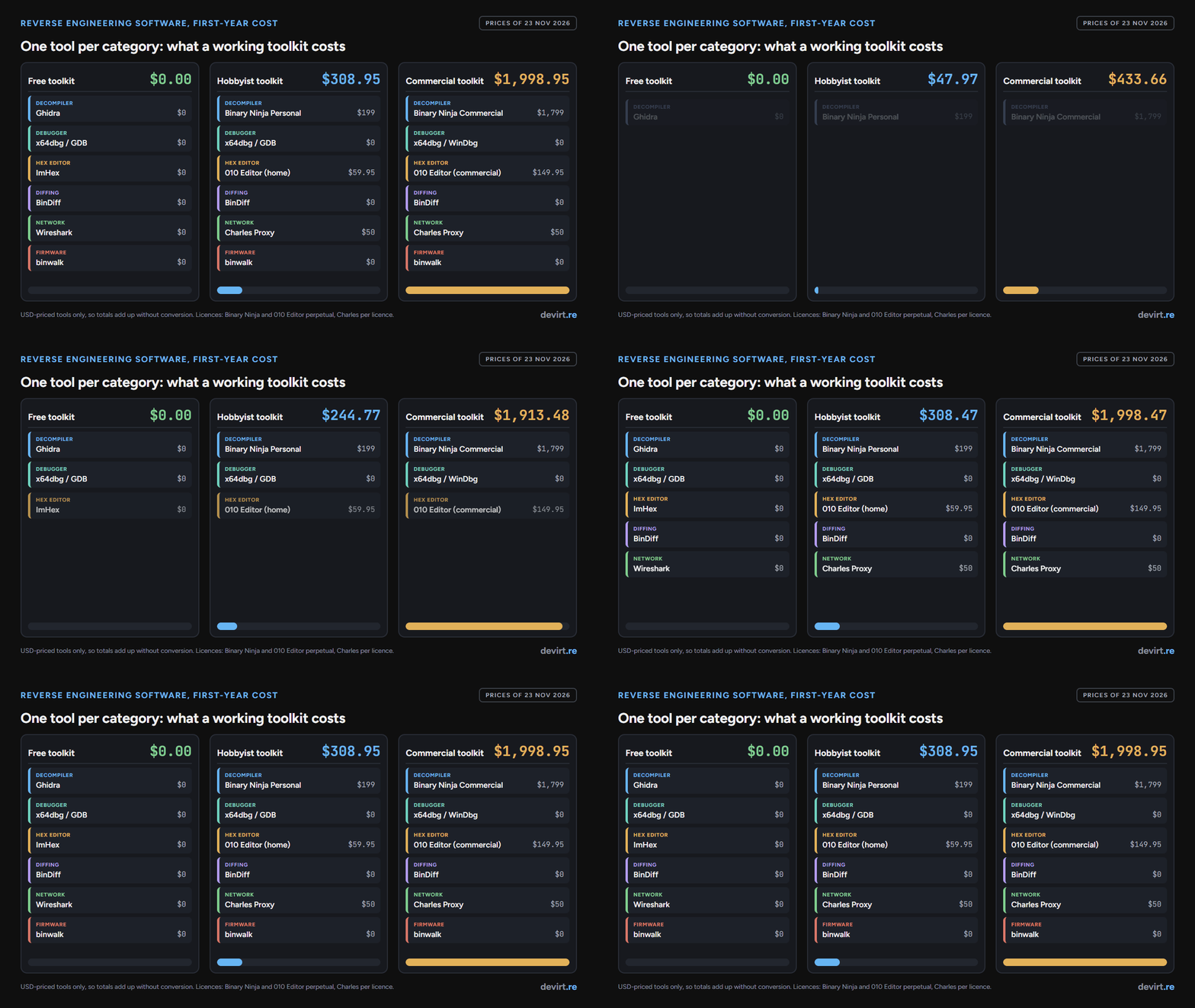
| Category | Free toolkit | Hobbyist toolkit | Commercial toolkit |
|---|---|---|---|
| Disassembler / decompiler | Ghidra ($0) | Binary Ninja Personal ($199) | Binary Ninja Commercial ($1,799) |
| Debugger | x64dbg or GDB ($0) | x64dbg or GDB ($0) | x64dbg or WinDbg ($0) |
| Hex editor | ImHex ($0) | 010 Editor home ($59.95) | 010 Editor commercial ($149.95) |
| Binary diffing | BinDiff ($0) | BinDiff ($0) | BinDiff ($0) |
| Network | Wireshark ($0) | Charles Proxy ($50) | Charles Proxy ($50) |
| Firmware | binwalk ($0) | binwalk ($0) | binwalk ($0) |
| First year | $0 | $308.95 | $1,998.95 |
Swap IDA in and the picture shifts. With IDA Home instead of Binary Ninja Personal, the hobbyist toolkit costs $474.95 in year one and $365 again every year after. With IDA Pro Essential instead of Binary Ninja Commercial, the commercial toolkit becomes €1,099 a year plus $199.95 for the rest. In year two, the Binary Ninja and 010 Editor licences keep working without another payment, because both are perpetual; you pay again only to keep receiving updates.
What is the best reverse engineering software?
The best reverse engineering software for most people in 2026 is Ghidra, because it's free, open source, runs on Windows, macOS and Linux, and includes a decompiler for many processor families. IDA Pro is the long-standing commercial standard, and Binary Ninja is the commercial alternative with a perpetual licence. Past that, the right pick depends on three questions: which platform you analyze, whether you need commercial-use rights, and how much you can spend.
- Learning, on Windows: Ghidra, x64dbg and ImHex. Add Binary Ninja Free or IDA Free when you want a second decompiler to compare against.
- Learning, on a Mac: Ghidra or Hopper, LLDB and Hex Fiend.
- Paid work for an employer or client: you need a commercial licence. IDA Free, IDA Home, Binary Ninja Free and Binary Ninja Personal are all non-commercial. That leaves IDA Pro, Binary Ninja Commercial or Ultimate, Hopper (its store lists no non-commercial limit), or the open-source tools.
- Android apps: JADX first, then JEB if obfuscated apps are a daily job.
- .NET programs: ILSpy, or dnSpyEx when you also need to debug.
A tools-by-task view of the same field, with what each one is for rather than what it costs, is in the Devirt guide to reverse engineering tools.
Where reverse engineering software stops
Reverse engineering software stops being enough when a function has been virtualized by a protector such as VMProtect or Themida. Virtualization turns selected functions into bytecode for an interpreter built into the file, so every disassembler and decompiler in this guide, free or paid, shows the interpreter rather than the original logic. Paying more buys a better decompiler, not a way past that layer.
Packing is a different problem. A packed program decompresses its real code in memory at run time, and the tools above can read that code once it's there. Virtualized code never turns back into the original instructions. The difference between unpacking and devirtualization decides which job you're facing, and devirtualization is the one Devirt does.
Is it illegal to reverse engineer software?
Reverse engineering software isn't illegal in itself in the US or the EU, but licence terms, copyright and anti-circumvention law set limits. In the US, the DMCA's interoperability exception (17 U.S.C. 1201(f)) lets someone with the right to use a program analyze it to make an independent program work with it, under conditions. In the EU, Article 6 of the Software Directive 2009/24/EC allows decompilation when it's indispensable for interoperability, again with conditions. This is general information, not legal advice. Analyze software you own or are authorized to analyze, read the licence first, and note that several free editions in this guide forbid commercial use.
Can ChatGPT decompile code?
ChatGPT can explain and rename decompiled code, but it doesn't replace a decompiler. A language model works on the text you give it, so it does best with pseudocode that Ghidra, IDA or Binary Ninja produced, and its suggestions still need checking in a debugger. The tools are moving toward assistants: Hex-Rays lists an IDA MCP server, Binary Ninja's 6.0 release added MCP, and Hopper ships an integrated MCP server, so an assistant can query the open project directly instead of pasted snippets.
Written by Devirt, an automated devirtualization service for authorized analysis of protected software. Method: prices read from each vendor's own page on 23 November 2026 (rendered page text saved), free-tool licences, stars and release dates from the GitHub REST API on the same day. Prices change; check the vendor before you buy.



